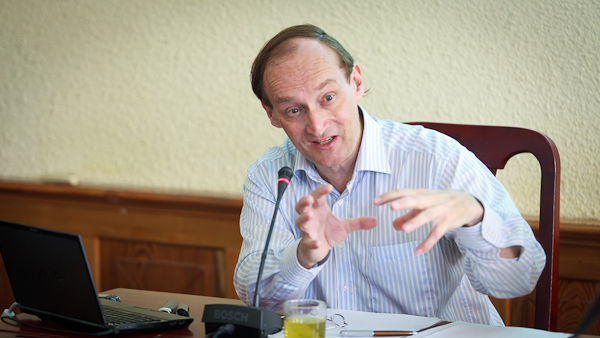
On the morning of October 13, 2010, Professor Vincent JH Houben (Director of the Institute of Asian and African Studies, Humboldt University) gave a presentation to faculty and students of the Faculty of International Studies. This was part of a series of activities leading up to the 15th anniversary of the Faculty of International Studies.On behalf of the university's leadership, Vice Rector Assoc. Prof. Dr. Nguyen Van Kim warmly welcomed Professor Houben and thanked him for dedicating his time to presenting to the university's staff and students on methodology and research methods in Southeast Asia, a particularly important issue for Vietnamese researchers. According to Assoc. Prof. Dr. Nguyen Van Kim, Southeast Asia, with its position and role, is a worthy subject of research for scientists and is in great need of new research theories. In two hours, Professor Houben guided the audience with a concise yet engaging presentation—philosophical yet not dry, general yet not superficial, specific yet not fragmented—on a new theoretical approach to Southeast Asian research, combining historical and regional studies methods.
Listen to the presentation (excluding the discussion):[audio:VincentHouben-20101013.mp3]The length is 69 minutes.
Translator:Le Lena- Lecturer in the Department of International Studies.
The first 50 seconds are a translation of the speech by Associate Professor Dr. Nguyen Van Kim.
Professor Houben's question is: what are the prospects for regional studies in general, and Southeast Asian studies in particular? This question is valid because, according to Professor Houben's observations, most historical studies to date have been influenced by a European-centric perspective. Furthermore, compared to other regions, there are very few studies on Southeast Asian history. Another reality is that, if any exist, most of these studies are merely descriptive, attempting to differentiate Southeast Asia from other regions and, importantly, lacking a solid theoretical foundation. Based on this observation, Professor Houben... Houben presented a history of historiography in Southeast Asia, reviewing the work and contributions of early scholars, from JC van Leur, John Smail, and Wim Wertheim, to the golden age of Southeast Asian studies in the 1960s and 1970s with figures such as Benedict Anderson, Geertz, and Wolters, and then the period from the 1970s to the 1990s, re-examining Southeast Asian studies. According to Professor Houben, since the end of the Cold War, a new generation of Indian-American researchers has emerged, such as historian Dipesh Chakrabarty, anthropologist Talal Asad, sociologist Arjun Appadurai, and literary scholar Gayatri Chakavorty Spivak…

According to Professor Houben, we are currently in a phase where the relationship between history and regional studies needs to be redefined. In recent years, both history and regional studies have undergone a period of intense "soul-searching" because the parameters of the Cold War era are incompatible with the realities of our current interconnected and globalized world. Therefore, according to Professor Houben, at a general level, we must transcend the limitations of the "post-structural" world to move towards a world with broader meanings. In this context, Professor Houben suggests that a new theory applicable to Southeast Asian regional studies can be developed. After analyzing and explaining the advantages and limitations of five different approaches, and because most historians are obsessed with change, Professor Houben proposes... Houben suggests using “processual concepts” to identify specific developmental dynamics in Southeast Asia at particular historical points in time, encompassing both “point” and “plane” levels, and connecting disparate events to a broader structure or context. To illustrate this point, Professor Houben makes an interesting observation: “the development of Vietnamese history should be understood not only in terms of specific internal factors but also as a result of the interaction between internal and external factors within the Southeast Asian context.” Although not a specialist on Vietnam, Professor Houben... Houben surprised his audience by generalizing Vietnamese history into four "historical conjuncts" with the following characteristics: The period of Chinese cultural infiltration can be called "progressive enculturation," the period of thriving maritime trade can be called "plural integration," the period of nationalism development can be called "dynamic transposition," and Vietnam's current role in globalization can be called "responsive adaptation."
We will collaborate with Humboldt-zu-Berlin University, Germany, to offer a Master's program in International Relations.
On the morning of October 7th, Professor Nguyen Van Khanh (Rector of the university) received a delegation from Humboldt University (Germany) led by Professor Vincent Houben. The main purpose of the visit was to discuss with the university the development of a joint master's program in international relations. Professor Nguyen Van Khanh welcomed Humboldt University's idea and affirmed the university's determination and commitment to cooperating with Humboldt University in building this joint master's program. After exchanging views and agreeing on general principles, the leaders of Humboldt University and the Rector of the university signed an agreement to jointly train master's students in international relations. This serves as the legal basis for the German Academic Exchange Service (DAAD) to consider and fund the initial phase of the project. The necessary procedures are expected to be completed this year so that the first cohort of students can enroll in September 2011. Humboldt University is one of Germany's leading universities, with a 200-year history and ranked among the top 200 universities in the world.