
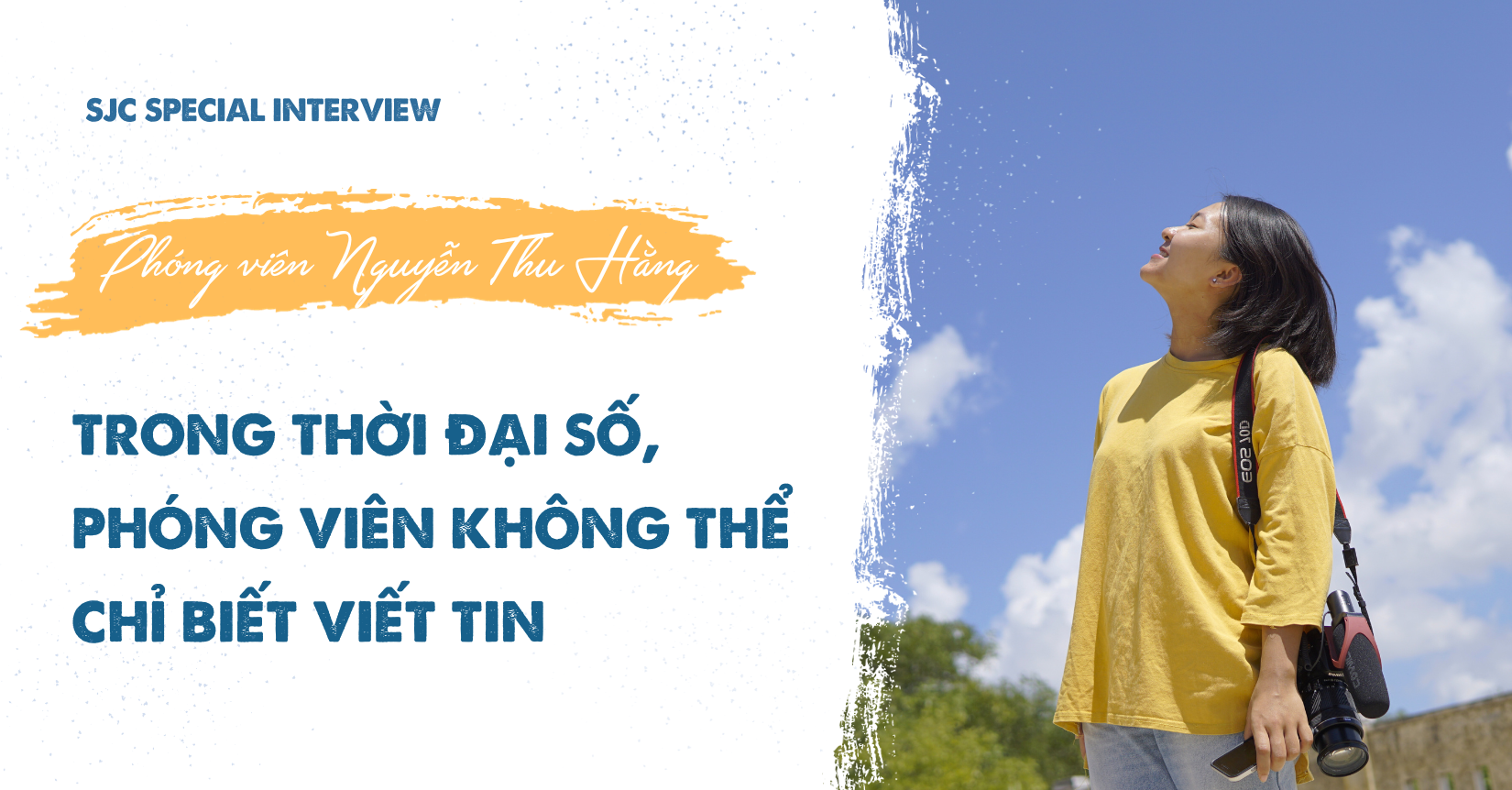
Reporting tirelessly across Central Vietnam on storms and floods, and spending 45 days stationed in the COVID-19 epicenter of Da Nang – these are two unforgettable assignments for young reporter Nguyen Thu Hang, a former student of the K58 class at the Institute of Journalism and Communication Training. One trip began with a sudden directive, requiring only a few hours of preparation after receiving the assignment, and with no set return date. Hang's backpack was filled with the hope of bringing readers the most authentic stories from each place she visited.
For later generations of students at the Institute of Journalism and Communication Training, Ms. Hang is a senior figure in the profession whom we often look up to and learn from. We had the opportunity to chat with her about the challenging journey of a young reporter in journalism.

Having collaborated with Tuoi Tre newspaper since her third year of university, Thu Hang realized she lacked the experience to pursue a long-term career in journalism, or as she put it, "she was still very inexperienced." After graduating, she decided to temporarily stop working in journalism and instead worked for a non-governmental organization. After two years, Hang returned to journalism when she felt more confident. She chose to move to Ho Chi Minh City to start over from scratch, hoping to gain new perspectives in her work and life.
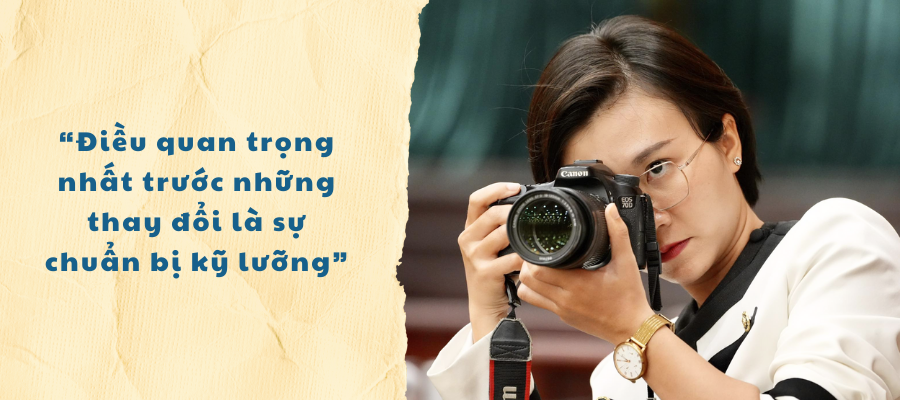
“For me, the most important thing before any change is thorough preparation. When I decided to move to Saigon, I was worried about both the living environment and starting over in journalism. But I was confident because I had prepared my own set of rules to know what to do and what not to do. I spent time researching Saigon's weather, reading a lot about the people of Southern Vietnam, and trying to understand the bottlenecks in their cultural life over the past few decades. The adaptation process was therefore smoother,” Hang recounted.
Having moved to the South four years ago and worked for two different media outlets, Thu Hang views each move as a new journey and emphasizes the importance of clearly defining her destination.
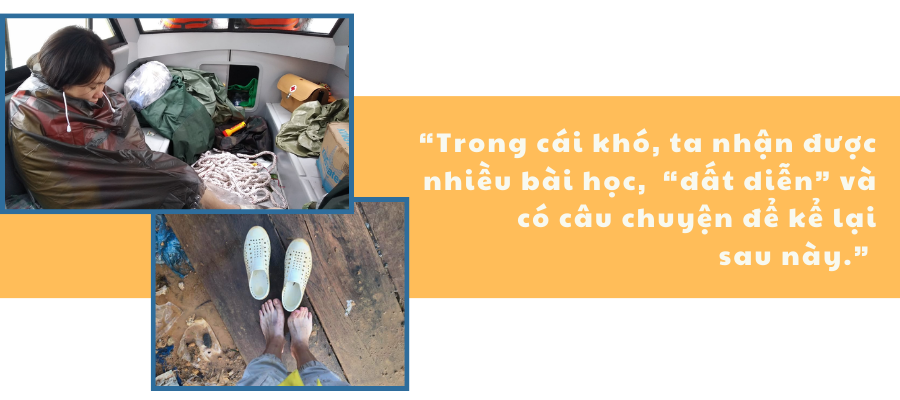
The period of 2020-2021 marked Thu Hang's growth through months of persistent reporting on breaking news events. Constant storms, lurking landslides, skin irritation from wading through water for kilometers, and the high risk of COVID-19 infection… none of these deterred the young reporter. She cherished each trip and volunteered many times to go to the hottest spots. Once, upon receiving notification to return to the office, Hang regretted missing out on important information.
“Sometimes, when I’m tired, I complain: Why do I have to suffer so much, Hang? But the thought of giving up never crosses my mind. There’s no extraordinary willpower or secret technique for those difficult situations; I simply ‘crawl’ through them. I overcome each challenge, solve each problem, and everything falls into place. In hardship, you learn many lessons, have opportunities to shine, and have stories to tell later.”
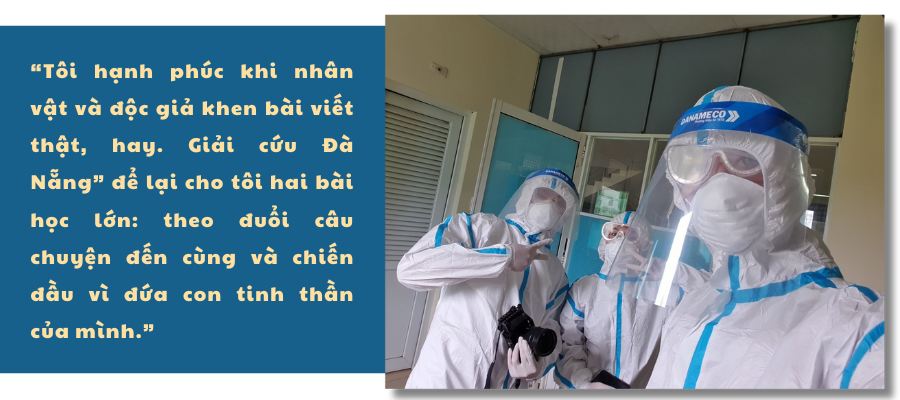
One of the stories Hang is always proud to share is her journey in writing "Saving Da Nang"—an article that portrays the heroes fighting Covid-19 in the epicenter of the outbreak in Da Nang. The idea for the article began when she happened to chat with members of the medical team assisting Da Nang hospitals. The way they developed strategies to help the city escape the tense pandemic situation reminded Hang of troop deployment on a fierce battlefield.
On her personal Facebook page, Hang once mentioned that "Saving Da Nang" was her most arduous project, likening it to picking up crumbs of bread. She only needed 1-2 days to visualize the article, but the time spent tracing the story took many times longer. The planned interview list included over 20 people, but she managed to approach and interview 13. In the end, Hang could only include a few individuals in the article, transforming 120 pages of meticulously transcribed recordings into a 6000-word manuscript. When the editorial team requested that she shorten it to 3000 words, Hang broke down in tears, regretting every word she removed and every detail cut. "My superiors suggested revising some words because they were rough, but they were necessary for the article to be authentic. With 'Saving Da Nang,' I had to fight to protect every word I wrote. When the article was published, both readers and the doctors and nurses I interviewed praised it and thanked me," Hang shared.
Interviewing 13 individuals who directly participated in that arduous battle was no easy task. In response to my curiosity about how she approached and extracted information from these individuals in the context of natural disasters and epidemics, Thu Hang shared:
"In the face of natural disasters and epidemics, reporters being present at the scene and showing concern and sharing their experiences easily earns the goodwill of the people, so approaching individuals isn't difficult. The challenge lies in finding individuals and stories that resonate with emotion amidst the suffering and loss."
In the case of the Da Nang outbreak, I encountered more obstacles related to the health condition and busy work schedule of the person I was reporting on. Reporters were forced to wait and seize every opportunity. I often waited for hours outside the hospital because the person themselves didn't know when their shift would end. Doctors and nurses had to make the most of every moment of rest, so we reporters didn't want to disturb them for too long.
With influential figures and politicians, an effective approach is to gradually gain their attention, appearing frequently so they become familiar with you, and from familiarity comes trust. Additionally, contact can be made through relevant channels. I used the Ministry of Health's media team to interview former Deputy Minister Nguyen Truong Son during a critical period of the pandemic.”
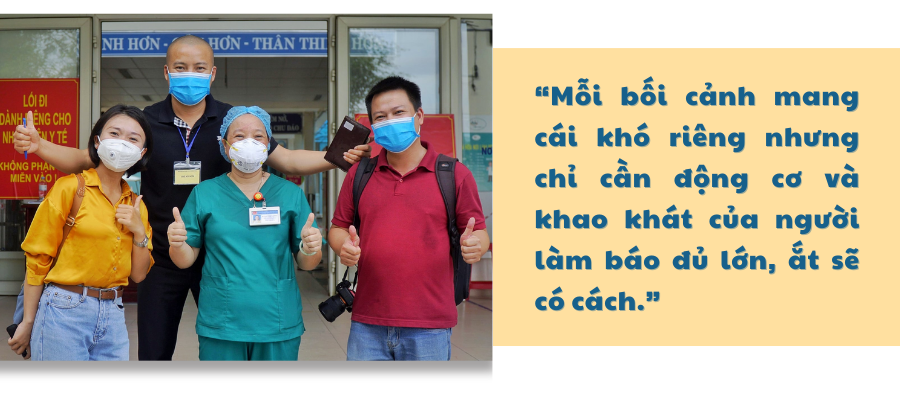
To obtain authentic articles and images for the press, reporters like Thu Hang may have walked kilometers through mud, spent days and hours at hospitals despite the high risk of exposure, and so on. When asked about the difficulties, Hang always answers optimistically and without hesitation. What worries her most on these assignments is "whether she's missed anything" or "whether she's disrupting the rare rest time of the subjects."
When asked about the disadvantages and difficulties faced by female reporters, Hang shared: “Not only are there no disadvantages, but there are actually many advantages. Of course, women face some issues such as weaker health, difficulty protecting themselves from the malicious intentions of the opposite sex, etc., but I guess male colleagues also face their own disadvantages. Women can be firm when they want to be, and gentle when they want to be. In some cases, a female reporter will find it easier to access sources than a male reporter. For example, in the midst of a storm or flood, the gentleness and empathy of a female reporter helps the subject open up more easily. Women also receive a lot of care and attention from those around them during their trips.” – Hang shared.

Responsible for many important and complex areas, Thu Hang always adheres to the principle of telling stories as truthfully, quickly, and comprehensively as possible. She particularly emphasizes creating products that are insightful and innovative to increase appeal.
When discussing the challenges facing journalism, such as artificial intelligence, declining audiences, and competition from social media, Thu Hang asserted that reporters would not survive in the profession for long if they only knew how to create simple content.
"AI can now write news quickly, but I believe that for at least another 5-10 years, it won't be able to write in-depth articles or create products with the same level of originality as a real journalist. Therefore, to avoid being replaced, the first thing is to abandon the idea that journalism is just about writing news. Reporters and journalists need to be less complacent, adapt to technology, and correct shortcomings in their work. Technology has created so many new things, and readers are becoming increasingly demanding."
According to Thu Hang, to achieve this, journalists and reporters should equip themselves with new skills beyond simply filming, photographing, and writing. She is pursuing the trend of data journalism and must master the skills of using data analysis tools. Hang also mentioned another option: using web programming tools to deliver information in an interactive format, attracting and retaining readers.
I've heard a lot about Thu Hang's vibrant student life at the Institute of Journalism and Communication Training. The Four Heroes Cup, Journalism Sings, CMP,... Thu Hang was present at almost every program. When I asked her about it, she just smiled:
"I guess I was too idle back then. Looking back, I see that the tasks of the extracurricular activities at our Institute are quite similar to the process of coordinating the production of journalistic products that I do every day – there are departments for filming, photography, and content creation. The Faculty teaches us skills and systems of thinking, while CMP, the Four Heroes, and 'Singing Journalism' teach us how to do it."
"When certain names like Minh Chien, Viet Bino, Anh Thu, Thu Quynh, Trung Ha,... are mentioned, Hang, what are your feelings?" I asked.
“It was so much fun, those were my youthful days. They were like older siblings and close friends who witnessed my growth from my university days, and they connected me to journalism. We met day after day without getting bored. I still maintain a close relationship with them now. Perhaps that's the thread that connects me to the Institute of Journalism even many years after graduation.”
The close bond with generations of fellow students reminds Hang that she will always be a student of the Journalism Faculty. The conversation concluded with a message she sent to future students of the Institute: in addition to guidance from teachers, proactively learn about new journalistic trends around the world to equip yourself with the appropriate skills.

Author:Source: Institute of Broadcasting and Communication Technology
Newer news
Older news

