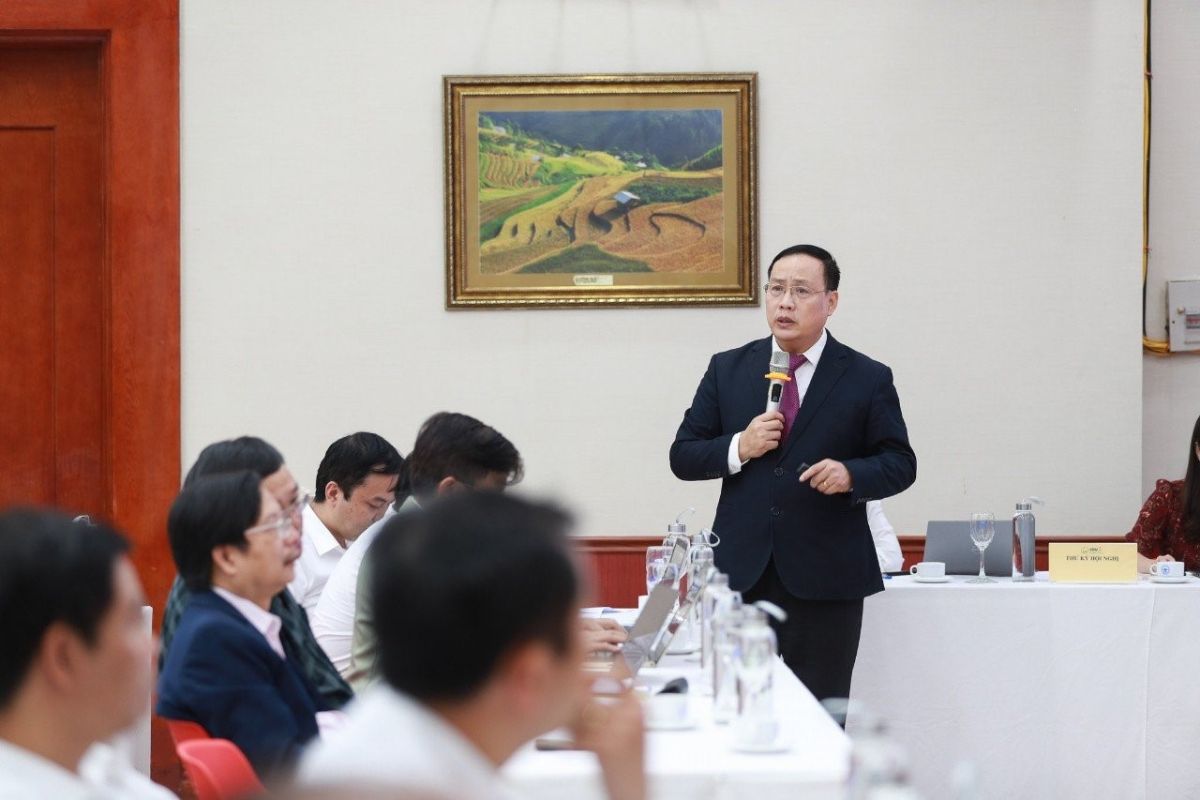
Professor Dr. Nguyen Dinh Duc, Head of the Advanced Materials and Structures Laboratory, Chairman of the University Council of the University of Technology - Vietnam National University, Hanoi, and Head of the Vietnam Higher Education Quality Assurance Network Club, is a leading expert in advanced materials and structures. He has published over 300 scientific papers and is a member of the international councils of 10 prestigious ISI international journals. He is one of the outstanding scientists who has contributed to establishing Vietnam's position in the global science and technology landscape.
For five consecutive years, from 2019 to the present, Professor Nguyen Dinh Duc has been one of only two scientists working in Vietnam to be ranked among the top 10,000 most influential scientists in the world, and is also ranked among the top 100 globally in the field of Engineering and Technology.
On this occasion, our reporter interviewed the professor about the achievements and challenges facing Vietnamese higher education after 10 years of implementing Resolution 29.
Prof. Dr. Nguyen Dinh Duc, Head of the Advanced Materials and Structures Laboratory, Chairman of the University Council of the University of Technology - Vietnam National University, Hanoi
But
Professor, after 10 years of implementing Resolution 29 on "Fundamental and comprehensive reform of education and training to meet the requirements of industrialization and modernization in the context of a socialist-oriented market economy and international integration," how would you assess the strengths and weaknesses of Vietnamese higher education in the process of implementing this Resolution?This Resolution holds historical significance in the nation's educational reform efforts. It was issued amidst the country's accelerated industrialization and modernization, and the world's entry into the Fourth Industrial Revolution. The seven objectives outlined in the Resolution are all important, fundamental, core, and foundational – highly modern and integrated, accurate, relevant, and timely.
Numerous conferences and seminars have been held to summarize and evaluate the results of implementing Resolution 29 from various perspectives. While many achievements have been made, I see four outstanding accomplishments in Vietnamese higher education as follows:
First of all, it can be said that Vietnamese higher education has rapidly integrated and approached international standards. It is evident that never before has Vietnamese education undergone such rapid and vigorous reform and adoption of international standards as in recent years.The clearest evidence for this assertion is the results of higher education quality assessment and university rankings.
To date, almost all higher education institutions in Vietnam have a dedicated quality assurance unit; seven centers for educational quality accreditation have been established and licensed to operate by the Ministry.
As of September 30, 2023, 186 higher education institutions and 11 teacher training colleges nationwide had met the accreditation standards according to the Vietnamese higher education quality accreditation standards, accounting for over 70% of the total number of universities and academies in the country; 9 higher education institutions were recognized by international assessment/accreditation organizations (HCERES, AUN-QA); 1,297 training programs had completed self-assessment reports; 1,143 training programs had undergone external accreditation and evaluation, and 996 programs had been recognized as meeting quality standards. In just the last few years, the number of accredited training programs has increased very rapidly, approximately eight times compared to 2020.
Through self-assessment and external evaluation, schools have identified their strengths and weaknesses and developed more realistic and effective quality improvement plans. Educational institutions have changed their perspective on quality assurance, strengthening school management and teaching and learning management capabilities.
While accreditation reflects quality, university rankings speak to prestige. Since 2018, for the first time in the history of Vietnamese higher education, only two national universities have been included in the QS ranking of the world's top 1,000 universities. Now, Vietnamese universities are included in many prestigious international rankings such as QS, THE, and ARWU. Recently, the THE ranking organization announced the 2023 ranking of the world's best universities, with six Vietnamese universities ranking quite highly: Vietnam National University, Hanoi; Vietnam National University, Ho Chi Minh City; Hue University; Hanoi University of Technology; Ton Duc Thang University; and Duy Tan University; with some fields of study ranking in the top 500-1000 globally…
A breakthrough in the quality and potential of science and technology.Ten years ago, the average percentage of lecturers with doctoral degrees in universities nationwide was only about 15%, but now this rate has more than doubled, reaching approximately 32%. The number and quality of the faculty have increased step by step, year by year, according to international standards. While previously, professors and associate professors were not required to publish internationally, now the criteria for these titles mandate that all professors and associate professors must have publications in reputable international journals.
To date, there are approximately over 1,000 research groups in higher education institutions nationwide, including hundreds of strong research groups. These strong research groups have progressed to establishing several excellent laboratories and research centers, playing a leading role in the nation's science and technology activities.
The quality of students in professional skills, foreign languages, and computer literacy is now higher than before. Foreign languages, in particular, have made significant progress: the foreign language proficiency requirement for undergraduate students is B1, with international, gifted, and high-quality programs achieving even higher standards; the current foreign language entry requirement for postgraduate programs is B2 for both master's and doctoral degrees. The employment rate for graduates is increasing, especially among Vietnamese students who are increasingly actively participating in the global labor market and working for multinational companies both domestically and abroad.
Thanks to improved quality standards and supportive policies for research and research groups, Vietnam's international publications have increased significantly. From 59th place (4,017 articles) in 2014, it rose to 46th place globally (18,466 articles) in 2022. The total number of international publications from Vietnam reached 97,520 during the period 2014-2022 (source: www.scimagojr.com). Not only has the number increased, but the quality has also improved, with the citation index of research results by Vietnamese scientists steadily rising. In recent years, several Vietnamese scientists have also been included in rankings of the world's most influential scientists, based on objective international assessments and selections. These are significant improvements in the quality of the workforce and a very proud achievement for Vietnamese higher education.
Focus on training and nurturing talent; rapidly and strongly shift the structure of industries to meet the requirements of the 4.0 industrial revolution. In implementing Resolution 29, in addition to standard training programs, the Ministry of Education and Training has directed universities to actively implement talent-based and advanced training programs to train and nurture talent.The faculty participating in these programs are selected from outstanding Vietnamese lecturers and some foreign lecturers, aiming to develop and internationalize training programs to meet global human resource needs. In addition, through programs 322, 911, and Project 89, we have sent thousands of young, outstanding intellectuals to study for bachelor's, master's, and doctoral degrees abroad.
The unprecedentedly rapid development of the Fourth Industrial Revolution has led to a huge demand for high-quality, highly skilled human resources, creating both opportunities and challenges for Vietnam. Vietnamese higher education is actively undergoing digital transformation, with increasing emphasis on STEM knowledge at the university level. Alongside this, there has been a rapid and appropriate shift in the structure of professions. From the beginning of 2016 to the first eight months of 2023, the total number of newly opened undergraduate programs was nearly 300, demonstrating that Vietnamese higher education is moving quickly and in the right direction, keeping pace with the trends of the Fourth Industrial Revolution.
University autonomyThe implementation has been rapid, extensive, and multifaceted, especially after the National Assembly enacted Law No. 34 in 2018 on the amended Law on Higher Education. To implement Law No. 34, the Government issued Decree No. 99/2019/ND-CP dated December 30, 2019, detailing and guiding the implementation of several articles of the Law amending and supplementing some articles of the Law on Higher Education. Policies on university autonomy have been a breath of fresh air, fundamentally changing the face and methods of university governance in recent years. According to a report by the Ministry of Education and Training, by the end of 2022, a total of 141 out of 232 universities met the conditions for autonomy as stipulated in Clause 2, Article 32 of the Law on Higher Education. And by August 2023, only 4 public universities had not yet established their boards and 2 private universities had not yet completed their councils.
The most significant achievement of university autonomy in recent years has been "unleashing" universities, thereby creating a mechanism for them to proactively attract and strongly promote resources for investment in quality and development. Autonomy is linked to accountability and responsibility for universities. University autonomy has truly been a breakthrough, making a significant contribution to enhancing the potential of science and technology, improving the quality of training, the quality of faculty, and the quality of science and technology activities of universities in the past few years. This has accelerated university rankings, rapidly increasing the human resources, infrastructure, and international integration capacity of Vietnamese universities.
In summary, over the past five years, the implementation of Resolution 29 has been actively and comprehensively carried out by universities, resulting in significant achievements for Vietnamese higher education. These include integration into and adherence to international standards; increased university autonomy; breakthroughs in quality; and a strong transformation in training programs, professional structure, and the structure and quality of human resources to meet the demands of the Fourth Industrial Revolution. These innovative achievements have impacted all aspects of the education sector, and more profoundly, the entire society, fundamentally influencing and comprehensively reforming the country's education system.
I believe the greatest achievement stems from these innovations in the higher education system, which have enabled us to train a new generation of high-quality, highly qualified, young, and talented cadres and human resources capable of shouldering the great and glorious mission of the country in the new era.
Professor, besides the achievements, what limitations do you see, and in order to better implement Resolution 29, what solutions are needed in the future to promote the rapid and strong progress of Vietnamese higher education?Alongside the great achievements we have made, we must also frankly acknowledge that there are still shortcomings and limitations.
To improve the quality of higher education, we must improve and excel in all aspects: student admissions; curriculum development; teaching organization and management; university administration (including quality assurance conditions; faculty, facilities, assessment); and learning outcomes.
Meeting some of the output standards for Vietnamese students, such as foreign language proficiency, critical thinking and problem-solving skills, and professional skills, remains low. Many training programs lack connection with research and practice. The quality of lecturers in some schools and fields is still weak and insufficient.
In particular, investment in higher education remains low; investment in research and research groups is scattered and funding is meager, while the procedures for reviewing and assigning research projects are slow, and the settlement process is cumbersome. Mechanisms for cooperation with businesses and business investment in universities also face many obstacles.
The pressure of entrance exams, coupled with the autonomy granted to universities and the near-certain chance of admission for all candidates, has given rise to numerous problems, such as: too many admission methods and combinations; and low quality of university entrance examinations in some universities and many fields. In the future, further research and improvement are needed, along with stronger innovation in the admissions process; and the leading role of state management agencies in determining the overall quality of university entrance examinations must be strengthened.
Another point that cannot be overlooked is university autonomy. Besides the tremendous achievements that university autonomy has brought in recent years, it must also be acknowledged that this is a very new model in Vietnam and needs further refinement.
- It is known that this year, Professor has improved his ranking from 94th to 85th in the world in the field of Engineering and Technology. What are your thoughts on this achievement?
I was surprised, very happy, and proud. My perseverance, hard work, and diligent research over the past few decades have finally been recognized and rewarded.
Scientists dedicate themselves not for rankings or fame, but to be recognized and ranked fairly and objectively in prestigious international rankings, which is a source of pride and honor. Without a database to evaluate and quantify the research results and impact of scientists according to international standards, Vietnam would not know its position compared to its international counterparts, and we would not know when talented and hardworking young people would be recognized and honored, thus gaining the motivation and confidence to continue striving and dedicating themselves to the arduous path of scientific research.
My success is also the success and joy of the research team, of generations of students, and also the joy and success of the school, of Hanoi National University. I believe that the recognition of Vietnamese scientists in the international scientific community is also a source of pride, a testament to the achievements of Vietnam's higher education and science.
Thank you, Professor, for sharing!