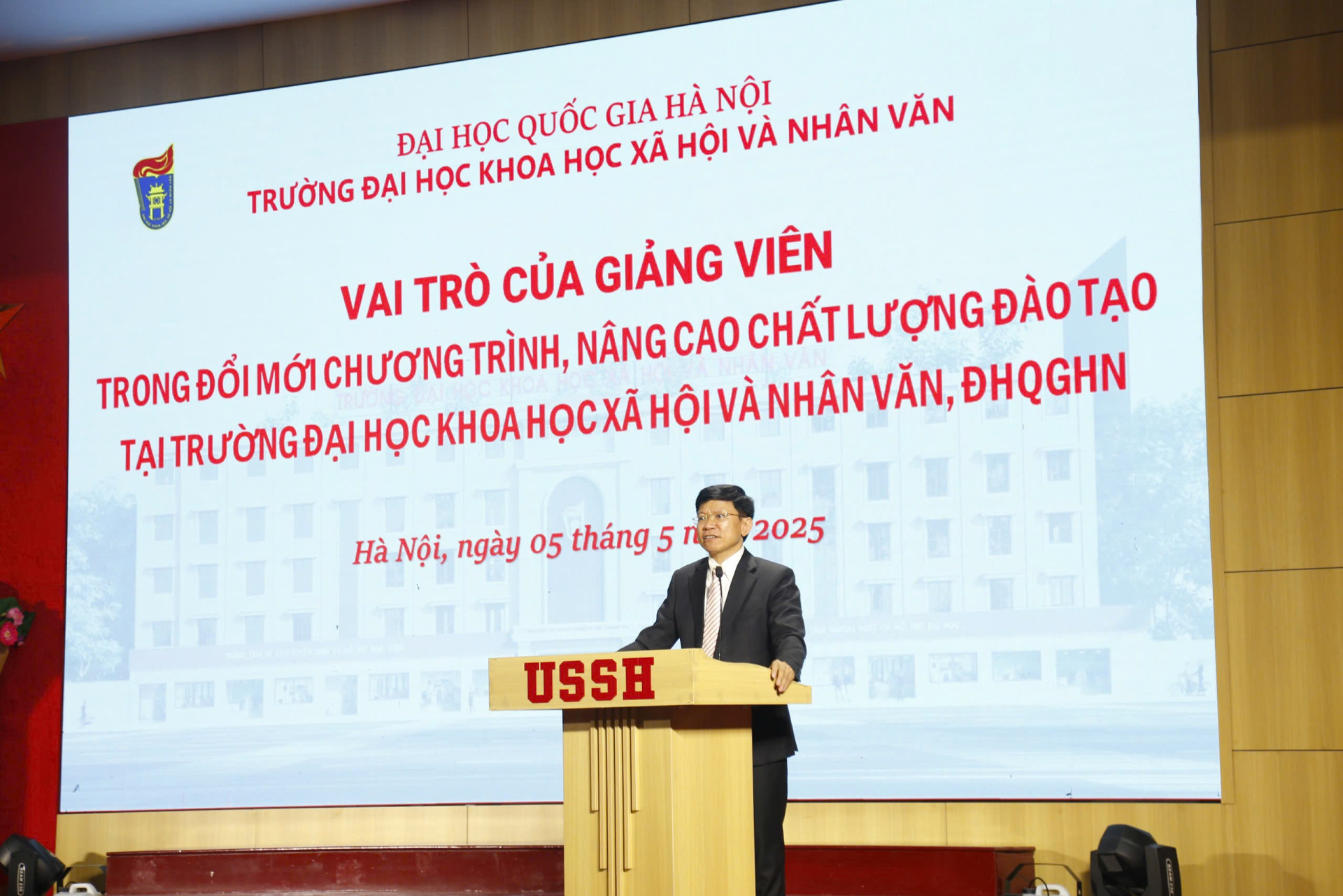
At the 2025 Conference of Outstanding Exemplars and Faculty Conference of the University of Social Sciences and Humanities, Vietnam National University, Hanoi, Professor Hoang Anh Tuan analyzed the main challenges and the urgent need for systematic innovation in the teaching activities of lecturers.
Professor Hoang Anh Tuan, Rector of the University of Social Sciences and Humanities, analyzed the main challenges and the urgent need for systematic innovation in the teaching activities of lecturers.
A rich tradition is a valuable asset.Eighty years ago, on October 10, 1945, President Ho Chi Minh signed Decree No. 45, establishing the Faculty of Literature at the Vietnam National University, the predecessor of the University of Social Sciences and Humanities today. Recalling the tradition and quoting President Ho Chi Minh's teaching, "Cadres are the foundation of all work," Rector Hoang Anh Tuan affirmed that the quality of the staff plays a decisive role in the reputation and standing of a higher education institution.
"If outstanding professionals contribute to creating a professional university governance system, then it is the outstanding faculty who establish the scientific reputation and social standing of a university."Continuing to quote President Ho Chi Minh's teachings in his letter to the National Education Conference in March 1955,
“Schools must be closely linked to social realities, closely linked to the lives of the people… the educational motivation of teachers must be linked to specific goals and tasks according to the needs of society, must meet the interests of the people, and must strive for human happiness.”Principal Hoang Anh Tuan believes that President Ho Chi Minh's philosophy on the role and responsibilities of teachers is very "open" and "dynamic," adapting to the social context, requiring teachers to strive to adjust and innovate their teaching activities to be as effective as possible. Therefore, the school's faculty needs to continuously innovate their teaching and research to improve the quality of the human resources they train.
University competition is increasing.Against the backdrop of increasing pressure on the domestic higher education system, Rector Hoang Anh Tuan mentioned many challenges and focused on analyzing three factors that are constantly impacting the university:
The first:With intense educational competition within the university community (and within the National University system itself), an increasing number of institutions are opening new majors and training programs in the social sciences and humanities.
Monday:The restructuring of the administrative apparatus from the central to local levels is creating significant pressure on the labor market after university graduation, directly impacting the enrollment atmosphere of most higher education institutions specializing in social sciences, humanities, and arts.
“We are not discussing whether graduates are better suited to working in the public or private sector, because each sector has its own strengths and mission. The success of our students in life is the measure of our success: no one would say that a humanities graduate becoming a university professor or research expert is more successful than becoming a director of a media company or CEO of a financial corporation...”
The changing context of the country today requires the School to redefine its philosophy, perspective, strategy, and training plan. This includes innovating teaching methods and adjusting training programs to keep pace with national trends: the workforce trained by the School will be strongly oriented towards the increasingly expanding private sector alongside the traditional public sector…”"Principal Hoang Anh Tuan analyzed."
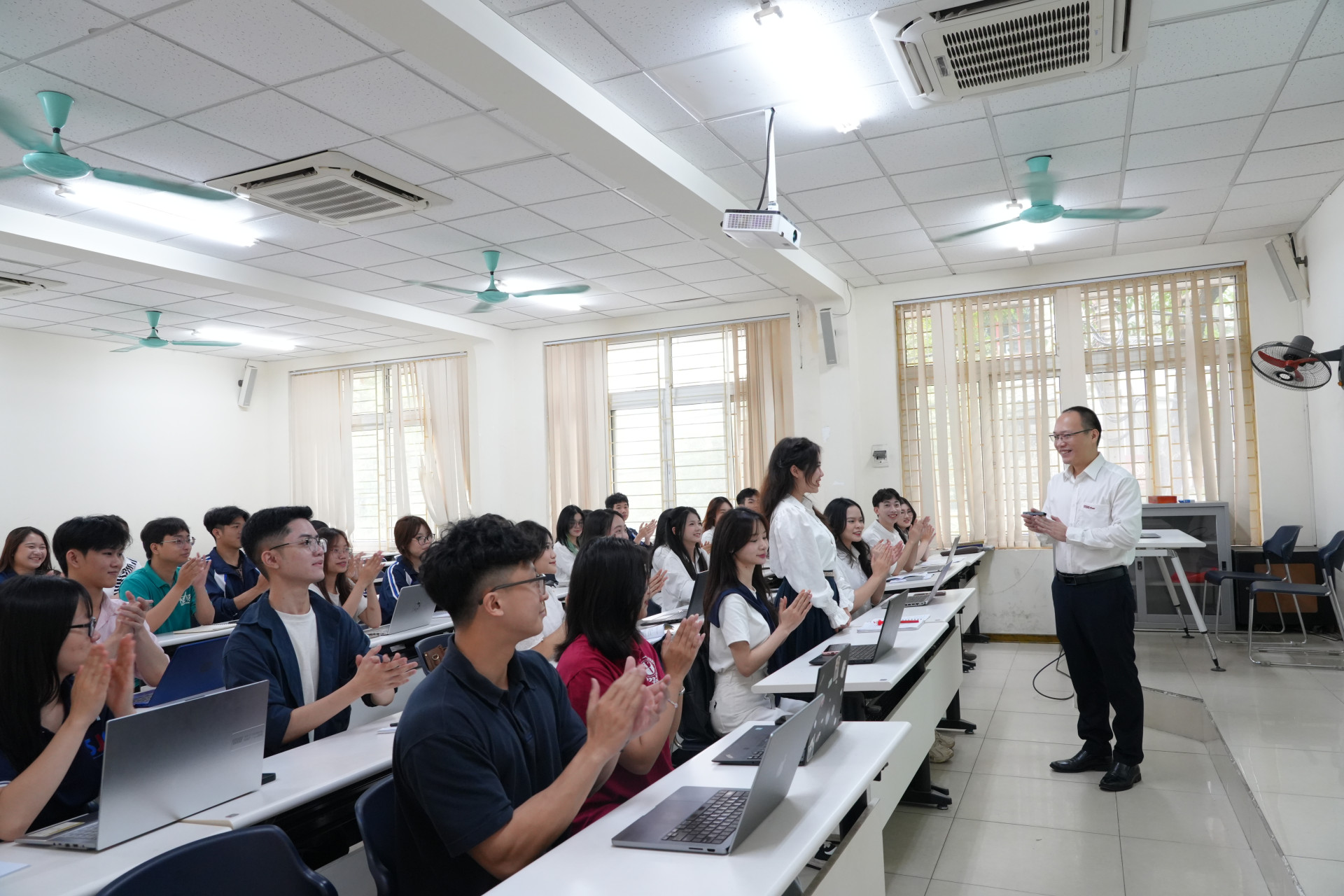
A class session for students at the University of Social Sciences and Humanities, Vietnam National University, Hanoi.
Tuesday:Technology, digitalization, and artificial intelligence have been, are, and will continue to disrupt many aspects of higher education and the workforce supplied to the labor market.
According to Principal Hoang Anh Tuan, AI itself doesn't eliminate anyone; rather, it is those who know how to optimize AI who will eliminate those who are lazy in using technology and slow to innovate. Therefore, teachers today need to master technology to ensure more effective teaching and research, and not be surpassed by their students.
It is essential to maintain the academic and specialized foundation that has built the reputation of the Faculty of Literature, General Studies, and Humanities over the past 80 years, while simultaneously ensuring the crucial requirements for student success, including: strong foreign language skills, advanced digital and artificial intelligence skills, flexible soft skills, positive and creative thinking, and the establishment of humanistic qualities for future generations of students at the university…
Innovation in teaching is a natural attribute of the teaching profession.Rector Hoang Anh Tuan urged the faculty to continue promoting innovation in order to achieve breakthrough development in the future:
The school firmly adheres to the philosophy of using academia as its foundation, but not everything should be done in the name of academia – hiding behind the guise of classical learning to avoid, or even reject, innovation, creativity, and integration. Innovation in teaching, in general, is a natural attribute of the teaching profession and a personal responsibility of teachers. We must continuously innovate to balance and harmonize the Ministry's responsibilities, the teachers' profession, and the students' careers. While academia serves as the foundation, modernity must be the trend – that's the principle.”Accordingly, future faculty innovation needs to be comprehensive and synchronized, focusing on five key areas: Innovating student recruitment and training structure towards formalization; innovating training management methods towards a focused, professional, timely, and effective approach; innovating teaching and assessment methods, with particular emphasis on genuine internationalization and stronger technological advancements; innovating student support and care, with a particularly significant role for teachers in providing professional advice; and innovating training programs.
According to Professor Hoang Anh Tuan, the new context of higher education and career trends necessitates the reform of training programs.
Rector Hoang Anh Tuan particularly emphasized the immediate and urgent task of adjusting the training programs. Since the large-scale adjustment in 2019, the training programs have undergone annual fine-tuning.
However, the new context of higher education and career trends necessitates the reform of training programs based on six key perspectives, including:
- Substantive and consistent innovation;
- Prioritize the quality of the training program as the goal and the logic of the training program as the guiding principle;
- The curriculum for 2025 is strongly guided by the philosophy of "Academic foundation - modernity as the trend" and focuses on the future success of learners as the goal.
- A balance should be struck between in-depth specialization and high levels of articulation in programs, as specialization does not preclude articulation to facilitate students pursuing dual degrees;
- The course structure is streamlined by increasing the number of credits for each subject to facilitate teaching and learning activities;
- Special priority will be given to the School's full-time faculty members to participate in teaching, mentoring, and serving on councils.
"Full-time faculty members of the university should be given priority in course assignments, scientific supervision, and participation in councils..."
Priority, but not a given, is conditional: lecturers must continuously improve their expertise and update their methods, proactively adjust teaching content to adapt to the philosophy and logic of the new training program, proactively innovate teaching methods and assessment to improve teaching quality, and proactively innovate activities related to scientific counseling and career guidance for students…
The school has been and will continue to promote the highest level of authority for faculty leaders and faculty training councils in building the philosophy, identity of the ngành (field of study), and training programs.”– Principal Hoang Anh Tuan emphasized.
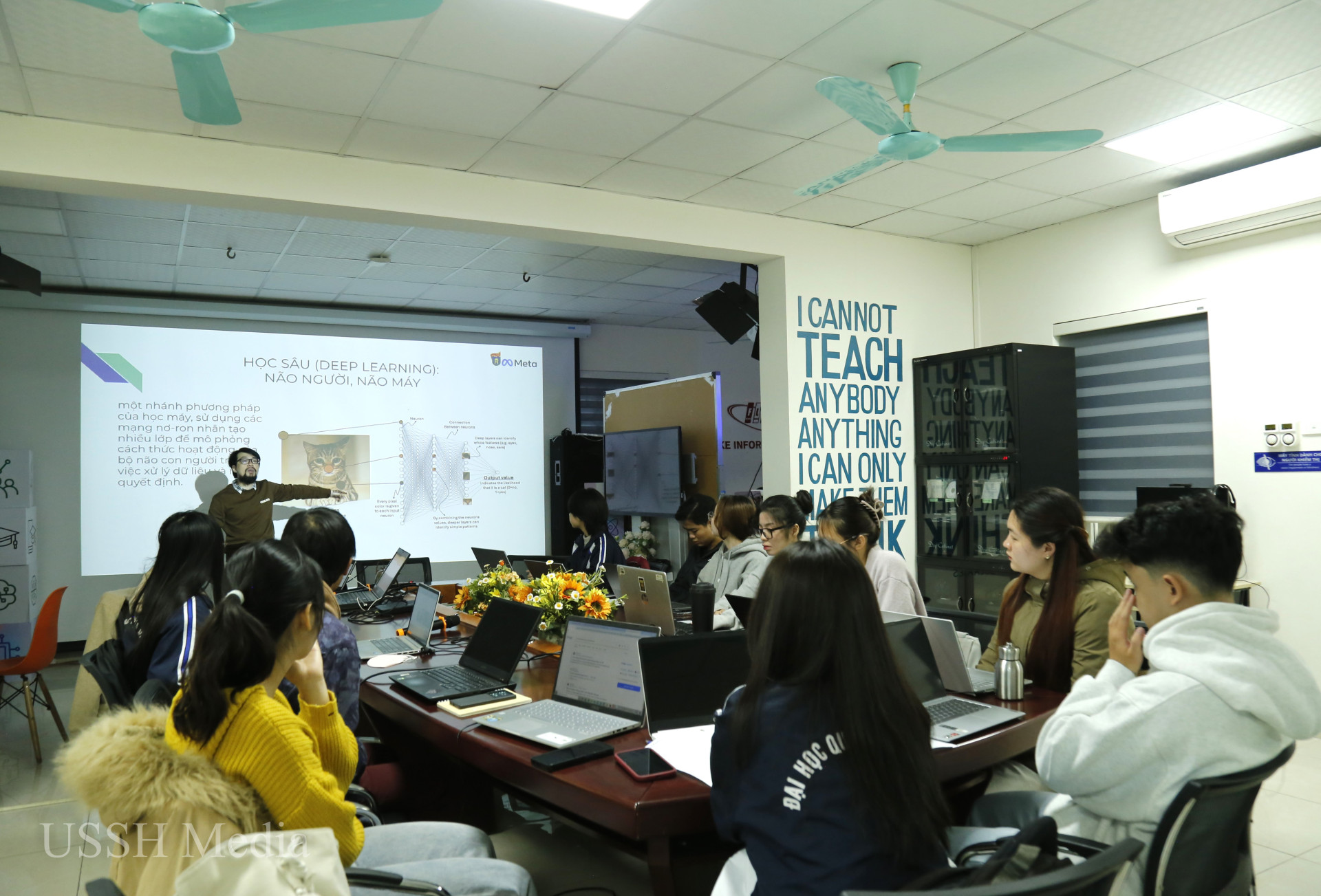
AI class for students at the University of Social Sciences and Humanities.
Ensuring learners succeed in their career journey.Based on the six perspectives on curriculum reform and strict adherence to Circular No. 17/2021/TT-BGDĐT regulating curriculum standards, Rector Hoang Anh Tuan requested the Training and Student Affairs Department of the University to pay special attention to analyzing the restructuring into four main knowledge blocks: the foundational knowledge block of the Ministry and the National University, the foundational knowledge block of the University, the knowledge block of the field, and the knowledge block of the major (and specialization – if any).
"The foundational knowledge base of the School of Humanities needs to be specifically established with a profound philosophy, clear principles, and a comprehensive approach that encompasses the current competency requirements for graduates, ensuring their success in their career paths."Accordingly, the Principal requested that the following be ensured: foreign language proficiency, soft skills, digital skills - AI skills, and moving towards equipping individuals with digital humanities, a humanistic entrepreneurial spirit, positive and creative thinking, and culture and development in the digital age.
Regarding subject matter and specialization, the University advocates empowering faculty heads and the unit's Scientific and Training Council to proactively develop and submit these to the University's Scientific and Training Council for review and approval.
Similarly, other specific issues such as yearbooks, internships, scientific research, graduation theses, studying abroad, and credit recognition… also need to be discussed openly and democratically within the training unit to ensure alignment with the philosophy and identity of the department and the reputation of the university.
"It's easy to stick to the old ways, but difficult to innovate! However, if teachers are willing to prioritize their students' futures over their own professional aspirations, know how to harmonize their teaching profession with their students' careers, and boldly innovate and create in their teaching methods… then nothing is impossible."Principal Hoang Anh Tuan concluded.
People's Representatives Newspaper:The Rector of the University of Social Sciences and Humanities urged lecturers "not to reject innovation in the name of academia."