In the context of many "hot" fields following current trends, fundamental disciplines such as Philosophy,
Religious Studies It is rarely mentioned for many reasons, even though it still plays an important role in explaining the social and spiritual life of humankind.
In fact, despite its rather unique name, many people still don't fully understand the field of Religious Studies, believing it's only associated with jobs directly related to religion, without fully appreciating the training content and diverse career opportunities it offers.
Training experts to approach religion from a scientific and objective perspective.In an interview with a reporter from the Vietnam Education e-magazine, Associate Professor, Dr. Nguyen Truong Giang - Head of the Department of Anthropology and Religious Studies, Faculty of Social Sciences and Humanities - Vietnam National University, Hanoi (USSH) said: Religious studies is a social science and humanities discipline that studies religion as a form of social consciousness, a socio-cultural phenomenon, and the spiritual needs of human beings, based on scientific, objective, and modern methods.
The role of this sector is becoming increasingly prominent as religion has a profound influence on global life. Citing data from the Pew Research Center (2020), more than 80% of the world's population currently follows a religion, and religious factors are present in many major issues such as conflicts in the Middle East, extremism, challenges to integration in Europe, and religious tensions in some countries.
Based on this experience, many international organizations such as the United Nations, the European Union, and developed countries are focusing on building teams of religious studies experts to serve policy planning, interreligious dialogue, conflict resolution, and peace promotion.
By pursuing a degree in Religious Studies, students are equipped with a system of knowledge and methods to analyze, research, and teach about religion. They can also participate in advising and supporting projects related to religious life in the community and society.
To avoid confusion with "studying religion," according to Professor Nguyen Truong Giang, the core of Religious Studies is to approach religion scientifically, objectively, and systematically, aiming to clarify the nature, function, role, and influence of religion on the lives of individuals and nations. This differs from studying religion from a doctrinal and practice-oriented perspective – that is, the internal viewpoint of a believer, which is more focused on religious experience and practice.
"Religious studies is interdisciplinary, multi-faceted, combining both internal and external perspectives on religion, while comparing and analyzing religious phenomena in relation to culture, society, and policy, but without aiming to propagate or oppose any religion," emphasized Associate Professor, Dr. Nguyen Truong Giang.
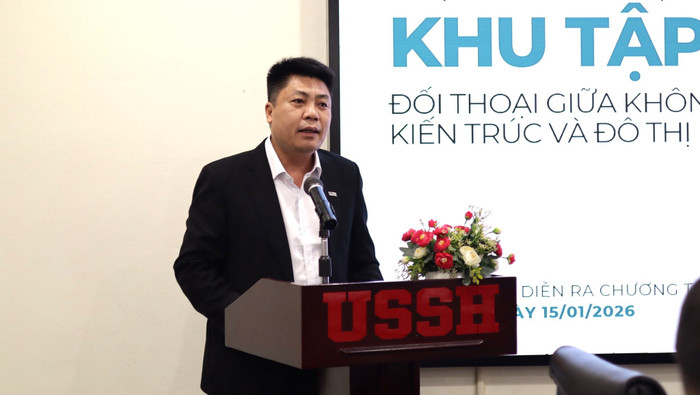
Associate Professor, Dr. Nguyen Truong Giang - Head of the Department of Anthropology and Religious Studies, Faculty of Social Sciences and Humanities - Vietnam National University, Hanoi. Photo: university website.
In Vietnam, the University of Social Sciences and Humanities - Vietnam National University, Hanoi is a pioneering institution in training.
Religious StudiesOver nearly 40 years (1990–2026), the training program has been continuously adjusted and updated according to the quality accreditation standards of higher education set by the Ministry of Education and Training, gradually affirming its quality at the national standard and aiming towards international standards.
According to Associate Professor, Dr. Nguyen Truong Giang, the program is designed with knowledge blocks including general knowledge in the Social Sciences and Humanities, interdisciplinary knowledge, foundational knowledge in the field, and specialized knowledge. The foundational and specialized knowledge blocks focus on three main areas: the theory and methodology of religious research, the history and current state of religions and beliefs in the world and in Vietnam, and practical issues concerning religious life, state management policies, and the role of religion in society.
Therefore, the field of Religious Studies aims to train a team of experts and researchers capable of participating in solving practical problems related to religious life in Vietnam and around the world.
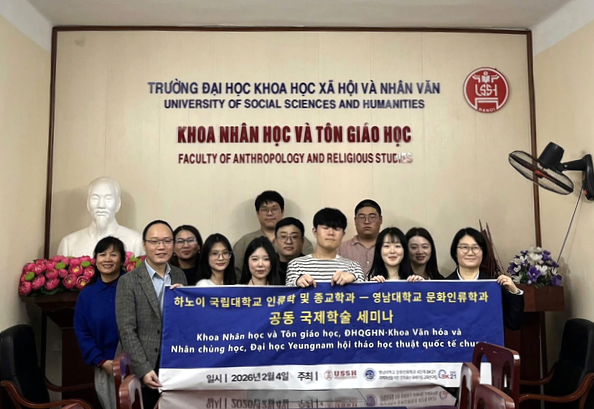
Academic exchange between the Department of Anthropology and Religious Studies (USSH) and the Department of Cultural Anthropology (Yeungnam University, South Korea). Photo: university website.
Regarding concerns about job prospects for graduates in Religious Studies, Associate Professor Dr. Nguyen Truong Giang stated that there is currently a huge demand for high-quality human resources in the field of religious studies, leading to many diverse career opportunities.
Specifically, after graduation, students can work in state agencies as specialists, researchers, lecturers, or state management officials on religion at the Ministry of Ethnic Minorities and Religion, ethnic and religious affairs committees from the central to local levels, the Ministry of Foreign Affairs, as well as in the fields of culture, sports and tourism, participating in the preservation of religious and belief heritage, or at the Vietnam Fatherland Front Committees at all levels.
In addition, graduates can become lecturers or researchers at research institutes specializing in religion, culture, and society, as well as work at universities both domestically and internationally.
Beyond the public sector, career opportunities also extend to international organizations and non-governmental organizations related to religion and belief, such as UNESCO and UNDP. Graduates in Religious Studies can advise on projects and multinational corporations related to culture and religion, as well as work in journalism, media, cultural and spiritual tourism, and community development projects.
Students gain practical experience right from their first year.In a society increasingly diverse in culture, beliefs, and religions, the role of Religious Studies in social management, cultural research, and policy-making is becoming increasingly evident. Not only does it help explain religious phenomena from a scientific perspective, but this field of study also plays a crucial role in developing appropriate policies and promoting harmony and stability in social life.
According to Dr. Vu Van Chung, lecturer at the Faculty of Anthropology and Religious Studies, University of Social Sciences and Humanities, Vietnam National University, Hanoi, a Pew Research Center study (2025) shows that by 2020, the world will have approximately 2.3 billion Christians, 2 billion Muslims, 1.2 billion Hindus, and 324 million Buddhists. In Vietnam, a country classified as having a very high level of religious diversity, 17 religions are currently legally recognized, along with a rich system of folk beliefs.
In this context, the role of Religious Studies is manifested through three main pillars. Firstly, training a team of experts, researchers, lecturers, and administrators capable of deeply understanding religion, serving management work, maintaining religious harmony, preventing the exploitation of beliefs, and simultaneously addressing "new religious phenomena" and promoting interreligious dialogue.
Secondly, it contributes to cultural research and the preservation of national identity, as beliefs and religions are important components of Vietnamese culture. This role is demonstrated through research activities, policy consultations, and the implementation of projects to preserve cultural heritage related to beliefs and religions, especially in areas inhabited by ethnic minorities.
Thirdly, participating in policy development and promoting international integration, through advising on the development of religious policies, participating in international dialogues on freedom of belief, and supporting organizations and businesses in understanding Vietnamese culture and religion, contributing to reducing conflicts and enhancing exchanges and cooperation.
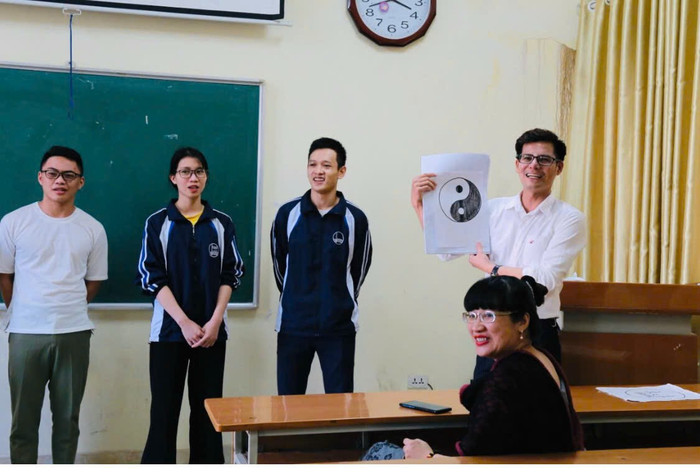
Dr. Vu Van Chung (in a white shirt) during a lecture on General Religious Studies. Photo: Provided by the interviewee.
In light of this reality, the University of Social Sciences and Humanities - Vietnam National University, Hanoi, currently offers a Religious Studies program with an interdisciplinary, applied orientation, approaching modern theories and methods linked to practical requirements. The curriculum helps students gain a deep understanding of religious life in Vietnam and around the world through modules such as General Religious Studies; Vietnamese Beliefs; Religion and Contemporary Society; Buddhism, Catholicism, Islam, and Protestantism in Vietnam; indigenous religions and religious festivals…
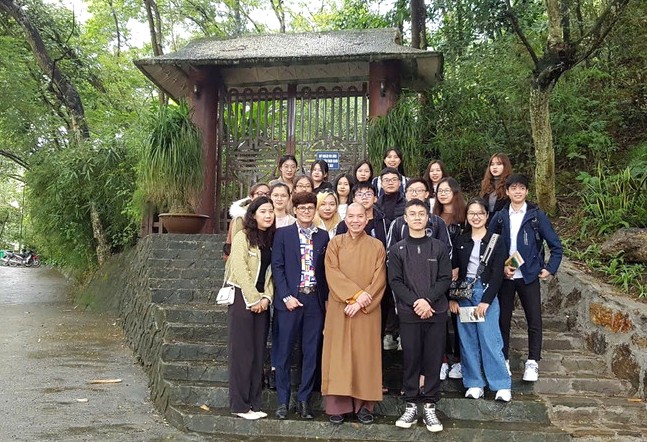
During their studies, students have many opportunities to participate in field surveys and research at religious sites and communities from their early years. Fieldwork and internships are organized in many locations, from festival sites such as Tran Temple, Hung Temple, Huong Pagoda, Yen Tu, to religious sites such as pagodas, churches, mosques, and temples… as well as in ethnic minority communities in Lam Dong, Hue, Ha Giang (formerly), Lao Cai…
Students majoring in Religious Studies (USSH) on a field trip to Truc Lam An Tam Zen Monastery, Tam Dao, Vinh Phuc (formerly). Photo: Provided by the interviewee.
In addition, students also have the opportunity to intern at state management agencies and research organizations on beliefs and religions such as the Government Religious Affairs Committee, the Department of Internal Affairs, the Fatherland Front Committees at all levels, and specialized research institutes.
“These experiences help students bridge the gap between theory and practice, while also honing core skills such as observation, interviewing, field note-taking, analysis, and research report writing. Through this, learners not only enhance their professional competence but also develop a mindset that respects diversity, adapts to culturally and religiously diverse environments, and improves their ability to handle practical situations in their research and future work,” Professor Chung explained.
According to Dr. Vu Van Chung, to excel in and pursue a long-term career in Religious Studies, students need to possess several core qualities and competencies. First and foremost are the ability to conduct independent research, an open and objective mindset, the ability to view issues from multiple perspectives, the separation of personal belief from scientific analysis, and the avoidance of prejudice when approaching religious matters.
In addition, learners need to show respect and empathy, understand the beliefs of people of different faiths, "put themselves in the shoes of those involved," and demonstrate sensitivity in communication and behavior appropriate to each religion and culture.
Patience and meticulousness are also important requirements, enabling students to observe rituals, take detailed notes, and persevere with long-term research, especially during field trips to remote areas.
In addition, students need to be equipped with skills such as reading and writing, communication, interviewing, critical thinking, analysis, and field research. They should also have an interest in cultural, human, social, and religious issues. The ability to listen, self-assess, and possess sensitivity and flexibility in problem-solving are also crucial factors for success in this field.
In the context of increasing competition for admissions, the University of Social Sciences and Humanities - Vietnam National University, Hanoi has implemented many policies and activities to attract candidates interested in Religious Studies, while also creating conditions for students to develop their research capabilities and career orientation.
Specifically, regarding financial support, students have access to a variety of scholarships. A notable example is the Talent Attraction Scholarship for Basic Sciences, implemented by Hanoi National University from the 2022-2023 academic year, offering a comprehensive support package including tuition fee waiver, dormitory accommodation, living allowance, and opportunities to participate in scientific research, with a total value of 100-120 million VND for the entire course.
In addition, there are scholarships from various domestic and international organizations and businesses, with an average support level of 5-20 million VND per year, helping approximately 60-70% of students receive at least one form of support.
In terms of capacity building, students participate in the scientist incubation program, have the opportunity to work with researchers, participate in scientific projects at various levels, and are given priority for higher education. Annual student scientific conferences also provide opportunities for students to publish research results and receive awards.
In 2026, the University of Social Sciences and Humanities - VNU Hanoi will discontinue the admission of the C00 and D66 subject combinations in many majors.
"In addition, the training program expands international cooperation, providing opportunities for short-term study and exchange programs in many countries such as South Korea, Japan, France, Germany, the United States, Canada, China, and India, as well as access to postgraduate scholarships and international conferences."
"The school also focuses on supporting career development through guided internship programs at state management agencies and international organizations, along with skills training courses and job placement activities, helping students to quickly define a suitable career path," Mr. Chung informed.
Sharing with reporters, Nguyen Thanh Thien Tu, a K68 student majoring in Religious Studies at the University of Social Sciences and Humanities, Vietnam National University, Hanoi, said: "Before starting this course, I thought it was a dry, academic field. However, after studying for a while, I realized that the subject is very new and interesting, not only researching religion and beliefs but also helping to understand people, society, culture, and history more deeply."
Commenting on the quality of education at the school, Tú said that the lecturers in the Department of Anthropology and Religious Studies are all experts with deep professional knowledge, and are also very approachable and ready to support students. Furthermore, the lecturers' teaching methods are very flexible, combining theory and discussion, helping students proactively approach issues and express their personal opinions.
In addition to training activities, the Faculty regularly organizes seminars with international researchers and representatives of religions, creating an open and multifaceted exchange environment. The learning atmosphere is therefore quite relaxed, encouraging students to ask questions, engage in critical thinking, and develop independent thought. Students are also given opportunities to participate in scientific research from an early age, conducting fieldwork at places of worship or in ethnic minority areas to broaden their understanding and connect theory with practice.
"The Religious Studies major has helped me better define my career path and equipped me with the necessary foundation to adapt to the diverse work environment in today's context. Therefore, after graduation, I hope to have the opportunity to work at non-governmental organizations or state management agencies in the field of religion and culture, contributing to promoting understanding and respect for religious diversity and contributing to the sustainable development of society," Tú shared.
Related articles:
This clip introduces the Religious Studies program at the University of Social Sciences and Humanities.
Vietnamese Education: Understanding Religious Studies Correctly: A Scientific Perspective and Broad Career Opportunities