

This page commemorates the 80th anniversary of the school's tradition and 30 years of development.University of Social Sciences and Humanities
.jpg)
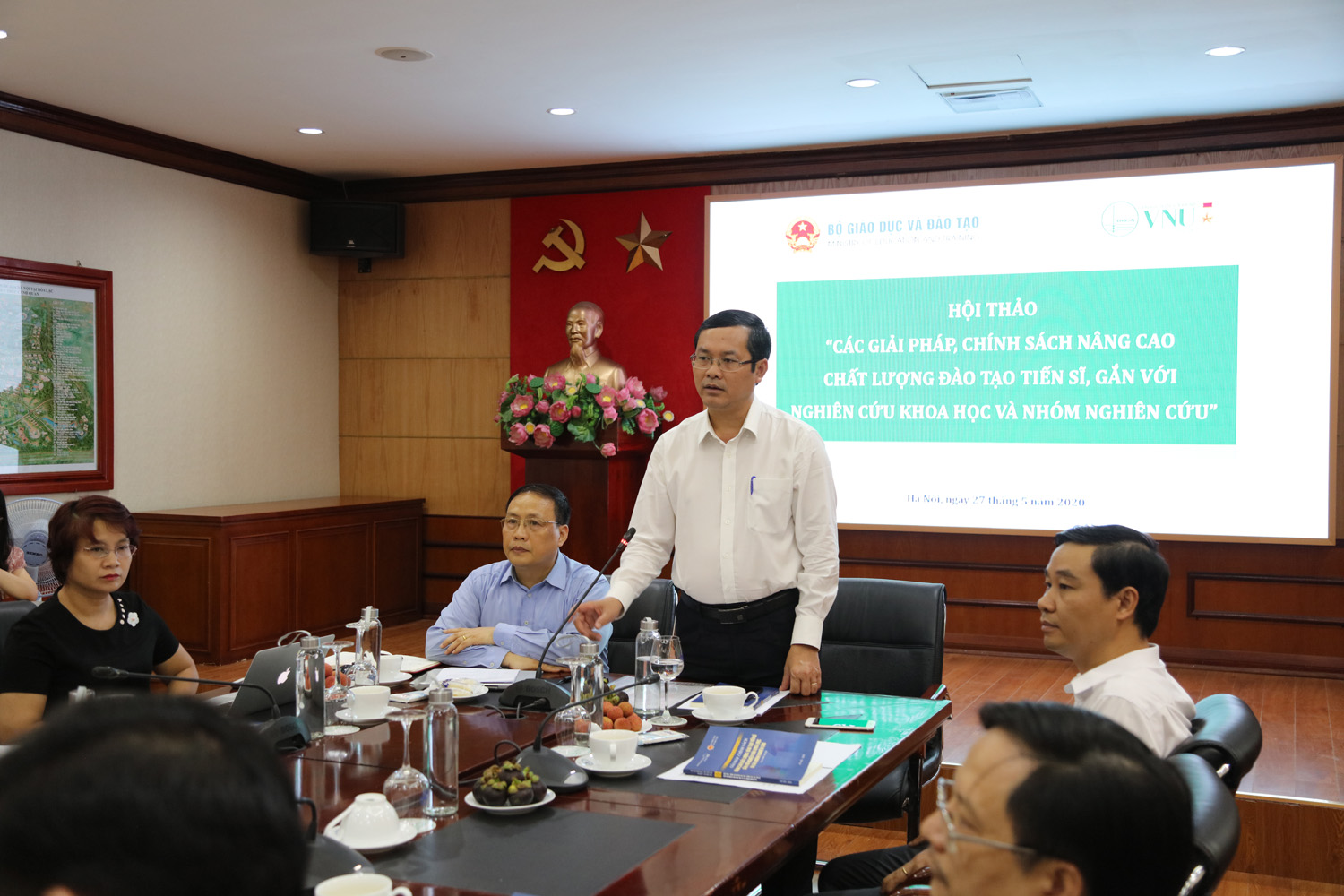
Deputy Minister of Education and Training Nguyen Van Phuc chaired the workshop.
Vice Rector of Vietnam National University, Hanoi, Nguyen Hoang Hai attended and delivered the opening speech. The workshop was also attended by representatives from the Ministry of Science and Technology and more than 40 higher education institutions nationwide.
Speaking at the workshop, Deputy Minister Nguyen Van Phuc shared: After the Law amending and supplementing a number of articles of the Law on Higher Education came into effect (Law No. 34) and Government Decree No. 99/2019/ND-CP guiding the implementation of this Law, autonomy has been granted to higher education institutions. Emphasizing the workshop's theme of improving the quality of doctoral training, linked to the needs of scientific research and research groups, the Deputy Minister said that the Ministry is developing a decree and accompanying circulars related to scientific and technological activities and student recruitment and training management in higher education institutions.
.jpg)
Vice Rector of Vietnam National University, Hanoi, Nguyen Hoang Hai, delivered the opening remarks at the workshop.
According to Vice Rector of Vietnam National University, Hanoi (VNU), Nguyen Hoang Hai, for a research-oriented university to survive and develop, scientific research and doctoral training are vital factors. Therefore, VNU, in collaboration with the Ministry of Education and Training, organized this workshop to listen to the experiences shared by higher education institutions and scientists, and to identify remaining obstacles to be addressed in the future.
The opinions and contributions of scientists at the conference will serve as a basis for the Ministry of Education and Training to research and incorporate into the decree and guiding circulars.
.jpg)
Professor Nguyen Dinh Duc proposed amending the regulations on doctoral admissions and training to set higher requirements for students and supervisors, while also implementing policies and incentives to encourage faculty and doctoral candidates to actively participate in scientific research; and to increase the scale and quality of doctoral studies.
Professor Nguyen Dinh Duc, Head of the Organizing Committee and Head of the Scientific Committee of the Conference, presented the introductory report, assessing the current state of doctoral training and the current state of strong research groups at higher education institutions. According to Professor Nguyen Dinh Duc's research, the quality of doctoral training has improved significantly in recent years, with important qualitative changes; many doctoral candidates have published research results in prestigious ISI journals, and a considerable number have achieved outstanding results, comparable to those of doctoral candidates trained full-time abroad. Professor Duc also noted that in recent years, many universities have recognized the importance of and invested in building strong research groups. These research groups are the building blocks of training and research activities within universities. Through strong research groups that attract, train, and nurture talent, and promote research that reaches international standards and benchmarks, thereby boosting international publications and enhancing the prestige and ranking of universities, these research groups also serve as an environment for individualized training, implementing innovative activities and entrepreneurship in the context of the digital transformation revolution. PhD candidates are a crucial source of science and technology human resources in universities. Professor Duc also proposed many comprehensive and fundamental solutions to promote and improve the quality of doctoral training, linking it with strong research groups in universities in the future. Professor Nguyen Dinh Duc further emphasized that, in Vietnamese universities with a tradition of respecting teachers and valuing learning, the establishment of strong research groups is considered a good environment and a suitable model for educators, scientists, colleagues, and students to bond, cooperate in research, and sustainably innovate.
The delegates unanimously appreciated the achievements that higher education has received from the policy of building research groups and linking training, especially doctoral training with scientific research and research groups. The workshop also agreed on the key points to ensure the quality of doctoral training meets international standards.
First,The training of doctoral candidates must be full-time and at the training institution;
MondayTherefore, doctoral students should be considered a scientific and technological research force within higher education institutions, and thus need policies on scholarships and financial support, such as living expenses, to help them focus on their research.
TuesdayFor doctoral candidates to reach international standards, a suitable research environment is essential; it is through research groups that they can access international-level standards.
Wednesday,The research group is the cell of training and scientific research activities, and is a model that connects postgraduate training with research.
Furthermore, the State and universities need to attract talent, particularly leading professors from prestigious universities both domestically and internationally, to work here; and to attract more young researchers and doctoral candidates – these are the key personnel who will implement the ideas of the research team leader. For research teams to be effective and successful, adequate and long-term investment mechanisms are necessary. In addition, research teams must access modern research trends worldwide and connect with new factors of the Fourth Industrial Revolution, such as the elements of Industry 4.0.smartandinnovationThese are the development trends for research groups in the next decade.

Representatives from universities attended the workshop.
The conference featured over 20 presentations and dozens of speeches from 40 leading higher education institutions and research institutes in Vietnam, including: the University of Science, the University of Social Sciences and Humanities, the University of Economics, the University of Education, the University of Technology, Vietnam National University, Hanoi; the Vietnam Institute of Studies and Development Science; the Institute of Information Technology; the Institute for Quality Assurance in Education; the Faculty of Law - Vietnam National University, Hanoi; Vietnam National University, Ho Chi Minh City; Thai Nguyen University; the Vietnam Academy of Science and Technology; the Military Science and Technology Institute - Ministry of National Defence; Hanoi University of Technology; National Economics University; Foreign Trade University; Hanoi Medical University; Military Medical Academy; Hanoi Pedagogical University; Hanoi University of Civil Engineering; Ho Chi Minh City University of Technology and Education; and representatives from the Office of the Science and Education Program, and leading professors of several prominent research groups.
The discussions addressed current issues within the unit related to strong research groups, doctoral training, and suggestions for improving the regulations on doctoral training, foreign language requirements, output standards, and support policies. Many opinions provided guidance for the Ministry of Education and Training to use as a basis for adjusting and improving the draft regulations on doctoral training.
Sharing the factors for successful doctoral training that foster strong research groups, which were of interest to the delegates, Professor Nguyen Van Kim, Head of the Asian Trade Research Group, Faculty of Social Sciences and Humanities, Vietnam National University, Hanoi, stated: to promote the development of research groups, it is first necessary to have the right research orientation to meet the requirements and align with the national development strategy, as well as with common international concerns to meet long-term needs.
Furthermore, to have a strong research team, human development is extremely important. It's crucial to guide, nurture, and attract students to participate in scientific research from their second year. Training, mentoring, and networking are essential to gradually involve students in solving major research problems. This also strengthens the bond between teachers and students, creating a connection and passion for young research teams to fully develop their abilities in discovery and research.
.jpg)
Associate Professor Tran Thi Thanh Tu, from the School of Economics, Vietnam National University, Hanoi, believes that for successful doctoral training that meets international standards, the key factors are policies to attract foreign professors and doctoral students to work full-time, and the need to build research groups.
.jpg)
Dr. Nguyen Dac Trung, Deputy Head of the Training Department at Hanoi University of Science and Technology, emphasized: "Doctoral candidates must truly consider this their job, dedicating themselves wholeheartedly to it, and thus reaping the rewards. This is what creates the right motivation, encouraging doctoral candidates to successfully complete their work."
Acknowledging the role of research groups in higher education institutions and doctoral training, Ms. Le Yen Dung, Deputy Director of the Department of Social Sciences, Humanities and Natural Sciences, Ministry of Science and Technology, stated that the Ministry will soon accelerate the implementation of the Project on training and fostering scientific and technological human resources domestically and abroad using state budget funds, as per Decision No. 2395/QD-TTg of the Prime Minister.
Associate Professor Dr. Le Hieu Giang, Vice Rector of Ho Chi Minh City University of Technology and Education, also stated that establishing research groups is one of the university's solutions to attract doctoral students. "Doctoral students without research groups lack support. Our research groups include professors, associate professors, doctors, masters, bachelors, and engineers."
According to Associate Professor Giang, through research groups, the university attracts many projects to research and solve practical problems. At the same time, with its autonomous mechanism, the budget allows the university to support doctoral students in scientific research, reward ISI publications, etc.
.jpg)
At the workshop, Associate Professor Dr. Nguyen Thi Thu Thuy, Acting Director of the University Department, discussed issues related to the basic directions for revising and improving the regulations on doctoral training.
According to Law No. 34, which has come into effect, higher education institutions have been empowered. This is a means for universities to improve the quality of their training, including doctoral training. Through research groups and the requirements of the Doctoral Training Regulations, the number of prestigious international publications from Vietnam has tripled compared to seven years ago. This represents a strong development in scientific research, and we have focused on international integration, achieving a dual benefit from building research groups and improving the quality of doctoral training. Statistical data shows that the scientific research capacity of universities has developed quite strongly. For example, within ASEAN, Vietnam ranks number 1 in international publications in the field of Mathematics.
According to Associate Professor Thuy, the upcoming revision of the regulations on doctoral admissions and training should draw on the experiences of developed countries around the world. However, what has been implemented successfully and remains relevant should be continued and further developed. Anything that is still inadequate or acts as a barrier needs to be reviewed and amended or supplemented to meet practical requirements and integrate with the world.
Leaders of the Ministry of Education and Training stated that the Ministry will report and discuss with the Ministry of Finance to develop a policy mechanism for doctoral students. If doctoral students receive scholarships, they will be able to focus more on scientific research. Through this workshop, based on the results of scientific research and the practical experiences of universities, the Ministry will study and incorporate feedback to refine legal documents, thereby contributing practically to the development of scientific research and improving the quality of doctoral training in higher education institutions.
According to VNU Media
Author:Thuy Duong, photo by Ngoc Tung - VNU Media
Newer news
Older news