

This page commemorates the 80th anniversary of the school's tradition and 30 years of development.University of Social Sciences and Humanities
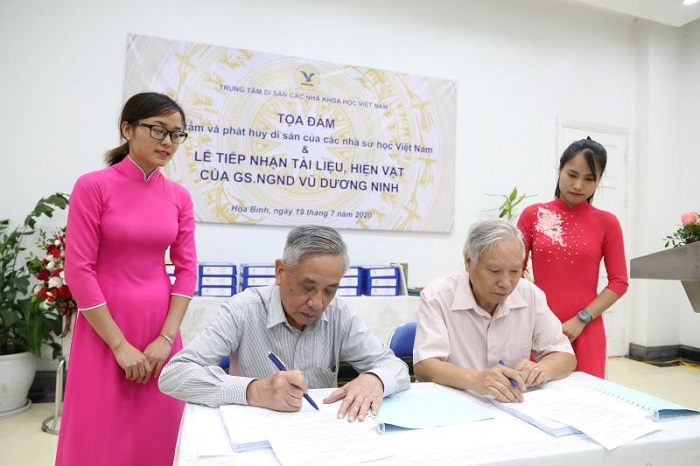
Professor Vu Duong Ninh, People's Teacher, former Head of the Department of International Studies, and President of the Association of Retired Teachers of the University of Social Sciences and Humanities, Vietnam National University, Hanoi, has donated nearly 700 documents and artifacts, representing the results of his research over many years, to the Center for the Heritage of Vietnamese Scientists.

Seminar on collecting and promoting the heritage value of historians and receiving artifacts donated by Professor Vu Duong Ninh (Photo: Nhan Dan online newspaper)
Professor Vu Duong Ninh is known as the first person to introduce the subject of World Civilization History into the curriculum of universities in Vietnam; he was the first Head of the Faculty of International Studies and one of the initiators and founders of the International Studies major at the University of Social Sciences and Humanities. Among the hundreds of documents and artifacts donated by Professor Vu Duong Ninh this time, there are many valuable materials such as four notebooks containing lecture notes from 1994-2000 on topics including World History, Southeast Asian History, World Civilization History, and International Relations History; research papers, textbooks, and monographs. In particular, the books "Modern World History" and "World Civilization History" have been reprinted 18 times... The documents and artifacts donated by the Professor to the Center are of great value, not only reflecting his life and career but also serving as a valuable source of information for understanding the development of historiography and historical science in Vietnam.
Professor Vu Duong Ninh shared that after visiting MEDDOM in 2019 and witnessing firsthand the achievements of the Center over more than a decade, he dedicated time to compiling, collecting, and annotating his documents and artifacts to donate to the Center. Professor Vu Duong Ninh stated: “MEDDOM alone is not enough; scientists need to contribute to the collection and research of historical documents about the lives of scientists. For this work to be effective, the scientific community must consider this a shared responsibility and work together with the Center to complete this meaningful task.”
To date, the Center for the Heritage of Vietnamese Scientists has established personal archives of 68 historians in various fields: history, ethnology, and archaeology, from many different institutions: the University of Social Sciences and Humanities - Vietnam National University, Hanoi; Hanoi Pedagogical University; Ho Chi Minh City Pedagogical University; the Institute of History; the Institute of Southeast Asian Studies; the Institute of Archaeology; the Institute of Ethnology; Da Lat University; Hue Pedagogical University; the Hue Historical Science Association; the Ho Chi Minh National Academy of Politics; the Institute of Party History, etc. However, this number is still quite modest compared to the large number of experienced and renowned historical researchers. The archives of these historians are further enriched and enlivened by audio and video recordings of interviews about the lives of these scientists.

Historians visit an exhibition at the Vietnamese Scientists' Heritage Park (Photo: Nhan Dan Online Newspaper)
The seminar "Collecting and Promoting the Heritage of Vietnamese Historians" was attended by a large number of scientists, historians, educators, and those interested in the heritage of Vietnamese historians. The seminar aimed to review the Center's research and collection work over the past decade and to guide future research, collection, and promotion of the heritage of historians. During the seminar, a proposal was made for a "home-based document preservation" model in cases where families are unable to transfer the scientists' documents to the Center as a way to salvage this valuable archive. Center staff would assist families with tasks requiring expertise in classification, systematization, and finding the best preservation methods to safeguard the memory of the scientists as well as future generations.
Author:Bui Huyen (compiled)
Newer news
Older news