
Promoting the application and research of AI in higher education.
Speaking at the conference, Deputy Minister of Education and Training Le Quan said that the Ministry is implementing two major tasks: building elite universities and centers of excellence, and promoting the application and research of AI in higher education.
Following the workshop for teacher training institutions, today's workshop focuses on promoting the application of AI in social sciences, economics, management, law, health sciences, and education. "These are all fields with a large number of learners and play a crucial role in training human resources for national development," the Deputy Minister emphasized.
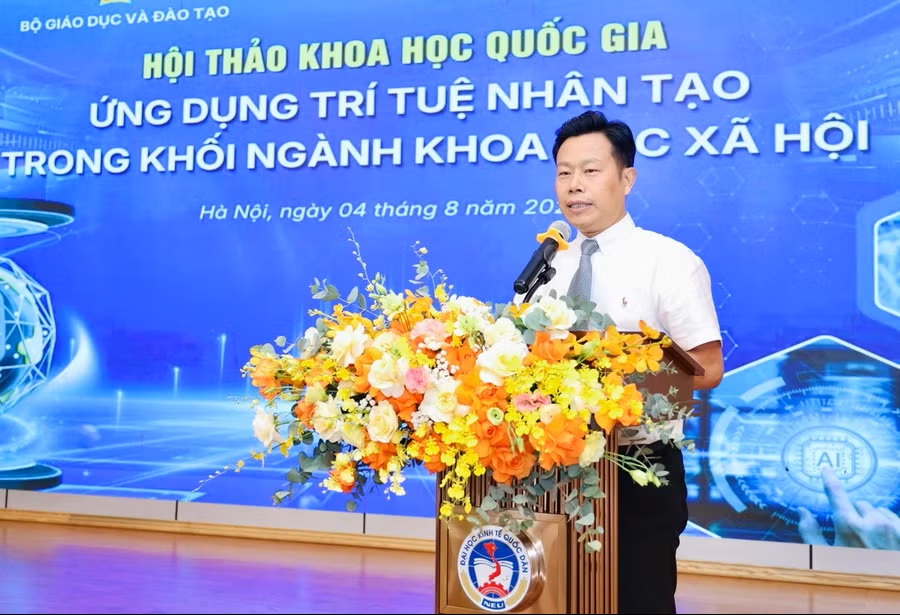
Deputy Minister of Education and Training Le Quan delivered a speech at the conference.
In the context of rapidly developing technology, restructuring training programs is a crucial and urgent task for higher education institutions. In that spirit, the Deputy Minister suggested that programs should be designed to be more open and adaptable to the labor market.
Students can choose their field of study based on their abilities, interests, and career aspirations, but regardless of the field, they need to be equipped with technological skills. Artificial intelligence is dramatically changing the way education is conducted and the demands for human resources; therefore, AI should not be taught as a separate subject but should be integrated into every field and every training program.
From economics, management, law, and education to social sciences and health sciences, all are being strongly impacted by AI. Integrating AI into training programs will help students better adapt to technological changes, learn to use, master, and gradually innovate technology in their studies and work.
Along with reforming training programs, the Deputy Minister suggested that universities, especially leading institutions, proactively develop centers of excellence in AI research linked to their areas of strength.
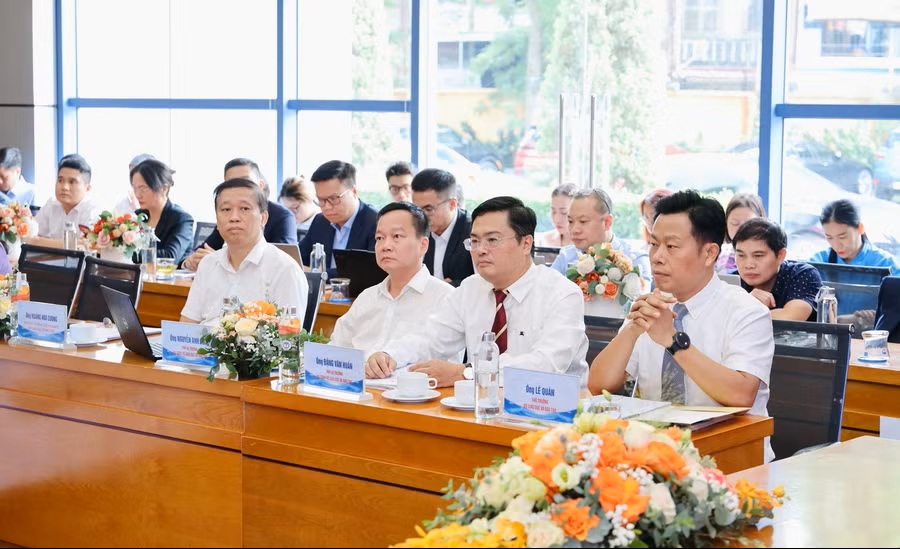
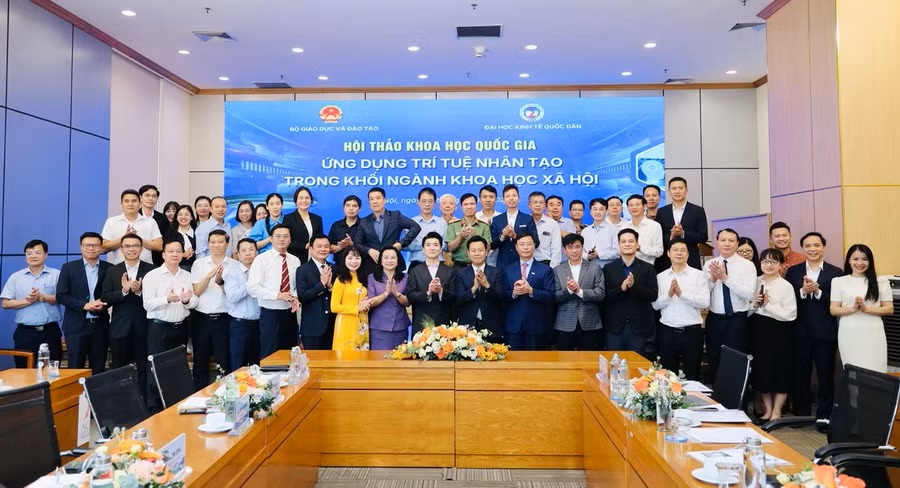
Deputy Minister of Education and Training Le Quan and delegates, experts, and scientists attended the workshop.
AI research should stem from the practical needs of the school.
According to the Deputy Minister, AI research should stem from the practical needs of schools, directly serving the innovation of training, scientific research, and management, thereby creating models that can be scaled up and transferred into practice.
Regarding the issue of restructuring training programs along with strong innovation in teaching and learning methods in the context of rapidly developing AI, Deputy Minister Le Quan stated that the issue is not about restricting or prohibiting the use of AI in the classroom, but rather about changing the way teaching and learning are organized.
The goal of higher education is to train individuals who know how to use and master technology, possess problem-solving skills and creativity, rather than simply exploiting AI to find answers.
AI is creating major changes in the way learning materials are built, lectures are designed, and learning activities are organized. This requires instructors to shift from simply imparting knowledge to developing learners' competencies, designing learning activities that align with the learning outcomes of the course and the curriculum.

A view of the conference.
According to the Deputy Minister, the application of technology also needs to be promoted in university management to improve the quality, efficiency of operations, and quality of service to students.
“Following the workshop, higher education institutions need to develop a plan for AI application over the next five years, report it to the Ministry of Education and Training for compilation and synchronized implementation throughout the system,” the Deputy Minister emphasized, adding that research may be conducted to develop indicators for evaluating the level of AI application in higher education institutions. This will serve as a basis for schools to gradually innovate governance, improve operational efficiency, reduce indirect costs, and create additional resources for school development.
The Deputy Minister requested that universities continue to concretize the requirements for learning outcomes as stipulated in the new university training regulations, with a focus on improving students' digital skills, AI application skills, and foreign language proficiency.
In this context, foreign language proficiency should be assessed based on actual competence, while technological competence is a requirement that higher education institutions need to implement immediately to meet the demands of human resource development in the new era.
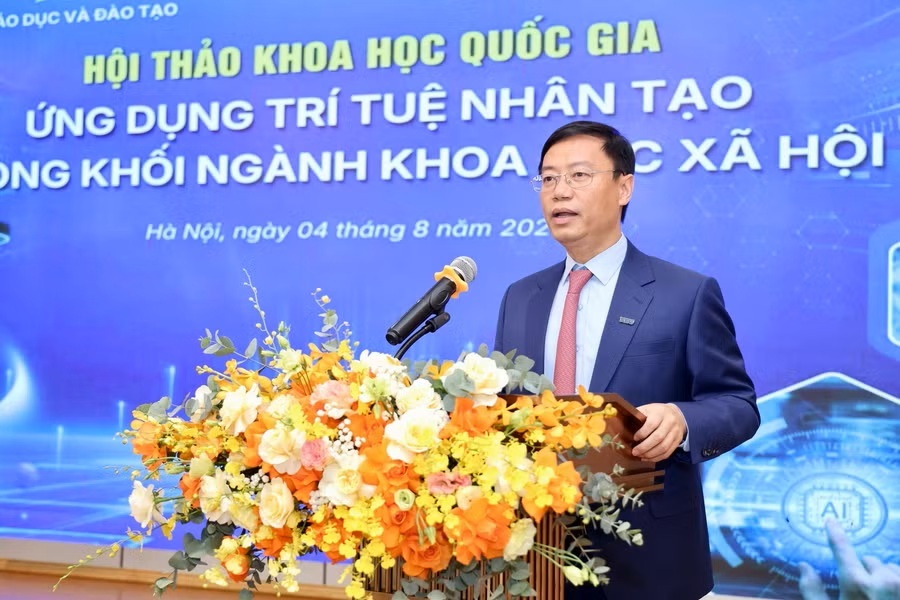
Bui Duc Tho, Director of the National Economics University, delivered a speech at the conference.
Sharing from the practical experience of higher education institutions.
At the workshop, experts, scientists, and representatives from higher education institutions shared various models, practical experiences, and proposed solutions to promote the application of artificial intelligence in training, scientific research, and university administration in the social sciences.
Associate Professor Dr. Do Van Hung – Head of the Information Management Department, University of Social Sciences and Humanities (Vietnam National University, Hanoi) shared that at some research organizations, the number of submitted articles has increased by about 42%. It is estimated that about 13-14% of the content in social science and humanities articles is generated by AI. Although about 70% of journals have issued policies related to AI, only 0.1% of articles publicly declare the use of this technology.
AI makes writing research easier and less expensive, but that doesn't mean publishing scientific papers becomes easier. Therefore, the important issue isn't about using AI extensively or minimally, but rather how to use it to improve research quality and ensure academic accountability.
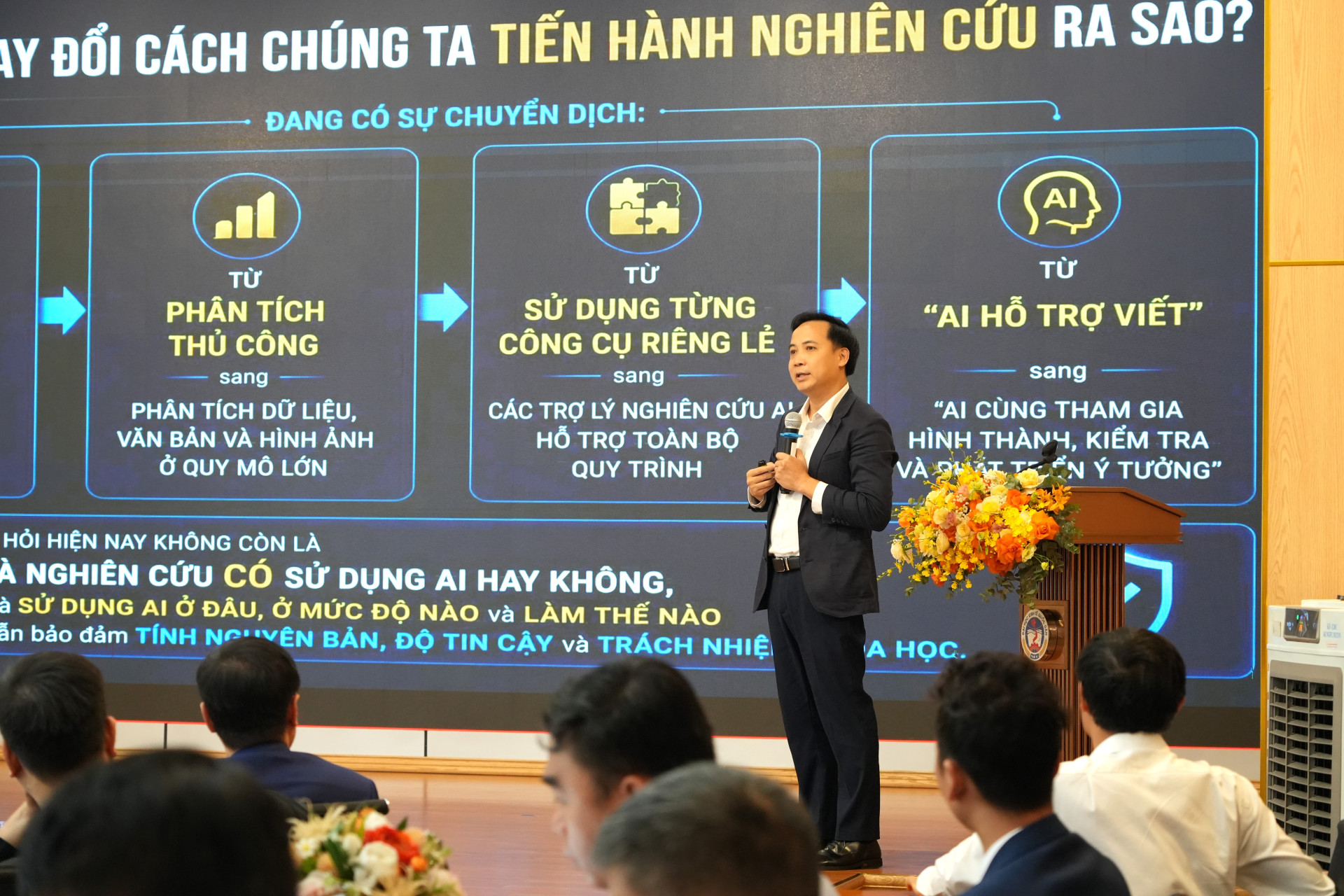
Associate Professor Dr. Do Van Hung – Head of the Department of Information Management, Faculty of Social Sciences and Humanities (Vietnam National University, Hanoi) presented a paper at the conference.
Emphasizing the shift in approach to AI, from a "research assistant" to a "cognitive partner," Associate Professor Dr. Do Van Hung proposed a four-tiered competency framework for researchers in the AI era, including: competency in using and operating tools; competency in verifying and evaluating AI results; competency in methodology and integrating AI appropriately; and ethical competency.
According to Associate Professor Dr. Do Van Hung, a good researcher in the AI era is not necessarily the best at writing prompts, but rather someone who asks good questions, conducts rigorous testing, and provides insightful explanations.
For AI to be effectively applied in research, universities need to issue user guidelines, build secure internal AI systems, and provide AI skills training for faculty and students; while shifting from a control-oriented approach to an evaluation-based approach to the quality of AI usage.

Associate Professor Dr. Nguyen Duc Son - Rector of Hanoi Pedagogical University, shared his views at the conference.
Associate Professor Dr. Nguyen Duc Son - Rector of Hanoi Pedagogical University, shared that AI exchange forums are opportunities for management staff and lecturers to update their knowledge, share experiences, and promote adaptation to the changes brought about by technology. For the social sciences, the application of AI is no longer an option but a requirement for innovation in training, research, and management in the new context.
Sharing experiences from the University of Economics Ho Chi Minh City (UEH), Mr. Dang Thai Thinh, Deputy Head of Infrastructure Management, said that the university has developed the UEH Notebook system based on a combination of AI-generated models with data built and managed by the university itself.
This model allows for the effective utilization of AI capabilities while ensuring data security, technological independence, and widespread deployment for faculty, students, and departments within the university.
According to the Deputy Minister, higher education institutions need to implement AI according to a suitable roadmap, from equipping lecturers and students with knowledge and skills in using AI; promoting the application of AI in teaching, research, and restructuring training programs; to developing human resources capable of innovation and mastering technology. The ultimate goal is to enhance the capacity of learners to meet the requirements of the labor market in the new context.
Highly appreciating the models and experiences shared by higher education institutions at the workshop, Deputy Minister Le Quan also emphasized that the application of AI in higher education, especially in the social sciences, needs to be implemented quickly, decisively, and geared towards specific products serving training, research, and management.
The Ministry of Education and Training is reviewing and developing specific requirements for learning outcomes for graduates by 2030. Among these, foreign language proficiency and digital skills are identified as crucial requirements.
Regarding foreign languages, the goal is to strive for English to become a second language, associated with internationally recognized certifications. In terms of digital skills, students are guided to master technology and AI skills. This will enhance their adaptability to the labor market, facilitate international integration, and ensure equal access to opportunities in the digital environment.
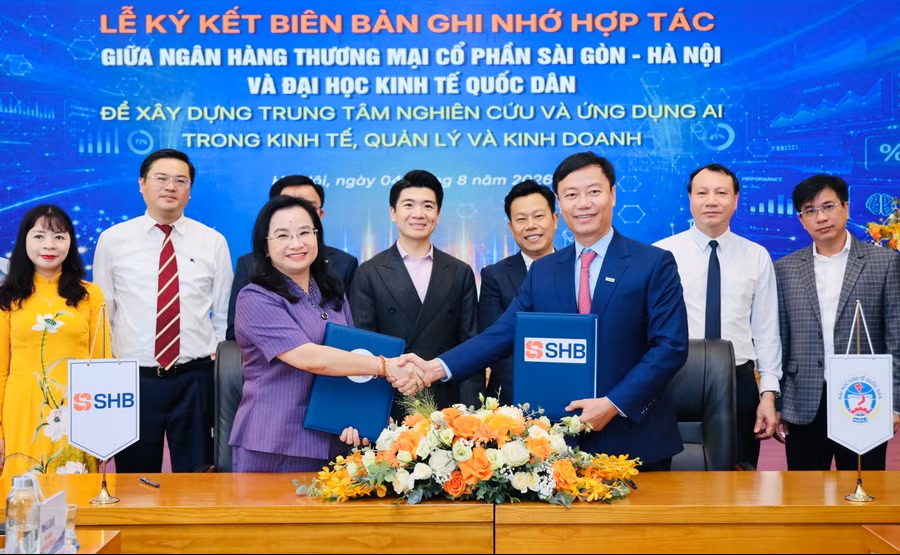
Deputy Minister Le Quan witnessed the signing of a cooperation agreement to promote the application of artificial intelligence in the social sciences between the National Economics University and Saigon - Hanoi Commercial Joint Stock Bank (SHB).
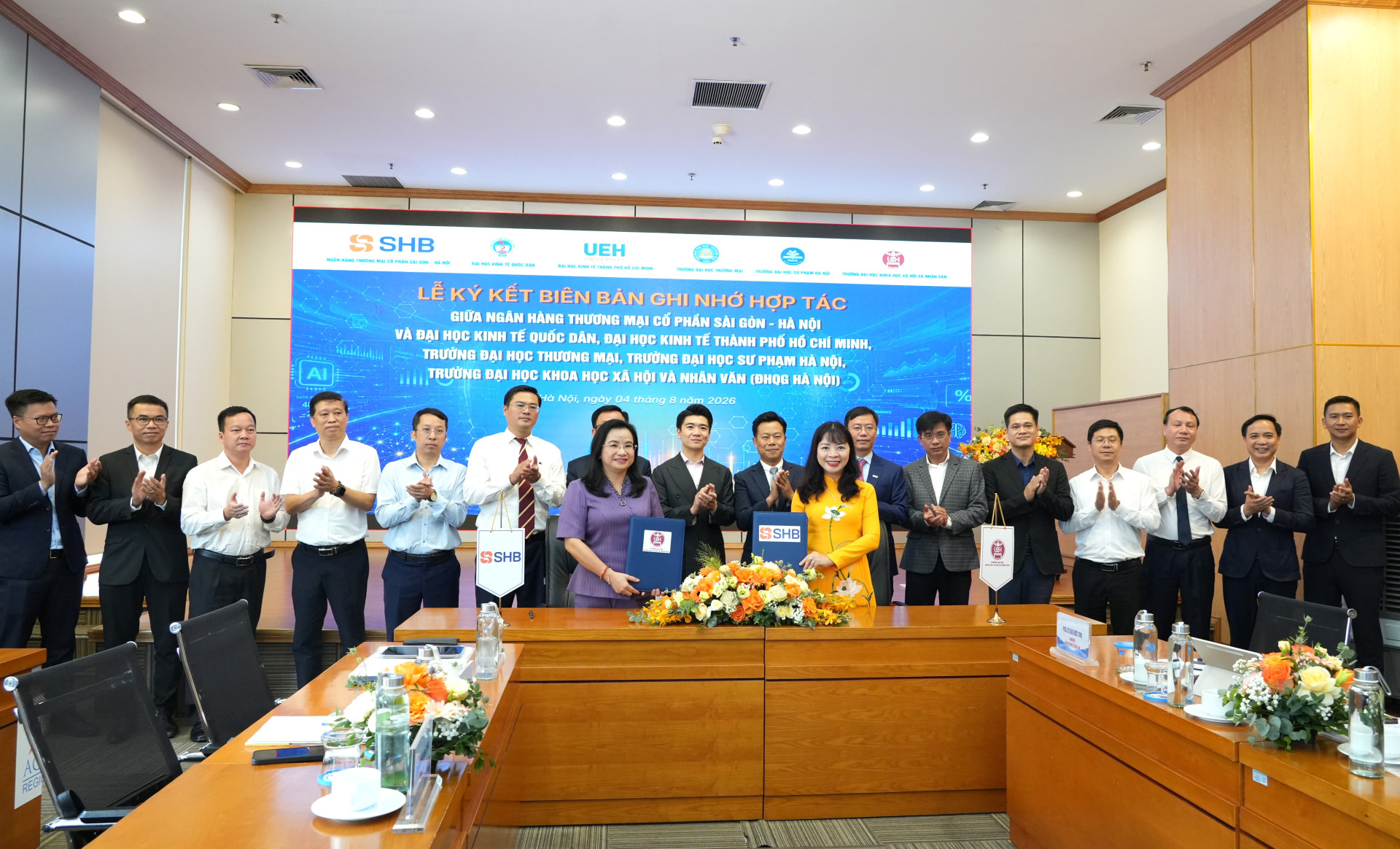
Signing ceremony between the University of Social Sciences and Humanities, VNU Hanoi and Saigon - Hanoi Commercial Joint Stock Bank (SHB)
The signing ceremony for the cooperation agreement aimed at promoting the application of artificial intelligence in the social sciences between five higher education institutions and SHB was successfully held.
Within the framework of the conference, five higher education institutions, including the University of Social Sciences and Humanities (Vietnam National University, Hanoi), National Economics University, Hanoi Pedagogical University, Ho Chi Minh City University of Economics, and the University of Commerce, along with Saigon - Hanoi Commercial Joint Stock Bank (SHB), signed a cooperation agreement to promote the application of artificial intelligence in the social sciences.
This initiative contributes to strengthening the link between higher education institutions and businesses in AI research, development, and application, aiming to create products that serve training, research, and meet practical requirements.
The press reported on the event:
Education and Times Newspaper:Promoting the application of artificial intelligence in the social sciences.
Author:According to the Education and Times newspaper.
Newer news
Older news

