
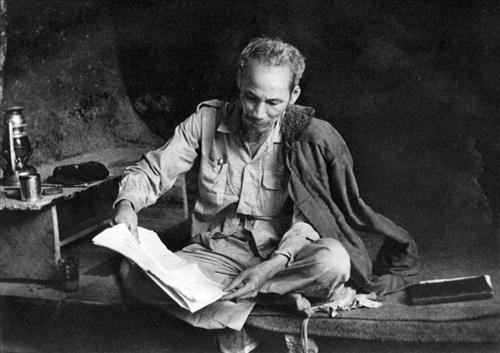
Unlike the field of literary creation, journalism is a political activity aimed at informing and propagating, so the role of the creative subject is revealed discreetly and within the limits of the genre. However, outstanding journalists with unique abilities often creatively express the subject on the page. Ho Chi Minh was a great journalist whose journalistic career spanned many stages over more than 50 years: the period before 1945, the period of resistance against the French, the period of peace and socialist construction in the North, and the period of resistance against the US and national liberation. His journalistic self manifested itself in many capacities: a revolutionary fighter during the period of clandestine activity; President of the country after the August Revolution; a general commanding throughout the two wars of resistance against foreign invasion; a father, an uncle, and an older brother to the broad masses of the people. It can be said that the most prominent subjective imprint in Ho Chi Minh's journalism is the strong spirit expressed through the steely quality of his political commentary. In his essay "Impressions on Reading the Anthology of Classical Chinese Poetry," he also demanded that poetry possess a steely quality. This principle and approach were even more evident in journalism. This steely quality manifested itself in firmness on matters of principle, in the fervent and passionate struggle for truth to prevail, and in the clear and precise demarcation of boundaries. There was no ambiguity, confusion, hesitation, or double-dealing. He spoke directly, forcefully, and clearly, establishing his position and viewpoint. In dialogues and debates with enemies, he employed a sharp, principled, and proactive writing style. In political discourse on major national issues, he used a dignified and majestic style. This heroic and decisive tone is typified in the "Declaration of Independence": "A nation that has bravely resisted the yoke of French slavery for over 80 years, a nation that has bravely stood with the Allies against fascism for several years, that nation must be free, that nation must be independent." And in the "National Call to Arms": "We would rather sacrifice everything than lose our country, than be enslaved." That courage and style were demonstrated through many journalistic genres, including interviews. In his responses to American journalist Harold Isaac, he clearly showed his stance, intellect, and unique identity through his answers:
"Question: In your opinion, what would the negotiations between France and Bảo Đại be like?"
Answer: We don't need to know about that "negotiation."
Question: In your opinion, could the terms of the concessions France made to Bảo Đại be used to revise the relationship between your government and Bảo Đại?
Answer: Between a private individual and a government elected by the entire nation, what constitutes a modification to the relationship?
Question: In the near future, will the Vietnamese forces be able to defeat the French? And given the current situation, when will that defeat occur?
Answer: It is certainly possible to overthrow colonialism; when the time is right, I will tell you.
Question: In your opinion, will the situation in China be beneficial to the independence movement in Vietnam?
Answer: Vietnam's independence has always been thanks to the strength of Vietnam.
...
Question: Are you afraid that Vietnam will become a vassal state of any country?
Answer: No, I'm not afraid.
...
Question: What is U.S. policy in Asia?
Answer: Speaking solely from the Vietnamese perspective, we regret that the United States supplied weapons to France, enabling them to kill our people and destroy our country.
The above are just a few of the 45 questions posed by Harold Isaac; however, even this much clearly reveals Ho Chi Minh's political acumen. The self, forged from this character and political integrity, runs like a red thread throughout Ho Chi Minh's writings. Ho Chi Minh's life was a life of constant struggle for national liberation, social liberation, and human liberation, so a significant portion of his journalistic work consists of condemnations and denunciations of colonialism, polemics against the enemy, appeals to the people, and all bear the indelible mark of an outstanding politician, a self with a dignified character, a strong spirit, and a close, heartfelt connection to life. President Pham Van Dong profoundly summarized the qualities of Ho Chi Minh: “Ho Chi Minh was a man of unwavering faith in the future of the nation, in humanity, and in socialism… Ho Chi Minh was a man of unwavering determination in the struggle against all enemies and all difficulties, and he instilled that unwavering will in the entire Party and the entire nation. Ho Chi Minh was dynamic and flexible in his contributions, wise and serene in spirit and demeanor.” All for the sake of the people, for the common good, in his writings, he neither spoke about himself nor wanted others to speak about him. As To Huu said: He was “like a high mountain peak that hides its form.”
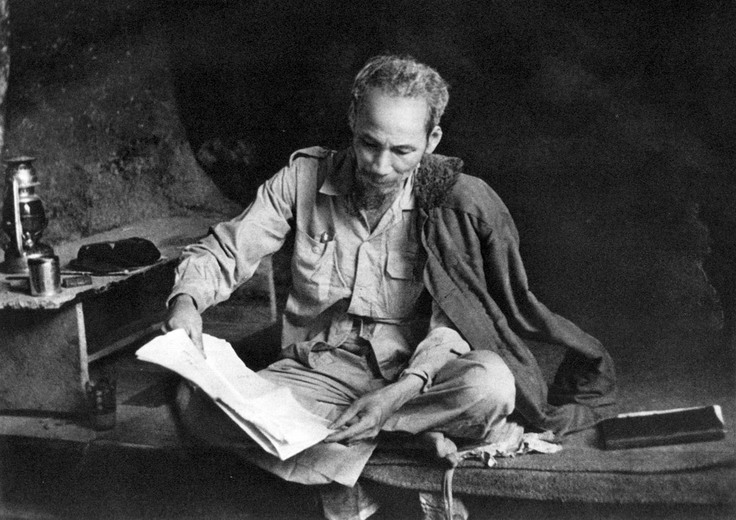
He always demonstrated a spirit of self-criticism and took responsibility for his work: “I must say truthfully, the successes are due to the efforts of our compatriots. The shortcomings mentioned above are our fault. People are not gods; no one is without flaws.” His nature was humility, the humility of a noble person, deeply aware of his own true values and the relationship between himself and the community. Humility was also reflected in his awareness of the limits in life that a person can and cannot reach. Of course, the result of this awareness was not sadness or passivity, but rather proactiveness and self-confidence in himself and others in both collective and individual work. Because of this, people easily perceived in him a calm, profound, and magnanimous attitude. He had a skillful way of handling complex situations and ill-intentioned remarks.
“Some people say, ‘Ho Chi Minh doesn’t know how to do anything, he just thanks one person today and another tomorrow.’ Well! I gladly accept that criticism! Moreover, I hope that I will write many thank-you letters every day, because that proves that our people have enthusiastically practiced the slogan: ‘Those who have money contribute money, those who have strength contribute strength.’”
The qualities of honesty, sincerity, and decisiveness were often revealed in his work. In an interview with a foreign journalist, he wrote: “Since you have asked, I will set aside my humility and answer truthfully: I have no home, no wife, no children; Vietnam is my great family. The elderly of Vietnam are my relatives. The women of Vietnam are my sisters. I have one desire: to make my homeland independent, unified, and democratic. When I achieve that goal, I will return to live as a citizen, enjoying the scenery, reading, and gardening.”
When discussing the creative imprint in journalistic activities, attention must be paid to the characteristics of the creative subject. In particular, the individuality of President Ho Chi Minh gave political commentary a unique character and creative spirit, resulting in writings with soul, where objective elements converge and are infused with subjective elements in a harmonious way.
Since the August Revolution, we have increasingly recognized the sincere, dignified, and heartfelt personality of President Ho Chi Minh through his newspaper articles. He paid attention to his audience (who he was speaking to, who he was writing for, and what issues he was discussing) and the appropriate way to express himself for maximum effectiveness.
On the occasion of the first Mid-Autumn Festival of independent Vietnam, in his capacity as President, he sent a letter to children nationwide. That letter created a special sense of connection and closeness with the children through its story and the familiar way of addressing them: "This is Ho Chi Minh speaking to you," "Old Ho is also happily smiling with you." However, he not only brought them love and affection but also constantly reminded them of their responsibilities in life now and especially in the future. In his "Letter to Students" on the first day of school in the Democratic Republic of Vietnam, he wrote: "Whether the Vietnamese nation will become beautiful and prosperous, whether the Vietnamese people will reach the pinnacle of glory to stand shoulder to shoulder with the great powers of the five continents, depends largely on your studies."
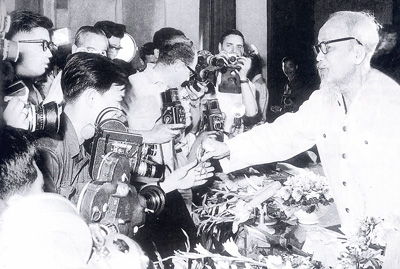
Sincere, heartfelt, and encouraging, motivating, and dedicated to the common cause, these were the familiar characteristics of many articles written by President Ho Chi Minh when he used his own perspective to share, commit to, and encourage something urgent of the time, especially those from the early period of the August Revolution. Faced with a complex political situation, internal enemies, external aggressors, and the ravages of famine and illiteracy, he earnestly appealed to, explained, and encouraged the entire nation to overcome this critical situation.
With food shortages and hunger looming, Ho Chi Minh called on everyone to practice frugality, and he himself set an example: “When we lift our bowls of rice to eat, thinking of those who are hungry and suffering, we cannot help but be moved. Therefore, I propose this to all compatriots throughout the country, and I will practice it first:
Every 10 days, skip one meal, or three meals a month. Donate the rice saved (one bowl per meal) to help the poor.
Thus, the poor will have a meal of vegetables and porridge to eat while waiting for the next rice harvest, so they won't starve to death.” These words reveal the compassion and mutual support, a long-standing tradition of the Vietnamese people. In terms of economic effectiveness, this is only a temporary measure; the fundamental issue is to produce food. In the newspaper "Tấc đất" (A Piece of Land), issue 1, dated December 7, 1945, he appealed:
“Increase production! Increase production immediately! Increase production even more! That is our slogan today. That is our practical way to maintain our freedom and independence. Farmers, move forward! Move forward!”
Both passages deal with the theme of food, yet they represent two contrasting emotional and intellectual currents of a person who is both compassionate and intellectually sharp, but also simple and considerate – a characteristic of Ho Chi Minh's personal style in his political writings.
In a speech to senior military officers, President Ho Chi Minh spoke about the relationship between position and force, a topic both familiar and profoundly philosophical. Speaking of position and force is speaking about the nature and strength of an object in its own context and in its dialectical movement across space and time. President Ho Chi Minh explained this issue in an easily understandable and convincing way: “A one-kilogram weight, when in an advantageous position, its force increases significantly, having the strength to lift an object weighing hundreds of kilograms. That is position overcoming force. We defeated the Americans with less power because our position was very advantageous. Our victory was clear. The enemy's defeat was clear; but they were still very stubborn, unwilling to abandon their plot to invade our country.” Although the text doesn't directly use the word "I," this method of thinking, with its profound philosophical depth, concrete, simple, and flexible imagery, bears the distinct mark of Ho Chi Minh.
Even with a topic, a thought, or a feeling that is mentioned repeatedly, the author always finds a fresh way to express it—one that is both specific, profound, and impactful.
During his time abroad, the author always cherished his love and respect for his homeland. Under the pen name Nguyen Ai Quoc, many literary and journalistic pieces were imbued with this ideology. At the Tours Congress, as a delegate to Indochina, he stated: “Comrades, I should have come here today to contribute to the world revolutionary cause, but with profound sorrow, I come here as a socialist party member to protest the heinous crimes in my homeland.” Present at a major congress, this young man from a colonial country did not lose his composure but proactively expressed his ideas truthfully and profoundly.
During this period, upon reading Lenin's "First Draft of the Theses on the National and Colonial Questions," the young revolutionary found the path to national salvation: "The Theses moved me deeply, inspired me, enlightened me, and filled me with such confidence! I was so moved I almost cried. Sitting alone in my room, I spoke aloud as if addressing a large crowd: 'My suffering and oppressed compatriots, this is what we need, this is the path to our liberation!'" These thoughts marked a fundamental turning point in Nguyen Ai Quoc's political understanding, carrying with them the atmosphere, breath, and aspirations of the entire nation. It was a special moment when the author fully expressed himself and created unique impressions in terms of content and language.
Many other important points that the author has recorded with his unique personal touch could also be mentioned. First and foremost is the letter "A Message to My Compatriots".,Written on June 6, 1941, and signed by Nguyen Ai Quoc, the text highlighted the characteristics of the times. It stated that the enemy's power was declining, making them even more ferocious. The uprisings in Southern Vietnam, Bac Son, and Do Luong, continuing the tradition of their predecessors Hoang Hoa Tham and Phan Dinh Phung, were brutally suppressed. However, this was also an opportunity for liberation, so the author called on the entire nation to unite: “Dear compatriots! Saving the nation is a common cause. Every Vietnamese person must shoulder a part of the responsibility: those with money contribute money, those with possessions contribute possessions, those with strength contribute strength, those with talent contribute talent. As for myself, I will dedicate all my strength to stand with you, for the sake of our compatriots, striving for freedom and independence, even if it means sacrificing my life.”
Nguyen Ai Quoc's letter was a call for the entire nation to awaken and unite to fight the enemy. The letter foreshadowed major social changes to come, both domestically and internationally. It emphasized the opportune moment, analyzed the balance of power between us and the enemy, and affirmed our strength: "The hour of liberation has arrived. Raise high the banner of independence, lead the entire nation to defeat the common enemy."
Following the success of the August Revolution, as President, his position was exalted, his words were commands, and his thoughts were strategic guidance. However, we still encounter a genuine, approachable self, wholeheartedly devoted to the people and the nation. For decades, the people of the South lived under the yoke of the US-backed regime, enduring hardship and suffering. Understanding their plight, he always held the deepest affection for the South: "The image of the South is always in my heart."
And in the final days of his life, he still held profound ideas and feelings about the people and the nation, especially the people of the South:
.jpg)
"In South Vietnam, people under 25 years old are illiterate."Free."Each person, each family has their own suffering, and when you combine the individual sufferings of each person and each family, it becomes my suffering."
Thus, there is oneness between me and life; I am a fraction, or a multiple, of the common life when the individual has completely harmonized and dedicated themselves to it. He affirmed: I dedicate my whole life to my nation.
It is a sacred and noble ideal, representing a life dedicated to the people and the nation.
Ho Chi Minh's journalistic style often revealed a cheerful and witty personality. Before the August Revolution, his literary style was heavily satirical and ironic. Through his writings in "The Indictment of the French Colonial Regime" and essays on the so-called French colonial justice in Indochina, journalist Ho Chi Minh proved to be an outstanding satirical and ironic writer. This satirical and ironic style, a characteristic of Ho Chi Minh, is evident in all his poetry, short stories, and political essays. In many of his political essays, he directly attacked French colonialism with powerful, sharp, well-crafted, and persuasive satire, profound and subtle ideas, and a mocking smile that was both that of an oppressed person and that of someone who held the moral high ground. Satire and irony became Ho Chi Minh's familiar writing style for attacking the enemy. From French colonial rule over the indigenous people to the French colonial invaders, then the American imperialists... for over half a century, the enemy was always present, always restraining, encircling, and invading our country. Under various pseudonyms, from Nguyen Ai Quoc to Chien Si, Tran Luc, CB, D.X., etc., his pen was always in a proactive stance, attacking the enemy. After the August Revolution, in his capacity as President, he did not use satirical or humorous writing in familiar ways, but mainly engaged in polemics with the leaders of the French and American states, directly criticizing the aggressive schemes and crimes of the enemy. However, with the people, he rarely used satirical or humorous language. He often displayed a cheerful and witty demeanor when engaging in dialogue with the masses. One can find in him...,Besides being intelligent, steadfast, and strong, a kind, cheerful smile easily creates a warm and harmonious atmosphere among people. If it's a criticism, the listener is more receptive. If it's a witty smile, everything becomes even more harmonious. In a conversation with officials of the Thanh Hoa Provincial Party Committee, using a playful, witty yet stern tone, he criticized the practice of excessive feasting during meetings: “Although ‘feasting and drinking’ has decreased compared to before, it is still widespread. The people have to pay for the officials to eat, but they themselves don’t get to eat; this means they are not helping the officials to live long and prosperously. In one place I visited, the officials slaughtered an entire cow and said it was to ‘entertain President Ho Chi Minh’; thus, they ‘ate’ President Ho Chi Minh as well. We must actively rectify this.”
In response to Comrade Martha Rohas - a reporter for the newspaper.Granma(Cuba), who has a very witty and humorous way of speaking that easily resonates with people and creates a very concrete educational effect: “Currently, women are undertaking tasks and holding leadership positions they never held before. We can meet many women who are currently heads of cooperatives. Do you know, comrades, that women are even more successful than men, because when men achieve success in their work, they often organize celebrations and feasts, sometimes spending more than the extra money they earned. Women don't do things like that.”
"Don't tell the men what I just said, but it's true that women do a very good job."
It can be said that in his writings, Ho Chi Minh paid close attention to his audience, the people he conversed with, and maintained an appropriate manner of interaction. He respected the culture of conduct in his writings and speeches, but without falling into formality or pretense. The warmth and closeness, while still adhering to cultural norms of conduct, gave his writings a unique appeal and charm.
Through thousands of articles, the identity and imprint of the creative subject can be revealed in many ways. Sometimes it's through the author's direct words. But more commonly and broadly, the characteristics of the author's thinking, methods, style, language, etc., are deeply ingrained in the writings. Chairman Pham Van Dong commented:
Regarding Ho Chi Minh's thinking: "A prominent feature in Ho Chi Minh's theoretical thinking is his systemic perspective," and "an extremely important point to emphasize is his style, his ability to adapt to historical developments."
Regarding the doctrine of humanity: "In Ho Chi Minh's revolutionary doctrine, the central theme is humanity," "which is communist humanism," and in the practical guidance of the revolution, it is "trusting in the people, relying on the people, nurturing the people's strength, and developing the people's capabilities," "the essence of Ho Chi Minh's humanity is the essence of Vietnam, the essence of revolution, the essence of communism, the essence of humanism..."
Regarding methodology: "Ho Chi Minh brought theory to life in practice and imbued practice with theory." Ho Chi Minh was both a theorist and a practitioner of Marxism-Leninism. These qualities and characteristics are revealed to varying degrees through his works, contributing to the unique identity and imprint of Ho Chi Minh in his writings.
The identity and imprint of the creative subject are not confined or concentrated solely in the individual journalist Ho Chi Minh, but rather are a common example that can and has been replicated in many revolutionary journalists.
Author:Professor, People's Teacher Ha Minh Duc
Newer news
Older news

