The guests participating in the seminar included: Prof. Dr. Trinh Hong Son - Deputy Director of Viet-Duc Hospital, Director of the National Organ Transplant Coordination Center; Assoc. Prof. Dr. Nguyen Thi Minh Thai - lecturer at the Faculty of Journalism and Communication; and journalist Vu Manh Cuong - Deputy Director of the Department of Communication and Emulation and Commendation, Ministry of Health.
The seminar served as a forum to provide the latest information on the alarming increase in cancer rates in Vietnam. According to the report, Vietnam currently ranks second in the world for cancer incidence. Statistics from the national cancer prevention project show that 80,000 people die from cancer each year in Vietnam, and 150,000 new cases are diagnosed. Health insurance payments for cancer treatment reach hundreds of millions of dollars annually. In addition, the guests also shared information about the increasing need for organ transplantation – a crucial solution in Vietnam for treating patients with incurable diseases.
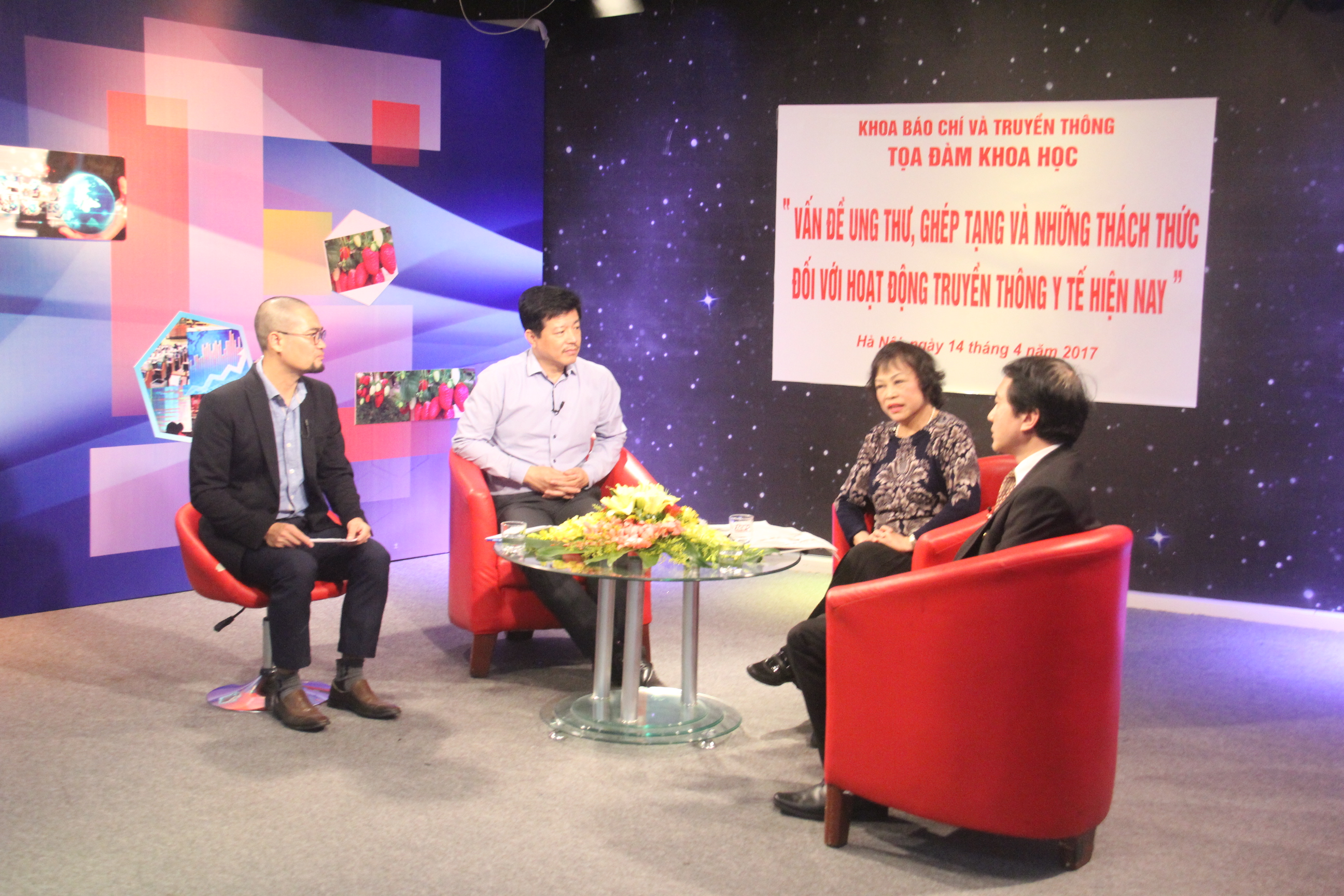
From left to right: Journalist Nguyen Cao Cuong - Deputy Director of CMP, journalist Vu Manh Cuong, Assoc. Prof. Dr. Nguyen Thi Minh Thai, Prof. Dr. Trinh Hong Son
From various perspectives, speakers emphasized the crucial role of media in disseminating accurate and timely information in the field of healthcare, raising public awareness and understanding of health care, and fostering positive cooperation between the medical sector and the public in combating disease and improving quality of life.
Journalist Vu Manh Cuong argues that the current situation persists where newspapers report hastily and inaccurately on medical activities, significantly impacting the work of doctors, nurses, and hospitals, as well as eroding public trust in the healthcare system. He cites the case of some newspapers reporting incompletely on child deaths due to vaccination, leading many parents to stop vaccinating their children out of fear of risk. This could potentially lead to outbreaks of diseases in the community in the coming years that could easily be controlled through vaccination. Vu Manh Cuong also points out that the field of healthcare is a broad and specialized area, challenging journalists to possess a certain level of knowledge in order to gain a thorough understanding of the events that occur.
From an insider's perspective, Dr. Trinh Hong Son stated that he and many colleagues have been deeply saddened by some inaccurate or biased information reported by the press regarding the treatment of patients. This forces doctors to both find ways to treat patients and worry about protecting themselves from public opinion. He also suggested that the media should focus on disseminating positive and practical information, for example, explaining to the public the humanitarian significance of voluntarily donating organs from brain-dead patients to give other patients a chance at life.
From the perspective of a cultural and media researcher, Associate Professor Dr. Nguyen Thi Minh Thai believes that health communication needs to be closely linked to culture, and that communication in the health sector must be humane and in line with Vietnamese culture. She explains that the limited supply of organs in Vietnam stems from the cultural beliefs about life and death among Vietnamese people. This creates hesitation among the population regarding organ donation. Understanding this allows journalists to communicate effectively and effectively, removing this psychological barrier, thereby not only supporting the healthcare sector in its professional work but also contributing to giving many people a chance to live.
The guest speakers also suggested that for effective communication in healthcare, or in other specialized fields, university students should be taught specialized courses on this topic right from the initial training stage. Sharing her thoughts on this matter, Associate Professor Dr. Dang Thu Huong, Head of the Journalism Department, stated that the department's curriculum includes a specialized journalism course to provide students with knowledge and skills in journalism and communication within specific fields. She added that today's seminar is part of a roadmap to develop high-quality and effective specialized journalism courses that are relevant to real-life needs and practices.
Author:Thanh Ha
Newer news
Older news

