
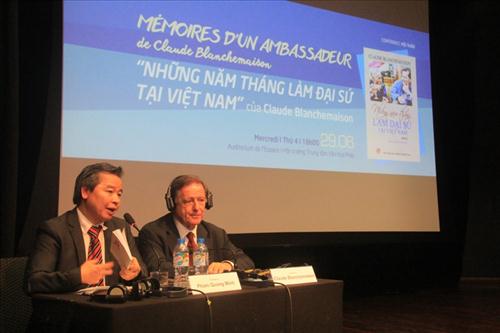
He spoke with great enthusiasm. The time allotted for him to introduce his newly released book to a large audience of both French and Vietnamese, as set by the L'Éspace Center, was only 40 minutes, but his presentation lasted over an hour. Yet, the entire L'Éspace hall remained completely silent. Initially, I wondered: what kind of love could motivate a foreigner in his sixties, who had been away from Vietnam for over 20 years, to recount his memories of the country with such passion and enthusiasm? But then, after listening to his stories, and especially after carefully reading his memoir, I found it quite captivating.My years as ambassador to VietnamFrom his book published by the National Political Publishing House in Hanoi in March 2016, I gradually realized: indeed, Claude Blanchemaison must have possessed an intense love for the people and country of Vietnam to speak with such beautiful sentiments.
My generation, some Vietnamese people from over 20 years ago, when the country was still facing many difficulties (the 1990s), still remember the French ambassador with a very "unusual" name:Ambassador White HouseKnowing the basics is one thing, but understanding the thoughts and actions of a foreign politician, especially one from France, a country with which Vietnam had previously experienced some strained relations, is even more difficult. During the two and a half hours of listening to his reflections and reading the book he had just introduced, many in the audience were impressed:How can a foreign ambassador love Vietnam so much?
In fact, Claude Blanchemaison did not boast about his "achievements" in his presentations or in his book. What he said and wrote was extremely simple and sincere. Blanchemaison officially arrived in Hanoi in the spring of 1989, a time when Vietnam was still under embargo, its economy was extremely difficult, and some friendly nations were coldly indifferent, even turning their backs and becoming hostile. France was one of the few countries that "broke the rules" and shook hands with Vietnam. Indeed, during his years as the French ambassador to Vietnam, Blanchemaison did not fully comprehend the "complexities" of the country he was visiting. He recounted that in his very first year as ambassador, coinciding with France's solemn celebration of the 200th anniversary of the 1789 Revolution, the new ambassador overcame all difficulties to welcome Vietnamese and international friends in the not-so-spacious French Embassy at 57 Tran Hung Dao Street, maintaining the warm and thoughtful hospitality typical of the French. As for myself, I still remember attending the ceremony with some colleagues from the University of Hanoi at the time, enjoying authentic French wine served in wooden barrels, which the ambassador mentioned in his memoirs had painstakingly ordered from Tourraine, his hometown. He recalled his early days in Hanoi, saying that despite anticipating difficulties, the ambassador was still "extremely worried. I had only been in Hanoi for a few days, with the general instruction to create conditions for France and Vietnam to draw closer together."
More than 20 years after his first arrival in Vietnam, Claude Blanchemaison has written two books about Vietnam. The first was about General Vo Nguyen Giap. It was in this second book that he fully dedicated his affection to the people and country of Vietnam, which he deeply loved. The book is less than 160 pages long. An elderly audience member (presumably someone who worked with Blanchemaison during his time as ambassador) complained, "I was somewhat disappointed because I thought it would be four or five times thicker." But co-presenter Pham Quang Minh asserted that, though the book is thin, it carries the weight of the ambassador's entire career. He explained that, although it only recounts the memories of a four-year term, Blanchemaison began his ambassadorial role at a time of great difficulty. At that time, Vietnam had only been undergoing reforms for about three or four years, facing numerous difficulties and dramatic events: the Gulf War, the collapse of the socialist system, including the Soviet Union, the betrayal of its great friend and neighboring country, and Vietnam being surrounded and embargoed by the world. The difficulties were so great that, as Claude Blanchemaison recounts a very interesting detail, even at the Embassy, the telephone used for communication was a manual rotary dial, requiring someone to always be on duty, unlike the modern telephones of today. Even as the Ambassador of a Western country that was no longer poor, the Ambassador was still unable to do anything about it.
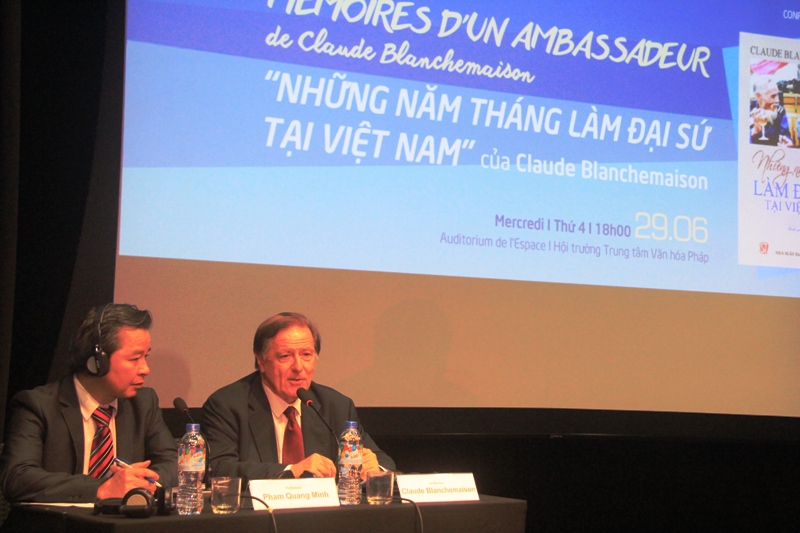
My years as Ambassador to VietnamThis collection comprises 23 fascinating and touching stories that the "White House" ambassador experienced not only during his four years as ambassador, but also, beyond his four official years in Vietnam, Claude Blanchemaison returned to Vietnam a couple of times. Furthermore, it took over 20 years of looking back from afar, and a heart filled with a deep love for Vietnam, for a Frenchman like him to express such positive feelings about his homeland. Those fortunate enough to attend his panel discussion with Associate Professor Pham Quang Minh at L'Éspace on June 29th surely understood the "genuine heart" and the passion for his work that Blanchemaison had during those years. From the recollections recounted by the person involved, I know that the stories he wrote and told are entirely credible. They are genuine thoughts. Blanchemaison revealed that, initially, when the idea of going to Vietnam first crossed his mind, he knew little about the country, and many people tried to dissuade him, but he still decided to go. He explained his decision, which some considered "reckless," in a very simple way: "And that choice was quite logical in my desire to explore Asia, because two years earlier I had been appointed Deputy Director of the Near East Division, much to the surprise of most of my colleagues, and the classic choice had been made. I would leave, and my destination would be Vietnam."
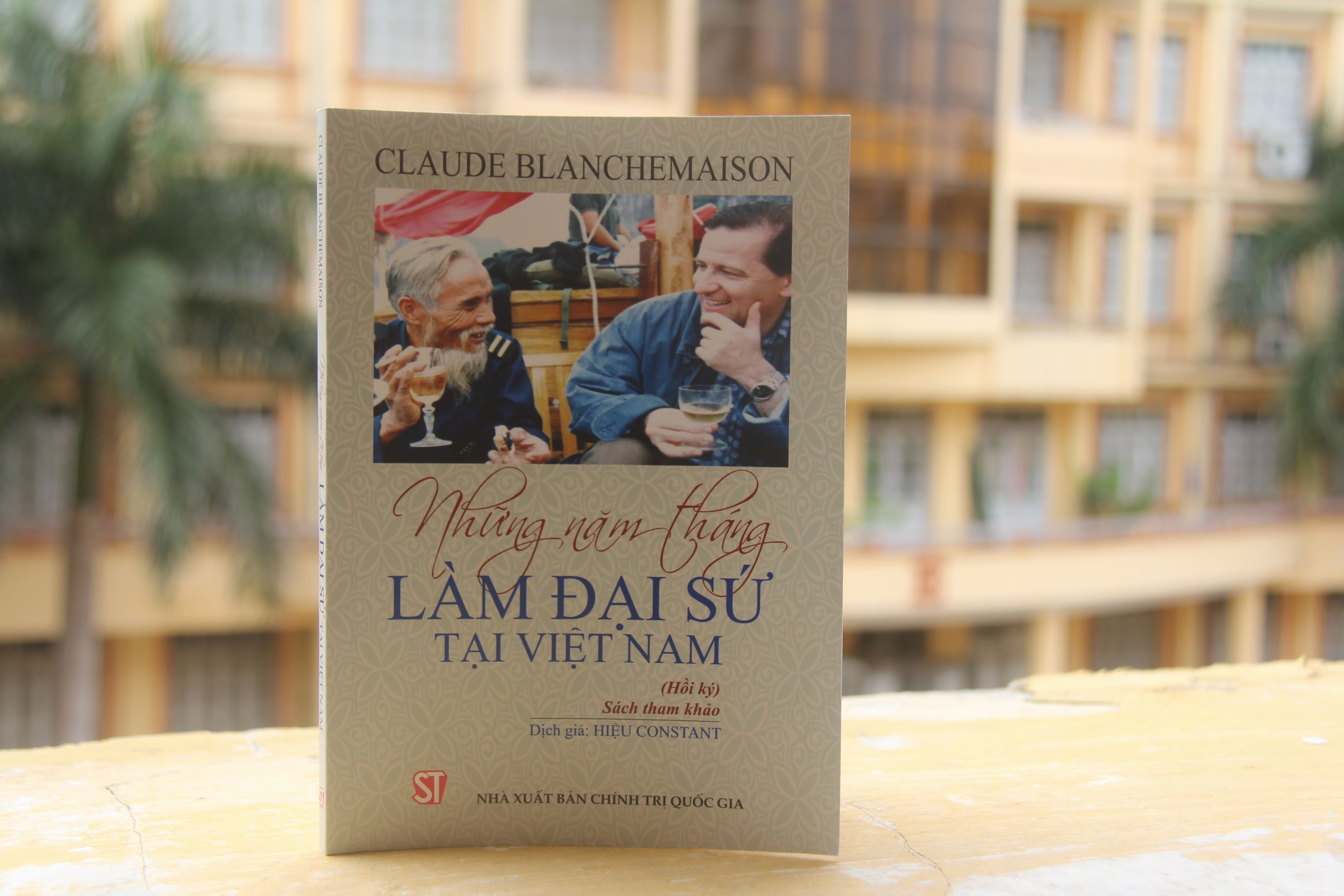
He later confirmed that this choice was entirely correct. In 1989, Blanchemaison, though not exactly young, was certainly not old: 45 years old, not exactly 20, but with the spirit of someone who loved a bit of adventure and risk (of those in diplomacy), and who enjoyed "being caught in the storm," was understandable. Blanchemaison recounted that on his first day in Hanoi,transitHaving flown from Bangkok on a Vietnam Airlines Tupolev (a very old Soviet-made aircraft), and having previously attended a champagne party hosted by his French ambassador there, he couldn't help but feel a little uneasy. Was it perhaps "a bad omen"?
But that wasn't the case. Upon arriving in Hanoi and taking up his duties as ambassador, "a mountain of things to worry about" left him no time to think outside of his official duties. He recounted that the French Embassy, then and now, was repurposed from an old, very poorly equipped, inadequate, and inefficient building. Even in early 1989, Hanoi was still extremely difficult. To buy anything, some foreign ambassadors in Hanoi had to go all the way to Bangkok. "There were very few cars on the streets, no taxis, many rickshaws and thousands of bicycles," "electricity was frequently cut off, even to embassies." The people of Hanoi had long been accustomed to hardship. "Thirty years of war had exhausted the entire country." But the ambassador, despite being accustomed to working in comfortable conditions, remained undeterred. He tirelessly went everywhere, doing everything he could, even "orchestrating" an inspection team from France. Thanks to this, the embassy grounds were equipped with essential supplies for work. But most importantly, as Claude Blanchemaison recounted, it was the Vietnamese people themselves who gave him confidence and inspiration in his work. The first person he spoke of with great enthusiasm was General Vo Nguyen Giap. He had known the General's name for a long time, but it wasn't until he arrived in Hanoi as the French Ambassador that he had the good fortune to meet him. He recounted: "Immediately, the man I met impressed me with his small stature, lively eyes, and broad forehead prominently displayed beneath a head of pure white hair –A volcano under the snow."That's what the journalists said." During his four-year term, Claude Blanchemaison witnessed not just once the heroic General's visit, but also in subsequent years. Perhaps because of his deep love for Victor Hugo's country, the General visited Vietnam every year on National Day, July 14th. He chatted warmly with the new Ambassador and everyone else. He even once asked to borrow some of his favorite French books to take home and read. This admiration for the hero of Vietnam fueled the enthusiasm of the French Ambassador, who was only in his early 40s. Perhaps that's why he began to love Vietnam and wanted to do something to help this small country that had suffered so much pain and loss from wars caused by larger nations.
That's right! In the 23 stories of the memoir...My years as Ambassador to VietnamClaude Blanchemaison also recounted many other touching stories, which I can hardly list all in this short article. For example, the story of his connections with French politicians to help bring Vietnam and France closer together; the story of how, during his four-year term, three French film crews came to Vietnam to make films that allowed people to look back at the historical years of French-Vietnamese relations (three films).Indochina, Dien Bien PhuandLover(French cinema was completed during this period). Most notably, perhaps, is the first visit of a Western politician, President François Mittérant, to Vietnam, in the final year of Blanchemaison's term, in early February 1993. This important trip would also lead to Vietnam's first-ever hosting of the Francophonie International Conference in 1997, with 75 foreign heads of state in attendance, elevating the country's international standing after a period of embargo and blockade…
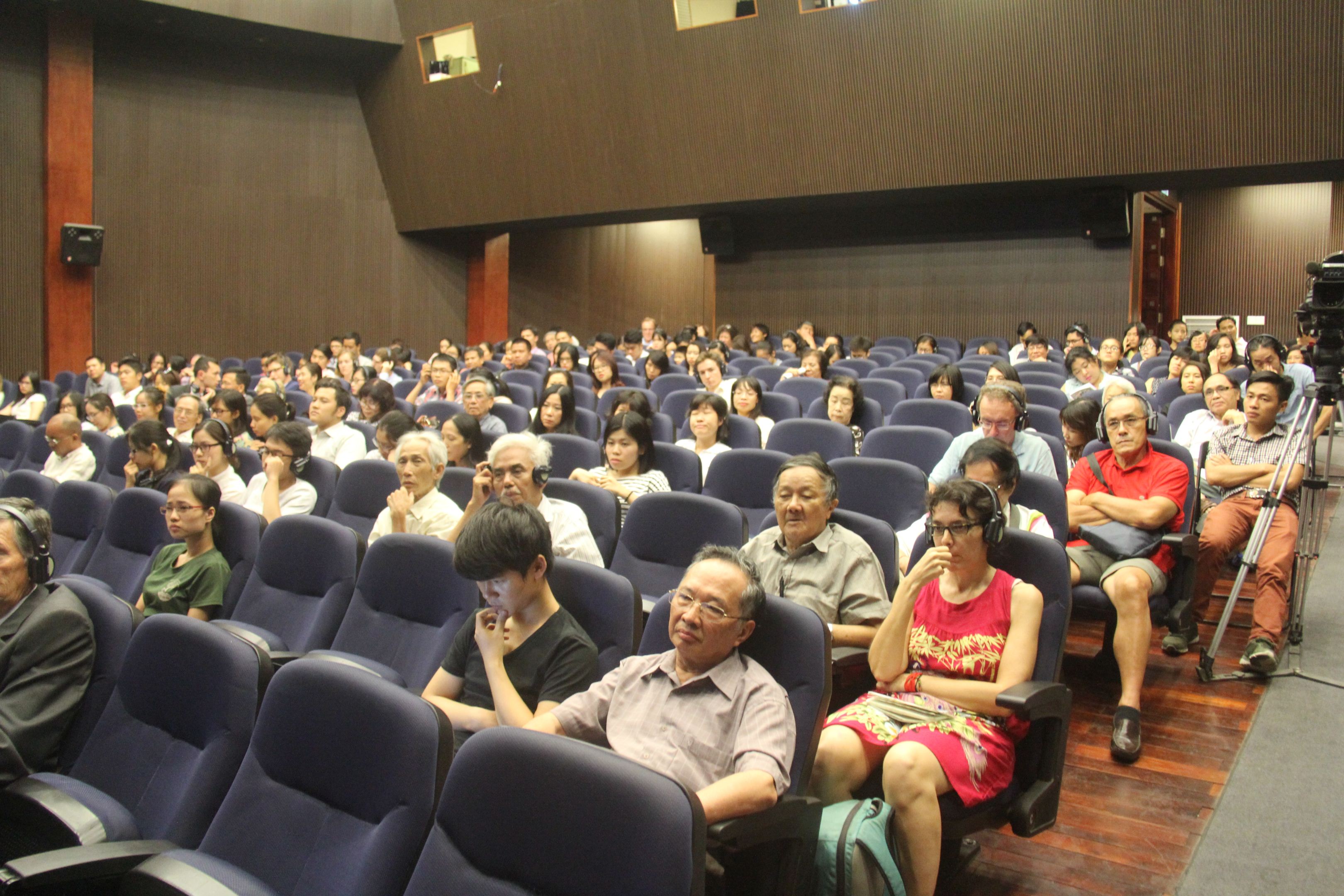
View of the auditorium
And there are many other stories, the most impressive being the one titled "The Country That Gave Birth to Wonderful Women," in which the author mentions female heroes in Vietnamese history (the Trung Sisters, the Trieu Sisters). At this point, Associate Professor Dr. Pham Quang Minh humorously compares France, so "great," to having only one female hero, Jean d'Arc, while Vietnam has "Two Trung Sisters." Furthermore, he mentions the Vice President of Vietnam during Blanchemaison's ambassadorial term, Ms. Nguyen Thi Binh, who could speak and understand French fluently, and whom he greatly admired; and the graceful women in their traditional ao dai dresses that Blanchemaison had the opportunity to meet and interact with over the years… This led Associate Professor Dr. Minh to ask: what is the underlying reason why the French Ambassador "cherishes Vietnamese women so much?"
It's a pity that the time available for an evening at L'Éspace wasn't enough for the ambassador to fully express his feelings about the country and the people of Vietnam he had met and interacted with over the years. At the end of the discussion, an elderly audience member asked a rather "sensitive" question: perhaps, being a diplomat, the ambassador's "subtlety" prevented him from revealing everything, only retaining the beautiful aspects of Vietnam and its people in his book. The ambassador didn't answer this question directly, but I secretly thought: life is always like that; when you love, and truly love, you only see the good things. That's quite normal. But if you read the final lines of Claude Blanchemaison's memoir, I think those "doubts" would no longer have any reason to exist. Claude Blanchemaison truly loves Vietnam. He affirmed:
"To conclude my book, I would like to share with my readers the reasons why I have come to deeply love Vietnam."
First, I respectfully bow my head in admiration of the courage that the Vietnamese people have demonstrated throughout their long history, whether those chapters were painful or glorious. And it is especially significant to think of all the women of this country, who, amidst the turmoil and upheavals of war as well as in the development of peacetime, have always known how to demonstrate their admirable strength.
Next, I would like to pay my respects to the rich culture of this country, which has skillfully combined the development of individual identity with a great deal of external support, leading to modernity and economic growth. This is evident in its literature, as well as in the arts of theater, music, and film.
I also want to express my admiration for the wisdom and wit of the Vietnamese people, whose humor and critical thinking bring laughter to them, as well as to me and my friends, through each story.
It's also because of the rich heritage and cuisine. And of course, it's also because of the captivating beauty of the landscapes and the idyllic atmosphere of both the countryside and the cities.
But among the reasons I've mentioned above, I must confess something to my readers, something that those who know me might confirm: I am truly fascinated by the intelligence, beauty, and sensitivity of Vietnamese women.”
Author:Tran Hinh, Photo: Tran Minh
Newer news
Older news

