
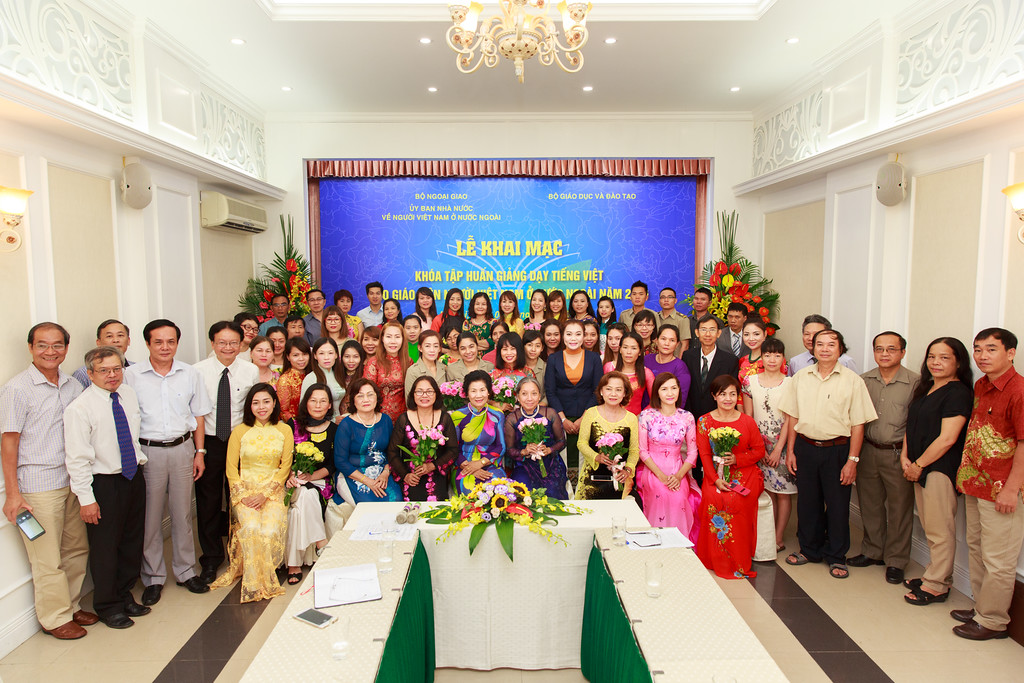
The training course is an annual event, implemented since 2013, aimed at improving the Vietnamese language teaching capacity of teachers abroad. This year, the number of participants is the largest ever, with nearly 60 people from 13 countries and territories around the world, including Cambodia, Laos, Thailand, Taiwan (China), Switzerland, the Czech Republic, Spain, France, Italy, Belarus, Germany, Hungary, and Malaysia.
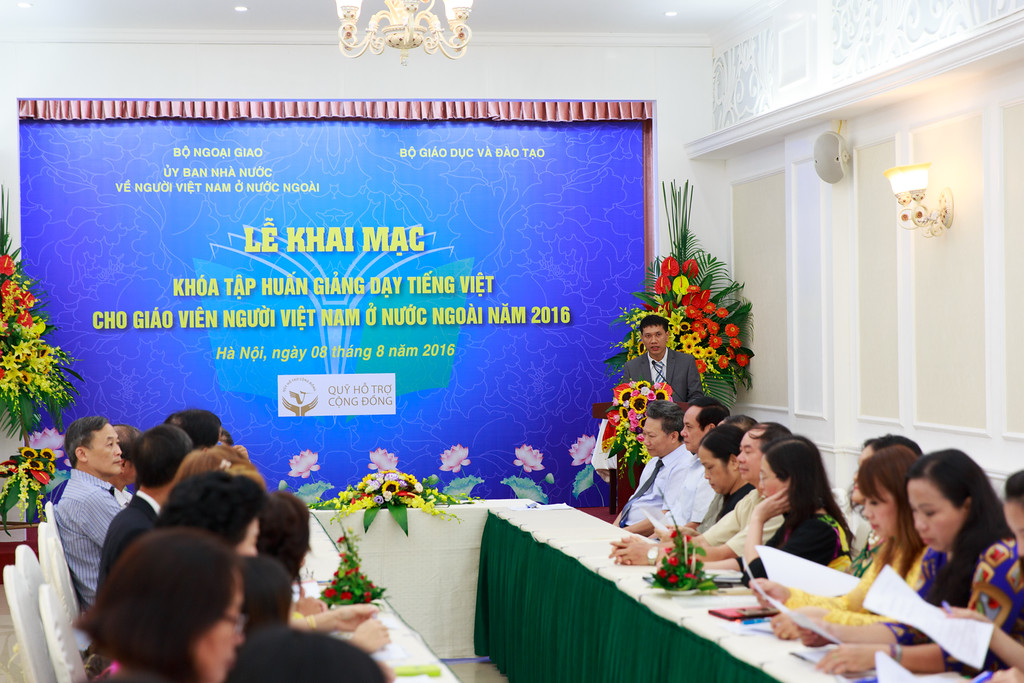
Photo: Jackie Chan
Responding to an invitation from the State Committee for Overseas Vietnamese, this year, the Faculty of Vietnamese Studies and Vietnamese Language has three experts participating in teaching at this course: Assoc. Prof. Dr. Nguyen Thien Nam (Head of the Faculty of Vietnamese Studies and Vietnamese Language), Assoc. Prof. Dr. Vu Van Thi (Head of the Department of Vietnamese Linguistics, Faculty of Vietnamese Studies and Vietnamese Language), and Dr. Nguyen Thi Thuan (Head of the Department of Comparative Studies, Faculty of Vietnamese Studies and Vietnamese Language). The course content focuses on: Methods of teaching and lecturing Vietnamese; Vietnamese phonetics and methods of teaching Vietnamese phonetics; Vietnamese vocabulary and methods of teaching Vietnamese vocabulary; Vietnamese grammar and methods of teaching Vietnamese grammar; Introduction to Vietnamese language teaching textbooks...
Besides core activities such as professional development and exchange of teaching methods, trainees also participate in other practical activities such as observing classes at schools in Vietnam and visiting the country's scenic spots.
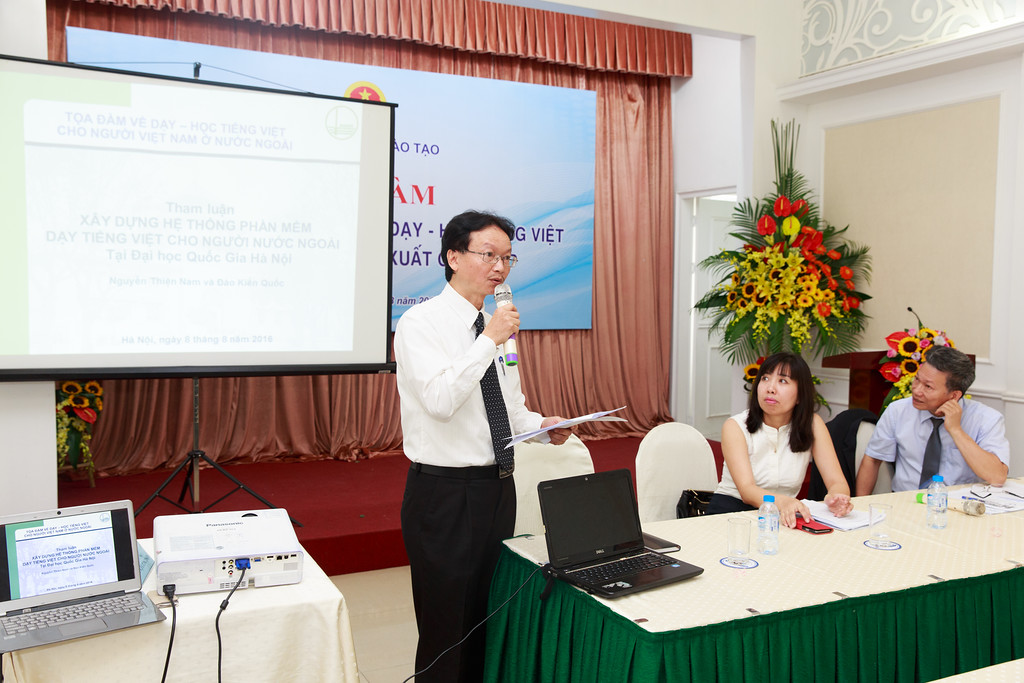
Associate Professor Dr. Nguyen Thien Nam presented his paper at the seminar.
Associate Professor Dr. Nguyen Thien Nam shared: "This is an extremely meaningful activity of the Committee for Overseas Vietnamese Affairs and the Ministry of Education and Training, because for the Vietnamese community abroad, the Vietnamese language is a crucial bridge to their homeland. Through the Vietnamese language, culture and national identity will be preserved and promoted in Vietnamese communities all over the world. Therefore, for many years, the lecturers of the Faculty have always accompanied the program, with the desire to impart the most basic, necessary, and up-to-date knowledge and teaching methods of the Vietnamese language to overseas Vietnamese lecturers."

Experts from the Department of Vietnamese Studies and Vietnamese Language, Hanoi University of Social Sciences and Humanities, have been involved with this program for several years. These lecturers are responsible for the professional content of the training course.
He also stated that teaching Vietnamese abroad currently faces many limitations. With approximately 4.5 million Vietnamese expatriates overseas, the number of people participating in Vietnamese language learning is still not large. The lack of direct immersion in a daily Vietnamese-speaking environment makes teaching and learning Vietnamese even more difficult. Textbooks for teaching Vietnamese abroad are also scarce, the number of qualified Vietnamese teachers is limited, and the classification of Vietnamese language proficiency levels remains problematic...
In that context, in 2015, experts from the University of Social Sciences and Humanities, with the Faculty of Vietnamese Studies and Vietnamese Language as the core, undertook the task assigned by the Ministry of Education and Training: to implement and complete the Vietnamese language proficiency framework for foreigners. This is a six-level framework, approved by the Ministry of Education and Training on September 1, 2015, and effective from October 16, 2015. This framework serves as a unified basis for assessing the Vietnamese language proficiency of foreigners; as a basis for developing curricula and teaching plans, compiling or selecting learning materials, and establishing criteria for testing and evaluation at each educational level and training program. Based on this framework, teachers and lecturers select and implement content, teaching methods, testing, and evaluation to support learners in achieving the requirements of the training program. The implementation of this competency framework is also significant in promoting cooperation, educational exchange, and recognition of diplomas and certificates with countries using the Common European Framework of Reference for Languages (CEFR).
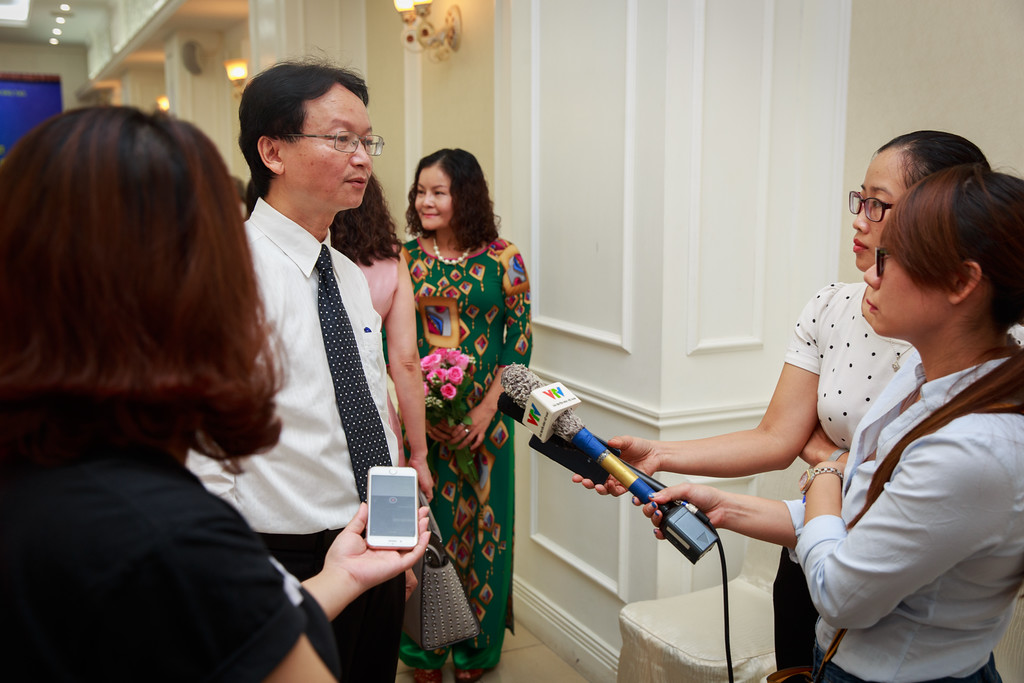
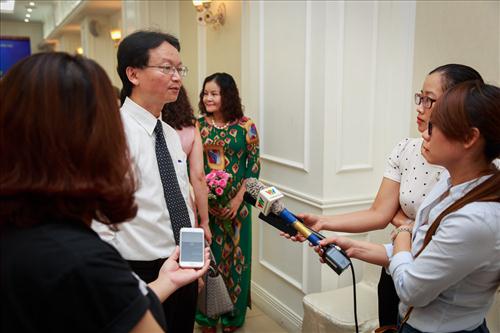
Associate Professor Dr. Nguyen Thien Nam answers media interviews about teaching Vietnamese abroad.
Along with this competency framework, the Faculty of Vietnamese Language and Literature has also compiled a six-level Vietnamese language exam format, which was signed and issued by the Ministry of Education and Training on June 21st.This comes as of 2016. From now on, the learning and assessment of Vietnamese language proficiency in Vietnam and around the world will have a standardized framework to apply.
Also at the seminar on the current state of Vietnamese language research and teaching – an activity within the framework of the training course – Assoc. Prof. Dr. Nguyen Thien Nam and MSc. Dao Kien Quoc (Vietnam National University, Hanoi) presented the "Project to strengthen online Vietnamese language teaching for Vietnamese people abroad". The presentation also contributed to supporting the inevitable trend of online Vietnamese language teaching today, with its undeniable advantages. These are the experiences that the experts of the University have gained while implementing the project "Building a software system for teaching Vietnamese to foreigners at Vietnam National University, Hanoi".

This year, nearly 60 delegates from 13 countries and territories participated in the training course – the largest number ever.
According to the plan, the course participants will have a class observation and professional exchange session at the Faculty of Vietnamese Language and Television on Monday morning (August 15, 2016).
Author:Thanh Ha-Thanh Long
Newer news
Older news

