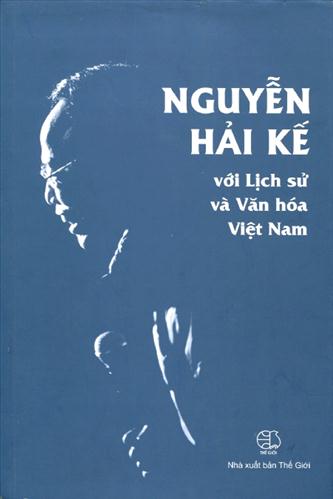
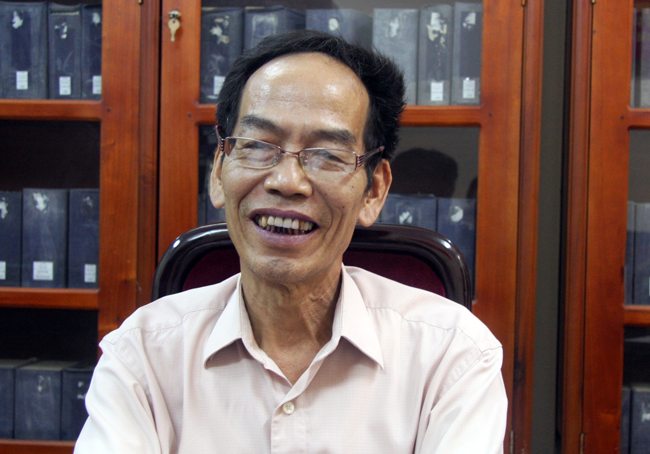
The late Associate Professor, Doctor of Science, Meritorious Teacher Nguyen Hai Ke (former Head of the Department of History, University of Social Sciences and Humanities)/Photo: Bui Tuan
During his lifetime, Associate Professor Dr. Nguyen Hai Ke published over 100 research works in various forms such as books, research papers, and presentations at scientific conferences both domestically and internationally. After Associate Professor Nguyen Hai Ke's death, his colleagues and students in the Department of History, Cultural Studies, and Vietnamese Cultural History collected and selected 54 of his most representative articles, focusing on the two main research areas that Associate Professor Nguyen Hai Ke pursued: History and Culture, to compile into a book titled "Nguyen Hai Ke and the History and Culture of Vietnam.Therefore, this book is considered a collection of research works by Associate Professor Dr. Nguyen Hai Ke on the topic of Vietnamese History and Culture. The book was completed and published by The Gioi Publishing House in 2014. Recently, the work received the Hanoi National University Science and Technology Award for the period 2011-2015.
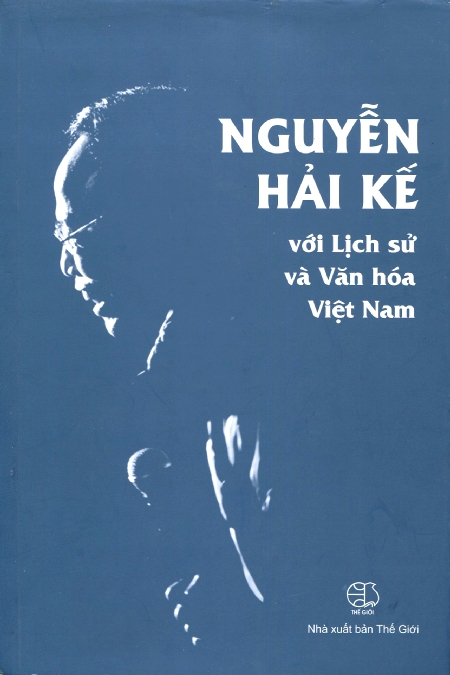
This project recently received the Hanoi National University Science and Technology Award for the period 2011-2015.
The book consists of three parts.
Part 1:From/and historical background,This book comprises 16 articles on traditional Vietnamese historical issues that Associate Professor Dr. Nguyen Hai Ke has spent considerable time researching and evaluating. Many topics covered in the first part, while not new, offer insightful and insightful interpretations from Associate Professor Dr. Nguyen Hai Ke's perspective and approach to various aspects of the Ly, Tran, early Le, Mac, and later Le dynasties, such as: issues concerning the Ly dynasty's homeland and its border region policies; determining the location and scale of the Thien Truong royal palace of the Tran dynasty and its role – the second capital of the Tran dynasty, second only to Thang Long – in the social, political, and historical life of Dai Viet in the 13th and 14th centuries; resistance wars against foreign invaders during the Tran and Le dynasties; land reclamation and reconstruction in Dai Viet after the war; and trade and commerce…
Not only focusing on the topic of wars against foreign invaders like many other historians, Associate Professor Dr. Nguyen Hai Ke also pays special attention to the complex and sensitive post-war period, including lessons learned from the post-war era and the policy of national reconciliation and harmony after the victory against the Ming dynasty – a topic rarely addressed by researchers. Specifically regarding the Nguyen dynasty, the articles in the book "Nguyen Hai Ke and the History and Culture of VietnamThis discussion examines the existing problems faced by Vietnamese Confucian intellectuals in the 19th century, as well as the shortcomings of the Vietnamese examination system during this period.
Part 2:Coming and culture: Theses, some spaces,This collection includes 28 articles by the author on Vietnamese cultural history, such as: the relationship between culture and the natural environment; Vietnamese cultural identity, the nature of Vietnamese patriotism, the source of Vietnamese strength; issues related to Confucianism and Confucian studies in Vietnam (characteristics, origins of Confucianism, the nature of Confucian education, etc.); traditional Vietnamese village culture; the worship of deities in the Northern Delta; cultural, social, and political issues of various regions: Thang Long - Hanoi; Hai Phong, Nam Dinh, Thanh Hoa, Southern Vietnam, etc.
Occupying a significant portion of Part 2, the author frequently addresses the topic of cultural contact and exchange to help readers better understand the identity and character of Vietnamese culture in various aspects, such as the history of the formation of Vietnamese writing, cultural contacts and exchanges between Vietnam and India, China, and Western civilization, the forms, nuances, and fields of contact in Vietnamese culture, and the role of Thang Long - Hanoi as a bridgehead in the process of cultural contact and exchange.
Part 3:Some faces,This collection comprises 10 articles about historical figures from ancient dynasties (Ly, Tran, Early Le, Later Le, etc.) and the present day. These include kings Le Hoan and Ly Cong Uan; renowned officials who made significant contributions to the court such as Nguyen Trung Ngan and Nguyen Trai; the famous and learned Zen master Khuong Viet Ngo Chan Luu; the historian Ngo Si Lien; Nguyen Nghiem, who contributed to educational reform during the Le-Trinh era; the scholar Nguyen Binh Khiem; and young talents of Thang Long - Hanoi.
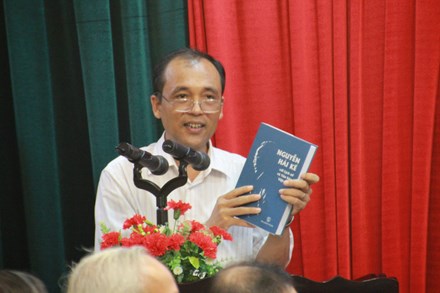
This book was compiled, edited, and published by the faculty of the Department of History. It is not only a valuable scientific work but also an expression of the respect and affection of generations of colleagues and students of the Department for their deceased teacher.
Pictured is Associate Professor Dr. Vu Van Quan - Head of the History Department - at a book launch in 2014.
In the historical and cultural studies of Associate Professor Dr. Nguyen Hai Ke, his interpretations of thorny historical issues are often not based on emotion or speculation, but rather on the foundation of systematic research methods. He is passionate about applying interdisciplinary, multidisciplinary, and transdisciplinary thinking and research methods in his studies. Reading the articles in this book, readers will find that the scientific value of the writings is built upon specific research methods such as: using the results of archaeological research, Han Nom inscriptions, village regulations, family genealogies, and documents from official and unofficial histories… to decipher issues of traditional history, culture, and society. Associate Professor Dr. Nguyen Hai Ke frequently uses statistical and quantitative methods from original documents – almost all of his articles in this book include statistical tables – to obtain objective qualitative observations. Furthermore, he also uses knowledge of geography, the natural environment, ecology, etc., to explain issues related to social dynamics, cultural issues, and the Vietnamese people. It is precisely because of the use of different methods in approaching the issues that the research conclusions in the articles of this book become objective and dialectical, avoiding generalizations.
Although this research work is a collection of articles of relatively short length, it contains many valuable arguments, evidence, and historical points in the writings of Associate Professor Dr. Nguyen Hai Ke that offer insightful and long-term theoretical guidance, with many issues worthy of reflection for future generations. Many of his explorations of historical and cultural issues in this book have become major theses and long-term research directions that subsequent generations of researchers can develop and implement.
According to Professor Dr. Le Hong Ly (Institute of Cultural Studies - Vietnam Academy of Social Sciences): The book “Nguyen Hai Ke and History and CultureThis clearly demonstrates the spirit, ideas, and unique scientific style of Nguyen Hai Ke, proving that the editorial team of the Department of History was very dedicated, understood the professor, and all the elements that made up this work, which, although not a monograph, is still of great scientific value.
Professor Le Hong Ly was also particularly impressed with the way the book's titles and sections were named: "From/ and the Foundation of History," "To/ and Culture: Theses, Several Spaces," "Some Figures," each word carefully chosen and emphasized, and perfectly matching the way Associate Professor Nguyen Hai Ke titled his articles, such as "Hai Phong - a 'forgotten' land during the early Le Dynasty," "There is a Van Don in the middle of Yen Bang and Yen Quang that is not quiet," "National Uniqueness - A Rearview Mirror of the Confucian Examination System in Vietnam," "The East Sea - the myriad paths of cultural contact and exchange for Vietnam"...
A notable characteristic of Associate Professor Nguyen Hai Ke's writings is that they are always full of historical data, using tables, statistics, and evidence, and are meticulously measured and weighed. He is also a person with many brilliant ideas. He sees the contradictions of the post-war era, the "tragic" lives of Confucian intellectuals, the opportunities and challenges of cultural contact and exchange, and the cultural values received from Chinese culture that have been modified and transformed...
Professor Nguyen Quang Ngoc (Institute of Vietnamese Studies and Development Science, Vietnam National University, Hanoi) stated: projectNguyen Hai Ke and the History and Culture of VietnamThis is a collection of the best and most outstanding articles by Associate Professor Dr. Nguyen Hai Ke. Originally a historian, and building upon that historical knowledge, Associate Professor Nguyen Hai Ke chose to delve deeper and specialize in the issues of Vietnamese culture. This underlying current has flowed throughout his academic life and is distilled in this book. The research on history and culture by Associate Professor Dr. Nguyen Hai Ke is selected in this book.Nguyen Hai Ke and the History and Culture of VietnamThese are works of scientific value, containing many meticulous and rigorous research results, numerous scientific ideas, and demonstrating the erudite thinking and multidisciplinary, interdisciplinary approach of Associate Professor Nguyen Hai Ke.
Associate Professor Nguyen Hai Ke's research also helped to inspire scientific ideas for subsequent generations of researchers to continue exploring and clarifying the issues and arguments that Professor Nguyen Hai Ke had highlighted in each event and sentence. Finally, this book is also the most heartfelt expression of affection from family, colleagues, and generations of students to a scientist full of passion, dedication to his profession, and a deep love for humanity and life.
http://www.ussh.vnu.edu.vn/d4/news/Nguoi-thay-giao-thuy-chung-voi-nghe-1-12235.aspx
http://ussh.vnu.edu.vn/thay-luon-trong-trai-tim-moi-nguoi/7531
Author:Thanh Ha (compiled)
Newer news
Older news

