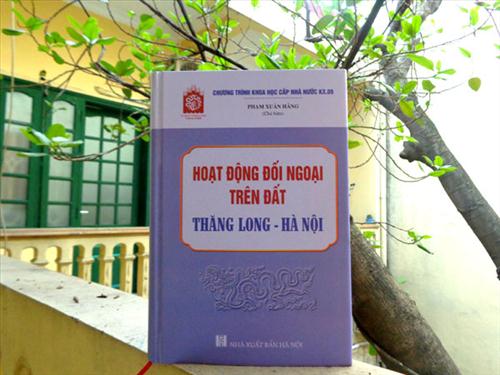
The practical experience of foreign relations in Thang Long - Hanoi over the past thousand years has shaped a system of viewpoints, principles, and diplomatic methods that are both profoundly scientific and subtly artistic. All of these have contributed to the formation of Thang Long - Hanoi's foreign relations culture. This book synthesizes typical foreign relations activities that took place in Thang Long - Hanoi over the past thousand years, thereby summarizing some historical lessons and pointing out the challenges facing Hanoi's foreign relations in particular and the country in general.
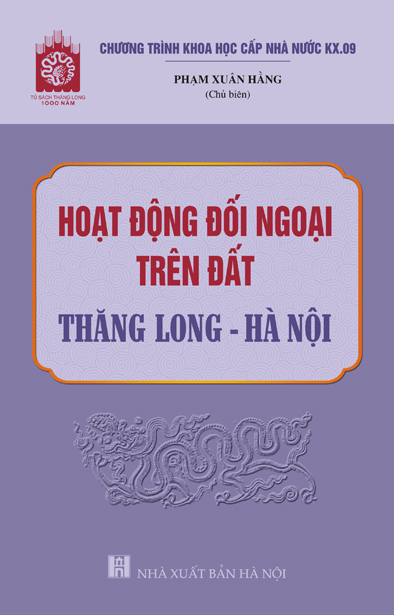
The book consists of 8 chapters with the following contents: Chapter 1 - Thang Long in the foreign relations of the Ly Dynasty (1009-1225); Chapter 2 - Thang Long in the foreign relations of the Tran Dynasty (1226-1400); Chapter 3 - Dong Do - Dong Quan in foreign relations during the resistance war against the Ming and the Early Le Dynasty (1426-1257); Chapter 4 - Thang Long in the foreign relations of the Mac and Le-Trinh Dynasties (1527-1789); Chapter 5 - Thang Long - Hanoi in foreign relations during the Tay Son and Nguyen Dynasties (1789-1945); Chapter 6 - Typical foreign relations activities of Hanoi in the period 1945-2006; Chapter 7 - Some observations on foreign relations activities over a thousand years of history in Thang Long - Hanoi; Chapter 8 - Historical lessons and some issues raised.
This work was contributed by leading history experts from the University of Social Sciences and Humanities: Assoc. Prof. Dr. Pham Xuan Hang, Assoc. Prof. Dr. Vu Quang Hien, the late Assoc. Prof. Dr. Nguyen Hai Ke, Assoc. Prof. Dr. Nguyen Van Kim, Prof. Dr. Nguyen Quang Ngoc, and Assoc. Prof. Dr. Vu Van Quan. The book was compiled within the framework of the program summarizing the thousand-year journey of Thang Long - Hanoi.
The book is considered to have utilized a large, rich, and diverse amount of materials related to the research topic, including 184 books in Vietnamese, English, French, and Sino-Vietnamese, along with many archival documents. The work also has a fairly rich and important appendix, such as a table summarizing 207 Vietnamese feudal diplomatic missions from 954 to 1883; a table summarizing a total of 84 Chinese diplomatic missions to Thang Long from 1010 to 1841…
The book's highlight lies in its approach from a geocultural and geohistorical perspective. The collective of scientists has focused on clarifying the role of Thang Long - Hanoi in the convergence and initiation of political and foreign policy thinking, diplomatic art, and the formation and implementation of the country's foreign policy throughout different historical periods. The book selects and provides an overview of the lives and careers of prominent diplomats in the nation's history – individuals whose talent, dedication, and contributions to foreign affairs have been closely intertwined with the development of Thang Long - Hanoi over nearly a thousand years. This is truly a source of pride for the people of Hanoi today, and it is essential to recognize this as a vital human resource of the capital that needs to be fully exploited and widely promoted in the era of integration for the purpose of development.
Chapters 7 and 8 of the work are considered to be of profound scientific and practical political significance. The authors have provided objective and comprehensive observations and assessments of foreign relations over a thousand years of history in Thang Long - Hanoi; clearly demonstrating the creativity and humanistic nature in the nation's choice of diplomatic approaches. These approaches have been and continue to be perfected, reaching the level of an art in handling diplomatic relations with the outside world in the face of complex contexts and situations in each historical period.
According to Associate Professor Dr. Trinh Vuong Hong (Vietnam Military History Institute), this is a comprehensive historical work that combines fundamental research with applied research. In just half a thousand pages, the authors have outlined the foreign relations history of an entire nation over 1000 years. Readers are captivated by the unique and profound events in foreign relations, handling, and dealing with these issues. The most important contribution, and the culmination of the authors' hard work, is found in chapters 7 and 8. The authors identify the role of Thang Long in establishing principles of conduct with feudal China; and the role of diplomacy in contributing to the victories of the resistance wars…
Associate Professor Pham Quang Minh (University of Social Sciences and Humanities) commented: The system of historical lessons in the thousand-year foreign relations activities in Thang Long - Hanoi is summarized by the authors in four aspects: general objectives, general principles, general methods, and general solutions. These results have useful reference value, both theoretically and practically, for the current foreign relations work of the Capital. In particular, the proposal to focus on developing a cultural environment for foreign relations is extremely important and necessary to be placed at the top of the strategic orientation for the development of foreign relations activities of the Capital as well as the whole country today.
This work provides readers with a fundamental and systematic understanding of the diplomatic landscape in Thang Long - Hanoi and the individuals who made significant contributions to the intellectual prowess and diplomatic prowess of Vietnam. Through the authors' observations and assessments of the characteristics of diplomatic activities and the historical lessons learned, the book clarifies the position and stature of the capital in foreign relations throughout history, as the capital of Vietnam. Having endured countless historical changes, this land, the capital of the Ly, Tran, and Le dynasties, and the capital of the entire country after the war against the US, has also witnessed numerous diplomatic and foreign affairs events, affirming its central position and its role as the heart of the nation.
Author:Thanh Ha (compiled)
Newer news
Older news

