
The training tradition and brand of USSH are valuable assets.
- Sir, university admissions and training are currently facing many challenges; the field of social sciences and humanities is certainly no exception. In the context of rapidly changing science and technology and societal needs, how does the university position itself to suit the current circumstances?
It is true that the 4.0 revolution has been changing many things in scientific and educational thinking, posing enormous challenges to Vietnam's higher education – a level of training considered elite and leading the development of the entire education system. Where we stand and where we will go in the future is a fundamental question that provides crucial direction for all activities and development strategies of the University.
First and foremost, it must be affirmed that the University of Social Sciences and Humanities (USSH) is a university with a long tradition, a rich history, and a prestigious reputation for research and training in social sciences and humanities nationwide. This is a system of values, an asset, and therefore a significant competitive advantage that has built a strong brand for USSH within society. Throughout its history, the University has produced many generations of leading intellectuals, educators, and scientists – those who laid the foundation for many academic disciplines in the country. Even now, with approximately 28% of its faculty holding professorships or associate professorships, and nearly 65% holding doctorates, this is one of the highest rates in the country.
After more than 70 years of construction and development, looking back at the University's training system, one can see its richness and diversity. These are the foundational, basic fields of study in Vietnamese social sciences and humanities that are synonymous with the University's name, such as History, Philosophy, Linguistics, Literature, and Classical Chinese Studies… It is on this foundation of basic sciences that a series of new, youthful, and attractive fields of study have been formed and developed increasingly strongly, becoming distinct brands of the University, such as: Oriental Studies, Journalism, Public Relations, Tourism and Travel Service Management, Hotel Management, Psychology, Management Science, Social Work, International Studies, Anthropology, Office Management,… Not many universities training in social sciences and humanities have such a diverse, rich system of study and a long tradition of training as the University of Social Sciences and Humanities, Vietnam National University, Hanoi. That creates the internal strength of the school, enabling us to go far and make steady progress in the future.
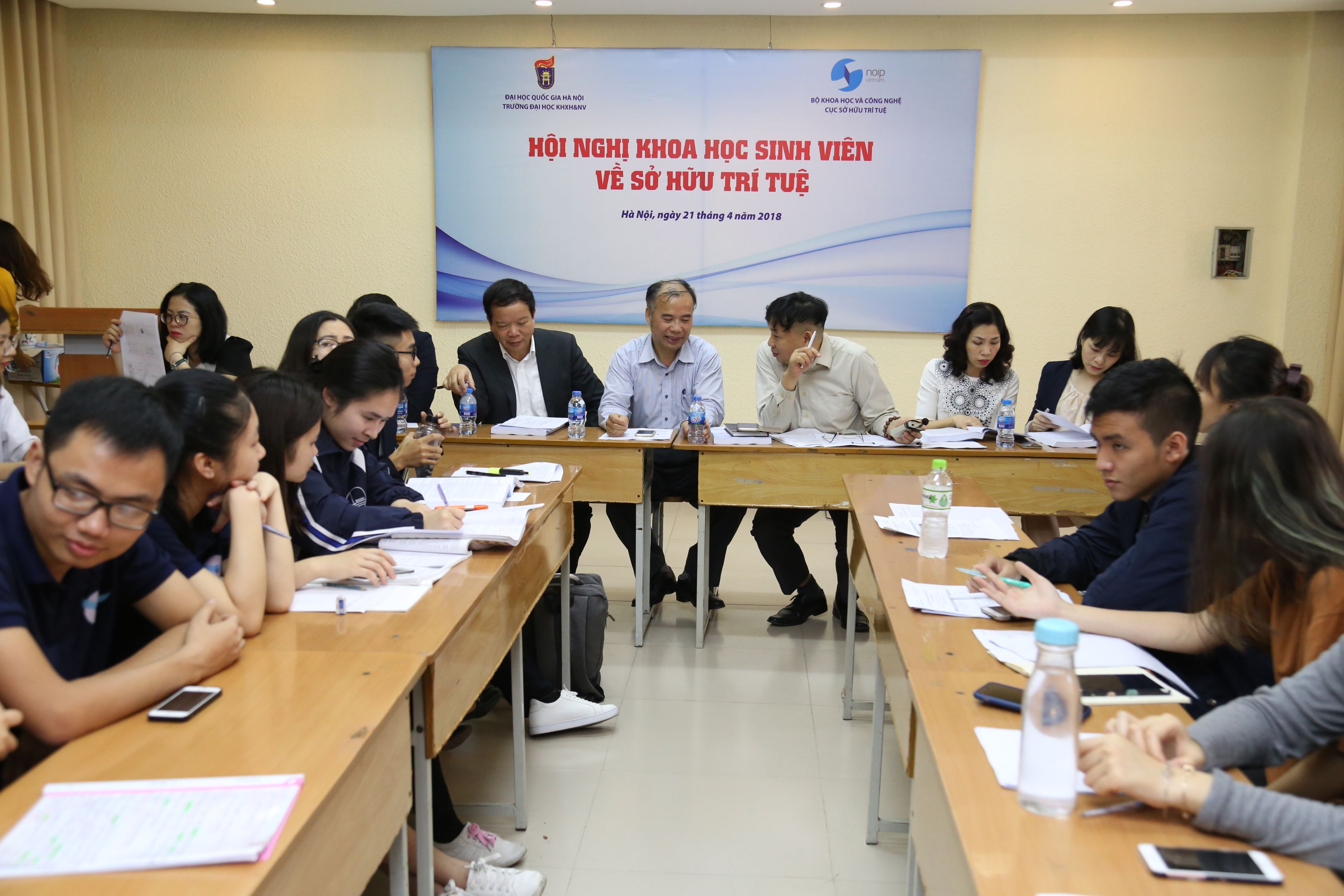
The Student Scientific Research Conference on Intellectual Property brought together students from four major universities: National Economics University, Hanoi Law University, Hue University of Law, Foreign Trade University, and the University of Social Sciences and Humanities (Vietnam National University, Hanoi). April 21, 2018. This is a regular academic activity hosted by the University of Social Sciences and Humanities, with the participation of representatives from the Intellectual Property Office.
- How are traditional values reflected in the school's activities, sir?
I believe that, in the field of education, especially in the social sciences and humanities, a long tradition is an advantage. Even from the time of Hanoi University (since 1956), education and research there had already formed a school of thought with its own unique identity. This was a way of training intellectuals who not only possessed a solid foundation of knowledge but also had a comprehensive, interdisciplinary, and holistic scientific mindset, capable of analyzing and solving many practical problems. These were individuals who were independent and creative in their thinking and actions...
It is readily apparent that graduates from the University are highly adaptable and capable of performing a wide range of jobs. Literature graduates can work in research, high-level teaching, journalism, editing, playwriting, etc. History graduates not only teach at universities, colleges, or research institutes but also work in cultural and tourism agencies, political and socio-political organizations, and non-governmental organizations both domestically and internationally. The career fields in the social sciences and humanities are vast. The University's students receive thorough training with a solid foundation of knowledge, enabling them to adapt and advance in their careers when facing real-world situations. This is a tradition in education that the University continues to uphold.
35% of students go abroad for internships or practical training.
But might an older, more established university struggle to be dynamic and adaptable when competing with younger universities?
The university considers tradition a valuable asset that needs to be preserved and further enhanced in the new context, but it must not rely on the past or be overly attached to tradition. A rich tradition should become a solid foundation for the university's staff and students to confidently move into the future. Therefore, the university has been striving to innovate even more strongly in all aspects, from the macro level of development strategy and modern university governance orientation to specific professional activities in teaching, learning materials, programs, training processes, and participation in quality accreditation of training programs according to national and international standards...

Students from the Faculty of Journalism and Communication get hands-on experience in a state-of-the-art studio system comparable to a television station.
- Could you please share your criteria for evaluating the quality of training outcomes to meet the demands of today's labor market?
The current labor market is very open, not only domestically but also internationally. This reality demands that workers not only possess strong professional knowledge but also excel in various skills and maintain a positive mindset to meet the new requirements in this new context. The school is well aware of this and is particularly focused on adjusting its training activities to keep pace with this trend.
Innovation in the school's training activities is taking place simultaneously in many aspects, from reforming training management methods towards a professional, modern approach with a high service spirit in teaching and learning... to the requirement to update/open new training programs to suit the trends of human knowledge. Fundamentally, the school's faculty always proactively updates and adjusts the curriculum to provide students with new knowledge, especially new approaches to ensure the quality of human resources after graduation.
The school is currently investing heavily to further improve the quality of education, aiming to produce graduates with excellent academic records.Strong expertise – solid skills – strong integrationFor example, graduates in Korean Studies, Japanese Studies, etc., are not only highly proficient in languages but also possess extensive knowledge of the history, culture, people, economy, and society of those countries. Similarly, graduates in tourism-related fields are not only skilled in fundamental professional skills but must also have comprehensive thinking abilities and a broad and solid knowledge base to be able to plan national-level tourism strategies and participate in the international tourism market.
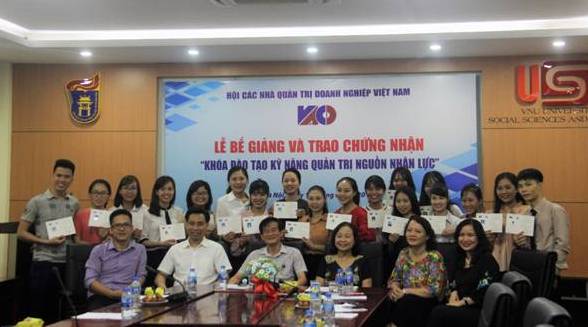
Students from the University of Social Sciences and Humanities participated in a course on human resource management skills training organized by the University and the Association of Vietnamese Business Managers (June 18, 2018).
To develop students' skills, the university is currently striving to create spaces and training environments to support the development of their specialized skills. The university currently has a diverse system of strong professional clubs such as the Media Club, Photography Club, Arts Club (dance, music, etc.), Cultural and Historical Propaganda Club, Young Managers Club, English Club, etc. By actively participating in these clubs, students learn both professional skills and practical experience. For example, Journalism students participate in reporting and creating media products for the university; Tourism students participate in activities promoting and developing tourism in Hanoi; International Studies students act as liaisons for exchange activities with international students; and Office Management students participate in activities with functional departments to improve their skills and expertise.
To prepare students for integration into the global workforce, the university is investing heavily in providing them with opportunities for internships and practical experience in international settings before graduation. In addition to a stable number of students receiving scholarships for short-term or long-term study abroad each year, in recent years the university has leveraged its extensive international network to organize internships and practical training programs abroad at very low costs. In 2017, nearly 450 students participated in study and internship programs abroad (along with over 1,000 international students studying and interning at the university, creating a vibrant international academic environment). Students participating in international internships not only gain valuable knowledge but also broaden their horizons, boost their confidence in integration, and prepare them for participation in the cross-border labor market. In particular, many students, after completing their internships, have received scholarships to pursue master's degrees at partner universities in China, Thailand, Taiwan, and other countries. The university aims to further promote international internships for students, striving to ensure that approximately 35% of its students experience an international internship environment before graduation and entering the workforce.

Students from the University of Social Sciences and Humanities interact with international students.
- International integration is a key criterion for university education today. How is this reflected in the school's training activities, sir?
When discussing international integration, the key issue is the ability to use foreign languages, especially English. It's easy to see that the foreign language skills of the university's students have increased rapidly recently thanks to the increasingly open international environment. Besides the annual international internships and practical training activities mentioned above, the university is also striving to build an international learning environment right here: numerous international scientific conferences, many on-site exchange and cooperation activities, foreign language clubs, etc.
For the past two years, the university has regularly offered courses taught in foreign languages each semester, with both international visiting lecturers and university faculty providing students with a choice of courses. The Master's Tea Club, a student English club, was established in 2017 and has increasingly attracted student participation. In particular, in an effort to improve students' foreign language proficiency to international standards, since the beginning of 2018, the university has collaborated with non-governmental organizations specializing in education to organize free foreign language classes taught by international volunteer teachers. After six months of implementation, nearly 20 classes have been organized with approximately 300 students enrolled. These courses last 7 to 10 consecutive weeks, meet international language training standards (for IELTS), and are completely free… Based on their improved language proficiency, more and more students (and postgraduate students) at the university are writing their theses and dissertations in English. This gives them an advantage in confidently starting their careers and developing their skills.
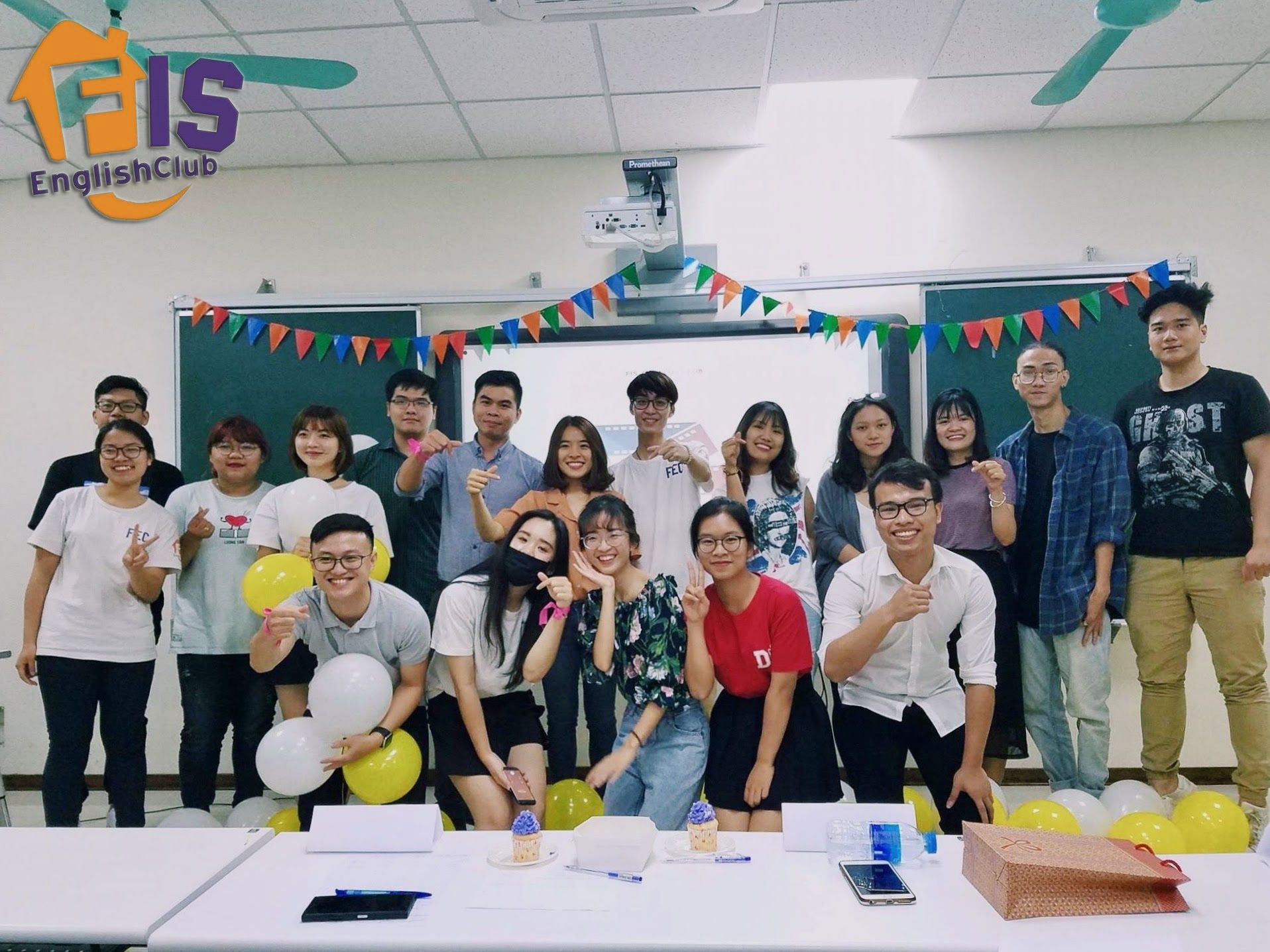
A meeting of the FIS English Club of the Faculty of International Studies (May 2018)
25%graduate studentsearly
- How does the school address career guidance and employment for students, sir?
Last June, the university organized a job fair immediately after the graduation ceremony, with the participation of 30 organizations, companies, and businesses, offering nearly 500 job opportunities for new graduates. After receiving their diplomas, students immediately participated in interviews, and many were hired on the morning of their graduation. Four months prior, during the early graduation ceremony of 2018, over 250 students were also interviewed by 22 recruiting companies, offering nearly 300 job opportunities.
Objectively speaking, the collaboration between the university and employers doesn't wait until graduation but is implemented regularly throughout the training process. For example, the development of the university's training programs has involved external experts from the very beginning. Researchers and entrepreneurs participate in curriculum development, teaching and mentoring, thesis evaluation committees, and recruitment and employment. For instance, Dr. Ta Bich Loan (Head of Entertainment Program Production at VTV3, Vietnam Television) also holds the position of Head of the Broadcasting and Television Department in the Faculty of Journalism and Communication, directly responsible for developing and innovating the training program, directly teaching and mentoring journalism students... This is a direction the university has identified, persistently pursued, and is determined to further promote in the future.
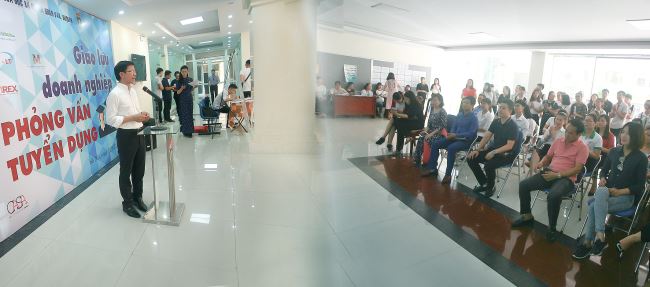
A business networking and recruitment interview event took place immediately after the graduation ceremony, with the participation of over 30 businesses from various fields (June 2018).
- Students and parents are very concerned about the training duration and the employment rate after graduation. What is the current situation regarding this at your school?tHey?
Over the past few years, the University has modernized its training process using the credit-based model. Accordingly, students have complete autonomy in scheduling their studies and deciding their study time. The Faculty and the Training Department regularly provide guidance to ensure the most effective learning for students. Therefore, since 2017, the number of students graduating early has steadily increased. Of the more than 1,000 students who received their bachelor's degrees in the first half of 2018, over 250 graduated six months ahead of schedule. Thus, the on-time graduation rate reached approximately 95%, with about 25% graduating six months ahead of the standard schedule, and some students graduating in just three years.
Graduating on time or ahead of schedule is entirely at the student's discretion. For example, by enrolling in two additional summer semesters, students can graduate from university in 3.5 years; if students enroll in two summer semesters, take a few extra credits each semester, and are exempt from foreign language courses (if they have an international language certificate), they can complete their university program in 3 years. This is entirely natural according to the credit-based training model worldwide and also aligns with the spirit of the Prime Minister Nguyen Xuan Phuc's directive on educational reform from the end of 2016.
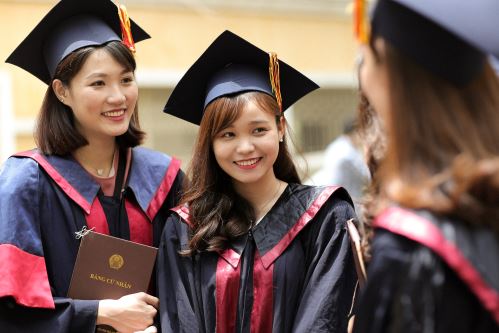
New students of the University of Social Sciences and Humanities show off their radiant beauty at the graduation ceremony in June 2018.
The good news is that the number of students graduating on time and ahead of schedule has increased, the quality of training remains assured, and the employment rate remains stable. For nearly 10 years, the university has proactively investigated the employment rate of its graduates. In 2015, 2016, and 2017, the percentage of graduates finding employment within 6 to 12 months consistently averaged 90% to 93%. In some fields such as Oriental Studies, Tourism and Travel Service Management, Hotel Management, Journalism, etc., the employment rate after graduation reached 100%, with many even being hired while still completing their internships. Several international corporations from Japan, South Korea, China, etc., often wonder why the university doesn't increase the number of Oriental Studies students annually, as they want to recruit but the university cannot provide enough human resources. Not only in applied fields but also in many basic science disciplines, the employment rate after graduation is very stable thanks to the relatively small number of students trained each year while ensuring the quality of training. For example, students majoring in Archaeology at the university are always notified of job openings by provincial agencies (Museums, Departments of Culture, Heritage Management Boards, etc.), but usually students have already secured employment during their graduation internship.
Thank you very much for your insights, teacher.
Author:Thanh Ha
Newer news
Older news

