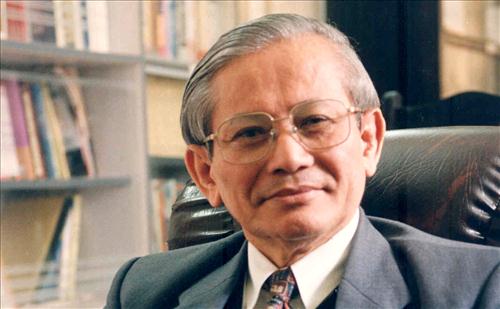
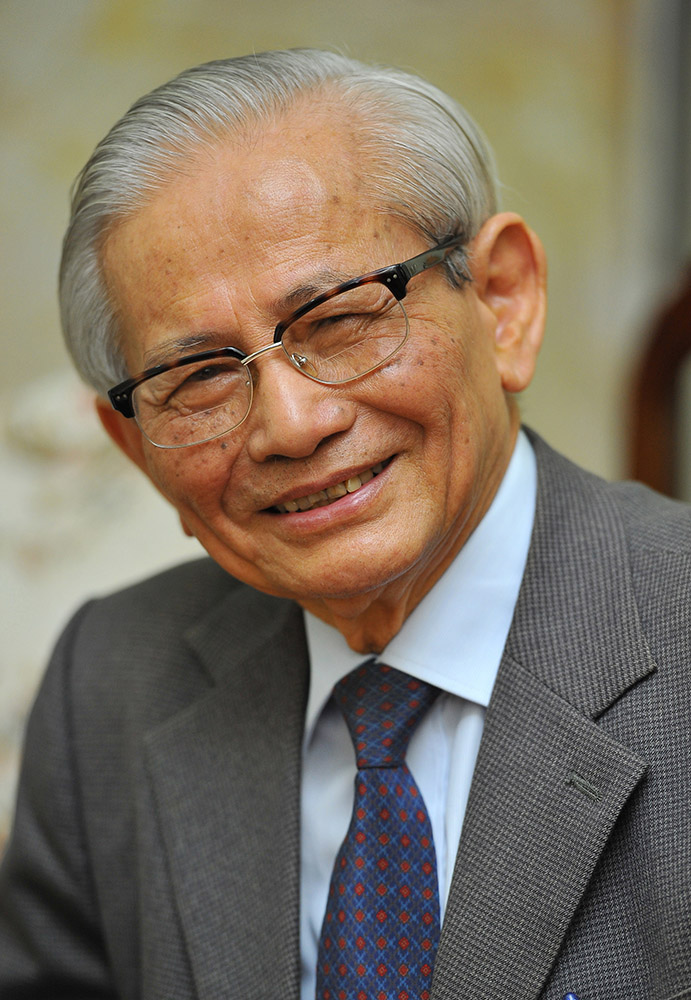
Professor, People's Teacher Phan Huy Le - a towering figure in Vietnamese historiography.
Professor Phan Huy Le was born on February 23, 1934, in Thach Chau commune, Loc Ha district, Ha Tinh province, into a family with a rich cultural tradition, boasting many prominent figures such as Phan Huy Can, Phan Huy Ich, and Phan Huy Chu. His maternal family was also a large and distinguished lineage, with many accomplished individuals such as Cao Xuan Duc, Cao Xuan Tieu, and Cao Xuan Huy…
Inheriting the patriotic and cultural traditions of his lineage and family, Professor Phan Huy Le showed early signs of intelligence and a thirst for knowledge. In 1951, at the age of 17, he attended a preparatory university course in Thanh Hoa, and then enrolled in the History and Geography Department of Hanoi Pedagogical University.
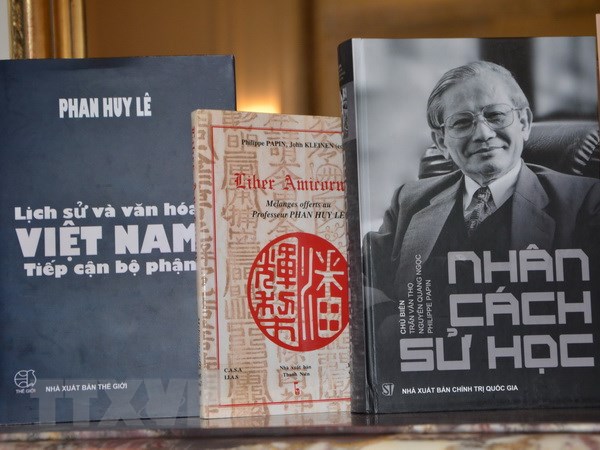
Professor Phan Huy Le's famous scholarly work, "History and Culture of Vietnam: A Partial Approach," and the book written about him, "History's Personality."
After graduating, he was assigned to work at the History Department of Hanoi University. Under the guidance and mentorship of prominent revolutionaries and cultural figures of the time, such as Professors Tran Van Giau, Dao Duy Anh, etc., the young teacher Phan Huy Le quickly matured and became one of the first generation of staff members, the ones who contributed to laying the foundation of the History Department and Hanoi University.
From the beginning of his work at the History Department (in 1956) until his passing, Professor Phan Huy Le dedicated over 60 years to continuous research, teaching, and contributing to the development of history and education in Vietnam. In particular, through his outstanding achievements in research and training, Professor Le, along with Professors Dinh Xuan Lam, Ha Van Tan, and Tran Quoc Vuong, established a "Comprehensive" school of historiography, with a legend surrounding the "Four Pillars": Lam - Le - Tan - Vuong. This legend has become a source of pride not only for the History Department of the former Hanoi University and the current University of Social Sciences and Humanities, Vietnam National University, Hanoi, but also for all history students and professionals in Vietnam.
As one of the leading figures in modern Vietnamese historiography, Professor Phan Huy Le has made outstanding achievements and contributions in many different research fields, from economic history, patriotic traditions, and traditions of resistance against foreign invasion to the values and characteristics of national culture, etc.
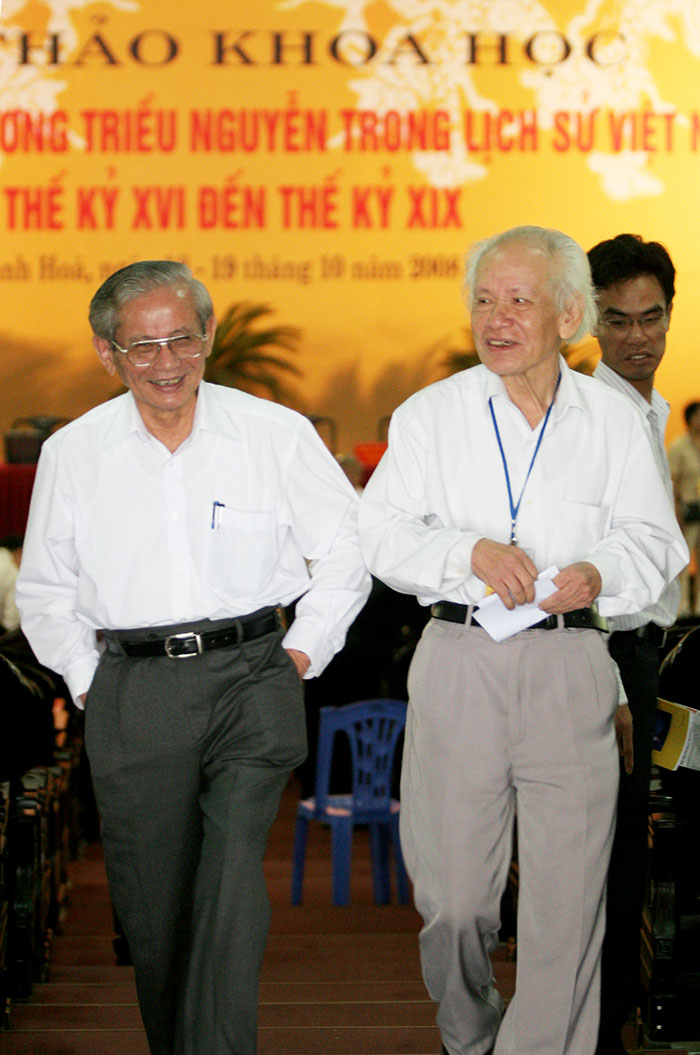
Professor Phan Huy Le and Professor Dinh Xuan Lam at a conference in 2008.
Professor's first major scholarly work wasLand ownership system and agricultural economy during the early Le DynastyCompleted and published in 1959 when he was only 25 years old, that book remains a highly valuable and relevant scientific work for the current times and for anyone studying the history of land ownership and agricultural economics in Vietnam. Over the past two decades, in his role as an organizer, proposing research goals and ideas, and applying modern methods and techniques in exploiting land register documents, he has made many new discoveries, not only on the land ownership system but also on the entire Vietnamese rural society at the end of the medieval period. This has opened up a new direction and a new approach in exploiting this extremely rich and valuable source of information.
Since the 1980s, the Professor has delved into the study of traditional values of the Vietnamese nation, from patriotic traditions to the characteristics of the Vietnamese people and culture; on that basis, he affirmed...Vietnamese patriotismThese are the core, most representative, and outstanding traditional values of our nation, the source, driving force, and the law governing the movement and development of Vietnamese history throughout the process of nation-building and national defense.
Although not born in Hanoi, Professor Phan Huy Le loved Hanoi and was very interested in researching Hanoi from a very early age. He published many excellent research works on the history of Thang Long - Hanoi, as well as on preserving and promoting the cultural values and heritage of the capital city of Thang Long - Hanoi.
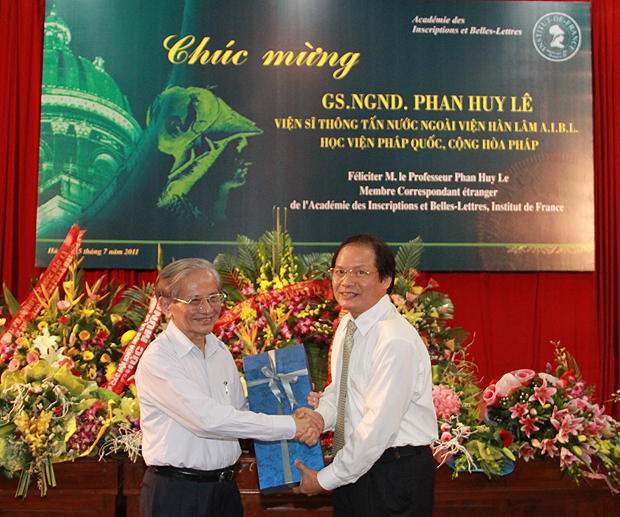
Professor Phan Huy Lê and Professor Nguyễn Văn Khánh in 2011
The professor also chaired and successfully organized the event.State-level research project on the history and culture of the Southern region of Vietnam.The results of this project are not only scientifically significant in providing new, scientific insights into the historical origins of the Southern region of Vietnam, but also contribute to correcting misconceptions and inaccuracies about the formation and role of this region in Vietnamese history. In the last three or four years, despite his advanced age and declining health, Professor Phan Huy Le, driven by his love and responsibility for the history of the nation and country, has happily undertaken the important task of leading the research and compilation of this series.History of VietnamEntrusted by the Party and the State, this is the national history of the Ho Chi Minh era (referred to as the National History), the most systematic and large-scale project undertaken since the founding of the Democratic Republic of Vietnam.
As a renowned and exemplary teacher and educator, Professor Phan Huy Le was deeply concerned with and made significant contributions to the training of generations of historians, especially influencing generations of students and researchers both academically and morally. He directly trained and nurtured many talented teachers, scientists, historians, and skilled administrators in central and local government agencies. In Professor Phan Huy Le, the meticulous and serious style of a scientist was naturally blended with the generous, kind, and selfless spirit of a virtuous and talented educator, always approachable, respectful, and ready to listen and share opinions with colleagues and students.
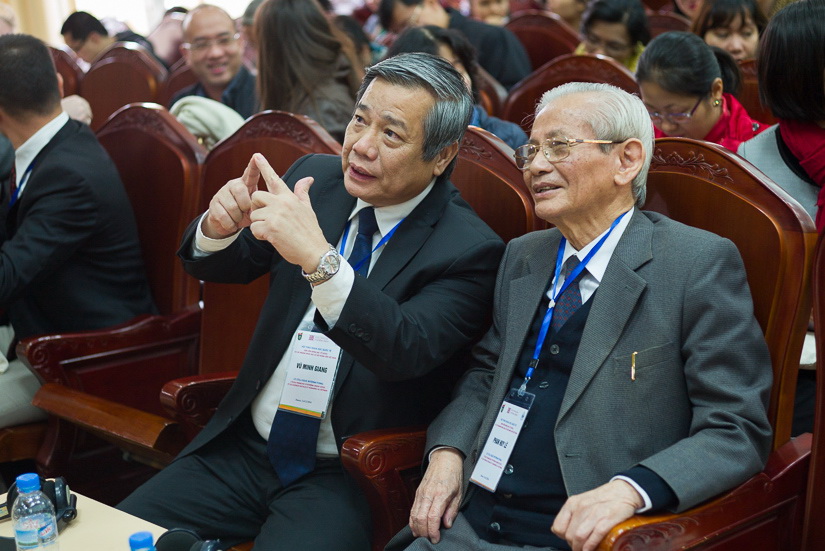
Professor Phan Huy Le and Professor Vu Minh Giang at the conference "The French School of Far Eastern Studies and the Social Sciences and Humanities of Vietnam" at the University of Social Sciences and Humanities, Vietnam National University, Hanoi in 2014.
With the far-sighted and comprehensive vision of a talented scientist, Professor Phan Huy Le was also a pioneer in proposing the establishment and development of new scientific disciplines at Hanoi National University and in the country, such as Oriental Studies and Vietnamese Studies. During his years as Head of the Faculty of Oriental Studies, and as the founder and first Director of the Center for Vietnamese Research Cooperation (now the Institute of Vietnamese Studies and Development Science at Hanoi National University), Professor Phan Huy Le made significant and immense contributions to establishing and promoting academic exchange between Vietnamese scholars and international scientists when the country was entering the period of Doi Moi (Renovation) and integration.
Besides contributing to the development of the University of Social Sciences and Humanities and Hanoi National University, a leading center of science and training in the country, Professor Phan Huy Le also participated in and provided many important opinions in formulating the direction and implementing the activities ofNational Council for Education, Central Theoretical Council, National Heritage CouncilFrom his profound and solid professional perspective, the Professor advised and directly contributed to supplementing and perfecting the dossiers on the city of Hoi An, the Ho Dynasty Citadel, and especially Thang Long - Hanoi, so that the Ministry of Culture and Information and the State of Vietnam could propose them to UNESCO for recognition as World Heritage sites. Regarding the University of Social Sciences and Humanities, Vietnam National University, Hanoi, in his capacity as President...Policy Advisory CouncilDuring his tenure at the university, Professor Phan Huy Le made significant contributions to research and proposed recommendations to the Party and the State on policies and strategies for the development of science and education, especially the education of national history. He contributed to the preservation and promotion of national cultural values, as well as to the task of safeguarding the country's independence and sovereignty.
Professor Phan Huy Le was not only a leading educator and scientist admired and respected by his students, colleagues, and the scientific community in Vietnam, but he also possessed widespread international prestige and influence, and was highly regarded and trusted by Vietnamese studies scholars worldwide. He was the first social scientist and one of the very few Vietnamese to be awarded...Fukuoka Prizeprestigious in Japan, received the awardAcademic palm branchand it is a particular honor to be elected a corresponding member ofInstitute of Inscriptions and Fine Artsbelong toAcademyFrance. Hundreds of researchers from many countries who had the opportunity to visit Vietnam and meet or work under the guidance of Professor Phan Huy Le could never forget the image of a passionate yet calm, erudite, strict yet sincere and approachable scientist.
Born into a family with a renowned tradition of scholarship and mandarins, but educated and trained under the new regime, Professor Phan Huy Le became a true revolutionary historian. He devoted himself wholeheartedly to serving the country and the people with his profound intellect and all the enthusiasm of a communist. In his work, he was always meticulous and careful; at the same time, he was exemplary in his ethics, conduct, and lifestyle, and always excellently fulfilled the tasks assigned by the Party and the State. Thanks to his immense and outstanding contributions to the revolutionary cause of the Party and the nation, he was awarded many prestigious medals and decorations, the most notable of which is...Ho Chi Minh Prize for Science and Technology and the Third-Class Independence MedalMost recently, in mid-May 2018, he enthusiastically visited the Spratly Islands, becoming the oldest scientist present in this remote area of the country to directly survey and research... But for him, the most precious reward is not necessarily the medals and prestigious awards at home and internationally, but rather the respect for scientific truth, and the trust, respect, and love that the people, friends, colleagues, and students in Vietnam and from many countries around the world have bestowed upon him.
*
Amidst many unfinished tasks, especially the compilation of the National History, which required all efforts to be urgently completed, unexpectedly, our teacher fell seriously ill and passed away. He left us all to return to his ancestors in the eternal realm, taking with him all his unfulfilled aspirations and wishes.
The sudden passing of our Teacher is an irreplaceable loss to the field of history and national education; it has left a void, profound sorrow, and immeasurable grief for his family, colleagues, friends, and generations of students. May his soul rest in peace in the afterlife; and may he smile in the afterlife for what he has done, contributed, and left behind for today and for future generations. Continuing his work and following his example, his students and colleagues will continue to strive to realize and make his noble dreams and aspirations a reality.
Author:Prof. Dr. Nguyen Van Khanh (Former Rector of the University of Social Sciences and Humanities, Vietnam National University, Hanoi)

