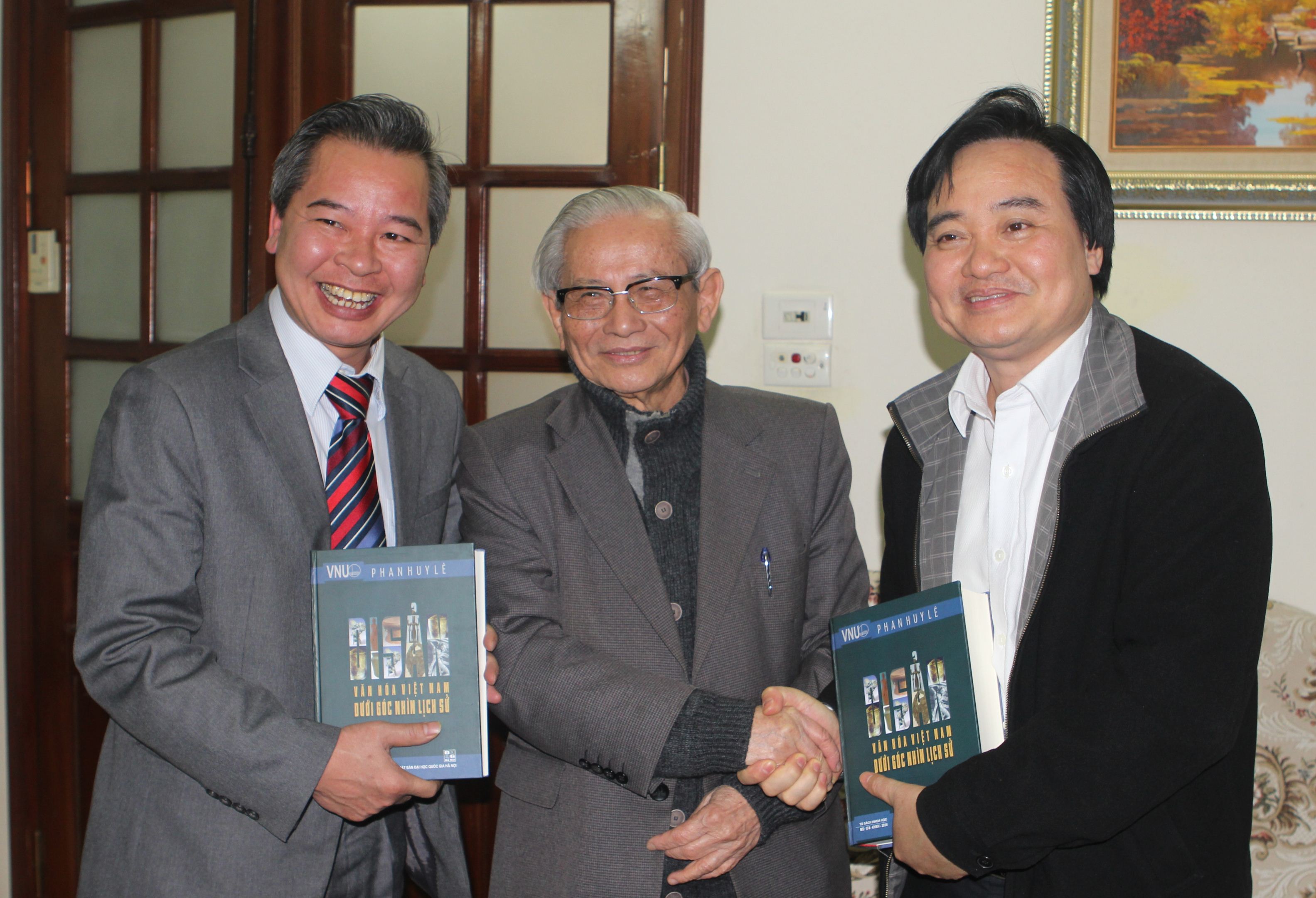
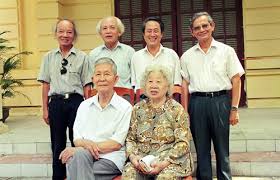
From left to right: The four pillars of the field of History, including Professor Tran Quoc Vuong, Professor Dinh Xuan Lam, Professor Ha Van Tan, and Professor Phan Huy Le, posing for a photo with Professor Tran Van Gia and his wife.
In 1952, at the age of 18, Phan Huy Le left his family to attend a preparatory university in Thanh Hoa, where he had the opportunity to interact with leading revolutionary intellectuals of the country. Naturally gifted and passionate about natural sciences, he initially planned to pursue a career in Mathematics and Physics, but fate seemed to have predetermined his path to becoming a historian. Professor Tran Van Giau and Professor Dao Duy Anh were among the first to recognize Phan Huy Le's potential and guided him to study History and Geography at Hanoi Pedagogical University.
In 1956, Hanoi University was established with four faculties: Mathematics-Physics, Chemistry-Biology, Literature, and History. Phan Huy Le, having just graduated with a Bachelor's degree in History and Geography, was immediately accepted into the Ancient History Department of the History Faculty under the direct guidance of Professor Dao Duy Anh. From his student days, he was trusted by his professors to be a teaching assistant. After graduation, he officially taught classes while also being assigned by Professors Tran Van Giau and Dao Duy Anh to write lecture notes and undertake the work of a true expert. Perhaps because of this, just two years later, when Professor Dao Duy Anh transferred to the Institute of History, at the young age of 24, he was firmly established in the important role of Head of Department, leading the organization and development of a key discipline in the Vietnamese social science system.
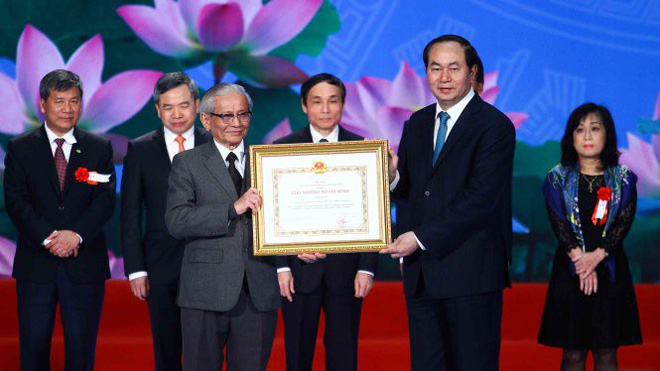
Professor Phan Huy Le, People's Teacher, received the Ho Chi Minh Prize for Science and Technology in 2016.
Embarking on a career in history, Phan Huy Lê believed that socio-economic factors were the fundamental basis of all history. Since Vietnam is an agricultural country, the study of traditional Vietnamese socio-economics could not begin without starting from the countryside, agriculture, and farmers. This explains why his first publications in his scientific career were...Land ownership system and agricultural economy during the early Le Dynasty(1959)Characteristics of the Tay Son peasant movement(1959)Labor and wage work in Vietnamese feudal society(1959)… In total, there were 5 major works in the first 5 years of his career that belonged to the socio-economic field.
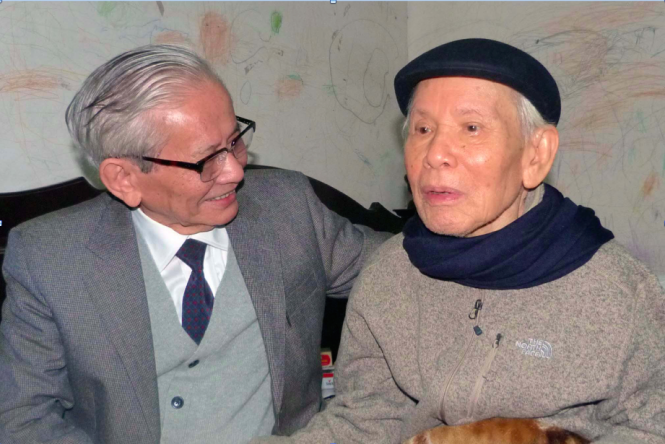
Professor Phan Huy Le and Professor Dinh Xuan Lam
Just as Phan Huy Le had established himself in socio-economic research, the US escalated its bombing campaign against North Vietnam. Conscious of his civic responsibility to participate in the national struggle, Phan Huy Le shifted his research to the resistance wars against foreign invaders and major battles in history. His works included...Lam Son Uprising(1965);The tradition of nation-building and national defense of the Vietnamese people.(1973)Some strategic decisive battles in the nation's history.(1976)The Battle of Bạch Đằng in 938 and 1288(1988)... were completed under such conditions and have become representative works of military history.
Professor Phan Huy Le, People's Teacher, Professor Phung Xuan Nha (former Director of Vietnam National University, Hanoi), and Professor Pham Quang Minh (Rector of the University of Social Sciences and Humanities, Vietnam National University, Hanoi)
After the liberation of South Vietnam and the reunification of the country, Phan Huy Le continued to devote much of his efforts to the topic of resistance against foreign invasion. In about 15 years (1975-1989), he wrote over 24 major works, not including dozens of articles and papers on this subject. When people think of Phan Huy Le, they immediately think of a leading expert on the history of resistance against foreign invasion, with an outstanding number of research works and profound summaries that directly contributed to the country's overall victories. In this field, he has 50 out of a total of 408 completed works (accounting for 12.2%).
However, Phan Huy Le was always particularly interested in socio-economic issues, socio-economic formations, and socio-political institutions in pre-modern Vietnamese history. Whenever he had the opportunity, he would return to the topic of land ownership, agricultural economics, peasants, and traditional villages. He wrote 51 works specifically on socio-economics (accounting for 12.5%), notably including works on the Tay Son peasant movement, books and monographs on the development of socio-economic formations, socio-economic structures, and villages of the Vietnamese people in the Northern Delta region… In addition, he always pioneered in thoroughly exploring relevant source materials such as land registers, imperial archives, and genealogies… combined with field investigations and surveys.
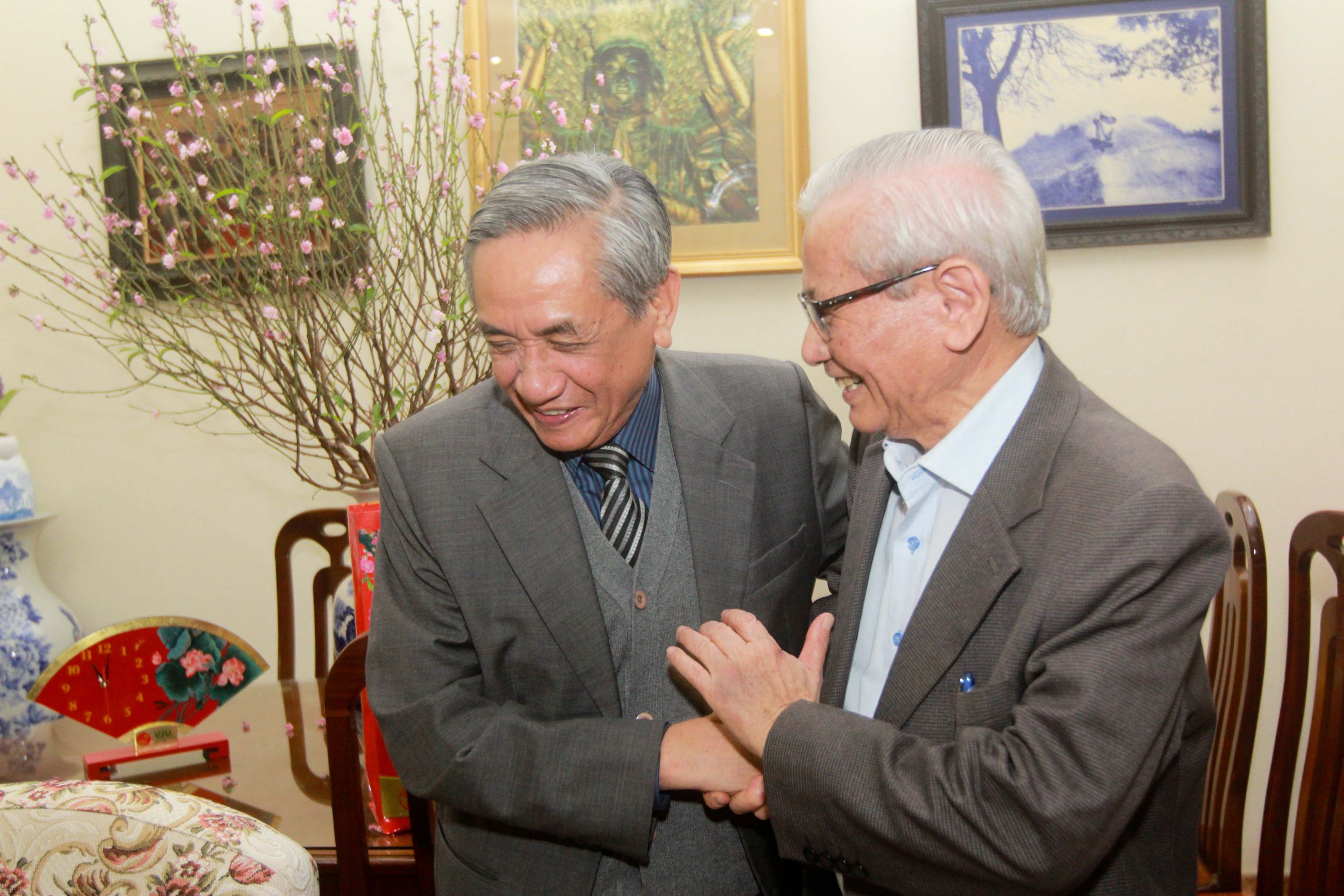
Professor Phan Huy Le and Professor Vu Duong Ninh
Phan Huy Lê began expanding his research into the field of culture and tradition in the mid-1970s, and his interest in this field became increasingly comprehensive, with an average of 64 works (accounting for 15.72%). His representative works include:Tradition and Revolution(1982)The issue of democracy in Vietnamese tradition(1988)Traditional values and the Vietnamese people today(3 volumes, 1994, 1996, 1997)Vietnamese patriotism, tradition and modernity.(2002) and the system of articles on the cultural heritage of the Thang Long Imperial Citadel heritage site...
Professor Phan Huy Le's entire body of work can be broadly categorized into seven main areas, with the number of works ranging from 41 to 92 (an average of 58) for each area. However, the greatest responsibility placed upon Professor Phan Huy Le was not to focus on specific historical areas, but to synthesize the history of the nation. Even as early as 1959, when he began writing the first drafts, he already had a collection of lectures.History of Vietnam from 1406 to 1858For two consecutive years, he released...History of the feudal system in VietnamVolume II (1960) andHistory of the feudal system in VietnamVolume III (1961) contributed to the stature of the Department of History. In 1971, he co-authored with Tran Quoc Vuong.History of VietnamVolume I is considered the first comprehensive history of the new regime. During this period, a series of lectures and other textbooks were also published on...History of VietnamThese were created (in 1966, 1970, 1978...) as the basis for their emergence.History of VietnamVolume I (1983) - a book summarizing the history of Vietnam from prehistoric times to the 10th century, relatively complete and up-to-date. Particularly recently, in the independent state-level scientific project to build this book series.History of VietnamIn four volumes, Professor Phan Huy Le served as both editor-in-chief and the main author of volumes I and II, which are considered the highest-level summary of the historical period from its origins to the mid-19th century.
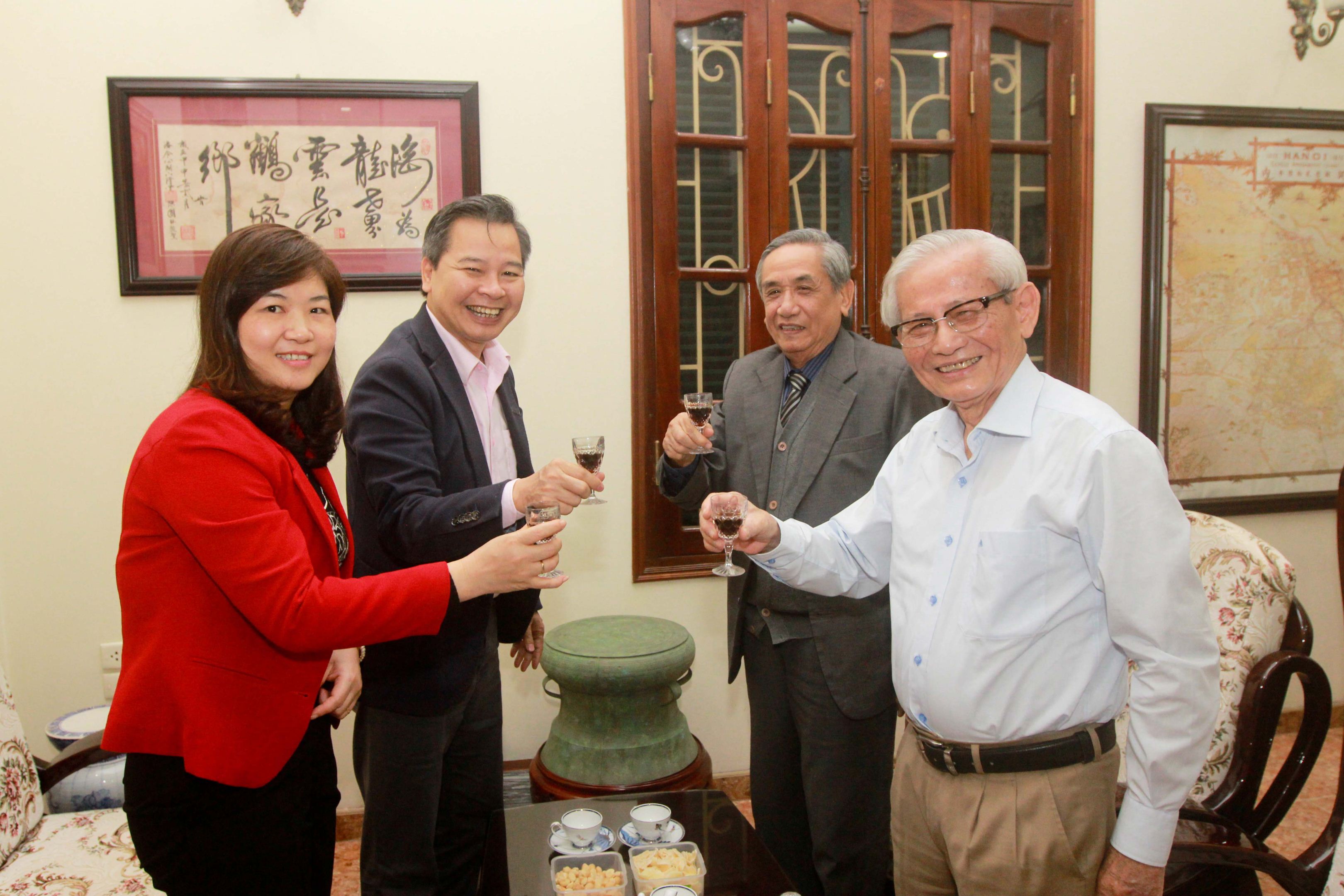
Leaders of the University of Social Sciences and Humanities extend New Year greetings at the home of Professor Phan Huy Le.
Not only did Phan Huy Le devote his time and energy to writing comprehensive histories and textbooks, but he was also the author of many works on local history. Respecting and valuing traditional historiography, he was also a pioneer in modernizing and updating research methods. Therefore, the number of his comprehensive historical works, lectures, textbooks, and highly generalized histories reached 41 (accounting for 10.0%), creating a perfect and outstanding quality in the historiography of Phan Huy Le.
The profound erudition in Professor Phan Huy Le's historical works stems from the noble responsibility of a teacher, for, in his view, teaching at the university means teaching the results of one's own research.
For over half a century, in addition to his main teaching duties at the Department of History, he has taught numerous classes both within and outside Hanoi National University, as well as at universities around the world, such as the University of Paris VII (France) and the University of Amsterdam (Netherlands). Thousands of his students have achieved success and hold important positions in research and teaching institutions at the central and local levels, both domestically and internationally. He is also one of the first experts of Vietnam's new education system to participate in teaching specialized courses, guiding and reviewing doctoral and scientific dissertations both domestically and internationally, including 17 of his direct students who have successfully defended their doctoral and scientific dissertations.
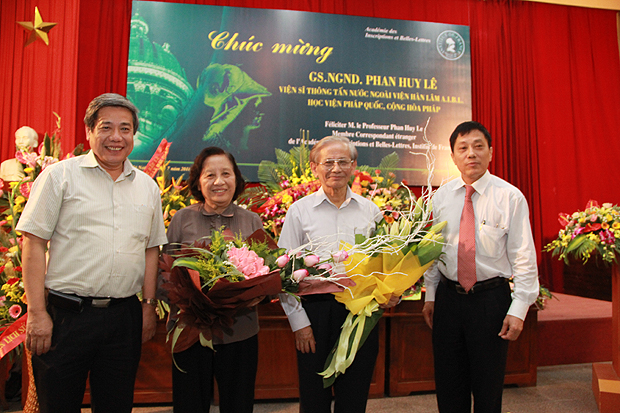
Professor Phan Huy Le, along with Professor Mai Trong Nhuan (former Director of Vietnam National University, Hanoi) and Professor Vu Minh Giang (former Vice Director of Vietnam National University, Hanoi)
Besides his role in teaching history, he was also entrusted with the responsibility of establishing two new academic disciplines: Oriental Studies and Vietnamese Studies. From 1988 to the present, Professor Phan Huy Le has continuously served as the Chairman of the Vietnam Historical Science Association. He has also held key leadership positions or served as a member of many national councils such as the National Council for the Compilation of the Encyclopedia, the National Council for Science and Technology Policy, the Central Theoretical Council, the Council for Science and Training of Hanoi National University, the State Council for Academic Titles, the Council for the Ho Chi Minh Prize and State Prizes, the National Council for Cultural Heritage... In every position he held, he made outstanding contributions.
He was awarded the title of Professor (1980), Distinguished Teacher (1988), and People's Teacher (1994); received the Second Class Resistance Medal (1985), the First Class Labor Medal (1998), Second Class (1994), and Third Class (1974); received the State Prize (2000), the Fukuoka Asian Culture International Prize, Japan (1996), the Order of the Academic Palm Branch from the French government (2002), Outstanding Citizen of the Capital (2010), and the title of Foreign Corresponding Member of the Academy of Inscriptions and Fine Arts of the French Academy (2011).
Above all, his name, talent, and character have become an idol, a legend, a source of pride, and a shining example for generations of students and colleagues both domestically and internationally.
(In the Portraits of Outstanding Educators and Scientists of the University of Social Sciences and Humanities 1945-2015)(Published by Vietnam National University, Hanoi Publishing House in 2015).
https://news.zing.vn/giao-su-su-hoc-phan-huy-le-qua-doi-o-tuoi-84-post853996.html
http://dantri.com.vn/giao-duc-khuyen-hoc/giao-su-phan-huy-le-qua-doi-o-tuoi-84-20180623153225913.htm
Author:Professor, Doctor, People's Teacher Nguyen Quang Ngoc

