
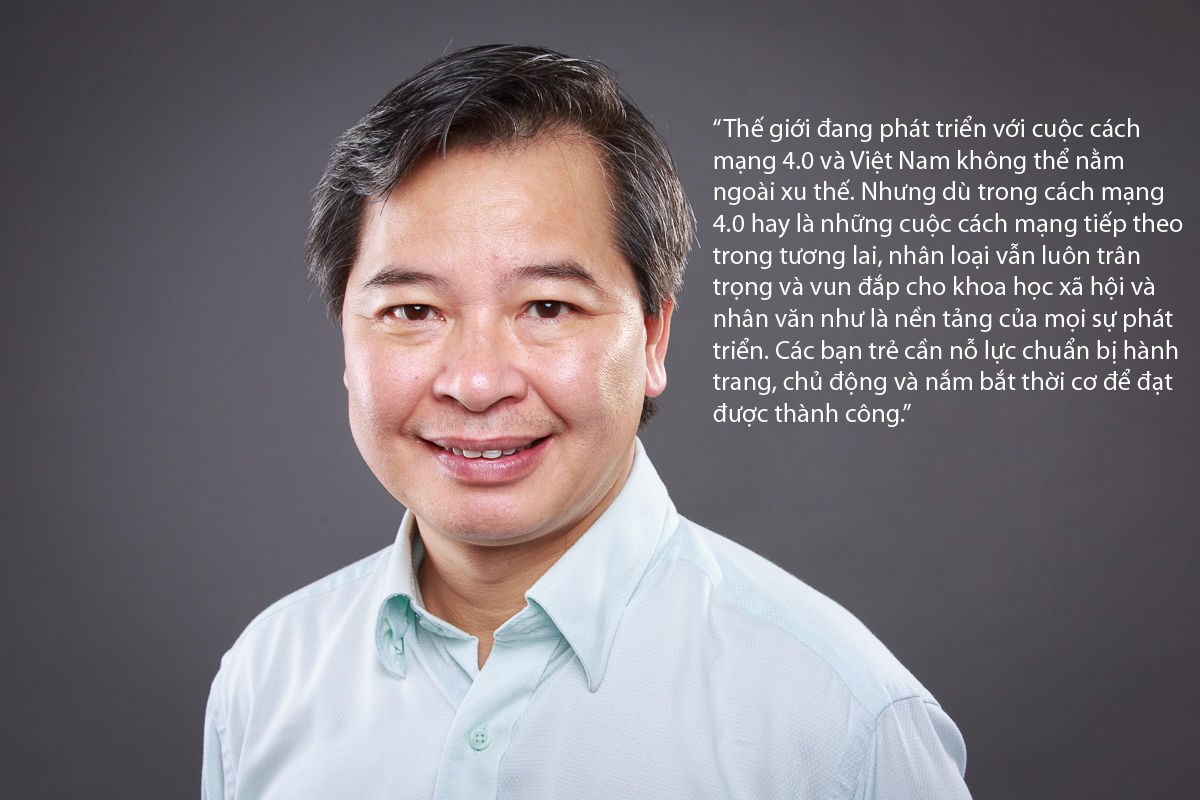
Prof. Dr. Pham Quang Minh - Rector of the University of Social Sciences and Humanities, Vietnam National University, Hanoi
Professor Pham Quang Minh, recently, experts and the public have shown great interest in the Vietnam University Rankings published by an independent research group. What are your comments on this ranking, and what is the University of Social Sciences and Humanities' perspective on university rankings in general?
I believe that the recent publication of a university ranking in Vietnam is a very important and commendable first step. The criteria used are also very appropriate, such as scientific research, education and training, infrastructure, and university governance. These criteria are also consistent with the general trend of universities and, in particular, with the policies of Vietnam and the world. However, this study lacks a clear classification between different groups of universities, such as research universities, training universities, multidisciplinary universities, or single-discipline universities, which may create conflicting opinions in public discourse. Independent and objective assessments of the standing of universities are urgently needed to create a transparent information environment and to promote development and integration. In this context, the University of Social Sciences and Humanities, a member unit of the Vietnam National University, Hanoi, has been very active and proactive in the work of quality accreditation and university ranking. Over the years, quality accreditation has become a regular activity of the University. We have three training programs whose quality has been assessed according to the standards of the ASEAN University Network (AUN), and many training programs have been assessed according to the standards of the Vietnam National University, Hanoi and the Ministry of Education and Training. The essence of quality accreditation is not to find limitations and errors, but rather to serve as a mirror showing us our strengths and weaknesses so that we can improve and continue to innovate. Quality accreditation and university ranking act as a catalyst, motivating universities to develop further.
Professor, the training and research in social sciences and humanities in Vietnam have undergone significant changes in recent years. As a multidisciplinary university with a long tradition and prestige in social sciences and humanities, could you share the key milestones in the university's innovation in training and research during the past academic year?
Over the past year, the University has continued its strategy of building itself into an advanced research university. This is a long-term roadmap, inherited from many years ago, but at this stage, the University is further strengthening and promoting the improvement of training and scientific research quality. In training, the University has reviewed the process to shorten the training time from 4 years to 3.5 years, while still ensuring the quality of output standards. This has contributed to saving students and society a great deal of financial and time, increasing job opportunities. The University has opened many new training programs at the undergraduate, master's, and doctoral levels, meeting the needs of society. The University is the first institution to open a Religious Studies program. The doctoral program in Science and Technology Management was the first in the country to be implemented, and one doctoral degree has been awarded. The Vietnamese Studies major also has one international student who received a Master's degree... In scientific research, the policy of promoting international publications continues to be well implemented with nearly 50 high-quality works, one-fifth of which are published in high-ranking journals in the ISI and Scopus systems. In addition, there are dozens of state-level, ministerial-level, VNU-level, and local-level scientific projects nationwide. The university is investing in three new laboratories to serve training and research. These achievements demonstrate the university's pioneering role in the field of social sciences and humanities, as well as its position through internationally published research and its application to social practice.
It is true that Vietnamese universities in general, and the University of Social Sciences and Humanities in particular, have shown great interest in international integration. Compared to natural sciences, engineering, or economics, the integration of social sciences and humanities faces many difficulties and limitations, such as language barriers, ideological differences, and methodological challenges. However, I believe that social sciences and humanities possess unique advantages that other scientific disciplines lack. International scholars are particularly interested in Vietnamese history, culture, and traditions. Every year, we welcome thousands of international scholars, lecturers, and students to learn Vietnamese and conduct research in the fields of social sciences and humanities. This is a distinct advantage compared to other scientific disciplines. Secondly, Vietnam is truly a model of exemplary social development, a model of transition from a centralized, bureaucratic, and subsidized economy to a market economy. This model is highly attractive to the international community. Thirdly, Vietnam is like a "living museum." Here, social and humanities scientists have many advantages in researching case studies on issues facing the whole world, such as urbanization, migration, sustainable development, climate change, and the languages and cultures of ethnic groups. Vietnam is now known not only for its past wars, but also as a peaceful, dynamic, and innovative country. This makes Vietnam a highly attractive subject of research. Social and humanities sciences essentially possess a very valuable living resource for research. We urgently need domestic efforts as well as international cooperation to develop and exploit this potential in order to have comprehensive and scientific strategies for national development.Many argue that the social sciences and humanities face significant challenges in integrating with the international community. What are your views on this, Professor?
The university considers international integration a key focus in its development strategy, as reflected in the Party Committee's resolutions and the university's general policies. On the one hand, the university welcomes hundreds of foreign lecturers and students, while also sending students abroad for study, practical experience, and exchange. Faculty and students regularly exchange information and participate in international programs, projects, research, and training programs. The university has signed over 270 cooperation agreements with important partners worldwide, creating opportunities for collaboration with universities and organizations around the globe. Simultaneously, the university has introduced many courses taught in English, established two English clubs for faculty and students, and upgraded its English website. The University's Journal of Social Sciences and Humanities publishes two issues in English each year... All of this has created a new awareness among faculty and students of the University that it is necessary to improve foreign language skills, considering it the key to opening doors to the world. The context of internationalization and integration is the condition that helps universities improve the quality of training and research, demonstrating their position in the general development trend.
Returning to the topic of high-quality human resources to meet the demands of innovation and international integration, what advice would the professor like to share with students in the social sciences and humanities in particular, and the younger generation in general?
Families, schools, and society have always cared for and trusted the younger generation. Today's students need to correctly understand their role, responsibilities, and position in the new era. A student body still carries the mentality of the subsidy era, lacking initiative and exhibiting considerable inertia. The world is developing with the 4.0 revolution, and Vietnam cannot be outside this trend. But whether in the 4.0 revolution or subsequent revolutions in the future, humanity will always cherish and cultivate social sciences and humanities as the foundation of all development. To keep pace with the new trends of the era, we need to strive to prepare ourselves, be proactive, and seize opportunities. Success only comes to those who know how to seize opportunities with confidence and are ready to overcome challenges.
Thank you very much, Professor.
(according to Education and Times Newspaper)
Author:Le Thu Ha
Newer news
Older news

