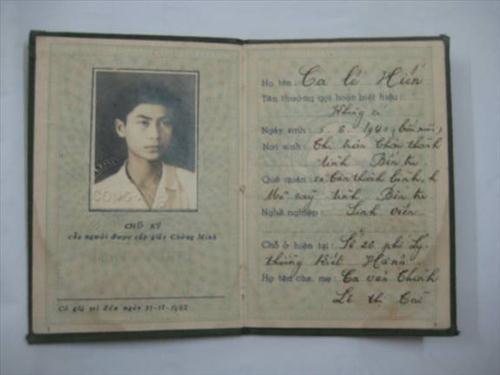
Ca Lê Hiến lived for 10 years in the independent and free half of the country, while his beloved homeland in the South, where he was born and raised, remained divided and engulfed in bloodshed. Living and working in the North, and deeply attached to it, Ca Lê Hiến also felt a profound longing and sorrow for the suffering of his compatriots in the South. His feelings and sense of responsibility towards his homeland constantly urged and beckoned him to return.
"My homeland is in turmoil.
How could we possibly live in peace?
Oh, I long to hold a gun in my hands!
Walking among the troops with friends.
Waiting for the enemy in our heroic homeland.
We are intoxicated by the scent of fallen leaves by the bamboo grove."
The hardships of life, with days spent in the North and nights in the South, were finally relieved when, following the Party's call, Ca Le Hien made what could be considered a momentous decision in his life: he refused the offer to pursue postgraduate studies abroad and submitted a request to the organization to return to the South. With this decision, he accepted parting ways with everything dearest to him: his parents, siblings, friends, teachers, and even his beloved fiancée, whose image he had cherished in his heart for many years.

Poet Lê Anh Xuân, real name Ca Lê Hiến (1940-1968), was a student and later a lecturer at the History Department of Hanoi University.
This is the written statement of desire that Hien submitted to the organization, resolutely and earnestly expressing his wish to return to the South to participate in the fighting:Dangereemployeeọng and quyunmarketableheartincubateI am abelchCVèMale boparticipate in the anti-criticismunmarketabletogether with my fellow villagersay. Hietoday's expertiseincubateWhat am I?herng dsir/ma'ammedical schoolLpoopch sughthunmarketablegiOhICsocketDsir/ma'amilive Twineuhng Tâmsir/ma'aminhọc Tsocketng hbelchp, but vèeyelashesèIn my South, I haveegiherng dsir/ma'amy science subjects họsocietyoICherLiterature, SughBesides my expertise, I also have other skills...herability to participate in journalistic workac. Writing poetry. In addition to teaching work.umyat muon roadbelchc participates in work vèliteratureọindustryecollectậtliveeyelashesèin the South. I have theegounmarketablenbatcchokingwhere Dherng can đunmarketablen. Nguyeneemployeeọng and quyunmarketableheartincubateI am abelchCVèeyelashesèn South, vèlsir/ma'am"my homeland". (Tuh25-HOhSHey1429-Udepend onBoard Thong nhat Chíhouseincubate-CentralamlUhu trwomanQuo(family III).
In his personnel record, under the section detailing his family, Ca Lê Hiến also clearly stated:"TUmbrellaICoovbelchchUhacwetmehallonlaBhumi Xuan Lan hienDang họcneatm thchokingthree Học vien Economyai Thdrinkng Hheri (China)oc)”.
With all that effort and determination, her request was approved by the organization. After a period of arduous training and marching in Phu Tho, on December 22, 1964, Hien set off for "B" with a new name, Le Lan Xuan, combining Le Hien and Xuan Lan – reversed to Lan Xuan; later, in the battlefield, she adopted the pen name Le Anh Xuan. I suspect this pen name is probably the middle name of three people: Le from Le Hien, Anh from the writer Anh Duc – Xuan Lan's older brother and the person who guided her on her literary and artistic path from the beginning and whom she greatly respected, and Xuan, which is certainly from Xuan Lan.
The march south was the first real challenge for Ca Le Hien. While today, a flight from Hanoi to Ho Chi Minh City takes only 1 hour and 45 minutes, or a car only 2 days and 2 nights, back then the crossing of the Truong Son Mountains lasted 3 months, involving heavy loads, climbing mountains and wading through streams, eating rice wrapped in leaves, and facing imminent danger and death. Despite his slender build, rheumatism, and cracked soles, Ca Le Hien was determined to go all the way for his beloved South, marching with the "spirit of Anh Troi," as he later recounted to Ms. Quyen:
"...Even when I was still in the North, I was captivated by the image of Anh Troi printed in the newspaper with all my love and admiration. Anh Troi's example deeply moved me. A month later, I embarked on a three-month march from North to South. I myself traveled with the strength of Anh Troi. When I was exhausted, climbing high mountains, the image of Anh Troi gave me strength, and I reached my destination!"(Arts and literature of a bygone era to remember - Bao Dinh Giang).
Upon arriving in Southern Vietnam, Ca Lê Hiến endured a horrific bombing and sweeping attack. He recounted this in a letter to the poet Chế Lan Viên:"Lan đaPriority to the Southo, my dearpoopu ngay mot trậbombs andheri chsir/ma'amy can suofour or five days in a row. There werewomanpriceunmarketabledeep bombaI was the one who looked after the small pond.ay nhwomanguitarselfThe helicopter skidded along the road.au at that timeliveoutsideamy sister cchokingphheri tliveprivatebelchng".

Literary critic Hoài Thanh (second from the left) congratulates Ca Lê Hiến.(Fourth from the left) at the awards ceremony for the Literature and Arts Magazine poetry competition, 1961(Photo: TL)
But Ca Le Hien quickly adapted to the fervent atmosphere of the struggle and immediately set to work. This included attending and writing about the First Congress of Heroic Emulation Fighters of the South, resulting in the publication of a collection of prose."Giwoman stonet”This is about the hero of the South Vietnamese army – martyr Nguyen Van Tu."Giwoman stonet”It is one of the two best prose works written about this Congress, published by the People's Army Publishing House in 1966.
It was also during this Congress that I was able to record countless stories about the heroes and exemplary soldiers of the Southern Liberation Armed Forces, providing living material for my later poems, such as:"Gap nhwomanbrotherhumng”,"KhUmbrellanghereu nhUh liveMièn South”,"Combinationaocac brother, nhwomanng ngmani chiunmarketablen thắng”,"AhnhDuoc”,"Older brotherstandpricewomana Thap Mmani”,"ViaAp Bắc” ...I have also summarized the noble qualities of the liberation army soldiers, among which a shining example is their extraordinary fighting spirit, which I recorded in my diary:"Combinationincubatelselfc: LihallontuctancUmbrellang vOhi tinh thancach msir/ma'amng,largeplhallonsắt thép,largeplhallondamu thhum,largeplhallondamupinsubstanceancUmbrellasacrificeOhntancUmbrellasacrificeOhmeUhthunmarketabletancUmbrellang”(Le Anh Xuan's diary - September 14, 1967).

File of poet Lê Anh Xuân (Ca Lê Hiến) No. 1429 - Cadre file sent to the South, Government Unification Committee Archives, National Archives Center III.
And perhaps it was from that feeling that later, when she encountered the image of Special Forces soldier Nguyen Van Mao, who had bravely sacrificed himself in the battle at Tan Son Nhat airport, still standing and firing, she was moved to write that immortal poem."Dangstandng VieVietnam”,To praise the extraordinary courage of the Liberation Army soldiers:
"...Blivei anh chunmarketabletrOhi nhUhng lOhng dũng cherm
Vmodelnstandngmomentumng hoang nsocketSúng tiunmarketablencUmbrellang.”
During my time immersed in the battlefield in my hometown of Ben Tre, I tirelessly traveled day and night through villages and hamlets to learn about real people and real events, meticulously recording almost everything I encountered or heard in my diary to prepare material for my writings. Some examples include: "To Brother Tư" (referring to the heroic martyr Nguyen Van Tư), expressing my love and admiration for the heroic deeds of this barefoot hero; "The Ferrywoman" extols the courage and resourcefulness of a female liaison officer on the An Hoa River, who, despite the dangers, cleverly changed her clothes to avoid being recognized by the enemy; "The Old Guerrilla," a typical example of a brave and resourceful Southern peasant guerrilla fighter; "The Cotton-Planting Mother," who lovingly and silently cared for the martyrs' cemetery; "Crossing the Bridge," dedicated to the 12 girls of Ben Tre who used their shoulders to support the soldiers crossing; "The Bamboo Spike," depicting plants and trees also participating in fighting the enemy; "Coconut Leaf Torch," about a brave teacher who dared to rush into napalm bomb fire to save children and sacrificed herself; "The Village Team Leader" (Ut Tiet), who covered her ears while listening to peasant songs, but single-handedly took down an enemy outpost; "Red Ixora Flower," about a persistent, courageous, and resourceful mother who sheltered cadres, was captured by the enemy and blinded in both eyes, yet continued to fight and died heroically; "Light" "Fire on the River" tells the story of a young messenger named Tri, who bravely jumped onto an enemy ship, detonated explosives, setting the ship on fire and burning himself... These are all ordinary people, but incredibly heroic.
.jpg)
Le Anh Xuan (left) and Anh Duc. Archival photo.
During his nearly four years fighting in the South, Ca Lê Hiến composed 37 poems, published in the approximately 100-page collection "Coconut Flowers," a poem titled "The Epic of Nguyễn Văn Trổi" with about 1500 verses, and a prose collection titled "Defending the Land," about the hero Nguyễn Văn Tư in Bến Tre. These literary works propelled him into the ranks of renowned contemporary artists, and the country recognized his contributions with the title of Hero of the People's Armed Forces.
The more I read your poems, the more I enjoy them. The reader doesn't feel like they're reading a pre-written poem, but rather hears you confide, evoking emotions with a captivating, clear, gentle, and sincere voice that deeply touches the heart and soul. I've read Lê Anh Xuân's poems many times, written after returning to fight in the South, especially during my time in Bến Tre. I've practically memorized some of them. Unfortunately, due to space limitations, I can't include them all for everyone to read and enjoy. So, I'll just pick a few, though not the most outstanding, each a story brimming with love and affection:
|
Red Ixora Ben Tre coconuts are lush and green all year round. The Ham Luong River sings from dawn till dusk. Sing: Oh, my beloved mother My mother's life was as beautiful as the color of a frangipani flower.
My mother's house was a small room. My mother placed small bougainvillea flowers in a vase for worship. Does Mother miss the flag? When will the children be returning here?
On the altar, incense smoke rises and spreads. Does anyone know what's happening beneath the altar? The mother sheltered the cadres in the underground bunker. My mother held onto hope, she longed for the day...
Oh, my homeland, a long night of mourning! The hunting dogs were lurking by the porch. But the heart of a mother from Ben Tre It's a place where officials come and go early in the morning and late at night.
My mother cooked the rice and braised the fish all by herself. Raising children means supporting the movement. Once the enemy troops raided. The meal has just been served, where should we hide it now?
The mother calmly pretended to blow on the fire. Then they carried the tray and placed it in the middle of the altar. The mother murmured softly, her voice trembling. The incense fills the ancestral altar with its fragrant scent.
My mother's prayer: I'll send you a message to let you know. I prayed for my child's safety. Listen as the enemy fades away. Watching her children eat while holding the tray of food, the mother smiled.
Unable to sleep at night, my mother sits and keeps watch. I hear the coconut trees rustling on the porch. A sudden, sharp pain in my heart. We thought the enemy troops were going to raid in the middle of the night.
That night...the rain poured down like a waterfall. My husband just got back from a business trip. Mother happily closed the bamboo gate. Suddenly, enemy guns roared from all directions. Oh, a mother's heart is filled with a hundred conflicting emotions! Ten years later, the mother lost another child. The mother's body was recovered from the sandbank. At midnight, he secretly wrapped the mat around the body and buried it behind the house.
"My husband died, and the revenge is not yet over." Now my son is dead too, because of whom? Old grudges have led to new ones. "The West leaves, America arrives with a pack of wolves."
My mother sat guarding in the pitch-black night. The old wound aches intensely. The ixora flowers are as red as lipstick. I miss my deceased child, and I grieve for my child now.
Some mothers feel young again. Raising children – nurturing the belief forever. Mother sat guard in the dark of night. Hearing the rooster crow at dawn, the sky gradually brightened all around.
Oh, spring, the spring of the uprising! The sound of gongs echoed, fires blazed near and far. Mom! Can you see this? The coconut forest is swept by the wind, and the waves of Ham Luong roar.
We opened the hatch and stood up. The thugs trembled and surrendered. Mom! Can you see this? The old grudges have been avenged for my husband and son.
But my mother's eyes can no longer see. One day my mother came to Mỏ Cày. The traitor confessed. The enemy captured my mother and interrogated her for several days.
When the enemy attacked my mother, she screamed and cursed. Spray betel quid on the thugs. If she doesn't confess, the mother will endure the beating. The old man's eyes were blinded after a few days of fighting.
On the night of the Uprising, the old man's heart was filled with joy. Beat the bamboo gong, even hitting your hand. A mother's heart remains full of love even when her eyes are blind. The pain in my hand is unforgettable, the long night is unforgettable.
My child loves her mother, whose eyes gaze into the darkness of night. By dawn, my mother had already gone blind. Mom! The sunlight The coconut tree's surface bears the marks of countless grievances.
My mother has passed away, and the grass is green on her grave. Water in the bomb crater ripples through the coconut forest. My mother lay there for five months, enduring wind and rain. "But the red blossoms of the crape myrtle haven't faded yet." 12-1965 |
The mother grows cotton. I met my mother at An Thoi cemetery. With gentle hands, mother tills and gathers the soil. Mother sat among the rows of white daisies. My mother's hair and the wind blew through it, making it flutter.
The place where my mother used to sit was the foundation of a military outpost. The enemy shot and stabbed the corpses, piling them up into mounds. Night after night, together with the villagers. My mother climbed over the fence to carry the body away for burial.
These are secretly buried graves. No beer, not a single flower. The cemetery is the heart of a mother. The resting place of the hero has a pleasant scent.
Today the enemy outpost is no more. The sky is vast, the rice fields are ripe and golden. Mother sat amidst the vibrant flowers. The cemetery is covered in lush green grass in the spring.
My mother remembers the name of each grave clearly. Liberation Army graves next to the National Guard Oh, you are gone, lying there. And yet they remained perfectly aligned like an army.
My mother said there had been several jet-powered missions. They dropped bombs and bullets on the cemetery. My mother, along with the villagers. We've put out napalm fires several times.
And the cemetery is very beautiful this afternoon. The hero's tomb is bathed in bright golden sunlight. Cotton grown by my mother fears nothing, not even steel. It has grown tall, filling the sky with its refreshing fragrance.
The flowers you planted are a reflection of your love, Mom! 11-1965 Firelight on the river At sunset, boats dock at the riverbank. Waiting until nightfall to cross the Co Chien River.
Tri, the little messenger girl He was a quick-witted young man with dark eyes and a cheerful smile. I'm splashing water and playing. Startled, the fish jumped, carrying the fragrant scent of alluvial soil. Morning and evening seem blurred by smoke. A vast, boundless expanse of sky and water. Poor as a row of lush green willows Reflections on the azure water, waves gently lapping. I asked her, "You've lost your father?" My father often crossed this river when he went to fight the French. Now, let's fight the Americans instead. Once again, they acted as liaisons and took action to counter the rowing. Smooth and clear as night falls. Clusters of yellow fireflies hung on the branches. That's when the waves roared around. The small boat sails proudly through the night. That was at the front of the boat. Your image is etched vividly against the starry sky. My shoulders are drenched with the surging waves. Silently, I still watch into the late night. My eyes see, my ears hear. Each wave rolls, each raft of leaves drifts by. American ships sailed back and forth here. The blood is still there, the bodies are still here. Past enemies alongside present enemies. Compressed inside the hand grenade I hold in both hands The motorboat continued to hum. In the gentle heart of a child, there is still a secret wish: "The boat arrives peacefully at the riverbank." I was so happy, what could be happier than that? Crossing the dangerous river without flinching. "I braved bombs and bullets, I crossed raging waves." Suddenly, a headlight flashed. Like a sword flashing, blinding my eyes. The ship's red-hot bullets surrounded the boat. Holding the hand grenade, her chest heaved. -"Even if I die in the middle of the river" "As long as you guys are still alive, I'm happy." Enemy ships have just arrived. My younger brother Tri has risen to the top. Her voice soared like the roaring waves. Gentle and melodious, like the chirping of birds flitting among green branches: -"Uncle Ho, I'm sacrificing myself!" With that, she darted quickly across the train. The river blazed with red fire, the boat swayed. The waves of Co Chien roar relentlessly. My dear! Are you happy? The enemy's corpses have sunk to the bottom of the river, my dear. You stay here, I'll go. After defeating the American enemy, he'll come visit me. I'll stay in Co Chien. My homeland, where the waves lull me to sleep through all four seasons. The boat has safely reached the shore. From afar, I can still see the silhouette of my innocent sister amidst the stream. The firelight shines brightly on the river.. 10-1967 |
To be honest, reading and transcribing Hien's poems about Ben Tre has brought tears to my eyes countless times due to emotion. Each poem is a moving story, a true example of heroism, not fiction. I also think that these aren't just stories unique to Ben Tre during the time when our homeland in Southern Vietnam was still engulfed in bloodshed.
I kept copying:
|
The ferrywoman's sister I am an eighteen-year-old messenger. On the An Hoa River, ferrymen operate boats day and night. It's sunny at noon, and rainy in the afternoon. My boat still connects the two banks lined with green coconut trees.
Once upon a time, the sun rose. I led the protesters across the river. Why did the enemy shoot and block? Why did you cross the river without hesitation?
I heard bullets whizzing past my head. But you still stand tall in the sky. The oar was broken in two by enemy gunfire. With nimble strokes of the oar, she paddles using the paddle.
The ferry still crosses the river. Find me, but the enemy will never find me. Your dress is like it has magical powers. The ferry has passed many times, and your dress is now in many colors. The rice is golden, shining brightly like stars. The rice fields are green, a vibrant green like the color of your hair. The fire glows like blood in the heart. A courageous heart rises above the enemy. When it was dark, the color of the war zone uniform. When you were wearing your beloved school uniform Like purple flowers in the evening sky Loyal to the color of their uniform, pure in spirit.
On the river, the gunfire still rings out loudly. My boat still glides across the waves on both sides. The crowd was packed together like sardines. The "hairy" army charged forward in a frenzy. After the boat was finished, I quickly planted the pole. Her figure quickly merged into the army. Oh, my dear – the swallow of spring Joining in the myriad heroes of the South Waving at a ferry crossing. 10-1965 |
Crossing the bridge
Why are you hesitating? My shoulders, though heavy, can't compare to yours. A night spent submerged underwater. We're not very cold, but you guys are much colder. My dear liberation fighter I feel sorry for him when he's on marches morning and evening. His shoulders were bruised from carrying the gun. The road was long and the rain soaked us several times, my dear! The base of the melaleuca tree was bleeding profusely. I feel sorry for him wading through the vast waters of Thap Muoi. Go ahead, just cross the river. Don't worry about the floating bridge, I'm listening! My shoulder supports, my arm holds. I'll hold on tight, so you can leave with peace of mind. Go ahead, just cross the river. I was happy and relieved that we opened fire on time. Beneath the river, my heart beats with emotion. Twelve girls, twelve bridges The river's surface reflects a starry sky. Your eyes sparkle, which star is more beautiful?
During the march, my heart suddenly felt uneasy. Crossing the bridge, I remember your graceful figure. 10-1966 |
Old Guerrilla
He's over sixty years old, but still very healthy.
The old man spoke very cheerfully, his laughter ringing out.
He was shirtless all day, with a pack of cigarettes tucked into his waistband.
His head was covered with a checkered scarf, and in his hand he held a sharpened machete.
The old man's life in the old days is full of endless suffering.
He is like a withered leaf, his hatred higher than the mountains.
In his thirties and forties, the old man hung up a red flag.
The drums in the village hall beat incessantly. It was all done by that old man.
During the nine-year war against the French, the old man with no legs defended himself.
After each victory, the old man would sing traditional Vietnamese opera.
Now the old man sits here sharpening the tips of his spears.
Every time he heard the sound of airplanes, the old man brandished his sharpened machete:
-"Even with jet engines flipping over, I'm not afraid, old man."
"Only a few betel nut trees were broken, and the old man whittled them down to make fishing rods."
Then he told me the story of hunting wasps.
The American's face was swollen. The old man's laughter was very loud.
Then there's the matter of building a fortress; the old man wants to go and shell it.
The children looked at the old man and laughed, "You need glasses to aim a gun."
The story of the old man and his son stretching lead wires on the road.
Waiting for those reckless drivers to get tangled in the wires and fall into the pit.
Listening to the story, I pictured the old man holding a sharpened machete.
He slapped his thigh and jumped onto the road, grabbing the security guard right next to the police station.
He said he was old. Every time he went to fight in the war...
The old man only needs a little: just a few sips of white wine.
Seeing me looking at the house with its clay pillars and beams.
The old man nodded in satisfaction, then calmly explained:
"The US dropped napalm bombs on the old man in that way."
"The leaves burned several times, but the pillars and beams didn't burn."
I suddenly found it strange. A small thatched house.
Oh, the mud and soil of Vietnam are stronger than American bombs and bullets.
I looked closely at the house, then at the old man sitting there.
The blade gleamed in the distant sky, the long beard trembling, turning white.
1-1966
And there are many more poems, each a heroic example of the bravery of the sons and daughters of the heroic South. Among them, we cannot fail to mention the immortal poem "The Stance of Vietnam," which depicts the simple yet heroic Vietnamese liberation soldier, and portrays Vietnam as a heroic nation of the century; a poem that has brought my name into the glorious pages of modern Vietnamese literature.
Vietnamese Stance
"He collapsed on the Tan Son Nhat runway.
But he struggled to his feet, leaning his rifle against the wreckage of the helicopter.
And he died standing while shooting.
His blood spurted out in a rainbow of gunfire.
Upon seeing him, the enemy panicked and surrendered.
Someone fell at his feet to avoid the bullets.
Because he is dead, but his courage remains.
Still standing firm, they opened fire and advanced.
What is your name, my dear?
He stood motionless like a bronze wall.
Like the sandals under his feet stepping on the corpses of Americans.
Yet it remains a simple, bright, and pure color.
Not a single picture, not a single address.
He left nothing behind before he set off.
Leaving behind only the iconic Vietnamese stance etched into the century:
He was a soldier in the Liberation Army.
His name has become the name of the country.
Oh, my Liberation Army soldier!
From his stance on the Tan Son Nhat runway.
"The homeland soars high in the boundless spring."
5-1968
But Ca Le Hien was still not satisfied with the poems she had written; she felt the need to be present in the midst of the fierce battle so that she could speak even more about the wonders of the Vietnamese people and the country of Vietnam. This is her short letter to Vien Phuong, with the most heartfelt plea to be allowed to go to the front lines:
“We’ve come all this way, we can’t just go back empty-handed. Please let us go on a short trip, a very short trip, just a few days, to experience the atmosphere of the battlefield, and then we’ll return to base. Without going into the deep areas, we can’t possibly produce a good piece about this historic general offensive. We’ll stay here and wait for you to send someone to pick us up.”
Her request was granted, and she eagerly packed her bags and set off. But no one could have imagined that this would be a fateful journey; she sacrificed herself a few days later, and her poetic journey came to a halt, leaving behind many unfulfilled creative plans. It was during her trip to the battlefield to participate in the second phase of the Tet Offensive. In her backpack remained her diary, meticulously kept from the moment she left North Vietnam until May 24, 1968, the day of her death at the young age of 28.
Upon hearing of his sacrifice, his fiancée, Xuan Lan, who was then in Hanoi, expressed her feelings in the following verses:
A life
At nineteen, I met him again.
There was no time to think, and it felt like there was nothing left to think about.
Besides a feeling of excitement and wonder.
I want to see him, I want to be with him.
No, not exactly.
Because his eyes seemed so inviting:
"Come to me. Come to me."
We both came together.
Very short and also very long
Everything seemed to stand still.
It was as if the earth and sky had never existed.
That's how we came together.
Simple, sacred, overflowing like ocean waves.
Joy, love, and happiness overflow!
Both of them looked more radiant than ever before.
That's it...and that's all.
Because we were too young, too full of ambition.
Life today, for tomorrow as well.
Without a word, their eyes spoke volumes:
Let's wait for each other!
Two days later
You and I are each in a far-off place.
I flew north, he flew south.
My path is wide open and spacious.
I was raised in peace.
Months and years passed by endlessly.
Those months and years were also filled with fond memories!
In my anguish, I long to wait.
I am still alive, I have lived like millions of others who are still alive.
But my heart still echoes, calling out to you:
"Where are you? Where are you?"
Because on the road to the South, he traveled through gunfire.
Hunger, cold, sickness, disease
Life and death hung in the balance.
He just keeps going and living his days like that.
Still with my comrades, guns in hand.
Together we will write glorious chapters of history.
Let's write some passionate poems together.
To celebrate humanity, to celebrate life.
He continued to move forward.
He just kept going like that, just kept walking.
Until his heart stops beating
A life is only twenty-eight years long.
But why is life worth living like the person who lived it?
And he was buried deep in the ground.
He has dedicated himself to the peace of the nation:
Throughout life
A mind
A heart.
Xuan Lan(Hanoi, December 1968. Received news of his death on May 24, 1968).
And for decades since the country was liberated, year after year, on Tet (Lunar New Year) and the anniversary of Ca Le Hien's death, even though she had her own family, Xuan Lan always brought the most beautiful bouquets of flowers to place before Hien's grave, with silent, tearful eyes...
Author:Nguyen Long Trao
Newer news
Older news

