
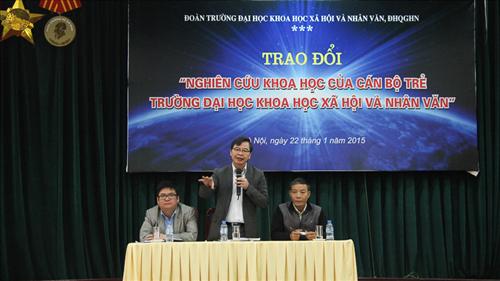
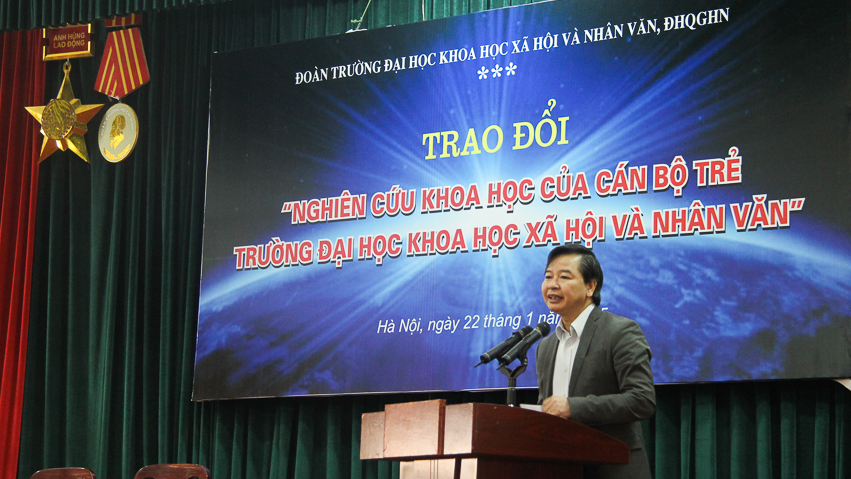
Associate Professor Pham Quang Minh, Vice Rector of the University, delivered a speech at the exchange session.
Scientific research is a mandatory task.
The University of Social Sciences and Humanities currently has 526 staff members, of which 224 are young staff (under 40 years old), accounting for 42.6%. 94.2% of these young staff members hold postgraduate degrees. This is a relatively high percentage compared to other universities. The young staff has played and continues to play a crucial role in scientific research in particular and the overall development of the University in general.
Associate Professor Pham Quang Minh affirmed that scientific research is a mandatory task for young lecturers at the University of Social Sciences and Humanities. This is the team that the University has identified as a priority for investment and support, providing them with favorable conditions to conduct their scientific research and expand academic exchanges with the international community.
Currently, the university's staff is implementing 14 state-level research projects, dozens of Nafosted-funded projects, and projects at various levels; publishing an average of over 600 scientific articles and dozens of books annually; and organizing more than 30 scientific conferences and seminars, half of which are international. Notably, since 2010, the number of international publications has steadily increased. While there were only 7 international publications in 2010, by 2014, there were 42 international publications, including those in scientific journals listed in the ISI and Scopus systems. With the goal of developing into a research university and integrating with the region and the world, scientific research activities will certainly be further promoted in the coming time. This is a favorable environment for young staff members to develop their abilities.
In addition, the University has implemented policies to encourage young staff members, such as: rewarding internationally published works; providing tuition support for young staff members pursuing postgraduate and doctoral studies; supporting fees for international English language proficiency exams; and supporting staff with PhDs in their first year of employment at the University. A scientific conference for young staff members is held annually, aiming to create a forum for academic exchange among postgraduate students, doctoral candidates, and young researchers. This year, the University is launching a scientific journal on Social Sciences and Humanities, which will provide further opportunities to support young staff members in publishing their works.
Obstacles come from many sides.
At the conference, many opinions were expressed that the scientific activities of young researchers are still not commensurate with the potential of the workforce. The reasons stem from many factors.
Scientific management activities have not yet fully utilized their function of advising and supporting staff in accessing resources for research. Associate Professor Hoang Thu Huong (Faculty of Sociology) believes that young staff members urgently need support to increase their opportunities to access research projects at all levels. Currently, such opportunities are limited. Furthermore, the project registration process is still complicated, and information regarding project approval reaches staff members slowly.
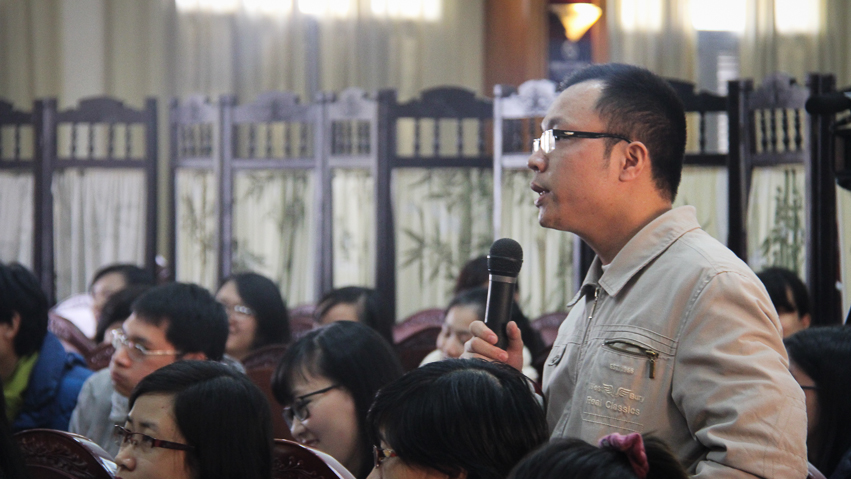
PhD candidate Pham Van Hung (Faculty of Literature) presented some opinions at the discussion session.
PhD candidate Pham Van Hung (Faculty of Literature) pointed out a difficulty in international publication: the foreign language proficiency of authors. He also suggested that the university should provide solutions to support scientists in translating their research into foreign languages.
Ms. Tran Thi Mai Hoa (Faculty of Tourism Studies) shared that young staff members face difficulties due to limited time for research caused by excessive administrative and managerial tasks. In addition, they struggle to access the latest scientific information because the university's scientific database is limited.
Explaining the lack of internationally published research by young scientists, some argue that the problem lies in the quality of the papers themselves. The research often lacks connections with other studies in the same field and fails to find common ground with the international scientific community. Although the university organizes dozens of international conferences annually and supports staff in participating in scientific exchanges abroad, a segment of young staff members have not yet fully utilized these opportunities.
Be passionate and dare to take on challenges.
"We were truly passionate about research."How can research not only fulfill obligations and responsibilities to the university, but also, more importantly, stem from the intrinsic needs of each young researcher?" - Associate Professor Pham Quang Minh posed this question to the young staff members.
"We have a great advantage: the University has a long history and a strong research tradition with prominent scientific figures throughout its development. This tradition of scientific research has been continued through many generations of scientists and lecturers. Young lecturers should take advantage of this and learn from the experience of previous generations of teachers." - Assoc. Prof. Dr. Pham Quang Minh suggested.
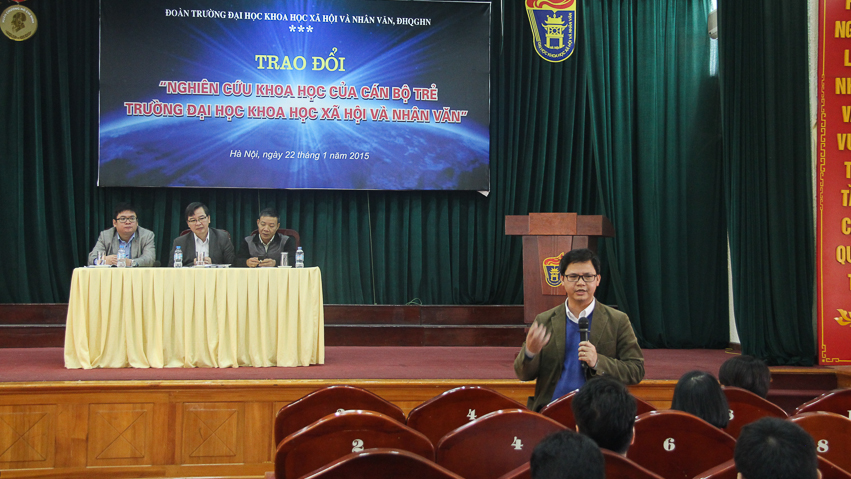
Associate Professor Vu Van Tich (Head of the Science and Technology Committee, Vietnam National University, Hanoi) is sharing his opinions in the discussion.
Associate Professor Vu Van Tich (Head of the Science and Technology Committee, Vietnam National University, Hanoi) believes that young scientists need to be bolder and more proactive in seeking funding for their research:Gather a list of international research funding sources; they are also very "open" to research topics in the social sciences and humanities and are willing to take risks. In addition, look for opportunities in local areas – places that truly need the intellectual contributions of scientists to help develop the socio-economic aspects of the province or region.".
Connecting domestic and international scientists, linking social sciences and humanities with natural sciences and technology to solve major, interdisciplinary problems of society and the country – this is an inevitable trend in science and social practice. If young scientists are left out of this trend, it will be very difficult to elevate the level of their research.
Associate Professor Dr. Vu Van Tich affirmed:Young scientists must be aware of the need to earn a living from their research, and in fact, Vietnamese scientists today can absolutely make a good living from their research.".
Author:Thanh Ha - Photo: Dinh Hau
Newer news
Older news

