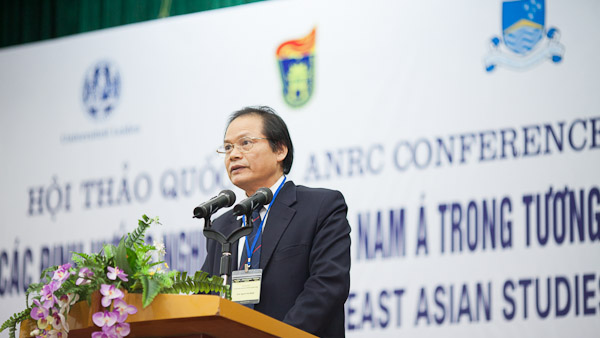
The Scientific Conference on the theme "Future Research Directions" was organized by the University of Social Sciences and Humanities in collaboration with Leiden University (Netherlands) and the Australian National University over three days, March 8, 9, and 10, 2012.The conference was attended by over 40 international scientists and more than 50 domestic scientists. The main focus of the conference was summarizing research achievements and discussing key trends in Southeast Asian studies in the 21st century. During the conference, scientists presented and discussed in-depth issues related to: history, culture, language, national policies, and the relationships between countries in Southeast Asia. Simultaneously, the scientists also outlined future research directions on Southeast Asia, such as research on ethnic minorities in Southeast Asia, indigenous peoples and natural resources, migrant labor and human trafficking in Southeast Asia, and religion in society.

Since the late decades of the last century, Southeast Asia has emerged as a dynamic region, playing a significant role in global development. From its inception, Southeast Asia has been a region with its own unique identity and distinctive cultural values. Studies on Southeast Asia have achieved many successes over the past century and continue to make even greater progress in the first decade of the new century thanks to the dynamism of several research organizations and large-scale research projects. One of these successful initiatives is the Australian-Netherlands Research Cooperation, established in 2006 and run by Leiden University and the Australian National University, aimed at promoting collaborative training between the two countries in the field of social sciences and humanities, particularly in Southeast Asian studies. Over the past six years, the program has funded and organized several large-scale conferences focusing on various topics. In addition, the program also supports students in researching and studying in other countries. This workshop aims to summarize the first phase of the cooperation process, with the University of Social Sciences and Humanities as the host institution.