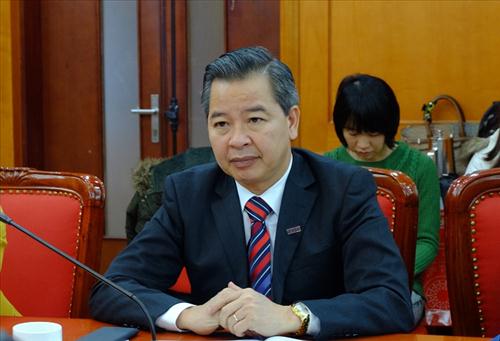
Thirty years ago, we embarked on the reform process, but today, despite achieving many successes and advancements, it must be acknowledged that the reform process has progressed very slowly, leading to Vietnam falling further and further behind the world and even other countries in the region. Therefore, at this point, we need to carry out the reform process more vigorously and decisively. I think that no other ministry but the Ministry of Science and Technology should be one of the leading and pioneering ministries in this reform.

Prof. Dr. Pham Quang Minh
To meet the need for innovation in the social sciences and humanities, I believe that scientific activities must be internationalized. In the overall strategy of internationalization and integration in science, international publications are a very important indicator, because it is through international publications that the world understands Vietnam and Vietnam can connect with the world. For example, for a long time, we have been fighting to protect our territorial sovereignty, but there are very few articles in international journals researching the South China Sea, while China has many. In the field of natural sciences, two-way "exchange" between us and the outside world is perhaps better than in the field of social sciences and humanities. I have the feeling that our social scientists are isolated in the world of scientific research, unable to engage in dialogue with the outside world due to language barriers, limitations in methodology and methods, and limitations in thinking. To break down these barriers, it is necessary to introduce, and if necessary translate, the new research findings of scientists worldwide to Vietnam. Currently, many Vietnamese scientists are completely unaware of what the world is doing, what research they are conducting on Vietnam, and vice versa.
Implementing the policy of international publication in the social sciences and humanities still faces many difficulties. For example, Hanoi National University assigns our University of Social Sciences and Humanities a target of publishing 34 articles in ISI/SCOPUS journals each year. However, in reality, we average 40 international publications per year, but only about 5-6 of them are in ISI/SCOPUS journals. This situation has remained unchanged for almost 10 years. Initially, the university awarded each staff member with an international publication 5 million VND per article, while ISI/SCOPUS publications were initially rewarded 10 million VND, later increased to 15 million VND per article. But increasing the reward money does not necessarily mean an increase in the number of publications. The reward money only serves to encourage the spirit of the scientists. Therefore, in addition to encouragement, we are considering whether to implement a system of assigning international publication quotas to individual associate professors and professors, similar to how we implemented the "quota of 100" and then "quota of 10" for households and agricultural workers. Although difficult, we must be very resolute and cannot maintain the current stagnant situation. Many scientists, after being awarded the titles of associate professor or professor, become complacent, thinking they have completed their task. According to statistics, the country currently has over 1,100 professors and over 9,000 associate professors, but less than 40% of them have published internationally.
To promote research in the social sciences and humanities, in addition to the efforts of individual scientists and research institutions, a more rational science management policy is also needed. Regarding investment in science, to promote the social sciences and humanities, it is essential to focus more investment on this sector. The current imbalance in investment between natural sciences and social sciences (natural sciences 60%, social sciences only 4%) cannot be allowed to continue. Many misconceptions must be immediately dispelled, such as the idea that learning from anyone is unnecessary, that social science and humanities research only requires "paper and a pen," or that social sciences and humanities do not produce material wealth and therefore do not require investment. It is precisely because of these misconceptions that we are currently paying a heavy price for the backwardness and stagnation not only of the social sciences and humanities but also of society as a whole.
On the other hand, it is also necessary to "liberate" academic thinking; we cannot continue with outdated, one-sided thinking and imposed approaches in many areas of social science research. Looking at the world, international awards for social science research on Vietnam in the last 10 years have all gone to foreign scientists with new research that is considered "sensitive" or "controversial" in our country. Clearly, if we still cling to outdated thinking, and are afraid to delve into new topics with new thinking, new approaches, new methods, and new sources of information, we will certainly not be able to promote social science research and engage in dialogue with the world.
Author:According to Tiasang
Newer news
Older news

