The workshop was attended by Mr. Jean-Noel Poirier (Ambassador Extraordinary and Plenipotentiary of the Republic of France to Vietnam), Mr. Yves Goudineau (Director of EFEO Paris), Professor Phan Huy Le (President of the Vietnam Historical Science Association), Professor Nguyen Van Khanh (Rector of the University of Social Sciences and Humanities), along with scientists from Vietnam, France, and Japan.
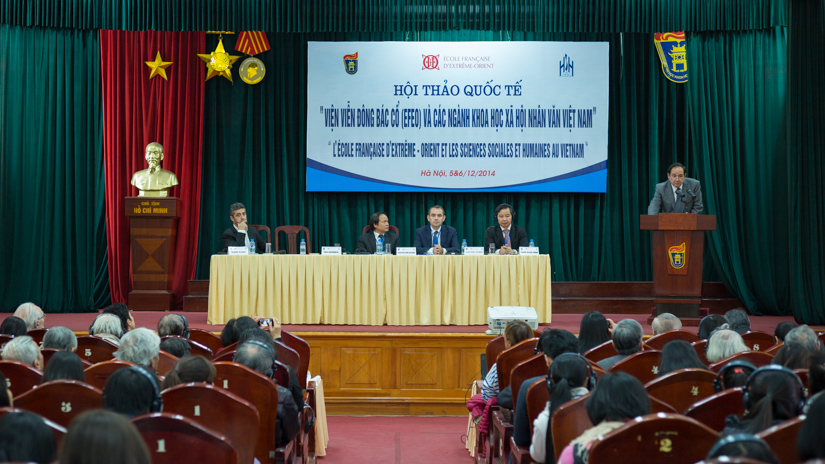
Overview of the opening session of the Conference/Photo: Thanh Long
At the opening session, Professor Nguyen Van Khanh delivered a speech affirming the important role and contributions of EFEO to the formation and development of the social sciences and humanities in Vietnam.
"EFEO is the most solid bridge among many bridges of knowledge connecting Vietnam's academia with the world."The Rector emphasized this point.
In 1898, the Governor-General of Indochina, Paul Doumer, signed a decree establishing a research institution on the Orient called the "Permanent Archaeological Mission in Indochina." In 1900, this institution was renamed the "French School of Far Eastern Studies," abbreviated as EFEO, with the main function of conducting scientific research on history, archaeology, linguistics, ethnology, geophysics, and anthropology in the Indochina peninsula and other countries in the Far East.
On November 23, 1945, President Ho Chi Minh signed Decree No. 65 establishing the "French School of Archaeology" to replace the "French Far East Institute of Archaeology," with the task of preserving and safeguarding the research achievements of the EFEO throughout Vietnam.
Following the 1954 Geneva Accords, the EFEO moved its headquarters to Saigon. In 1960, the EFEO officially closed, ending over six decades of operation in Vietnam. In 1993, the EFEO re-established its representative office in Hanoi. Currently, in addition to its headquarters in Paris (France), the EFEO has 18 centers in 12 countries, including two representative offices in Vietnam, in both Hanoi and Ho Chi Minh City.
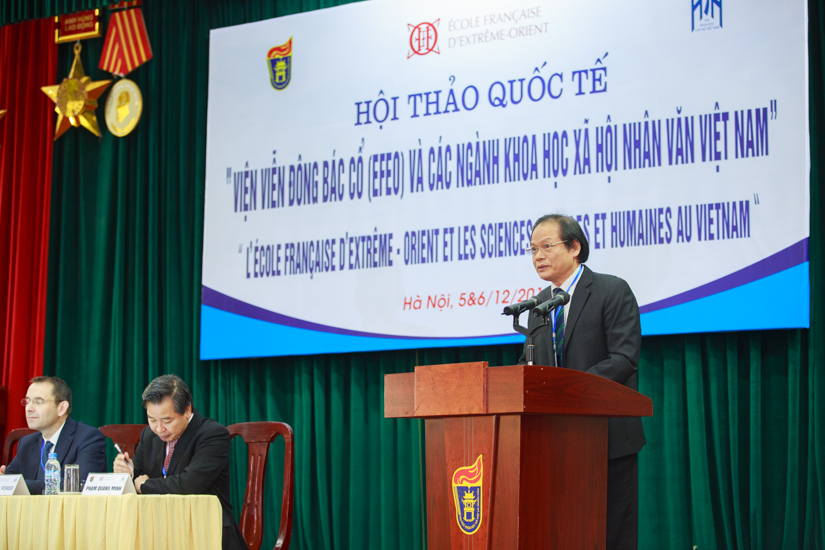
Professor Dr. Nguyen Van Khanh (Rector of the University of Social Sciences and Humanities) delivered the opening speech at the conference/Photo: Thanh Long
The contributions of the EFEO to the Vietnamese social sciences and humanities are evident in the following key areas: contributing to the opening of several modern social science and humanities disciplines in Vietnam such as archaeology, ethnology, museology, and textual studies; promoting the modernization of traditional social sciences and humanities disciplines while simultaneously developing new ones; contributing to the development of a team of international Vietnam studies scholars, and simultaneously contributing to the training of a generation of modern Vietnamese social scientists and humanities scholars in the 20th century; organizing numerous large-scale research programs and projects on the Neolithic period (Hoa Binh), the Metal Age (Dong Son, Sa Huynh), ancient kingdoms (Funan, Champa), etc., and publishing.Bulletin de L'Ecole Francaise d'Etrême-Orient-BEFEO)and many works of significant cultural and historical value to Vietnam; in addition, EFEO makes practical contributions to the collection and preservation of antiquities, the construction of modern museums, and contributes to the field of heritage management in Vietnam.
In recent years, EFEO has made effective contributions to introducing new research trends, perspectives, and scientific schools of thought, thereby contributing to the development of the social sciences and humanities in Vietnam.
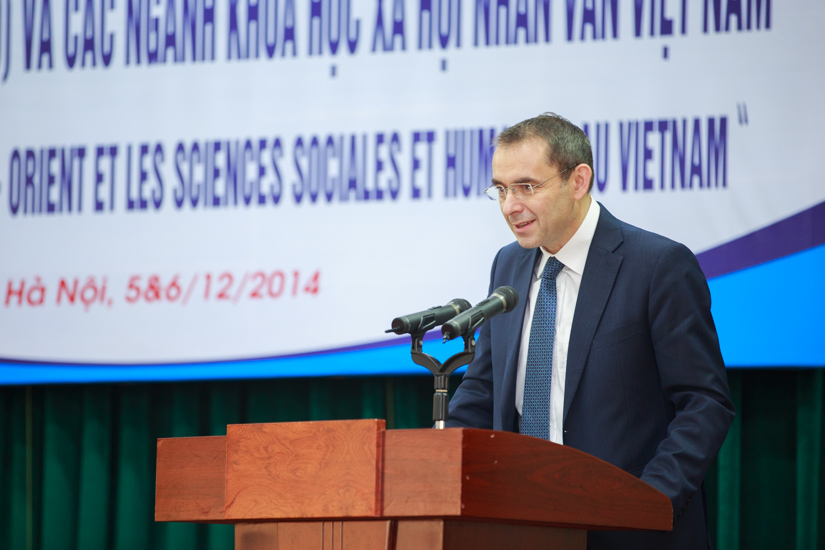
Mr. Jean-Noel Poirier (Ambassador Extraordinary and Plenipotentiary of the Republic of France to Vietnam) speaking at the Conference/Photo: Thanh Long
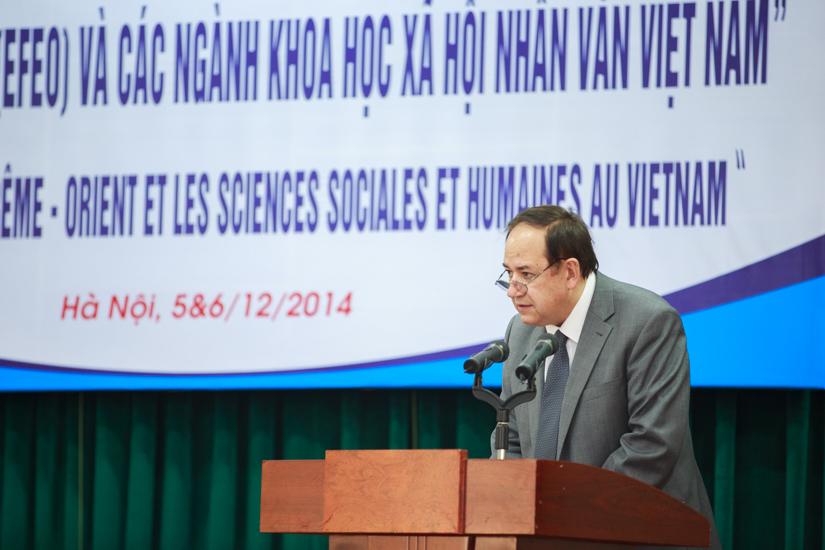
Professor Yves Goudineau (Director of EFEO Paris) speaking at the Conference/Photo: Thanh Long
Following the opening ceremony, the workshop will take place over two days, December 5th and 6th, 2014. This will be an opportunity for Vietnamese scientists to exchange research findings with scientists who have worked or are currently working in EFEOs worldwide, thereby strengthening interdisciplinary approaches, comparing and contrasting their research results with those in the region and the world, and gaining a more comprehensive understanding of the social sciences and humanities in Vietnam today.
The papers will be presented in six subcommittees.
Subcommittee 1 with the theme “History of EFEO before 1945The specific topics of discussion included: EFEO and the preservation of Cham relics; the French School of Far Eastern Studies and the preservation of historical and cultural relics in Hanoi during the period 1900-1945; and BEFEO (1901-1945) sources in the study of Vietnamese history.
Subcommittee 2 with the theme “Scientific exchange and training of national scientific elites before 1945The specific topics of discussion included: From the French School of Far Eastern Studies to the French School of Oriental Studies: aspects of scientific cooperation between French and Vietnamese researchers; Henri Maspero and the study of Vietnamese phonetics; LeoPol Cadie and his research on religious studies in Vietnam - a significant milestone in the formation of the field of Religious Studies; EFEO and the formation of Area Studies and Vietnamese Studies.
Subcommittee 3 with the theme “Scientific exchange and elite scientific training from the period of independence to the period of reform.The specific topics of discussion included: Spatial approaches in the study of Vietnamese villages and the contributions of the French School of Far Eastern Studies; and the application of EFEO's resources to continue social science research by Southern scholars before and after 1975.
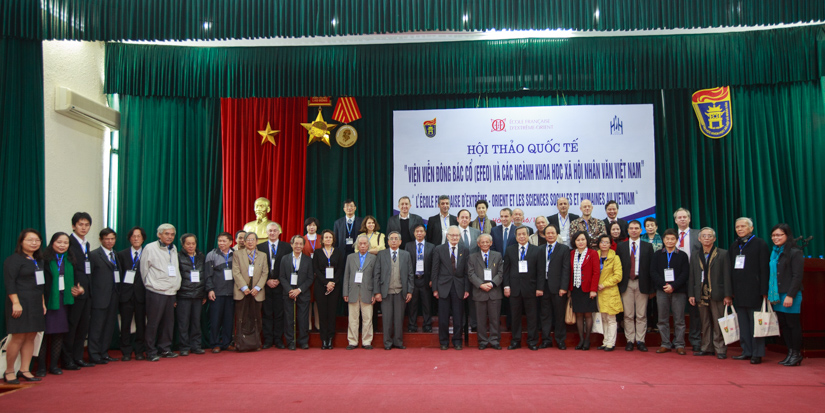
Delegates pose for a commemorative photo after the opening session of the Conference/Photo: Thanh Long
Subcommittee 4 with the theme “The EFEO center in Vietnam has been operating since 1993.The specific topics of discussion included: Multidisciplinary research conducted by EFEO and the Vietnam Institute of Archaeology; EFEO's central role in a regional cooperation program to enhance methodological research in social sciences; and observations on a new research direction in Southern Vietnamese culture and current research conducted by EFEO.
Subcommittee 5 with the theme “Scientific collaboration between Vietnamese research institutes and museums and the EFEO Center has been ongoing since 1993.The specific topics of discussion included: the comprehensive collection of Han Nom inscriptions – a highlight of EFEO's scientific cooperation in the early 21st century; EFEO's activities in collaboration with the Institute of Archaeology in researching and preserving Vietnamese cultural heritage; the research cooperation between the Thang Long - Hanoi Heritage Conservation Center and the French School of Far Eastern Studies from 2010 to the present; scientific research by EFEO scholars on the collection of the Da Nang Cham Sculpture Museum; and EFEO's research on Lao Cai.
Subcommittee 6 with the theme “EFEO centers in Southeast AsiaThe specific topics of discussion included: Preservation and restoration of sculptures of the Champa culture and the Mekong Delta; Recent research activities on Champa inscriptions; EFEO's photo library, focusing on data related to the Vietnamese background; The value of EFEO to researchers of Vietnamese history: the case and expectations of researchers in Japan.
Author:Thanh Ha - video: Dinh Hau
Newer news
Older news

