

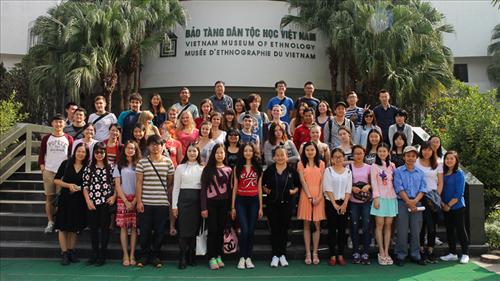

The students came from many different countries such as Russia, France, Germany, Japan, South Korea, the Czech Republic, Ukraine, Mongolia, Laos, and China… The majority were students under agreements (students who come to Vietnam to study within the framework of agreements signed by the Vietnamese government with other countries, and are granted scholarships by Vietnam), in addition to short-term students and, notably, undergraduate students majoring in Vietnamese Studies. This field trip was part of a study plan aimed at helping international students not only learn Vietnamese but also gain a better understanding of Vietnamese culture.
Students were divided into groups, touring the museum while listening to guides explain about the ethnic groups in Vietnam, their language families, and regional characteristics. During their time living and studying in Vietnam, most students had only interacted with Vietnamese people. At the museum, they had the opportunity to see firsthand the cultures of other ethnic groups living in Vietnam, such as the funeral rites of the Muong people, the traditional clothing of the Thai people, the conical hats of the Nung people, the baskets of the Sedang people, and the ox carts of the Cham people. Their curious eyes and eager faces clearly showed their surprise and interest in the diverse, rich, and unique cultures of the ethnic groups in Vietnam.

The students listen to the museum's explanation. (Photo: Nguyen Thi Nguyet)
After carefully examining the exhibits in the indoor museum, the students went on a tour of the outdoor museum. They were delighted to directly step on and touch the houses of various ethnic groups that had been transported to the museum and recreated by the ethnic people themselves in the outdoor exhibition area. These included houses such as the stilt houses of the Tay people, the communal houses of the Bana people, the burial houses of the Gia Rai people, the longhouses of the Ede people, and the double-roofed houses of the Cham people… A series of questions were asked of the teachers, such as: Why are there so many wooden statues around the Gia Rai burial houses? What is the purpose of such tall communal houses? Why are Vietnamese houses said to have two bays and three wings?… After the teachers' thorough explanations, soft murmurs of "I understand now," "So that's how it is," could be heard, leaving both teachers and students satisfied.

The students climbed onto the communal house. (Photo: Nguyen Thi Nguyet)
The enriching field trip concluded after nearly four hours of visiting the museum. The session helped students learn more about the ethnic groups of Vietnam, fostered interaction among international students, and strengthened the bond between teachers and students. On the way back, there was a constant stream of questions, discussions, and exchanges among the students in preparation for their group presentations the following week. This vividly demonstrates the Faculty's efforts in innovating university teaching methods and applying modern approaches to teaching and learning Vietnamese as a foreign language.