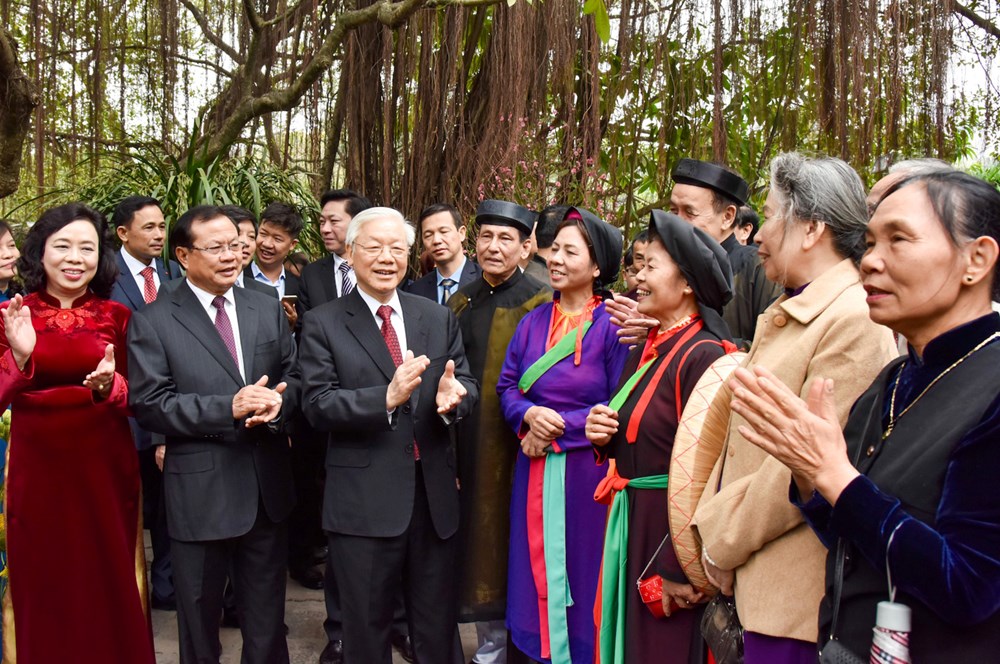
General Secretary Nguyen Phu Trong and former Secretary of the Hanoi Party Committee Pham Quang Nghi extended New Year greetings to the people of Hanoi at Ngoc Son Temple during the Lunar New Year of Dinh Dau 2017. Photo: DUY LINH
Reflecting on his life, General Secretary Nguyen Phu Trong has accomplished many things and earned the trust of the people through his actions for the people and the country. That is his character and cultural integrity.
"Therefore, practicality is necessary."In both his guiding principles and specific actions, he offered detailed, easy-to-understand, and practical advice, rather than vague directives. When persuading me to become Director of the Department of Culture and Sports, he simply said: "Don't worry that you've never done it before and therefore can't do it. No one taught me how to be a Party Secretary, yet I still did quite well. You learn as you go. The main thing is that you have the desire to learn and want to do useful things. And in your relationships with colleagues, you must be sincere and support each other."
When assigning the Department of Culture and Sports to prepare the project for the program on developing culture and building elegant and civilized Hanoi people, in practical terms to commemorate the 1000th anniversary of Thang Long-Hanoi, he instructed, in essence: The field of culture is broad; everything is intertwined with culture. It's not wrong to say that economics, politics, society, and people are all within culture, or that they are closely linked to culture; even then, there's still much debate. But we are not doing this program to define things nominally, not to talk about general theories, but to apply them to practice. Therefore, while the theory must be solid, reaching the final conclusion is not our job, but that of the research community. We need to create a shift from awareness to action, to push Hanoi's culture forward. Don't expect to create something grand, but to move Hanoi's culture forward, towards what is decent. Hanoi is working on it, the entire political system is involved, the people are participating, but things are still very disorganized. Therefore, practical solutions are needed.
Faced with differing opinions on the goals of Hanoi's cultural development and the direction for building a refined and civilized Hanoi citizen, he instructed that further consideration be needed to find the most effective approach. He said: "Experts have researched and identified the unique characteristics of Hanoi's culture, but is that enough? Does refinement and civility constitute the entirety of Hanoi's most representative qualities? How does the refinement and civility of the past, 'of our ancestors,' differ from ours today? We need to pinpoint these differences precisely so that we can work together to accomplish this task." When rather "academic" opinions were exchanged, he listened but only offered limited feedback. He said that because it's difficult, we need to invest in research. But we need to base our work on President Ho Chi Minh's principles of culture. This is not cultural theory, but rather a guideline for construction and a purpose for action. Uncle Ho said, "Culture must guide the nation, culture must contribute to building a new life, combating decadence and corruption, and reforming the lifestyles of our people..." If we follow that direction, we will surely achieve results. "I'm only stating the direction; how to organize and implement it, and in what way, must be based on experts and the people," suggested City Party Secretary Nguyen Phu Trong.
Culture is a broad concept with diverse content and a wide range of fields; to date, there are over 400 different definitions. Unlike scientists who research to define the essence of the concept of culture, we build culture from the perspective of creating an advanced culture that meets the demands of the times while remaining connected to tradition. Therefore, we need a historical and logical perspective. The direction must be defined, the goals must be set, but the specialized work should be left to the specialists.
(General Secretary Nguyen Phu Trong)
I was particularly struck by the practical approach, relying on professionals and the people. Work shouldn't be solely the responsibility of those assigned to the relevant sector. This idea wasn't established as a guiding principle of the Party until the 12th National Congress, becoming a set of guiding principles in practice. This shows that for such ideas to be put into practice, time and a change in perception are necessary. The then Secretary of the City Party Committee, Nguyen Phu Trong, gave profound and insightful guidance, both theoretically and practically. When drafting the program to present to the Standing Committee of the City Party Committee, we encountered a minor problem. Some people disagreed with our preparation, criticized it severely, and demanded a revision. To be fair, this comrade misunderstands the values of culture, the movement and transformation of cultural life. He primarily views culture as a movement, focusing heavily on the political aspects rather than considering the issue from its ontological perspective. Therefore, he demanded changes to the program content, which put us in a difficult position. I explained and tried to persuade him, but he did not change his mind.
In concluding the discussion, Party Secretary Nguyen Phu Trong made a very convincing statement: "Culture is a broad concept with diverse content and wide scope; to date, there are more than 400 different definitions. We are not like scientists who research to define the meaning of the concept of culture. Instead, we are building culture from the perspective of creating an advanced culture that meets the demands of the times but must also be connected to tradition, so we need a historical and logical perspective. The direction must be defined, the goals must be set, but the professional work should be left to the professionals." Thus, the draft plan was approved. He reminded me privately: "Working on culture is difficult, but don't be discouraged. The main thing is that practice will prove the correctness and effectiveness of the program. Therefore, we need to strive."
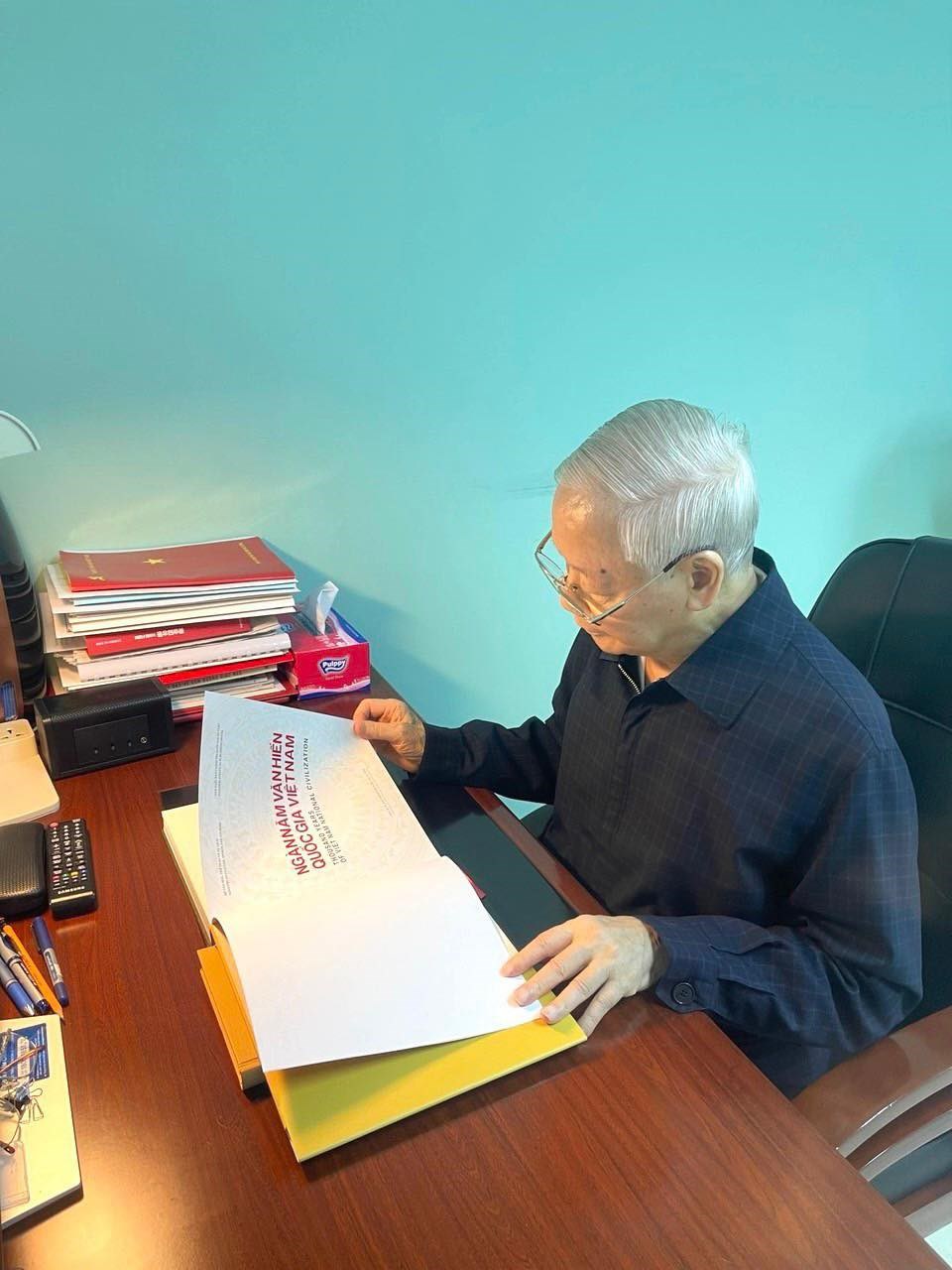
In his final days at Military Hospital 108, General Secretary Nguyen Phu Trong continued to receive medical treatment while also studying theory. (May 10, 2024)
Furthermore, he once corrected the flawed assessments of some who placed too much emphasis on economics without properly appreciating the role of culture. He thoroughly analyzed the viewpoint that while Hanoi should not be focused on developing into a leading economic center of the country, it must necessarily become a leading cultural center and a model for the entire nation. He said that failing to achieve this would be a disservice to Hanoi and the people of the whole country, because Hanoi is the capital, the face of the nation. This requires arduous and long-term effort, but the Party Committee and people of Hanoi must persevere to achieve this goal. While this work was underway, Hanoi Party Secretary Nguyen Phu Trong was elected Chairman of the National Assembly. He left Hanoi, but his directives on culture continued to be implemented. When the Law on the Capital City was enacted, the goal of striving to become the leading cultural center of the country was codified. This idea affirmed his vision when he held the important position of Party Secretary.
In his speech at the 2021 National Cultural Conference, he discussed the ideas of Vietnamese culture and people in the era of integration in more detail, comprehensively, and multifacetedly. The issue of national, family, community, and individual cultural values was raised in the context of increasingly rapid and intense globalization. The spirit of proactive integration to avoid cultural backwardness, which is tantamount to self-elimination from the global "big game," and to "stand shoulder to shoulder with the world's leading powers" was emphasized more forcefully. "Awakening the national spirit, uplifting the national intellect," relying on internal cultural strength to open up and integrate, and to avoid losing the nation's strengths, were new requirements. The issue of building a new value system for Vietnamese culture and people was raised more urgently for the first time. He spoke of the idea that "losing culture means losing everything." It is thought that human history has provided ample evidence that when a nation loses its inner strength and national identity, its race becomes alienated, and the nation falls into a path of self-destruction. However, a nation will lose its future if it exists with a crippled, lifeless culture. This situation has been and continues to be a threat to many nations around the world, especially in this era of openness and integration.
The root of a vibrant culture, capable of transforming the face of a nation, as he said, lies in its people and sound cultural policies. He often stated that national development must go hand in hand with social welfare, democracy, and justice to bring happiness to the people. More specifically, he said, "Human happiness is not just about having a lot of money, good food, and beautiful clothes, but also about richness of soul, living amidst love and compassion, truth and justice."
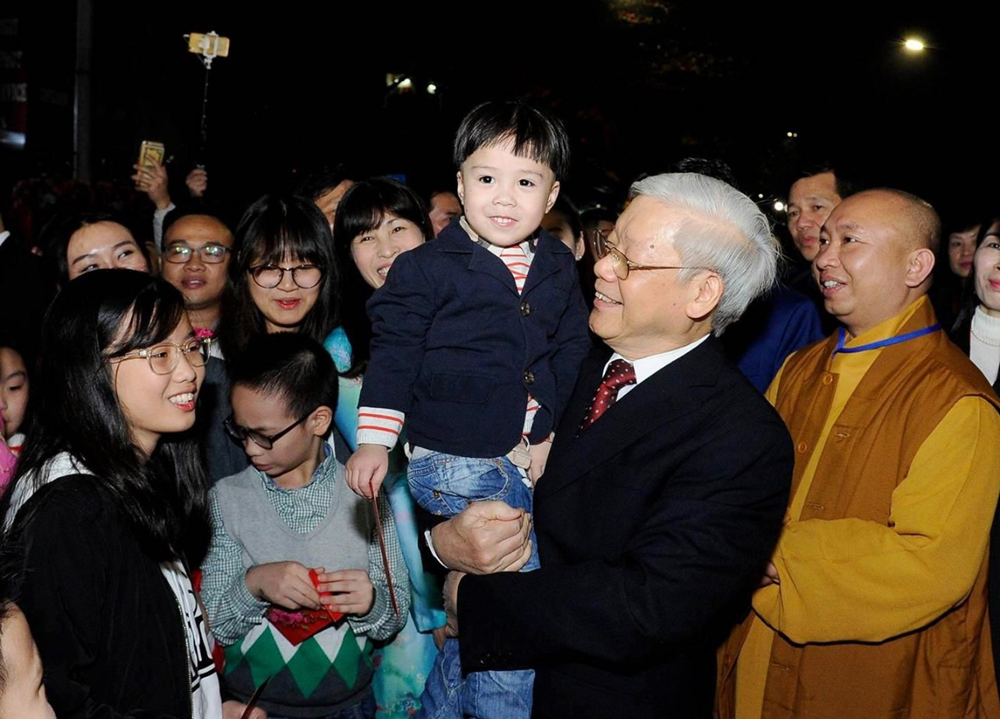
General Secretary Nguyen Phu Trong with the people of Hanoi. Photo: VIET THANH
A respected cultural personalityThe passing of General Secretary Nguyen Phu Trong leaves a void in society and for many people. For a long time, he was seen as a cultural figure, instilling confidence in society through his steadfastness and dedication to his chosen path. It can be said that, in the current circumstances, when many in the leadership have fallen into corruption and degeneration, he stands out as a shining star, a cultural figure most respected. His consistency in thought, morality, and lifestyle, as well as that of his family, not only earned the trust and affection of the Party and the State but also of what is good in life. He upheld honor, dignity, and conscience, and rejected all forms of pragmatism, hypocrisy, and deceit.
…Because it's difficult, that's why we need it, that's why everyone needs to invest in research. But we need to base our work on President Ho Chi Minh's perspective on culture. This isn't just cultural theory, but a guideline for development and a goal for our activities. He said, "Culture must guide the nation, culture must contribute to building a new life, combating decadence and corruption, and reforming the lifestyles of our people…" If we follow that direction, we will surely achieve results.
I'm only giving a general direction; how and in what way to implement it must be decided by experts and the people.
(General Secretary Nguyen Phu Trong)
Listening to him speak, some wondered: He quoted concepts of selfless living from the 1960s and 70s, but they seemed outdated. I have a different opinion. Back then, the lifestyle of living for others, always putting the collective good above personal gain, had an ideal beauty and a powerful appeal. It was the most valuable standard of living at that time. Living meaningfully, living for the community and the country, became such a social moral principle that one poet even contemplated it.
When we are in private, we feel ashamed.That meaningful way of life, a proud symbol of a bygone era, is sadly now looked down upon by many.
General Secretary Nguyen Phu Trong grew up in that atmosphere, chose that way of life, and strived to uphold those principles throughout his life, but he did not consider them as
the unique virtue of the selfHe instilled this passion in the younger generation, hoping they would also choose that beautiful way of life. His choice was that of a scholar, valuing spiritual values more than trivial material benefits. He didn't say it explicitly, but he strictly maintained the self-cultivation of a scholar: enriching himself with intellect, living a noble and simple life. The essence of a Northern Vietnamese scholar was very strong in his choice of lifestyle and conduct until the very last day of his life. He managed his family and governed the country in the true spirit of a gentleman.
A gentleman leaves behind worldly affairs, and his reputation will be built upon obscenities.(A virtuous person cannot overlook the importance of benevolence).
He hated evil, he hated corruption as much as he hated the dregs of society. He persistently fought corruption without exception, with the spirit of "eradicating internal enemies," directing all levels to "those who don't want to work should step aside" because he wanted a healthy social environment. He hoped to build Vietnamese people in this direction, without losing traditional qualities but also keeping pace with the times. Society recognized his contributions and respected his way of life. When he was still the Secretary of the Hanoi City Party Committee, an old professor presented him with a pair of couplets as a message to his student and also as a token of his trust in him:
Upholding the rule of law, punishing the nation; uniting the hearts of the people, eliminating the traitors.(meaning: Above, uphold the rule of law and punish those who corrupt the nation; Below, unite hearts and minds and eliminate those who harm the people).
Then, when he met with students from the 8th graduating class of the Faculty of Literature (Hanoi University), at which time he had already assumed the position of General Secretary, his teacher gave him a calligraphy inscription.
Upholding righteousness and integrity, upholding Party principles; showcasing talent and wisdom, winning hearts and minds.(Meaning: Emphasizing integrity and honesty, revitalizing the Party's spirit; promoting talent and intellectuals, uniting the people's hearts). Reflecting on his life, he accomplished many things and earned the people's trust through his dedication to the people and the nation. That was his character and cultural integrity. His passing leaves a void in society and in each individual. But the legacy he leaves behind is immense. Here, I'm not discussing other grand issues, but only the lessons learned from him as a cultural figure.
Author: Assoc. Prof. Dr. Pham Quang Long - Former Rector of the University of Social Sciences and Humanities
Link to the articlehere
Related articles
General Secretary Nguyen Phu Trong in the memories of his former teacher.
Beautiful memories with the students of Batch VIII (K8) and Mr. Nguyen Phu Trong.
General Secretary Nguyen Phu Trong - From Literature student to head of the Party and State
General Secretary Nguyen Phu Trong's affection for everyone.