It all started with work. One day in 1990, Professor Bui Duy Tan called me to his office to ask for my help. He said, "You know Mr. Nguyen Phu Trong, right? Go and invite him to teach journalism to the students of the Faculty of Literature. Our Faculty has always invited veteran journalist Quang Dam to teach, but he's in Saigon visiting relatives and will probably be gone for a while. Mr. Phu Trong has written a book on journalistic skills, and he's very professional. Try your best."
I rushed to the Communist Magazine and asked to see him. He enthusiastically agreed: "Oh, what could be better than serving the students of our Faculty? Tell Professor Tan that I, your student, am happy to accept. It's such an honor!"
After discussing the teaching schedule, the topic of transportation came up. He said, "Consider my return to the Faculty to teach a personal matter; I'll find a way to get there without using the company car."
I knew that at the time, he was the Deputy Editor-in-Chief of the magazine, holding the rank of Department Head, and had the privilege of owning a company car. I cautiously said, "Hey, how about I give you a ride on my bicycle? I only have a bicycle!" He replied, "That would be great! Much better than during the evacuation in Thai Nguyen! We only had one motorbike at home, and my wife used it for work."
So, as scheduled, I went to pick him up to go to My Dinh for his teaching job. We were riding bikes, but my legs are short, so if I wanted him to sit in front, I'd have to pull the bike close to the sidewalk and put my feet down. He said, "Just get on the bike, I'll run after you and jump on."
On the way to school, we chatted. Knowing my situation as a single parent with a child, I often had cold lunch. He suggested we meet at Nguyen Thuong Hien Street at 11 a.m. and have lunch at his house. "As a teaching staff member, I'm all too familiar with your situation," he said. From then on, on teaching days, I would go up to the third floor of the apartment building where he lived and eat the meals his sister, Man, cooked. Water spinach, fish sauce, and a dozen slices of thinly sliced pork belly. She was like a caring older sister, often pushing the plate of meat closer to me and saying, "Teacher, have some rice!"
Then, I received a message about a gift. I cycled to the house of poet Vu Duy Thong, a classmate from the 8th year of the Faculty of Literature at the University of Hanoi. I found a package wrapped in newspaper, and inside was an old, moss-green blazer. He said Phu Trong sent it as a gift because he thought it fit me well. It was old, but it was still in good condition. That's how I learned to wear a blazer. Putting it on made me feel much more respectable.
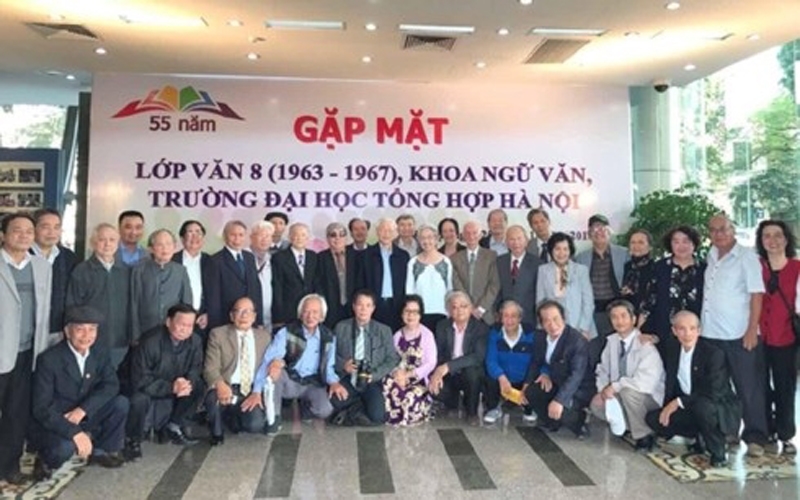
General Secretary Nguyen Phu Trong poses for a commemorative photo at the reunion of the Literature Class of 8th Grade (1963-1967), Faculty of Literature, Hanoi University.
The second story is from 2001. I received a phone call from him saying to wait in front of alley 160, a friend's car would pick us up, and we'd go to Van Tho, Thai Nguyen, to visit the place where our department was evacuated during the war against America. He asked me to come along for fun. So, a few cars set off. After the visit, in the evening, the ladies suggested spending another night by the lake because they were all nearing retirement age and opportunities were becoming scarce.
That night, we lit a bonfire and I heard a strange story. People pointed to the opposite hillside, dimly lit by the moonlight, and told us:
Back then, we male students climbed mountains and cut bamboo to build makeshift shelters for studying. Phu Trong and Nguyen Van Thinh were like two teachers, thinner and weaker, but they still carried ten bamboo poles like the others, trudging back and forth, arriving late to their resting place. The others teased them, calling them "Teacher Thu" and "effeminate scholars." At that time, an old man from Thai Binh, who had settled in Van Tho before 1945, came to ask for tobacco because he had gotten soaked while foraging in the forest.
Hearing everyone teasing him, he stood up, pointed at Nguyen Phu Trong, and said, "Don't tease me. That's the King, you're just ordinary people."
Then he turned to Van Giang, a man from Quang Ngai who had joined the resistance, who spoke with a strong, boisterous accent, so we called him "Giang Van Giang" because when we called roll, he would answer, "Giang Giang is present!". He said, "And this man will be a hero of the battlefield…but…". He put his arm around Van Giang's shoulder and shook him.
That's right, in 1968, our Jean Valjean went to the battlefield to write as a reporter and died. And now it's absolutely true, Phu Trong is the Party Secretary of the City, and we are all citizens of the capital now.
Mr. Trong just sat there, smiling to himself and straightening the pieces of firewood that had rolled out.
Being someone who enjoyed writing articles, I was eager to write about unusual stories, hoping to earn a few dollars. But being cautious, I immediately consulted with some of the K8 members and Mr. Phu Trong. Then Mr. Vu Duy Thong advised me: "Everyone in our class knows the truth. But don't publish it. Aren't you afraid people will think you're flattering your superiors?" At that time, Mr. Duy Thong worked in the Department of Culture and Ideology, in charge of Education and Journalism, so I followed his advice, even though I regretted losing such a strange memory.
The third recent event was the repatriation of Professor Nguyen Tai Can's ashes from Russia, according to his wishes, to his hometown of Thanh Chuong. Phu Trong learned about it and sent a message saying, "Professor Can was your teacher, but he was also my teacher. Please give me the date so I can send a wreath to pay my respects."
On the day of the reception, I also forgot to mention it. A convoy of cars traveled from Hanoi along the Ho Chi Minh Trail. When we reached Nghia Dan district, the organizers called me asking why the flowers from the General Secretary hadn't arrived yet. On the bus, I called him. He said, "It's ready! The car is on its way from Vinh." Turns out he remembered better than me. The car stopped at the Do Luong flower garden for a short break, then I received a phone call saying the flowers had arrived, so we rushed back.
Regarding the General Secretary's personal life, I will only speak from a personal perspective. He was a kind and benevolent elder, full of compassion and empathy for everyone. Secondly, he was serious and dedicated to his work; looking at the handwriting preserved from his student days, one can see that his handwriting truly reflected his character. Thirdly, he was steadfast in his convictions, very principled in his work, but he applied those principles flexibly within the complexities of the changing situation. Fourthly, he was wholeheartedly devoted to the common good, prioritizing work efficiency while being patient and discreet, without embellishment or pretense. Fifthly, he possessed unwavering courage and thorough thinking, engaging in tasks with great determination. Sixthly, he was undoubtedly an upright politician, embodying the spirit of self-discipline and adherence to propriety. The General Secretary acted tirelessly for 62 years, acting as a judge but always putting "heart" and "compassion" first.
It's also a personal story. When I was the Secretary of the Hanoi City Party Committee, through Professor Phung Huu Phu, he suggested I work at the City Party Committee. I refused because I felt I wasn't capable enough, sharp enough, or broad enough in my thinking to take on the job. I said, "Our professors are keeping me at the university to do research and teach. I'm almost 50 years old, I'm too embarrassed to change jobs." He immediately said over the phone, "Then I'll make you pay. Introduce me to someone." And I successfully introduced her to People's Artist Xuan Yen.
I think everyone has their own profession. Politics is also a profession. Being a politician is extremely difficult and arduous, even dangerous. Since we are in different professions, we must be very cautious and respectful when commenting on other professions.