
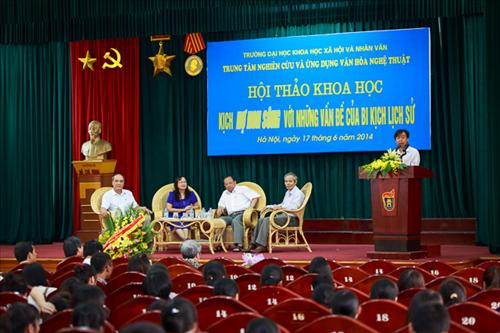
The play collection "Debt to the Nation" comprises seven plays: "Cao Bá Quát," "Nguyễn Công Trứ," "Debt to the Nation," "Moments of Ho Chi Minh," "The Returnee," "The Human-Faced Demon," and "The Inspector." Most of these plays have been performed on stage. Many plays in this book have been staged and performed with great acclaim, some winning top prizes at national theater festivals and awards. For example, the <i>chèo</i> play "The High Official Returns to the Village," based on the play "The Inspector" by the great Russian writer Nikolai Vassilievich (1809-1852), with a script by Phạm Quang Long, won four Gold Medals at the 2011 National <i>Chèo</i> Festival. In addition to the Gold Medal for the play itself, "The High Official Returns to the Village" also brought three individual Gold Medals to artists Quốc Anh, Thu Huyền, and Thu Hằng.
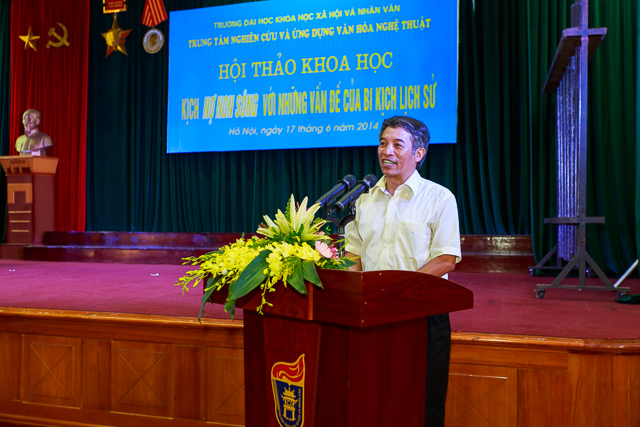
Associate Professor Pham Quang Long speaking at the conference. (Photo: Thanh Long/USSH)
Speaking about the historical figures featured in his works, author Pham Quang Long once shared:"I write about them as people who lived before us. They became famous through many real and fictional events. I researched them, and history (official and unofficial) could only provide me with the results of their work, the reasons they were honored or criticized. I tried to understand how they got there, but I was powerless because nowhere could point out these specific details. So I had to write about them based on my imagination. Therefore, my characters are fictional, my creations, like characters in novels; nothing is taken from their biographies."
According to critics, the play collection "Debt to the Homeland" is not only significant in terms of topicality, but also scientifically insightful and provides answers to the complexities of the nature of tragedy, the poetic characteristics and themes of historical drama... Therefore, this event goes beyond simply launching a book; it also aims to discuss general issues of universal significance for the entire theatrical art scene within the Vietnamese dramatic literature of today.
Specific topics discussed by critics and researchers at the workshop included: a general assessment of the play "Debt to the Nation" and the play collection "Debt to the Nation," and the "phenomenon" of author Pham Quang Long; the play collection "Debt to the Nation" from a genre perspective; the relationship between literary scripts and traditional opera; the relationship between artistic fiction and historical documents in literature and art; the nature of tragedy and the history of Vietnamese theatrical drama; and predictions for the development of historical drama…
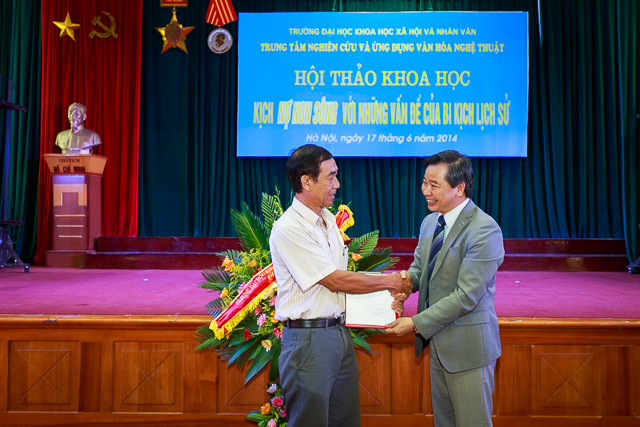
The workshop also marked the launch of the Center for Research and Application of Culture and Arts. In the photo, Assoc. Prof. Dr. Pham Quang Minh (right, Vice Rector) presents the relevant decisions to Assoc. Prof. Dr. Pham Thanh Hung (Director of the Center). (Photo: Thanh Long/USSH)
The following are some of the opinions expressed by critics at the conference:
Professor Ha Minh Duc: “The ‘Debt to the Nation’ contains new thinking and new perspectives.”
For author Pham Quang Long, the release of this book is a "breakthrough." The book contains eight plays. This is truly a spectacular "debut," a very commendable contribution from Pham Quang Long. Proof of this is that this collection of plays has been staged and performed by various traditional Vietnamese opera, drama, and reformed opera troupes.
The greatest strength of this script lies in its fresh perspective and innovative thinking. The way we think is crucial, and finding new ways of thinking is very difficult. Pham Quang Long consistently demonstrates fresh thinking, a talent for fiction, and a vivid imagination in his works. I deeply appreciate Pham Quang Long's talent. And this is truly a remarkable breakthrough.
Researcher Nguyen Hung Vi: Respect and admiration for the work ethic of Mr. Pham Quang Long.
"Debt to the Nation" is a collection of literary scripts by an Associate Professor specializing in Literary Theory, comprising 7 scripts completed over 8 years while serving as Director of the Hanoi Department of Culture, Sports and Tourism. This was a period when the author was extremely busy with countless administrative tasks, family difficulties, and the complexities of human affairs. It is a testament to his tireless work ethic, which I deeply respect and admire. Even more importantly, it reflects a quiet, enduring passion for literature, a profession he was trained in and dedicated himself to.
With these scripts, Mr. Pham Quang Long is undoubtedly a worthy contemporary playwright. Besides scripts, I know that over the past eight years, he has written no fewer than 200 articles for various media outlets and is currently working on several rather remarkable prose works. His work ethic is tireless, and his passion is unwavering. Knowing this, we understand why, at the age of 60, he resolutely refused other promising positions to retire completely, dedicating himself to his burning creative drive. Knowing this, it's easier to understand why his peers insisted on persuading him to return to his beloved Faculty of Literature to continue helping the university and training students in the new circumstances. And he respected and complied with his friends' wishes.
Literature is like a bird calling its flock; his example and the subtle talent he possessed urge us to sit at our writing desks every day, so that we may contribute our small efforts to the tradition of the Faculty of Literature and to this grateful institution.
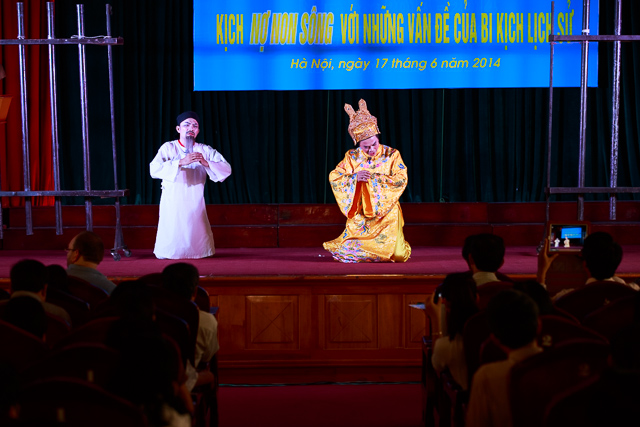
A scene from the final act of the play "Debt to the Nation" performed by artists from the Hanoi Cai Luong Theatre (excerpt) at the workshop. (Photo: Thanh Long/USSH)
Researcher Tran Hinh: "The Debt to the Nation" is a groundbreaking departure from the genre of historical drama.
Pham Quang Long is an educator, even a teacher of literary theory, a specialty that seems paradoxical with the field of creative writing like theater. For many years, Pham Quang Long has held various managerial positions, including Head of the Faculty of Literature, Rector of the University of Social Sciences and Humanities, Vice Director of Vietnam National University, Hanoi, and most recently, Director of the Hanoi Department of Culture, Sports and Tourism. His combination of teaching, theoretical, and managerial qualities, along with the struggles and experiences he gained to accomplish all these tasks, has allowed him to accumulate a wealth of life experience to write his plays. I believe this is enough for a literary theorist to become a creative writer, as he has demonstrated in the Hanoi theater scene in recent years.
The theatrical life in Northern Vietnam over the past few years has undeniably been quite "stagnant," but on the other hand, it cannot be denied that there have been times when it has managed to stir up public opinion. Although a non-professional playwright, Pham Quang Long has also had plays that have been part of this "stirring wave." Some people doubt his true abilities in this unfamiliar field, while others react to some fictional elements in historical events in his plays. Personally, I believe that if we consider his historical drama as a genuine genre, then among the four plays in his book, "Debt to the Nation" is a groundbreaking departure from the historical drama genre.
Historical themes have always been a challenge for all writers, playwrights, and filmmakers, not just in our country. For many years, in any field of artistic creation, from literature and theater to film, I've heard complaints from those involved that things are too "weak"! So what are the difficulties for writers in this field? Why do artists, considered "those who delve deep into thought, explore new ideas, and create things that haven't existed before," face such difficulties in their creative work? I believe the difficulty lies in our own ingrained ways of thinking. The field of "creative writing" itself doesn't pose any obstacles for artists. The lesson of Pham Quang Long's "Debt to the Nation" might offer us some insight. Perhaps, when writing historical fiction, writers must first dare to break the mold, meaning they must dare to overcome an invisible barrier that hinders their own creative thinking. This breaking the mold must begin with the writers themselves, then extend to the audience, and finally to the administrators.
Author:Thanh Ha
Newer news
Older news

