
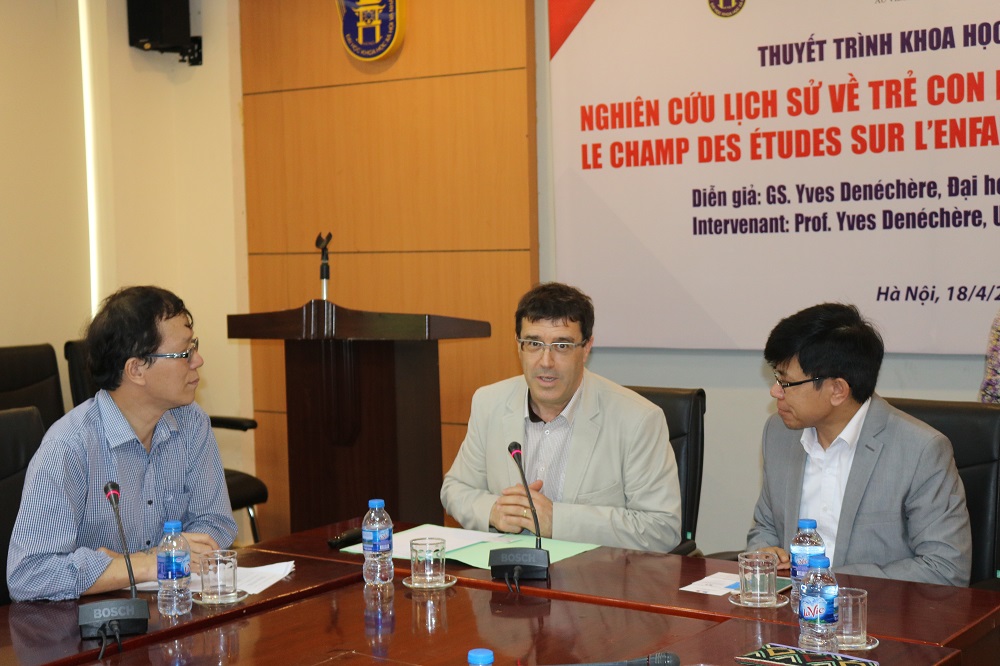
Professor Yves Dénéchère began his presentation by reviewing several perspectives and definitions of the concept of "children." According to researcher Philippe Ariès, children are considered miniature adults, possessing all the intelligence and personality of adults. Philosopher Dominique Bourg, on the other hand, views children as agents contributing to the development of society. Therefore, the concept of "children" can be seen as a cultural and social construct; it is also a norm and ideal. Children are conceived as part of the developmental cycle of human life.
Globally, children's rights have become part of human rights, enshrined in international documents, most notably the 1989 United Nations Convention on the Rights of the Child. Therefore, research on children is an interdisciplinary field, involving many scientific disciplines from history, sociology, philosophy, psychology to anthropology. In-depth research on children began in the 1970s in the United States and subsequently spread to other countries.
Next, Professor Yves Dénéchère presented on the phenomenon of mixed-race Vietnamese-French children. In the 20th-century history of Vietnamese-French relations, many mixed-race children were born as a result of relationships between French officers and soldiers of the French expeditionary forces and Vietnamese women. Estimates suggest that between 1947 and 1979, approximately 5,000 mixed-race Vietnamese-French children were born, with the peak period being 1946-1954. These mixed-race children were recognized by the French government not only as normal children but also as a valuable addition to the French population. Therefore, the French government instructed the Charitable Association for Children in Indochina to bring these children back to France, helping them escape the hardships of life during the division of Vietnam into two regions.
Professor Yves Dénéchère (center) giving a presentation.
Mixed-race children were brought to France by sea or air. Upon arrival, they received assistance from charitable organizations in finding employment, marrying French citizens, and psychological support. However, after 1954, the practice of bringing mixed-race children from Vietnam to France gradually shifted from a relief purpose to population assimilation. After integrating into society and receiving a French education, these children lost their connection to their birthplace and their Vietnamese mothers. Some became targets of racial discrimination.
Over time, these mixed-race individuals continued to try to reconnect with their relatives in Vietnam. They also began to question the meaning of migrating to France, and the advantages and disadvantages of being a Vietnamese person living in a foreign land. After 1975, many mixed-race people gathered together in a common house called the Association of Vietnamese People in France. This was a place where they could share their common fate and work together to encourage Vietnamese people in France to contribute to their ancestral homeland.
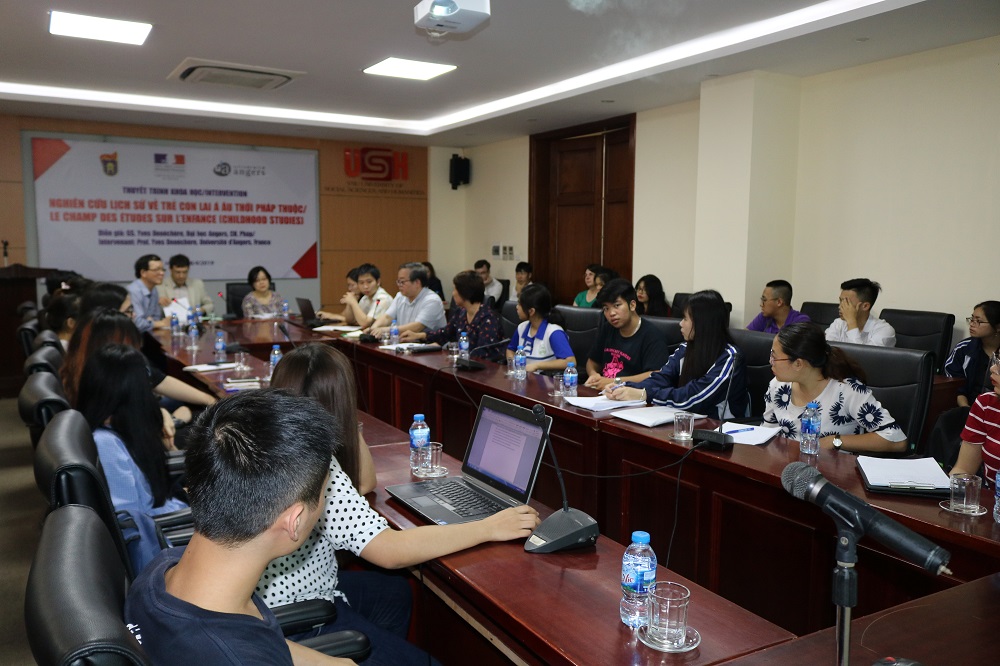
According to Professor Yves Dénéchère, the phenomenon of Vietnamese-French mixed-race children in the 20th century should be viewed not merely as a phenomenon of migration. Behind it lie profound implications for politics, society, culture, race, and international relations between Vietnam and France. Therefore, to thoroughly study such phenomena, researchers need an interdisciplinary perspective. Accordingly, as mentioned, children are considered a part of human growth and maturation, an agent of social development.
Following the presentation, Professor Yves Dénéchère received questions from the audience on several issues, including funding and support from the French government for the Association for Charitable Aid to Children in Indochina; discrimination against mixed-race children compared to native children; the background of mixed-race children; the criteria for accepting mixed-race children by the Association for Charitable Aid to Children in Indochina; and the level of connection between Vietnamese-French mixed-race children and their parents in Vietnam.
Author:Tran Minh
Newer news
Older news

