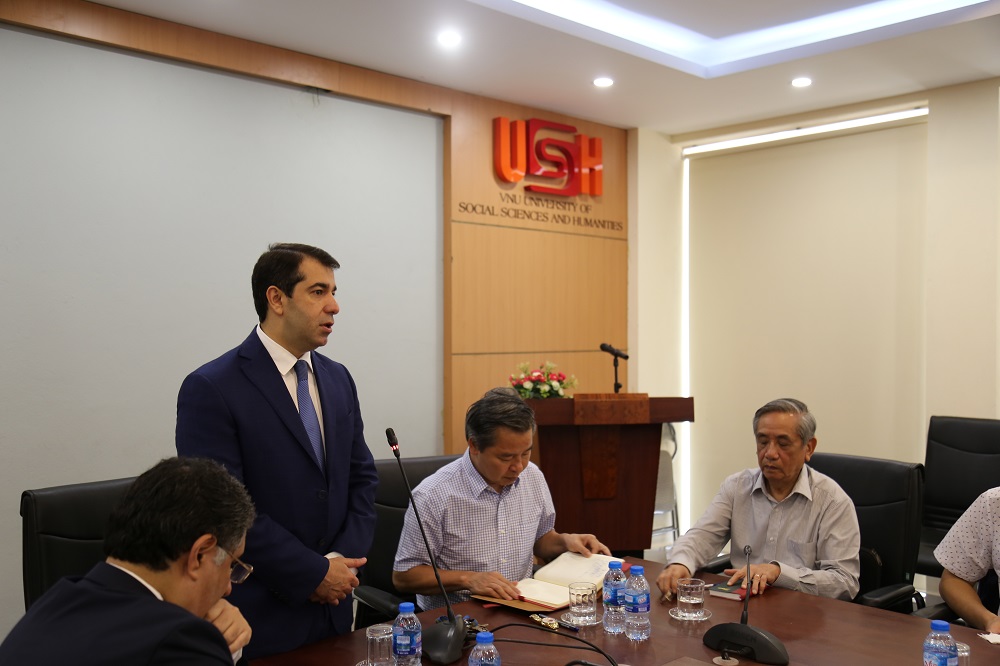
Mr. Anar Imanov's presentation began with a review of the history and, in particular, the diplomatic history of Azerbaijan.
Prior to the 20th century, Azerbaijan was a collection of small kingdoms ruled by khans (monarchs). These small kingdoms were heavily influenced by two major powers: the Persian Empire (a large part of which is now Iran) and the Russian Empire. After the collapse of the Russian Empire in World War I, Azerbaijan, along with Armenia and Georgia, became part of the Transcaucasian Federal Democratic Republic. In 1918, Azerbaijan declared independence and established a parliamentary republic called the Azerbaijani Democratic Republic. In 1919, the Azerbaijani Ministry of Foreign Affairs was established, giving birth to the country's diplomatic service. Diplomatic efforts helped secure recognition of the Azerbaijani Democratic Republic at the Paris Peace Conference on January 11, 1919.
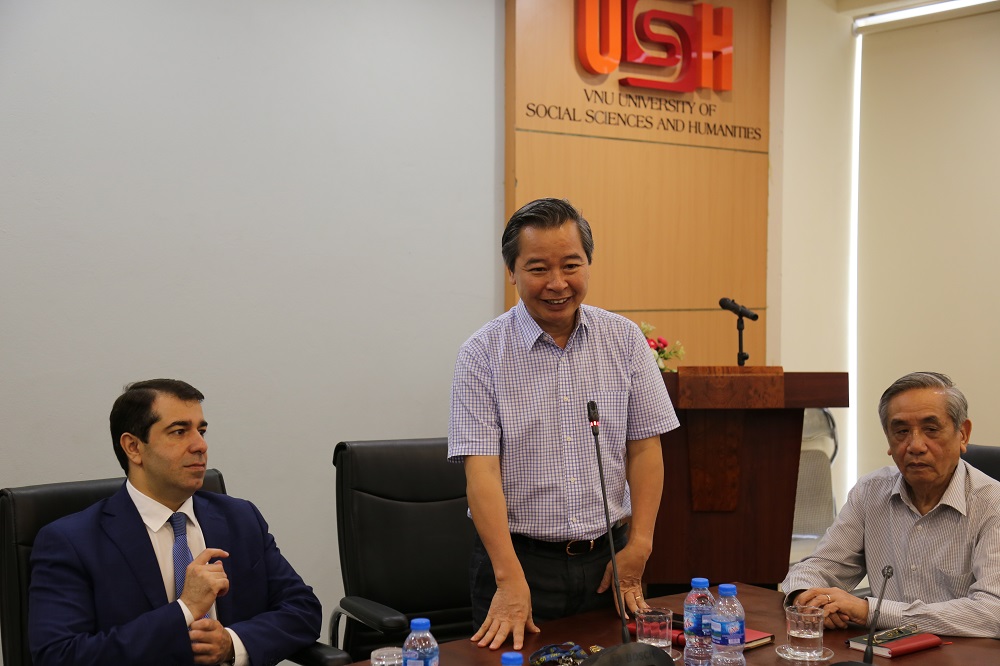
Professor Pham Quang Minh highly appreciated Ambassador Anar Imanov's active participation in exchange activities between the Azerbaijani Embassy and the University of Social Sciences and Humanities.
However, the Democratic Republic of Azerbaijan remained in existence until 1920, when the Red Army forces annexed its territory to the Soviet Union. Throughout this period under Soviet control, Azerbaijan's foreign policy had virtually no voice of its own. It wasn't until November 1990 that Azerbaijan declared independence as the Republic of Azerbaijan, just as the Soviet Union was on the verge of complete collapse. Following this, the late President Heydar Aliyev pursued a foreign policy of independence and equality with all nations. This policy continues to this day under President Ilham Aliyev.
Recognizing its crucial geostrategic position and its oil reserves, Azerbaijan has undertaken diplomatic efforts to persuade major global oil companies to invest in oil exploration. Billions of dollars earned from oil extraction have been used to build infrastructure, contributing to the country's development. Azerbaijan has also created numerous pipelines to supply oil, playing a role in ensuring energy security for European countries. Azerbaijan has also assisted Southeast Asian countries like Vietnam in developing their oil and gas industries since 1959. From a socio-cultural perspective, Azerbaijan plays a connecting role between the East and West by hosting numerous sporting events and international conferences attended by both Muslim and European countries.
Ambassador Anar Imanov pledged to continue supporting educational exchanges and student and faculty exchanges between the University of Social Sciences and Humanities and universities in the UK.
In addition to illustrating the role of diplomacy in the development of each country, Mr. Anar Imanov also highlighted its significance in ensuring international peace and security. One of the most typical diplomatic tools is international law, through which nations accept relations with each other according to a common system of rules. However, according to Mr. Anar Imanov, international law is being eroded by non-compliance, disrespect, and the use of double standards by nations. The consequences of this are international problems such as territorial disputes and conflicts, terrorism, and Islamic extremism. We can see these consequences in international crises such as those in Syria and Libya. Therefore, diplomacy plays a role in urging nations to respect the fundamental principles of international law, the most important of which are respect for sovereignty, territorial integrity, and non-interference in each other's internal affairs.
In comparison with Vietnam, the foreign policies of the two countries share many similarities. Vietnam is also situated in a strategically important location and maintains a policy of self-reliance and independence. Vietnam also went through a long period of struggle for independence, thus understanding the value of diplomacy and negotiation in resolving international disputes peacefully. Over 25 years since the establishment of diplomatic relations, Vietnam and Azerbaijan have achieved remarkable successes in many fields, while jointly contributing to maintaining a stable and harmonious world order.
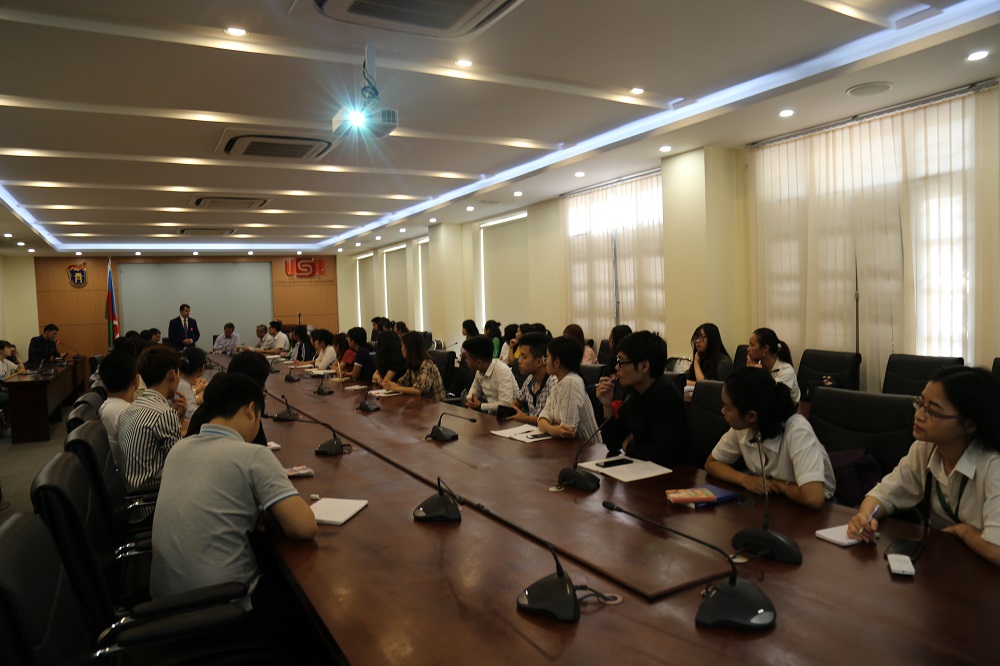
Following the presentation, Mr. Anar Imanov received questions from the audience on issues such as social and political crises in Azerbaijan; prospects for resolving the sovereignty dispute between Azerbaijan and Armenia; difficulties Azerbaijan faces in post-independence economic recovery; key areas of cooperation between Vietnam and Azerbaijan; and the Azerbaijani Embassy's plans to promote bilateral relations.
Author:Tran Minh
Newer news
Older news

