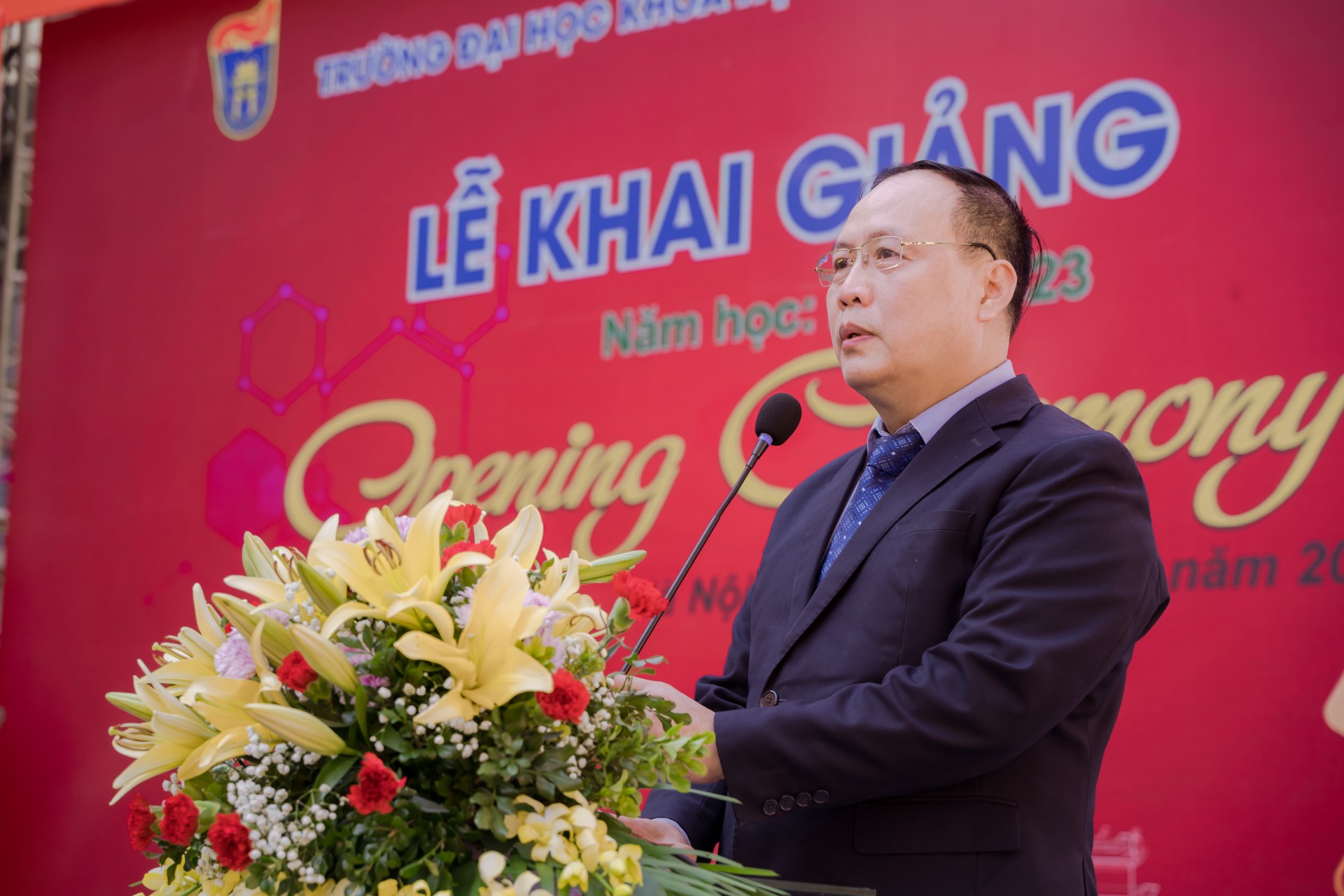
Professor Nguyen Dinh Duc delivered a speech at the opening ceremony of the 2022-2023 academic year at the University of Social Sciences and Humanities.
Professor Nguyen Dinh Duc, could you briefly introduce the newly issued regulations on undergraduate training at Vietnam National University, Hanoi?
The new regulations, comprising 9 chapters and 51 articles, govern undergraduate training at Hanoi National University, including: training programs; organization and management of training; student scientific research; rights and obligations of lecturers, academic advisors, and students; examinations, tests, and assessment of learning outcomes; and graduation recognition.
This regulation applies to units and individuals involved in full-time and part-time undergraduate training at Hanoi National University, including: training programs and study duration; organization and management of training; student scientific research; rights and obligations of lecturers, academic advisors, and students; examinations, tests, and assessment of learning outcomes; and graduation recognition.
Currently, the system for organizing and managing higher education consists of two levels: the Hanoi National University level and the training unit level.
To maximize the utilization of all resources and the combined strength of the units, the latest regulations are consistent with and imbued with the "one-VNU" perspective and philosophy. The Vietnam National University, Hanoi (VNU) is tasked with directing and uniformly managing the organization and administration of training according to an open, interconnected, and collaborative mechanism among training units; coordinating the use of common resources (human resources, physical and technical facilities, equipment) to serve training; and simultaneously, VNU is responsible for the comprehensive management of the organization and administration of training at its affiliated schools/faculties.
The training units are responsible for organizing and managing the training of the academic disciplines and courses assigned by the Vietnam National University, Hanoi; recognizing student learning outcomes between training units; recognizing student learning outcomes accumulated at partner universities through student exchange programs; and developing shared learning materials. In addition, they develop new academic disciplines and training programs, focusing on interdisciplinary programs, and report to the Director of the Vietnam National University, Hanoi for review and approval, issuing decisions on opening new disciplines, approving programs, and assigning the task of organizing training.
So, Professor, what are the important new points in the regulations that need to be noted?
Some notable points in the new training regulations of Hanoi National University include the issuance date and the allocation of enrollment quotas.
Specifically, annually, based on quality assurance conditions, social needs, and the employment situation of graduates in their specialized fields, the training unit develops enrollment quotas for each major and training format with the corresponding training program for the following academic year, and reports and requests approval from the Director of Hanoi National University before December 31st.
The campus of lecture halls HT1 and HT2 of Vietnam National University, Hanoi at the Hoa Lac campus.
Based on this proposal, as well as general resources and development orientations, the Director of Hanoi National University decides to allocate enrollment quotas to training units before March 1st of each year and report to the Ministry of Education and Training. After Hanoi National University's decision on allocating enrollment quotas, training units will then be notified to organize enrollment and training.
Regarding the organization of admissions, annually, based on the general regulations of the Ministry of Education and Training, the Director of Hanoi National University issues a separate guidance document on admissions procedures, applicable at Hanoi National University.
Regarding the structure and volume of training programs: Standard training programs are designed with a minimum of 120 accumulated credits for bachelor's degrees, 150 accumulated credits for engineering degrees, 155 credits for pharmacist degrees, and a minimum of 205 credits for medical doctor degrees; High-quality training programs are designed with at least 15 more credits than the corresponding standard training programs, based on enhancing and supplementing some modules, referencing foreign training programs or based on the training program of a reputable advanced university in the world, adjusted to comply with the regulations of Hanoi National University; Talent training programs are designed with at least 30 more credits than the corresponding standard training programs, based on enhancing and supplementing some modules with higher proficiency requirements and broader, deeper content, referencing reputable foreign training programs. Dual-major programs, in collaboration with foreign educational institutions and awarding degrees by Vietnam National University, Hanoi, are designed according to the regulations of Vietnam National University, Hanoi.


However, it should also be noted that the newly issued regulations do not consider transferring students from their second year of study to another major. The academic results of the courses already completed by students transferring majors or changing training formats will be considered for retention and recognition as equivalent to the courses in the new major.
The new regulations also continue to facilitate and allow students to study two full-time programs simultaneously – a strength that attracts applicants to a multidisciplinary university like Hanoi National University. However, the conditions for studying a second major have been supplemented with stricter regulations: Specifically, students must have completed at least two semesters of the first program, and if the average GPA of all courses from the beginning of the first program to the time of registration for the second program is 2.0 or higher, then students must meet the admission requirements of the second program in the admission year; if it is 2.5 or higher, then students only need to meet the minimum quality assurance threshold for admission to the second program in the admission year.
Professor Nguyen Dinh Duc, what is your assessment of these new regulations?
The newly issued regulations on undergraduate training at Hanoi National University have updated the Ministry's regulations and include many new points aimed at improving the quality of training and creating more favorable conditions for learners.
The regulations serve as a crucial legal framework for utilizing and mobilizing the common resources of the entire Vietnam National University. The new regulations promote decentralization and delegation of authority to units; granting autonomy and accountability to the heads of training units, while maintaining core mechanisms and values for operation and development, creating synergy to uphold the brand and quality of education at Vietnam National University, Hanoi.
These regulations take effect from the date of signing, October 21, 2022, and apply to all enrollment courses from 2022 onwards. All previous regulations contrary to these regulations are hereby repealed.
Thank you very much, Professor!

.jpg)

