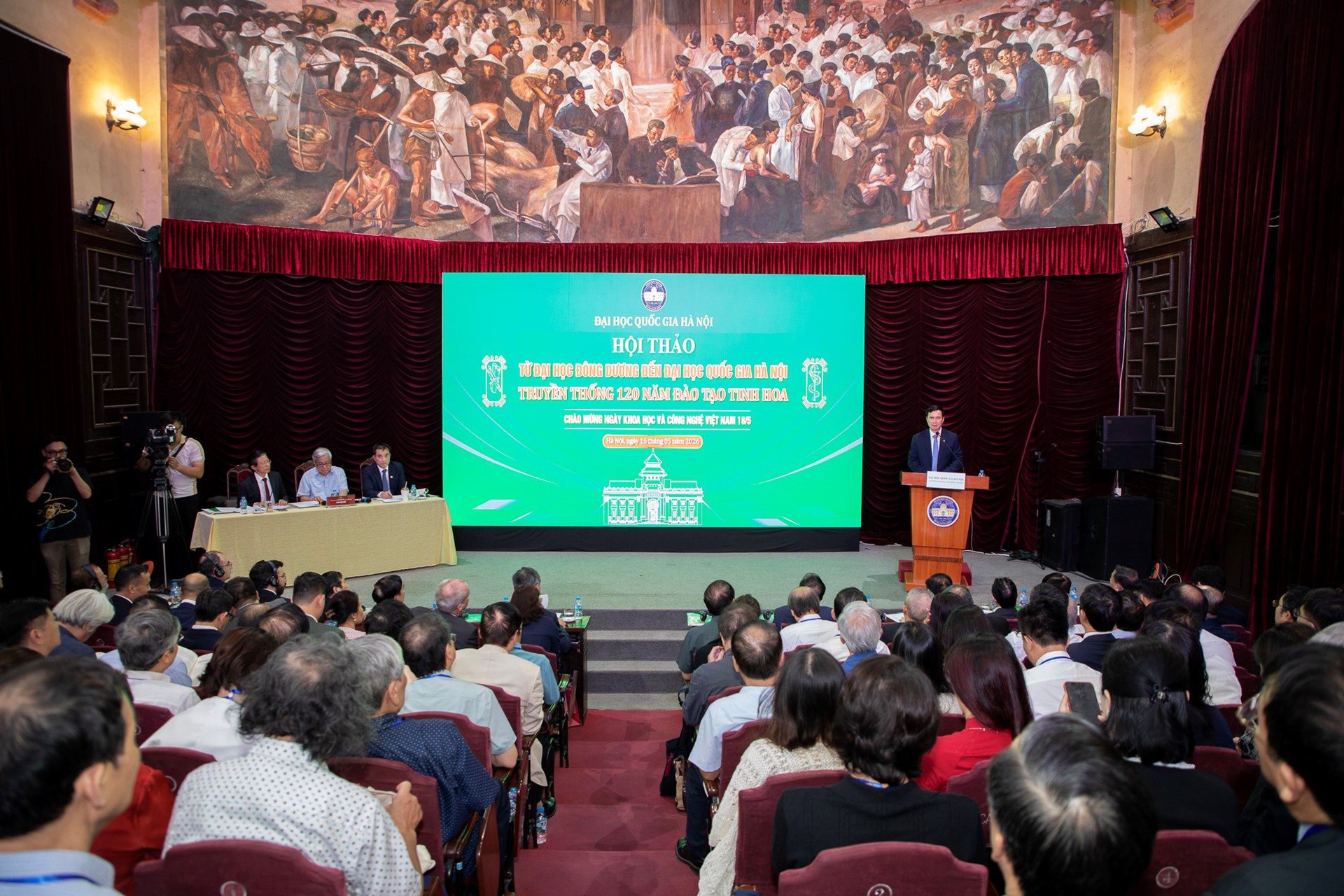
Chiều 16/5/2026, tại tòa nhà số 19 Lê Thánh Tông – không gian mang đậm dấu ấn lịch sử của nền giáo dục đại học Việt Nam hiện đại, ĐHQGHN tổ chức Hội thảo khoa học quốc gia “Từ Đại học Đông Dương đến Đại học Quốc gia Hà Nội: Truyền thống 120 năm đào tạo tinh hoa”. Không chỉ là hoạt động trọng điểm trong chuỗi sự kiện kỷ niệm 120 năm truyền thống ĐHQGHN, hội thảo còn là diễn đàn học thuật có chiều sâu đặc biệt nhằm nhìn lại tiến trình hình thành, phát triển của nền giáo dục đại học hiện đại Việt Nam; đồng thời gợi mở những vấn đề chiến lược về vai trò của đại học trong kỷ nguyên số, đổi mới sáng tạo và cạnh tranh tri thức toàn cầu.
Hội thảo do ĐHQGHN tổ chức; Trường ĐH Khoa học Xã hội và Nhân văn đăng cai thực hiện, phối hợp cùng Trường ĐH Khoa học Tự nhiên, Trường ĐH Ngoại ngữ, Trường Khoa học liên ngành và Nghệ thuật cùng nhiều đơn vị thành viên, trực thuộc.
PGS.TS Phạm Bảo Sơn - Phó Giám đốc ĐHQGHN; GS.TSKH Vũ Minh Giang - Chủ tịch Hội đồng Khoa học và Đào tạo ĐHQGHN; GS.TS Hoàng Anh Tuấn - Hiệu trưởng Trường ĐH Khoa học Xã hội và Nhân văn, ĐHQGHN đồng chủ trì hội thảo
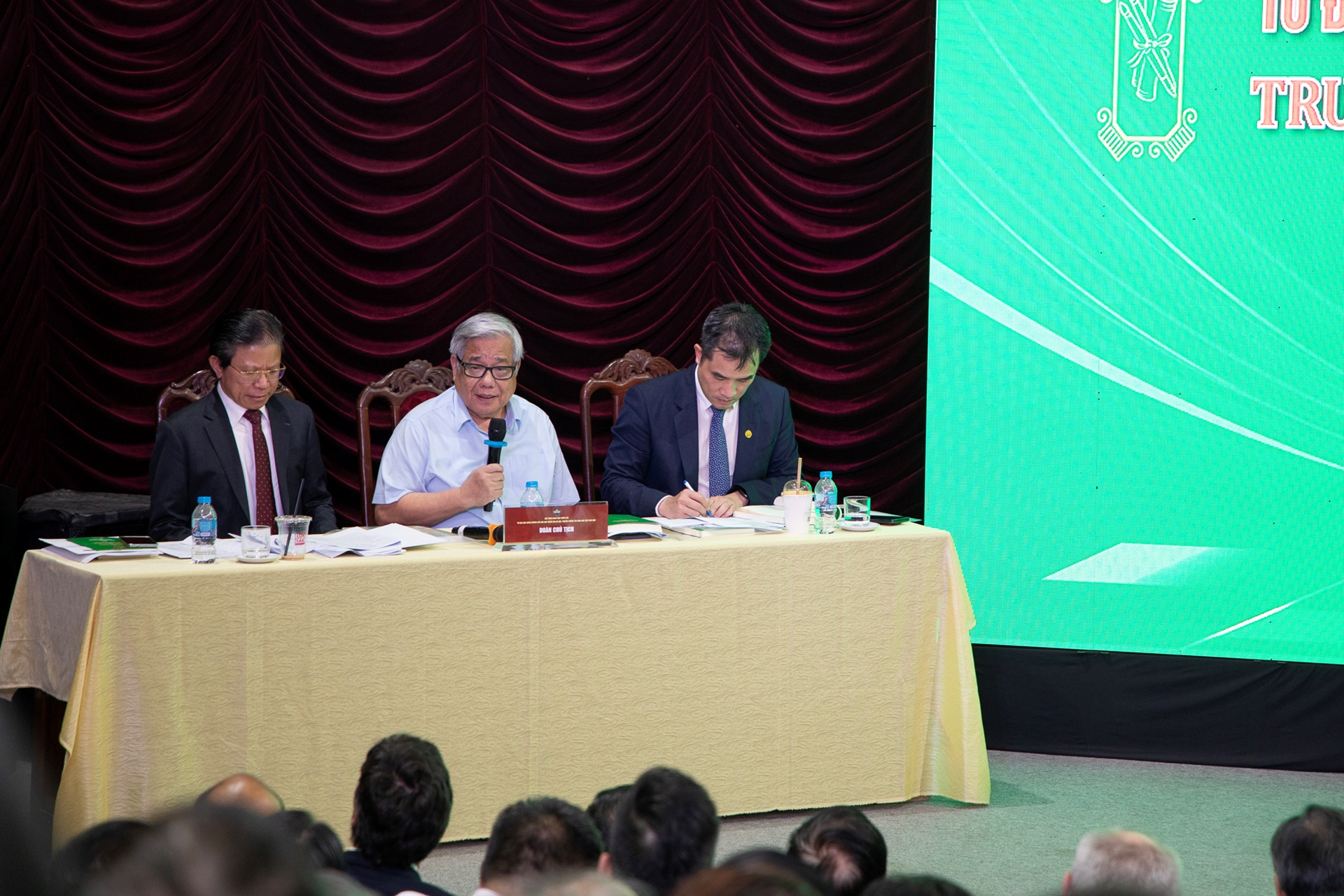
PGS.TS Phạm Bảo Sơn - Phó Giám đốc ĐHQGHN; GS.TSKH Vũ Minh Giang - Chủ tịch Hội đồng Khoa học và Đào tạo ĐHQGHN; GS.TS Hoàng Anh Tuấn - Hiệu trưởng Trường ĐH Khoa học Xã hội và Nhân văn, ĐHQGHN đồng chủ trì hội thảo.
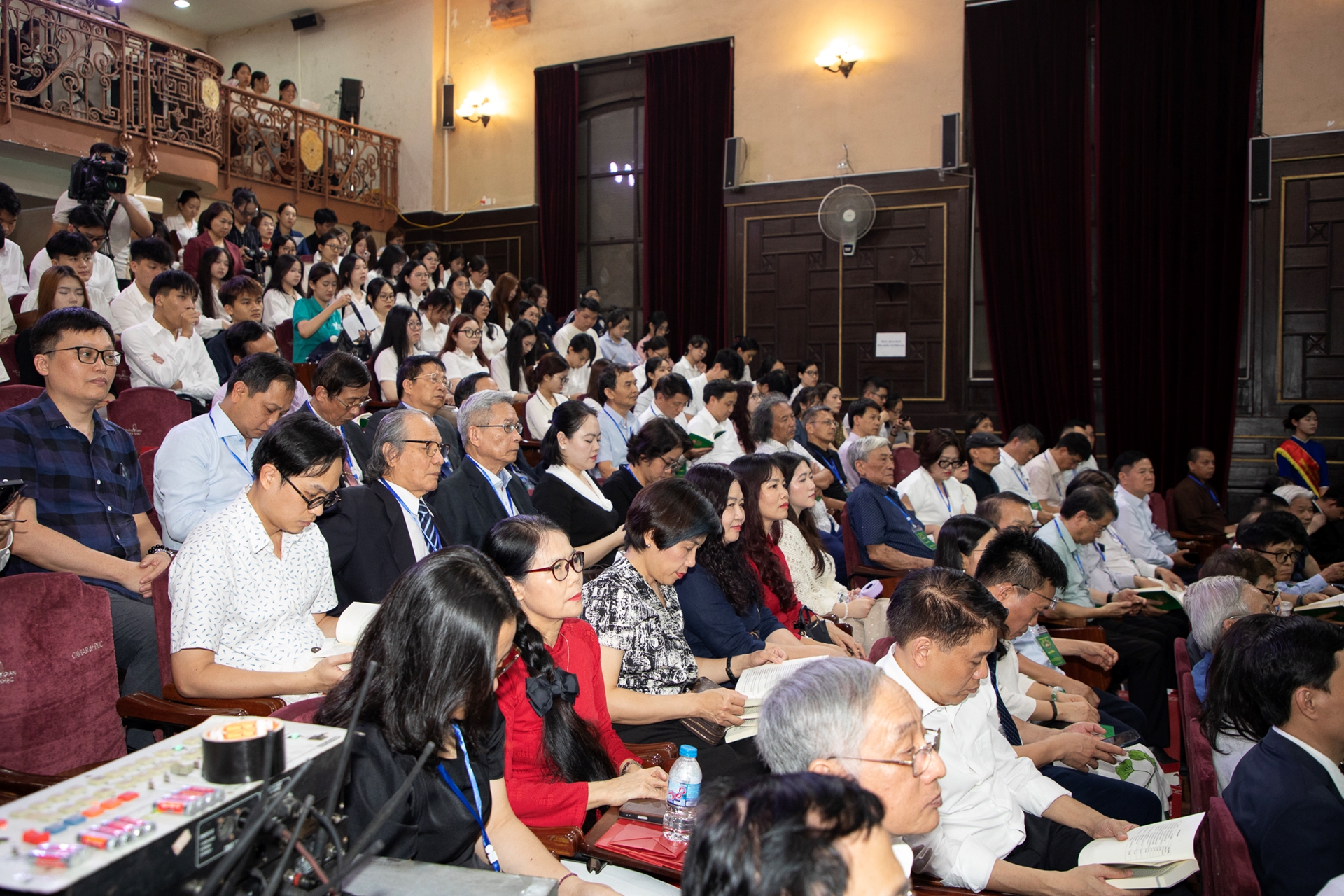
The workshop brought together approximately 300 delegates, including representatives from central ministries and agencies; representatives from international partner organizations, embassies of various countries, the French School of Far Eastern Studies (EFEO), prestigious universities worldwide, rectors of universities in the Russian Federation participating in the Vietnam-Russia University Rectors Forum; former leaders of Vietnam National University, Hanoi; current leaders of Vietnam National University, Hanoi and its member and affiliated units; professors, People's Teachers, Distinguished Teachers, leading scientists; outstanding students and alumni of Vietnam National University, Hanoi; and authors of papers.
A particular highlight of the conference was that it took place immediately after the solemn celebration of the 120th anniversary of Vietnam National University, Hanoi (VNU), held that same morning with the presence and keynote address of General Secretary and President To Lam. This demonstrates the direct and profound interest of the Party and State leaders in higher education, science and technology, and the role of VNU in the national development strategy.
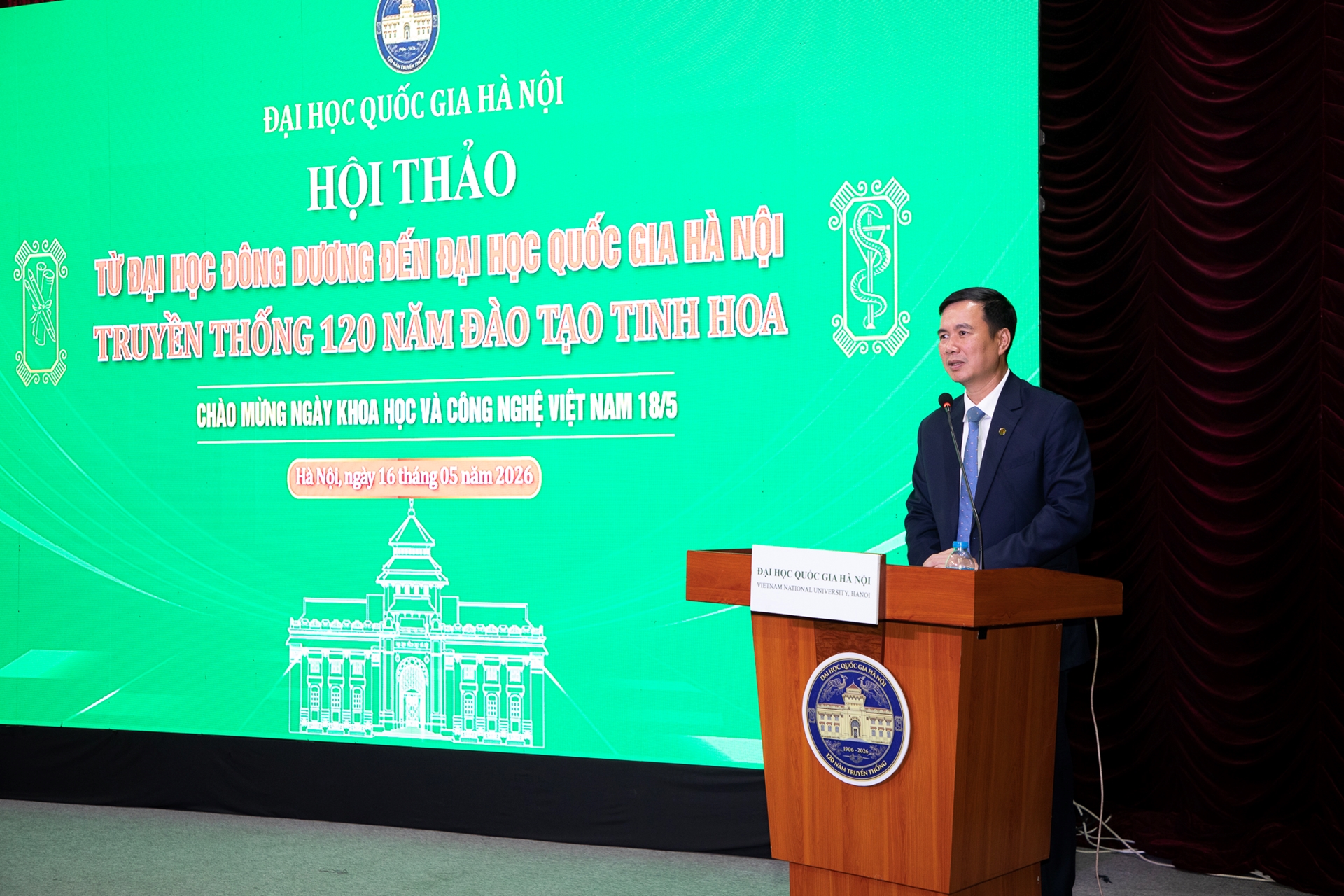
Bui The Duy, Alternate Member of the Central Committee of the Communist Party of Vietnam and Director of Vietnam National University, Hanoi, delivered the opening remarks at the conference.
In his opening remarks at the conference, Bui The Duy, Alternate Member of the Central Committee of the Communist Party of Vietnam and Director of Vietnam National University, Hanoi, emphasized that looking back at 120 years of history is not only about honoring the past but, more importantly, about clearly defining the path of future development. According to him, from its early days, Indochina University has embodied the characteristics of a modern, multidisciplinary university model with fields such as medicine, science, construction, literature, etc., and its training programs are recognized as equivalent to French standards. This demonstrates the international character and high academic level of modern Vietnamese universities from a very early stage.
Director Bui The Duy particularly emphasized the tradition of close integration between training and scientific research – a value that was formed more than a century ago and continues to be the core foundation in the current development strategy of Vietnam National University, Hanoi. According to him, throughout its history, Vietnam National University, Hanoi has always been a place that nurtures many generations of scientists, intellectuals, experts, and leaders for the country; whether in war or peace, generations of staff, lecturers, and students of the university have always carried within them a spirit of patriotism, national responsibility, and a desire to contribute.
In particular, Director Bui The Duy stated that the directives of General Secretary and President To Lam at the anniversary ceremony have opened a new phase of development for Vietnam National University, Hanoi, with a demand for more decisive, substantive, and groundbreaking actions. The Party's strategic resolutions on science and technology, innovation, digital transformation, and education and training are creating the political, institutional, and resource foundations crucial for Vietnam National University, Hanoi to break through and affirm its role as the nation's leading knowledge center.
At the national scientific conference "From Indochina University to Hanoi National University: A 120-year tradition of elite training," Professor Vu Minh Giang summarized the seven key strategic tasks that General Secretary and President To Lam directed during the 120th anniversary celebration of Hanoi National University on the morning of May 16th:
First and foremost, Hanoi National University must always reflect on its national responsibility and the nation's aspiration for progress. The word "national" is a sacred reminder of its responsibility, honor, and mission to serve the country. It must be a place where brilliant minds converge, opening up new horizons of knowledge, contributing to solving major development problems, and training individuals capable of leading and fostering Vietnamese intellectual prowess in the new era.
Secondly, Hanoi National University must strive to become a modern, elite university, multidisciplinary and multi-field, operating according to the model of an innovative university and capable of leading the nation. "Elite" must be measured by academic quality, the ability to create new knowledge, train talent, develop strategic technologies, make substantial contributions to the country, and have a recognized reputation internationally.
Thirdly, Hanoi National University must be a place that dares to be at the forefront, dares to experiment, and pave the way for new models in education, science, technology, innovation, and digital transformation. This will provide a practical basis for the Party and the State to continue refining development policies in the new era.

General Secretary and President To Lam attended and delivered a speech at the ceremony commemorating the 120th anniversary of the founding of Vietnam National University, Hanoi on the morning of May 16 (Photo: VNA).
Fourth, Hanoi National University must take the lead in implementing the Party's strategic resolutions. It should focus on solving major national problems, especially strategic technologies, core technologies, source technologies, and technology products bearing the Vietnamese brand. It should research, master, and develop foundational technologies such as artificial intelligence, semiconductors, biotechnology, new materials, new energy, big data, and green and sustainable technologies.
Fifth, Hanoi National University must become a center connecting knowledge with development, further strengthening the university's ties with the State, businesses, localities, and society. It needs to proactively develop research programs, policy consulting, and innovation initiatives based on major national orders; and strengthen cooperation with ministries, agencies, Hanoi, localities, technology companies, research institutes, and international expert networks.
Hanoi National University must become a "brains" that the State turns to when it needs scientific arguments for strategic policy decisions; a place where businesses seek to jointly develop technology, human resources, and new business models; and a place where society finds faith in the power of Vietnamese knowledge, science, and education.
Sixth, with its long-standing tradition and status as the country's leading university, Hanoi National University must become a prime example of Vietnamese academic diplomacy.
Seventh, Hanoi National University must effectively organize comprehensive political and ideological education for all staff and students on the proud traditions, roles, responsibilities, and missions of intellectuals in the new era of national development.
The 120-year trajectory of a major intellectual center.
The presentations at the conference profoundly and academically recreated the 120-year journey of modern Vietnamese higher education. From the University of Indochina (1906), to the Vietnam National University (1945), then the University of Hanoi (1956) and the Vietnam National University today, the scientists affirmed that these are not fragmented pieces of history, but a continuous and enduring flow of the spirit of enlightenment, modern scientific thinking, and the aspiration to train elites to serve the nation and people. Through all the changes of the times, these core values have been continuously inherited, nurtured, and elevated, creating the identity of a great intellectual center that always accompanies the development of the country.
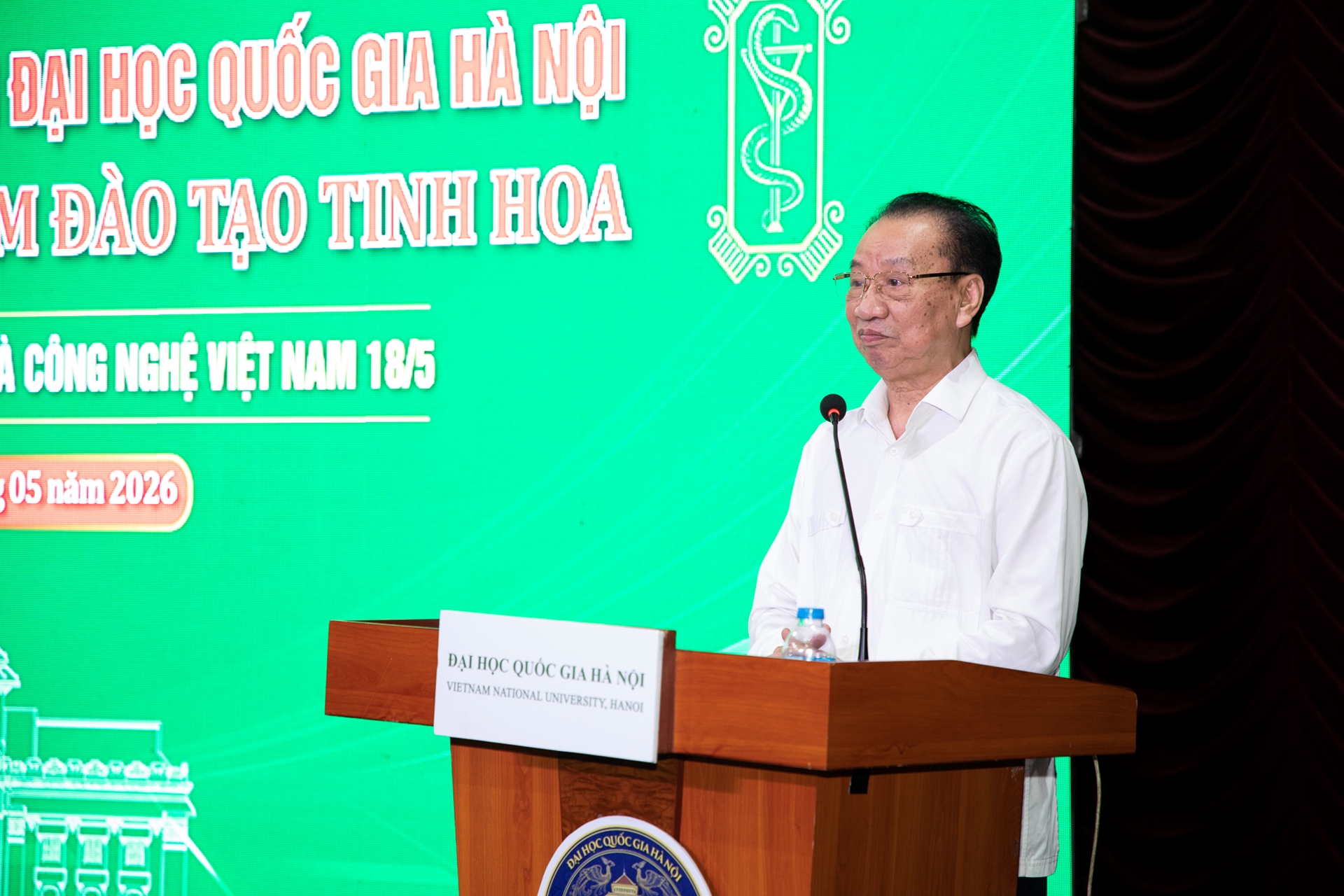
Professor, Doctor, Meritorious Teacher Phung Huu Phu presented his paper at the Conference.
Presenting his paper at the conference, Professor Phung Huu Phu, former member of the Central Committee of the Communist Party of Vietnam, former Deputy Head of the Standing Committee of the Central Propaganda Department, and the first Rector of the University of Social Sciences and Humanities, affirmed that from Hanoi University to Vietnam National University today, it is a continuous continuation and flourishing of the tradition of elite universities serving the nation. Hanoi University is considered a leading academic symbol of the country from 1956 to 1993, a place where many great intellectuals gathered, laying the foundation for modern basic sciences and fostering the spirit of enlightenment and social responsibility of many generations of Vietnamese intellectuals.
Building upon that foundation, Vietnam National University, Hanoi (VNU) was established in 1993 by the Party and State as an advanced multidisciplinary university, gradually affirming its role as a leading national center for talent training, research, and innovation. The paper also emphasizes the profound concern of the Party and State, especially the direct guidance of General Secretary and President To Lam, for the development of VNU into a research university and innovation center of Asian stature.
According to Professor Phung Huu Phu, looking back on the 120-year journey is not only about being proud of the glorious tradition but also about continuing to inspire the aspiration for development and enriching the core values of Vietnam National University, Hanoi: excellence, enlightenment, humanism, pioneering spirit, service, and integration.
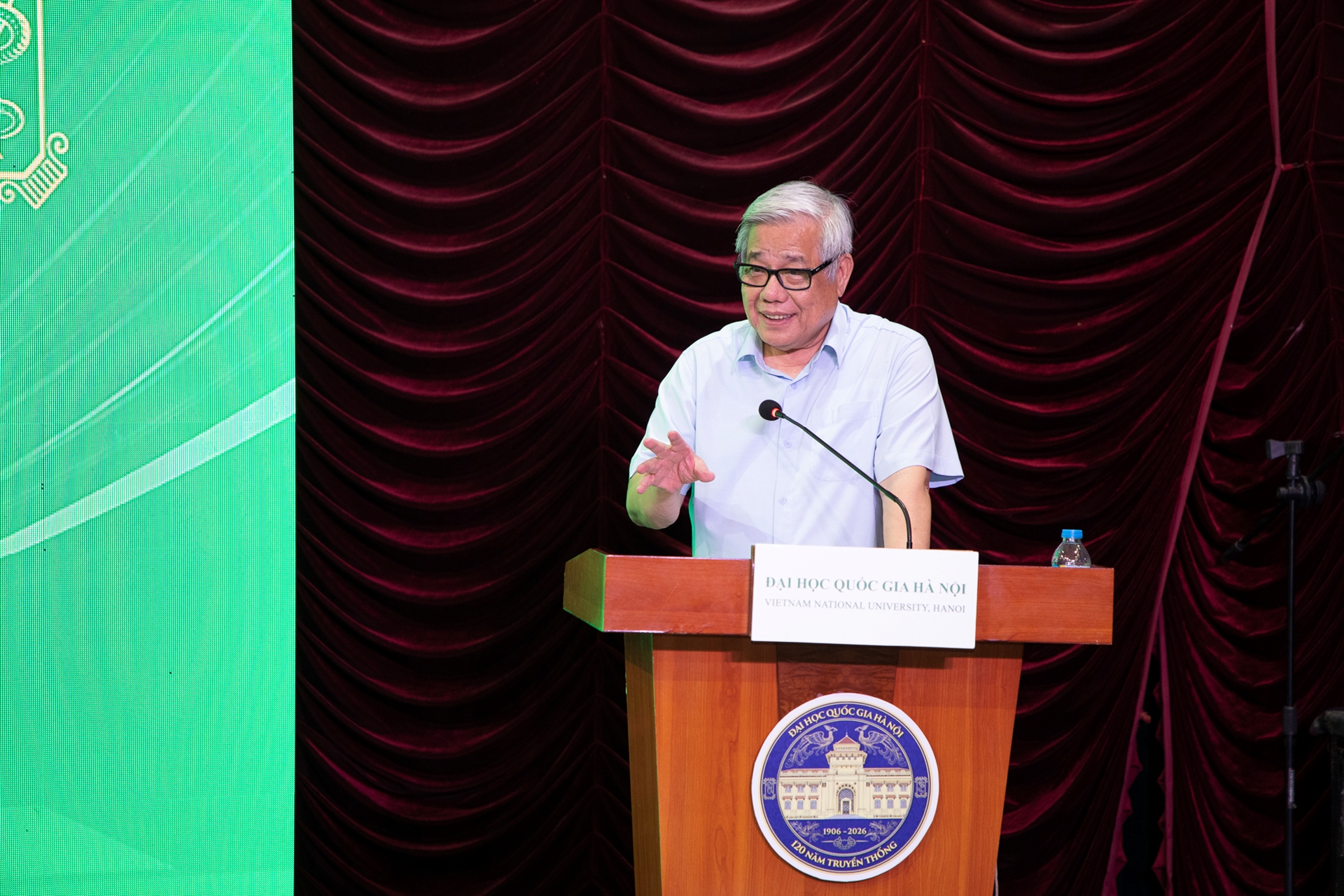
Professor Vu Minh Giang summarized the seven key strategic tasks that General Secretary and President To Lam directed during the ceremony commemorating the 120th anniversary of the founding of Vietnam National University, Hanoi.
Speaking at the conference, Professor Vu Minh Giang expressed that one of the things that impressed him most in the directive speech of General Secretary and President To Lam was the requirement for Vietnam National University, Hanoi to strive to become the intellectual face of Vietnam on the international stage. According to him, the General Secretary set a very grand vision: Vietnam National University, Hanoi should not only be a leading university in the country but must also become an elite university, capable of leading the nation's intellect and serving as a knowledge base for the country's development in the new era.
In particular, strategic technology fields such as artificial intelligence, semiconductors, biotechnology, and green technology are emphasized as fundamental drivers for Vietnam to make a leap forward in the 21st century. Professor Vu Minh Giang assessed this as a very high-level strategic thinking because in the new era, rapid and sustainable development must be based on science and technology and innovation; while universities are the places where new knowledge is created and national competitiveness is formed.

Professor Nguyen Huu Duc shared his paper on the topic "Mapping the development process of world universities to Vietnamese higher education - Positioning Hanoi National University in the knowledge era".
At the conference, many other presentations also affirmed the pioneering role of Vietnam National University, Hanoi (VNU) in the process of reforming higher education in Vietnam. Professor Nguyen Huu Duc – former Vice Director of VNU – argued that VNU should be positioned as an "innovative startup university" – a place that combines training, research, innovation, and knowledge transfer to become a center for creating value for the knowledge economy.
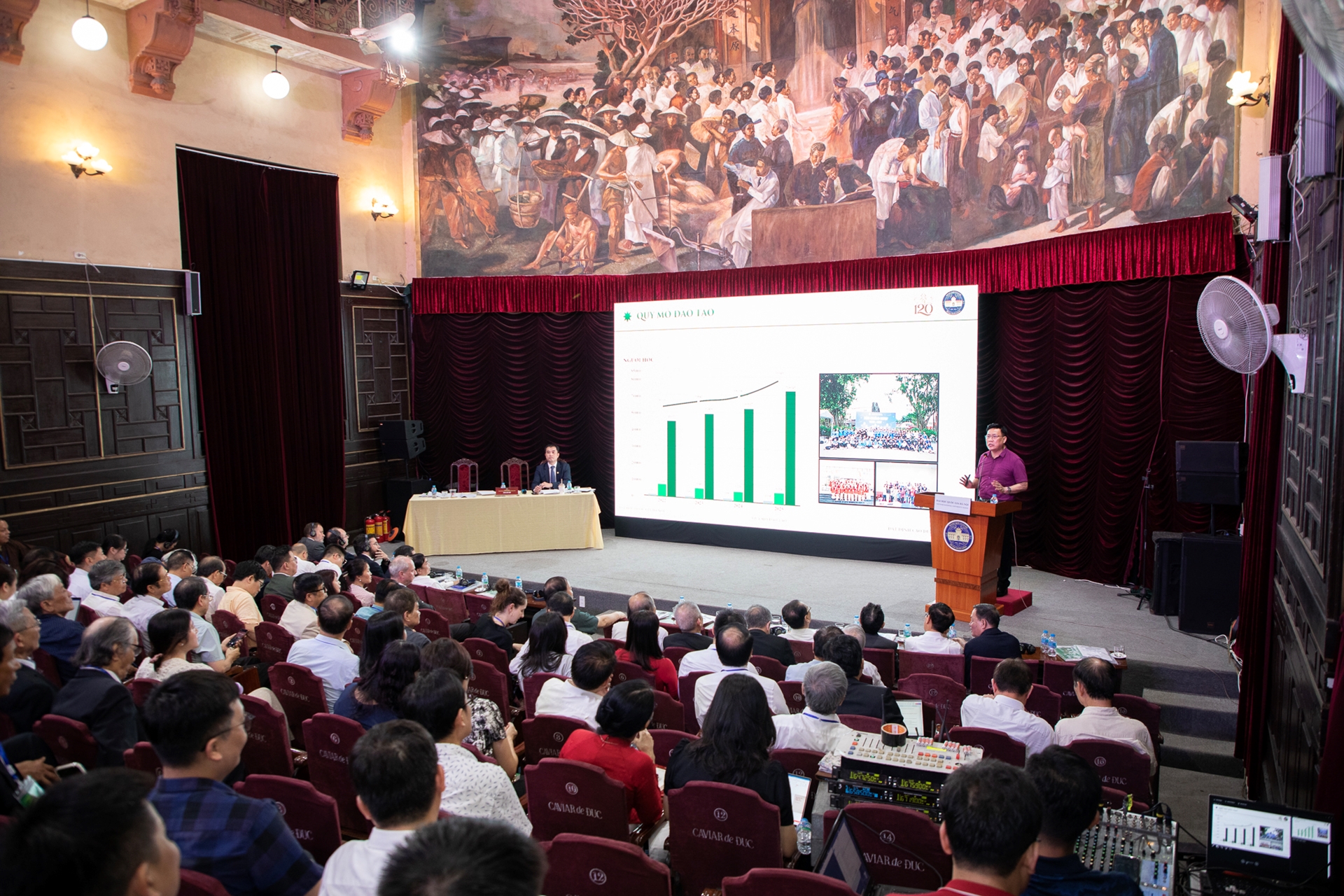
Professor Nguyen Dinh Duc presented a paper on the topic "Hanoi National University - Enduring the mission of pioneering, innovating, illuminating, and training and nurturing talent".
Meanwhile, Professor Nguyen Dinh Duc emphasized that for the past 120 years, Vietnam National University, Hanoi has always played a pioneering role in Vietnamese higher education in training talents, conducting scientific research, and fostering innovation; and it needs to continue to play a leading role in international integration and the development of the country's strategic technology sectors.
Building a modern research university to serve the nation in the new era.
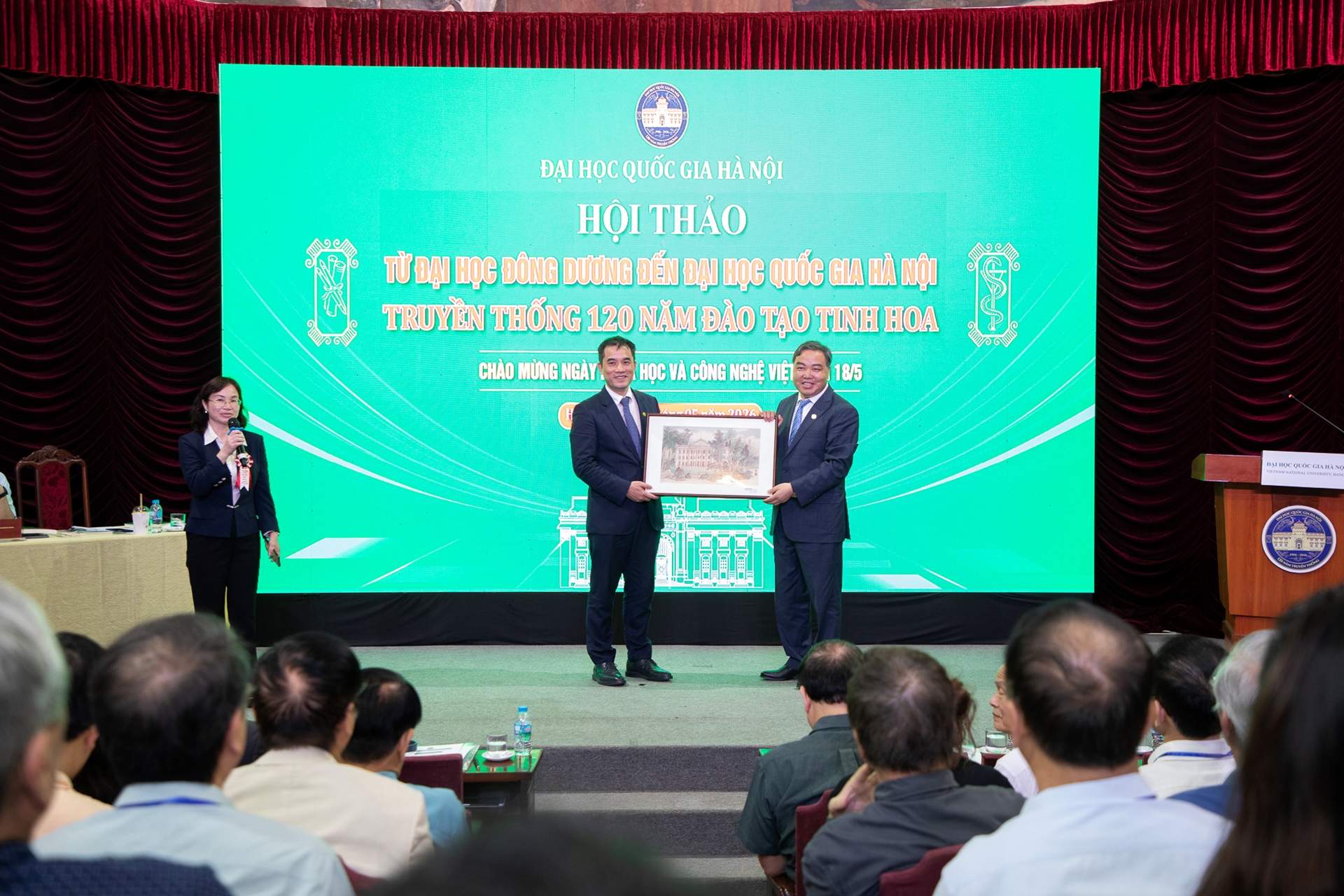
Director of Guangxi University, Xiao Jianzhuang, presents a commemorative gift to Vietnam National University, Hanoi.
Beyond simply reviewing history, the conference also expanded international academic dialogue on the future of higher education. Mr. Tieu Kien Trang – Director of Guangxi University (China) – highly praised the 120-year journey of Vietnam National University, Hanoi, and considered it not only a milestone for Vietnam but also an important part of the development of higher education in Asia. He emphasized the potential for cooperation between the two universities in the fields of artificial intelligence, semiconductors, doctoral training, and the establishment of joint laboratories.
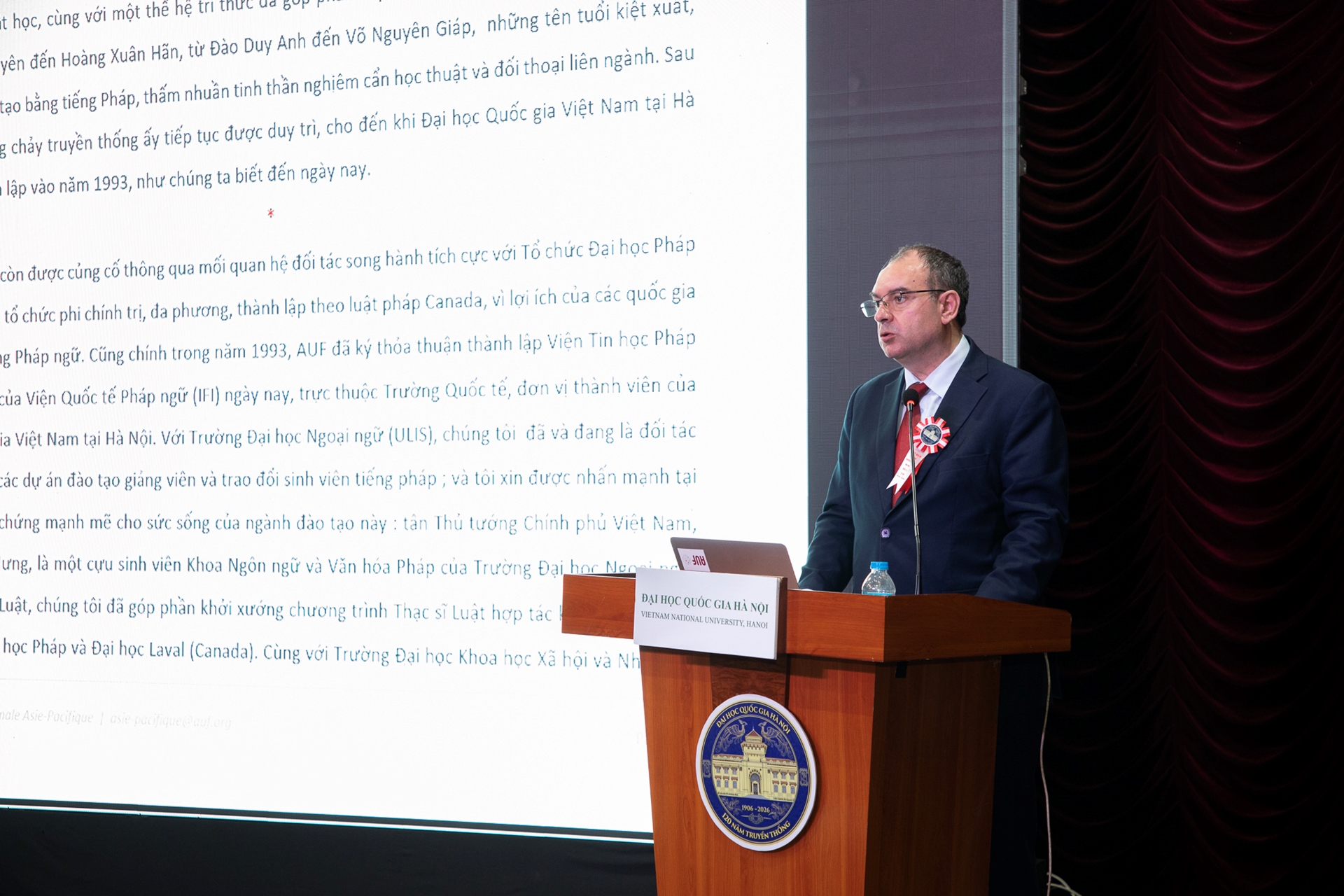
Mr. Nicolas Mainetti, Director of AUF Asia-Pacific, spoke at the Workshop.
Mr. Nicolas Mainetti, Director of the Francophone University Organization (AUF) for the Asia-Pacific region, affirmed that the liberal and international spirit of Indochina University remains as valuable as ever after 120 years. He asserted that Vietnam National University, Hanoi (VNU) holds a special position within the Francophone university landscape: a multidisciplinary training institution of international stature, inheriting and strongly continuing the Francophone tradition.

Professor Andrew Hardy shared this at the conference.
Professor Andrew Hardy, a senior expert at the French Institute of Far Eastern Studies, also shared a special story about the historical relationship between the University of Indochina and the EFEO – two academic institutions that were both established in Hanoi at the beginning of the 20th century. Memories of collaborative research, overcoming the difficulties of the early days of reform, and the persistent spirit of expanding international academic exchange demonstrate the academic depth and enduring vitality of the university model closely linked to scientific research.
The conference received 26 high-quality academic papers, which were selected and published in a 368-page proceedings. This is not only an important scientific achievement of the conference, but also a valuable academic document that contributes to preserving and disseminating the historical, academic, and spiritual values of the 120-year tradition. Through the papers, the insightful exchanges and scientific discussions of scholars from Vietnam and abroad, the conference contributed to comprehensively recreating the 120-year historical journey of modern universities in Vietnam; and at the same time affirmed the enduring values of the Vietnamese people's tradition of valuing learning, utilizing talent, and serving the country with knowledge.
One of the key values affirmed by the Conference is the special role of higher education in discovering, nurturing, and utilizing talent. From the traditional belief that "talented individuals are the lifeblood of the nation" passed down from our ancestors to the major policies of the Party and State today, especially Resolution No. 57-NQ/TW on breakthroughs in the development of science, technology, innovation, and national digital transformation; Resolution No. 71-NQ/TW on breakthroughs in education and training development; and Resolution No. 80-NQ/TW on the development of Vietnamese culture, all demonstrate consistency in strategic thinking regarding human development and knowledge development.

The presentations at the conference emphasized that, in the context of a world profoundly changing by the Fourth Industrial Revolution, artificial intelligence, digital transformation, and global knowledge competition, the mission of training elites has become more important than ever. Elites are not only those with superior knowledge, but also those with character, social responsibility, a desire to contribute, and the capacity to lead the nation's development.
From that perspective, many opinions have affirmed that Vietnam National University, Hanoi (VNU) needs to continue playing a pioneering role in the innovation of higher education in Vietnam; continue to develop into a leading research university in Asia; and become a center of innovation, connecting Vietnamese knowledge with global knowledge.
The workshop also proposed several important directions for the future development of Vietnam National University, Hanoi: continuing to build an open, creative, and humane academic environment; strongly developing basic sciences, strategic technologies, and interdisciplinary sciences; promoting knowledge transfer to serve national development; accelerating the internationalization of higher education; and at the same time continuing to preserve the identity and traditional values of Vietnam's elite university.
With a history spanning over a century and under the direct and special attention of the Party and State leadership – most notably the strategic guidance of General Secretary and President To Lam – Vietnam National University, Hanoi (VNU) is facing a new opportunity for development. This is not only a chance to further affirm its position as a leading center for training, research, and innovation in Vietnam, but also a mission to contribute to elevating Vietnamese intellectual prominence on the global academic map, serving the rapid and sustainable development of the country.
The press reported on the event:
Government Electronic Newspaper: Vietnam National University, Hanoi: Inheriting a 120-year legacy, positioning itself as an elite university model serving the new era.
Vietnam News Agency: Vietnam National University, Hanoi: A 120-Year Journey of Training Elite Students
Hanoi Newspaper and Broadcasting: The 120-year journey of an elite university.
Vietnam National University, Hanoi:120 years of fostering academic excellence and aspiration to serve the nation.
Author:According to VNU Media
Newer news
Older news

