
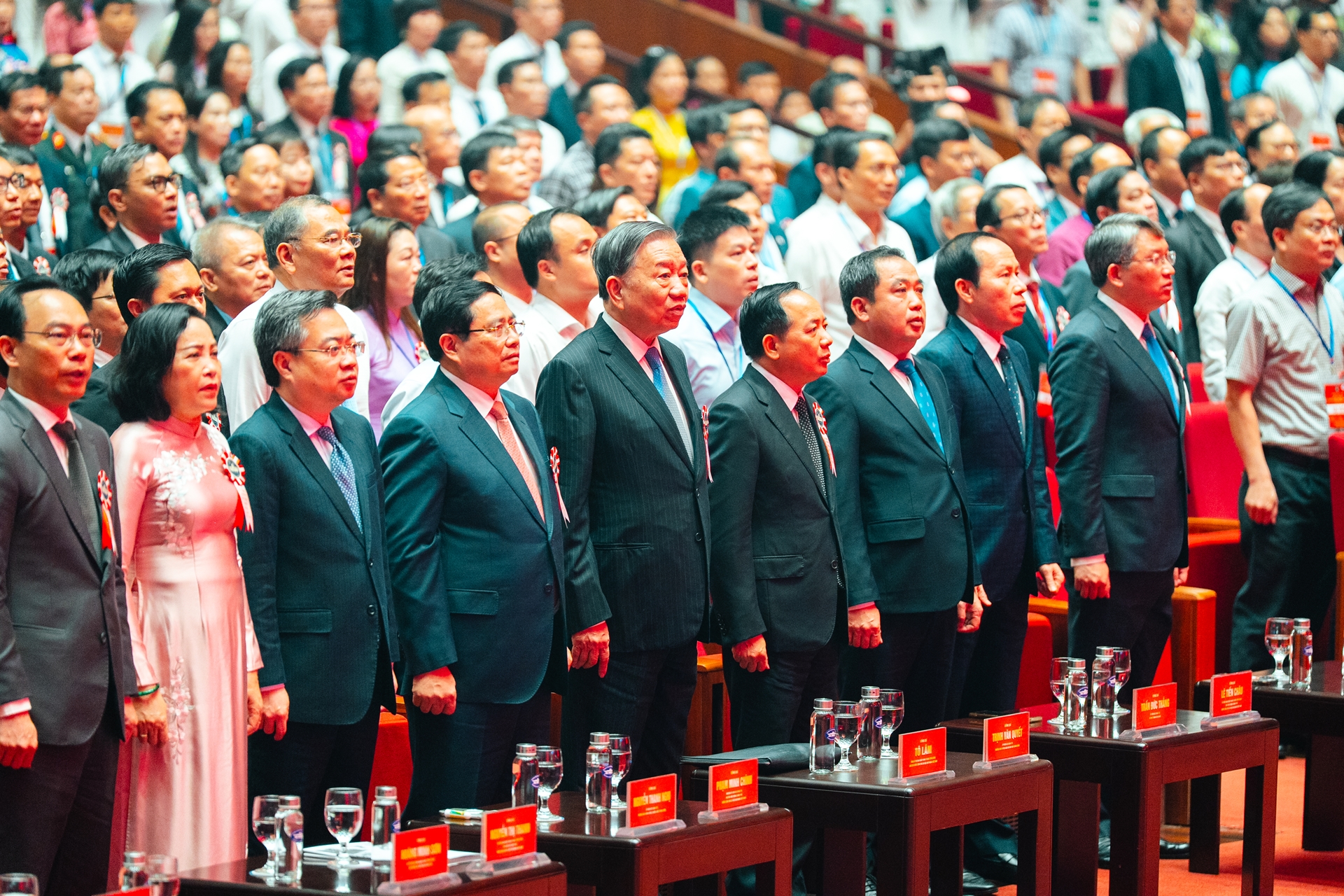
Party and State leaders and former leaders attended the commemoration ceremony.
General Secretary and President To Lam attended and delivered a speech at the commemoration ceremony.
Also attending were Comrade Pham Minh Chinh, former member of the Politburo and former Prime Minister; Politburo members: Trinh Van Quyet, Secretary of the Central Committee and Head of the Central Propaganda and Mass Mobilization Department; Nguyen Thanh Nghi, Secretary of the Central Committee and Head of the Central Policy and Strategy Department; Tran Duc Thang, Secretary of the Hanoi City Party Committee; and Central Committee members: Le Tien Chau, Deputy Prime Minister; and Nguyen Thi Thanh, Vice Chairwoman of the National Assembly.
The ceremony was also attended by local leaders, partners, businesses, ambassadors and representatives of diplomatic agencies, international organizations, universities, international partner research institutes, and representatives of universities, colleges, and academies nationwide.
On the part of Vietnam National University, Hanoi (VNU), the ceremony was attended by the VNU Board of Directors, leaders of functional departments, member units, affiliated units, former leaders of VNU from various periods, generations of teachers, scientists, staff, students, trainees, and alumni of VNU.
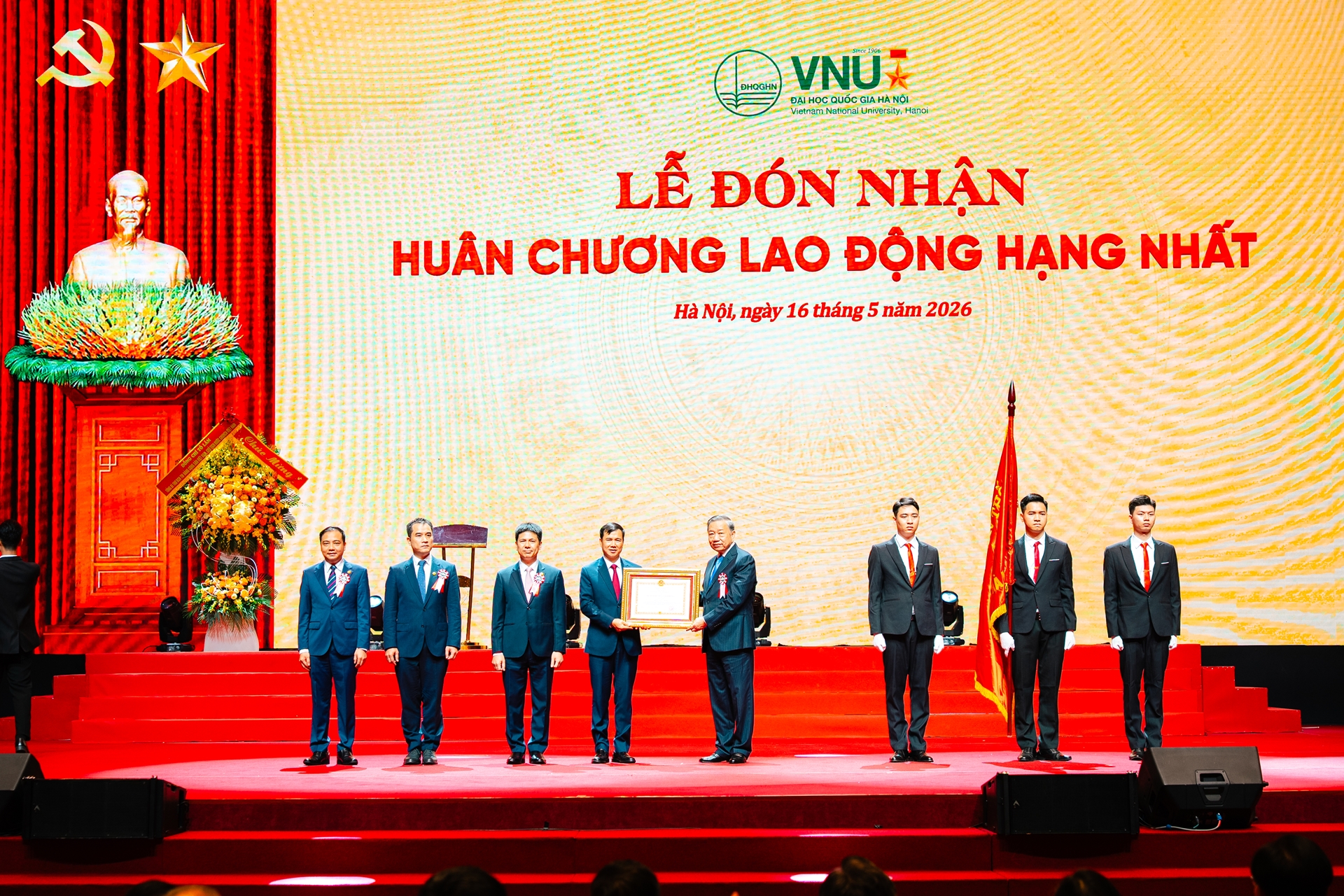
General Secretary and President To Lam, on behalf of the Party and State leaders, presented the First-Class Labor Order to Vietnam National University, Hanoi.
At the 120th anniversary celebration, General Secretary and President To Lam, on behalf of the Party and State leadership, awarded the First-Class Labor Order to Vietnam National University, Hanoi (VNU), recognizing its outstanding contributions to the training of high-quality human resources, nurturing talents, scientific research, knowledge transfer, innovation, and service to the nation. Prior to this, on the occasion of its 100th anniversary in 2006, VNU was awarded the Golden Star Order – a prestigious award from the Party and State, affirming its position, glorious tradition, and exceptionally important contributions to higher education, science and technology, and the cause of national construction and defense.
Originating from the University of Indochina, established on May 16, 1906, the first modern university institution in Vietnam and one of the earliest models of modern universities in Southeast Asia, Vietnam National University, Hanoi today is a continuous, selective inheritance and development at a new level of the academic values, liberal spirit, and elite training traditions of the University of Indochina, Vietnam National University, Hanoi University, and its predecessor institutions.
From its early days, the University of Indochina was characterized as a multidisciplinary university, laying the foundation for many modern academic fields such as medicine, pharmacy, law, basic sciences, fine arts, literature, commerce, agriculture, forestry, and veterinary medicine. Despite its origins in a colonial context, this university model transcended its initial limitations, becoming a center for disseminating modern knowledge, fostering scientific thinking, practical learning, and an open-minded spirit for many generations of Vietnamese intellectuals.
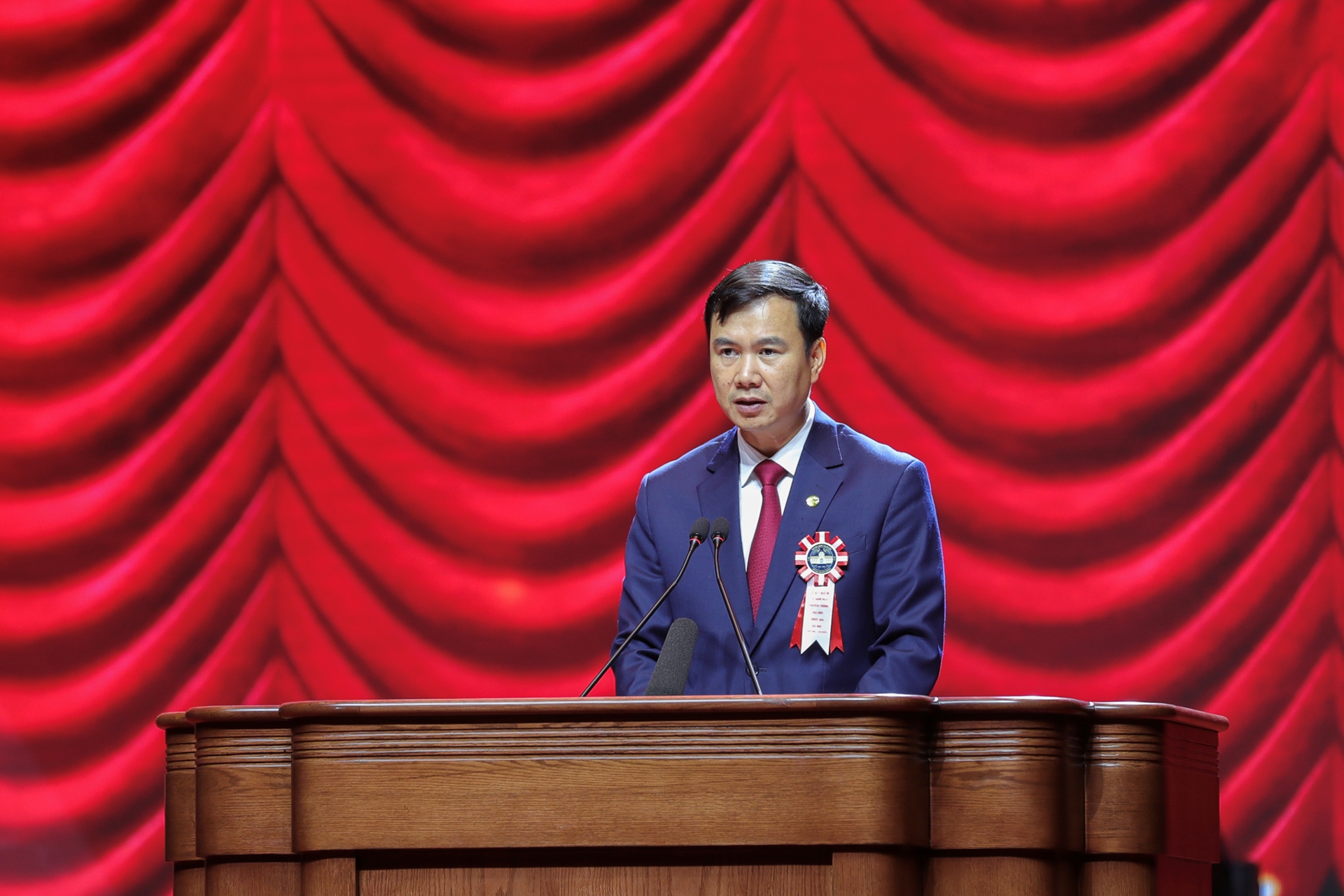
Director of Vietnam National University, Hanoi, Bui The Duy, delivered a commemorative speech.
For 120 years, this school has produced or been associated with many outstanding intellectuals, scientists, cultural figures, and leaders of the country. From the time of the University of Indochina, notable figures include Nguyen Thai Hoc, Pho Duc Chinh, Nguyen An Ninh, Truong Chinh, Vo Nguyen Giap, Ton That Tung, Duong Quang Ham, Hoang Ngoc Phach, Nguyen Gia Tri, To Ngoc Van, Luu Huu Phuoc, Nguyen Dinh Thi, Xuan Dieu, and Huy Can. During the period of the Vietnam National University and Hanoi University, the tradition of cultivating excellence continued to be nurtured through the names of many great educators and scientists such as Nguyen Van Huyen, Nguy Nhu Kon Tum, Le Van Thiem, Hoang Tuy, Tran Van Giau, Dao Duy Anh, Tran Duc Thao, Dinh Gia Khanh, Phan Huy Le, Ha Van Tan, Tran Quoc Vuong, Nguyen Tai Can, Ha Minh Duc, along with many other generations of exemplary intellectuals.
This tradition of elite training is not only reflected in the great names in history, but is also continued by outstanding achievements in talent training, scientific research, and international integration today. Vietnam National University, Hanoi (VNU) is currently a leading multidisciplinary research university in Vietnam, with over 80,000 students enrolled in regular programs; a system of nearly 500 training programs; and a staff of over 5,000 employees, including more than 3,000 scientists and 631 professors and associate professors. By 2025, VNU will launch 16 new training programs, focusing on core technologies of the Fourth Industrial Revolution such as semiconductor technology, integrated circuit design, robotics, and aerospace technology.
Vietnam National University, Hanoi (VNU) is committed to developing basic science as its core academic foundation, while simultaneously promoting strategic technology fields, interdisciplinary science, applied science, and innovation. To date, VNU has 210 laboratories and 50 strong research groups; it has published nearly 10,000 international articles in the ISI/Scopus index, with approximately 65% in the Q1 and Q2 categories. VNU scientists have received numerous awards, including the Ho Chi Minh Prize, the State Prize, the Ta Quang Buu Prize, and other prestigious international awards.
In talent development, the specialized high schools of Vietnam National University, Hanoi (VNU) continue to affirm their role as a special "nursery" for the country's talents. These specialized high schools have contributed over 80 international Olympic gold medals to Vietnam. From this environment, many generations of students have grown up to become reputable scientists, experts, managers, and leaders both domestically and internationally.
The position of Vietnam National University, Hanoi (VNU) continues to be affirmed in international rankings. According to the QS World University Rankings 2026, VNU is in the group of 761-770 best universities in the world, ranking 158th in Asia, further improving its position compared to the previous year. Indicators of academic reputation, employer reputation, employment results, and sustainable development demonstrate the quality of training, research, and the increasing influence of VNU in the region and globally.
In particular, the development of the Vietnam National University Urban Area in Hoa Lac is gradually realizing the model of a "smart, green, and innovative university city," forming an integrated ecosystem of training - research - technology transfer - entrepreneurship - business cooperation according to the standards of an advanced research university.
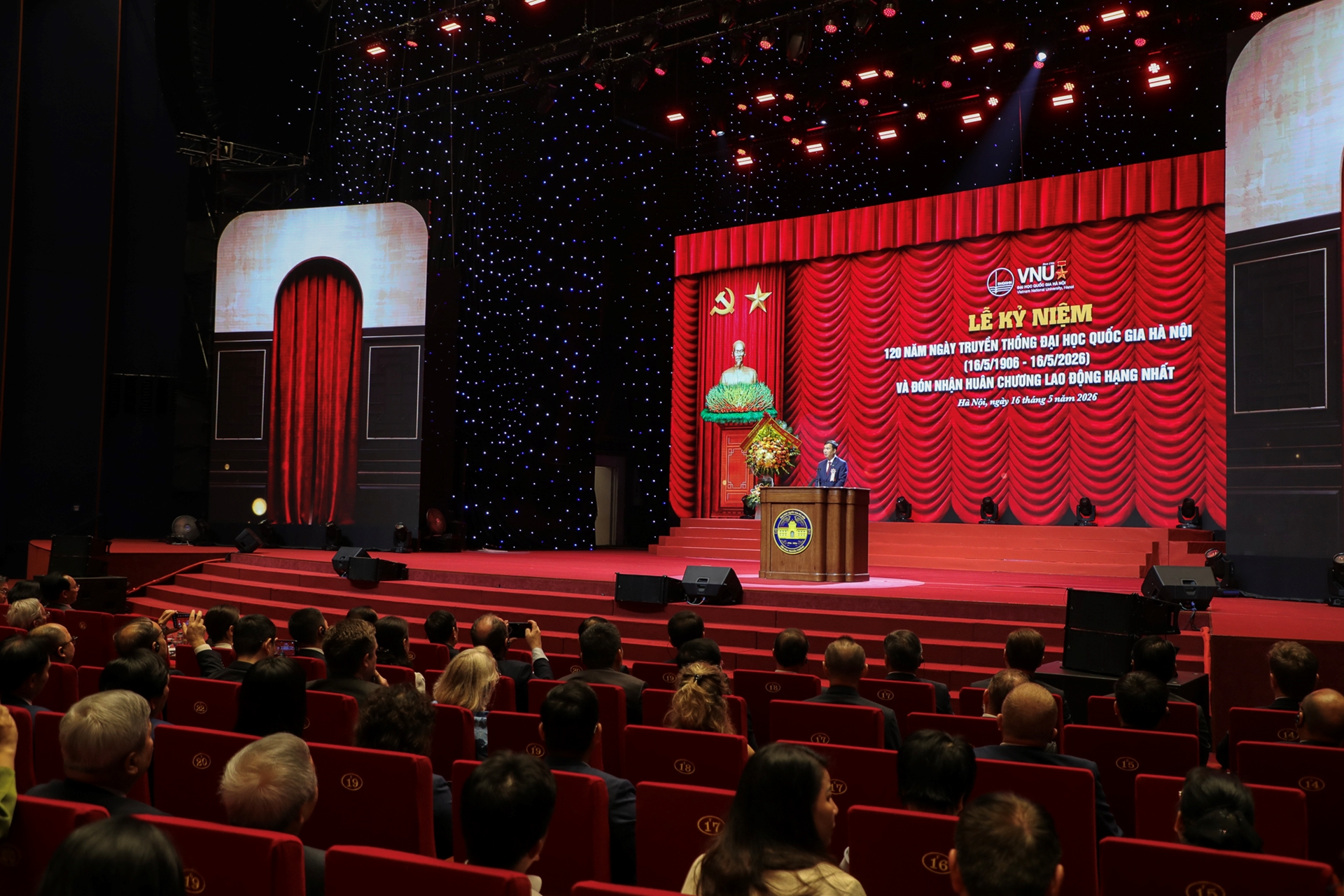
In his commemorative speech, Associate Professor Bui The Duy, alternate member of the Central Committee of the Communist Party of Vietnam and Director of Vietnam National University, Hanoi (VNU), emphasized that the 120th anniversary celebration is an opportunity for VNU to reflect on a flow of knowledge spanning centuries, a journey of self-affirmation of Vietnamese intellect in the context of global civilization. According to the Director, if 120 years corresponds to two cycles of the sixty-year cycle of the Chinese zodiac, then today's milestone is not only an opportunity to look back on the glorious journey of the past, but also to usher in a new era of development for VNU with the aspiration to reach higher levels in the new age.
He affirmed that Vietnam is a nation with a long-standing tradition of valuing education, always prioritizing learning and utilizing talent. In this historical context, the establishment of the University of Indochina on May 16, 1906, was a significant milestone, marking the beginning of modern higher education in Vietnam and Southeast Asia. From its inception, the University of Indochina was oriented towards an elite university model, focusing on fundamental sciences, and quickly developing a model that integrated training with scientific research. Simultaneously, it created a modern interdisciplinary academic ecosystem through its connections with specialized research institutions such as the French School of Far Eastern Studies and the Pasteur Institute.
The Director of Vietnam National University, Hanoi emphasized that, transcending the limitations of a colonial educational institution, Indochina University became a training ground for many generations of outstanding intellectuals, making significant contributions to the development of modern Vietnamese education, science, and culture. After the August Revolution of 1945, this academic tradition continued to be inherited and developed with the formation of Vietnam National University on the basis of Indochina University. After peace was restored, Hanoi University continued to maintain its multidisciplinary model, focusing on its strengths in basic sciences, gradually becoming a leading center for training and scientific research in the country, while also forming a tradition of discovering and nurturing talent with the establishment of the "A0 block" in 1965.
Looking back on its development, Associate Professor Bui The Duy believes that Vietnam National University, Hanoi (VNU) has affirmed the correctness and effectiveness of its multidisciplinary, high-quality university model oriented towards research. The ripple effect of this model is increasingly evident in the Vietnamese higher education system, creating an interdisciplinary, flexible academic space capable of solving large, complex problems in the practical development of the country.
In the field of education, Vietnam National University, Hanoi (VNU) continues the tradition of training talented individuals in basic sciences, persistently developing high-quality talent programs, prioritizing investment in science and technology resources, and maintaining its role as the cradle of talent training for the country. VNU also pioneers innovation in higher education with interdisciplinary and dual-discipline training models, transitioning from a semester-based system to a credit-based system, promoting digital transformation, successfully piloting competency assessment exams, and leading in accreditation and quality assurance of education.
In scientific research, technological development, and innovation, Vietnam National University, Hanoi (VNU) has consistently maintained its leading position nationwide. The number of international publications in prestigious journals has increased from under 300 articles per year before 2010 to approximately 2,000 in recent years; many works have been awarded the Ho Chi Minh Prize and the State Prize, and the number of patents and intellectual property assets continues to grow. VNU's research is closely linked to practical requirements, has high application value, and contributes to policy advice for the Party, State, ministries, sectors, and localities in many important fields.
The Director of Vietnam National University, Hanoi also emphasized the achievements in international cooperation and academic diplomacy. With a wide network of cooperation with hundreds of universities and research institutes around the world, Vietnam National University, Hanoi has become a bridge connecting, exchanging, and engaging in global academic and policy dialogue. It has had the honor of welcoming many heads of state, renowned scientists, economic experts, and leaders of large corporations to visit and work with it.
In response to the country's new development requirements, Vietnam National University, Hanoi (VNU) is determined to continue pioneering the effective implementation of the Party and State's strategic policies, especially Resolution No. 57-NQ/TW on breakthroughs in the development of science, technology, innovation, and national digital transformation; Resolution No. 71-NQ/TW on breakthroughs in education and training development; and Resolution No. 80-NQ/TW on the development of Vietnamese culture. VNU aims to become an elite university, striving to be among the top 100 universities in Asia by 2030 and among the top 300 universities in the world by 2035.
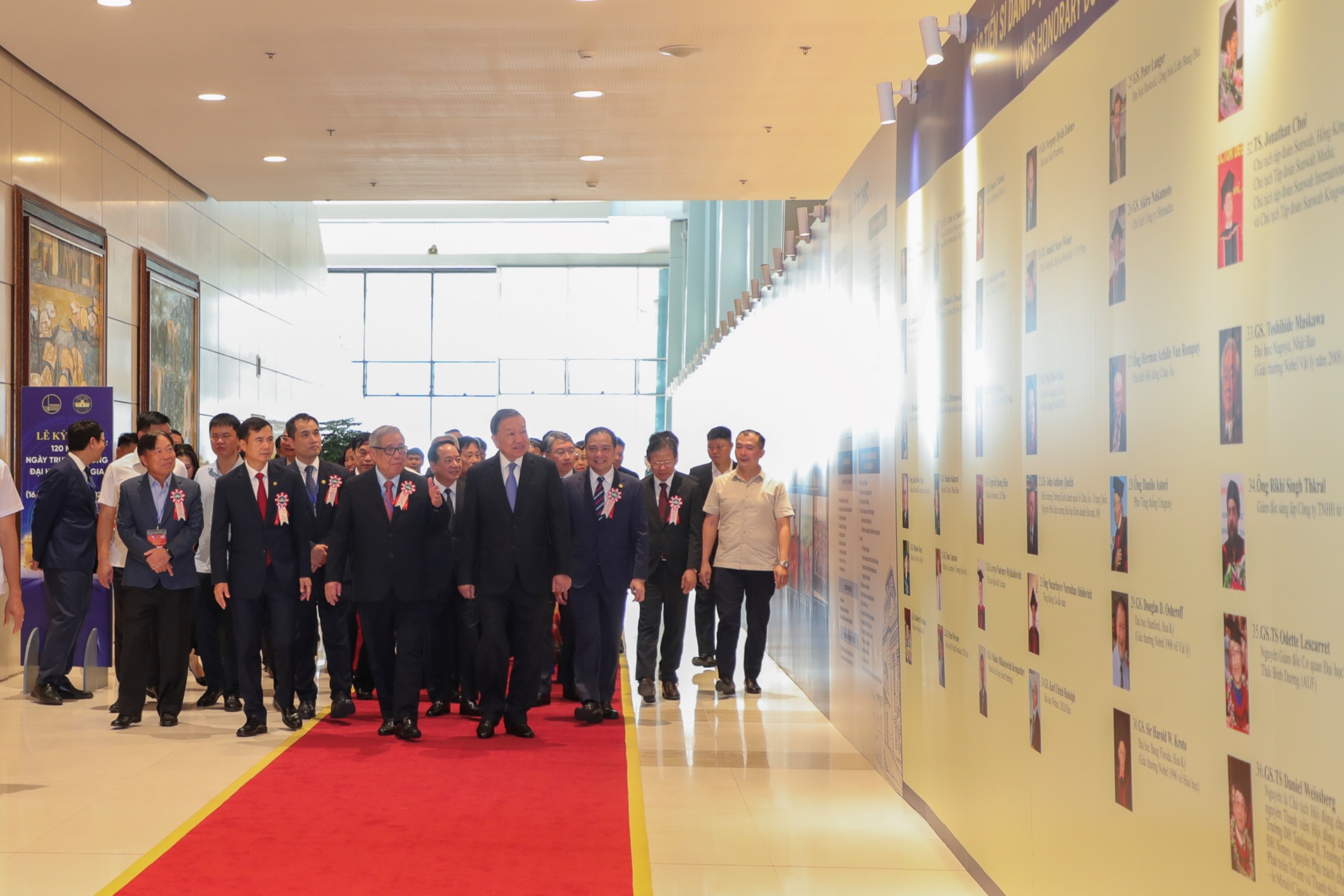
Delegates visited the exhibition showcasing the 120-year history and traditions of Hanoi National University.
To realize that goal, Vietnam National University, Hanoi (VNU) focuses on promoting its core role in training high-quality human resources, developing basic science, mastering strategic technologies, fostering innovation, and building an advanced academic environment on par with international standards. At the same time, VNU is strongly reforming its university governance model towards modernization, shifting from administrative management to results-based and effective governance; developing as a platform for creation and sharing, in which member units both promote initiative and creativity while operating according to a consistent mission, strategy, plan, and standards.
A key strategic direction emphasized by the Director of Vietnam National University, Hanoi (VNU) is to focus on developing the VNU Urban Area in Hoa Lac into a modern university and technology city, gradually forming a new growth pole to lead innovation in the capital. The VNU Urban Area in Hoa Lac is envisioned as an open innovation space, a green, modern university city with integrated technical and digital infrastructure and advanced services; a place where businesses, technology corporations, and other entities can participate in research, testing, and technology demonstration, strengthening the "three-party" model linking universities with businesses, research with application, and training with technological practice.
Based on this experience, Vietnam National University, Hanoi (VNU) proposes that the Central Government, the Government, and the city of Hanoi pay special attention and prioritize the allocation of resources and the application of special investment mechanisms to accelerate the construction of the VNU urban area in Hoa Lac, in line with the relocation schedule of over 80,000 students. VNU also proposes that the Central Government and the Government direct the development and implementation of special mechanisms to develop VNU into a leading elite university in Asia, a center for talent training, scientific research, technological development, and strategic innovation for the nation.
The Director of Vietnam National University, Hanoi (VNU) affirmed that the 120-year tradition is not only a source of pride but also a driving force for VNU to continue its breakthroughs in the new development phase. All staff, lecturers, scientists, and students of VNU will unite, innovate, and concretize the directives of the Party and General Secretary and President To Lam into practical actions, determined to build VNU into a symbol of Vietnamese intellect, making a worthy contribution to the country's development in the new era.

General Secretary and President To Lam delivered a speech at the commemoration ceremony.
Speaking at the anniversary ceremony, General Secretary and President To Lam emphasized that Vietnam National University, Hanoi has become a symbol of Vietnamese intellect, a place where academic aspirations converge, talents are nurtured, and important contributions are made to the cause of national construction and development.
Acknowledging the great efforts and significant achievements of Vietnam National University, Hanoi (VNU), the General Secretary and President emphasized that in an era where the nation's destiny is increasingly determined by knowledge, science, technology, innovation, and human quality, VNU must always reflect on its national responsibility and the nation's aspiration for progress; it must strive even harder to become a leading academic pillar, a major creative center, a pioneering force in Vietnamese higher education, and a prominent and reputable representative of Vietnamese intellect on the international stage.
Agreeing with the goals set by Vietnam National University, Hanoi, the General Secretary and President suggested that several key disciplines should be ranked among the top 100 globally. To realize these goals, the university must operate according to the model of an innovative university with the capacity to lead the nation; possess a modern educational philosophy, advanced governance, and a liberal academic environment; and urgently complete the Hoa Lac University Urban Area in a green, smart, and modern direction, organically connected with the Hoa Lac High-Tech Park, forming a leading ecosystem for training, research, technology, and innovation in the country.
The university needs a specific roadmap, assigning goals and tasks to each member, unit, and research group, and orienting management towards results. Investing in Vietnam National University, Hanoi must be considered a strategic investment in the nation's future, with a special financial mechanism, sufficient resources, and superior policies to build a modern scientific infrastructure and attract and utilize domestic and international talent.
General Secretary and President To Lam, along with a high-ranking delegation, visited an exhibition showcasing scientific and technological achievements.
The General Secretary and President emphasized that Vietnam National University, Hanoi must be a place that dares to be at the forefront, dares to experiment, and pave the way for new models in education, science, technology, innovation, and digital transformation; it must be a pioneer in implementing the Party's strategic resolutions; and focus on solving major national problems, especially strategic technologies, core technologies, source technologies, and technology products bearing the Vietnamese brand.
This provides a practical basis for the Party and State to continue refining development policies in the new era. The university needs to become a hub for national intelligence (leading scientists, top technology experts, technology entrepreneurs, outstanding students, etc.) to research, master, and develop foundational technologies such as artificial intelligence, semiconductors, biotechnology, new materials, new energy, big data, green and sustainable technologies.
Vietnam National University, Hanoi (VNU) must become a center connecting knowledge with development, further strengthening the university's ties with the State, businesses, localities, and society; proactively developing research programs, policy consulting, and innovation initiatives based on major national orders; and enhancing cooperation with ministries, sectors, Hanoi, localities, technology companies, research institutes, and international expert networks.
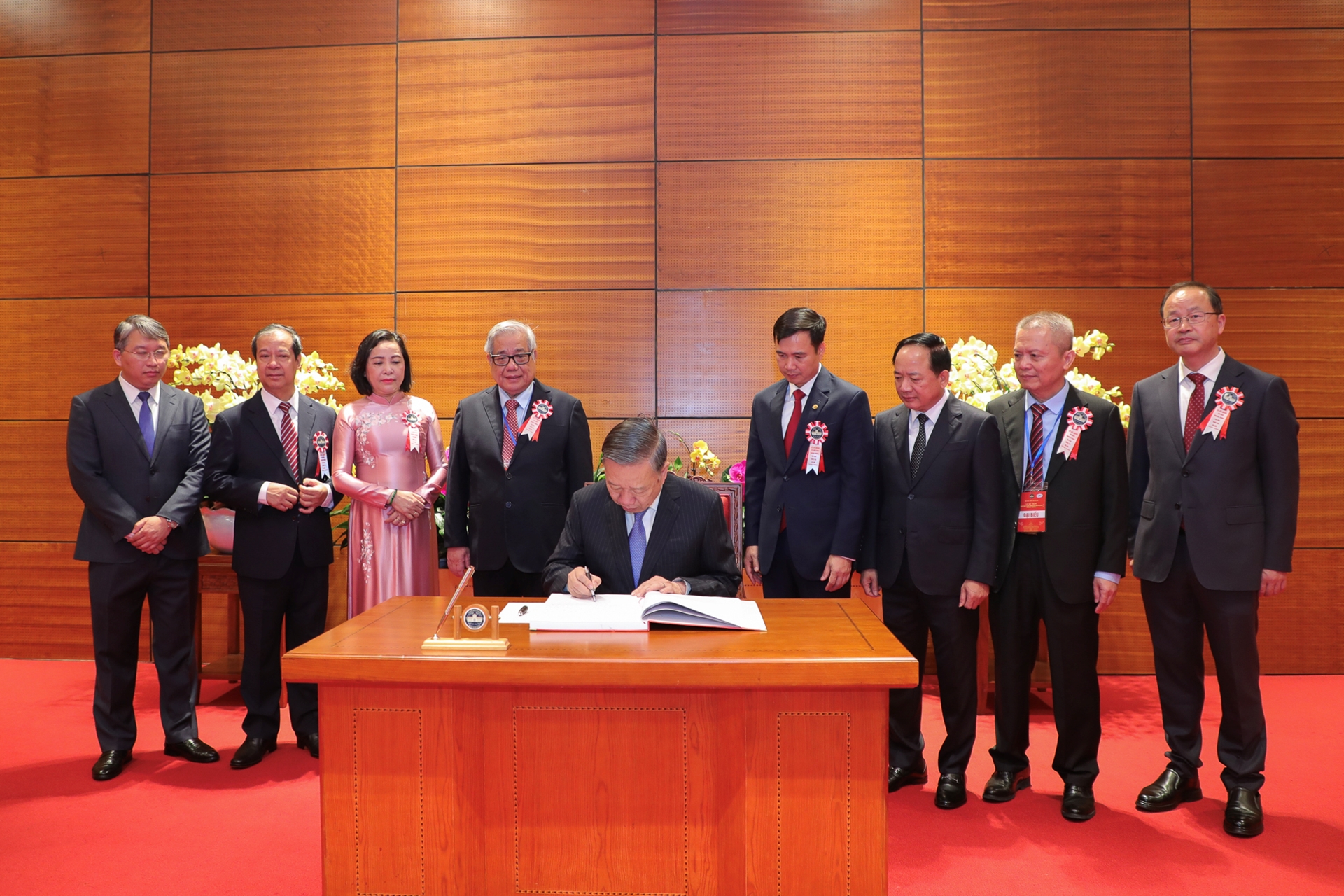
General Secretary and President To Lam signs the commemorative guest book.
With its long-standing tradition and leading position in the country, Vietnam National University, Hanoi (VNU) must also become a leading institution of Vietnamese academic diplomacy. Every staff member, lecturer, and student needs to be deeply aware that they are contributing to representing Vietnamese intellect, culture, and dignity in all academic, diplomatic, and international exchange activities.
To successfully accomplish these tasks, the General Secretary and President requested that Vietnam National University, Hanoi (VNU) organize effective and comprehensive political and ideological education for all staff and students on the proud traditions, roles, responsibilities, and mission of intellectuals in the new era of national development. The university must proactively coordinate with relevant agencies to research and propose to the Politburo and the Government breakthrough development mechanisms and policies for VNU in particular and Vietnamese higher education in general.
In particular, emphasis will be placed on removing bottlenecks in institutions, governance, finance, human resources, university autonomy, academic freedom, and investment in basic science and strategic technology to help Vietnam National University, Hanoi develop to its full potential, while simultaneously creating a strong impetus for innovation in Vietnam's higher education system.
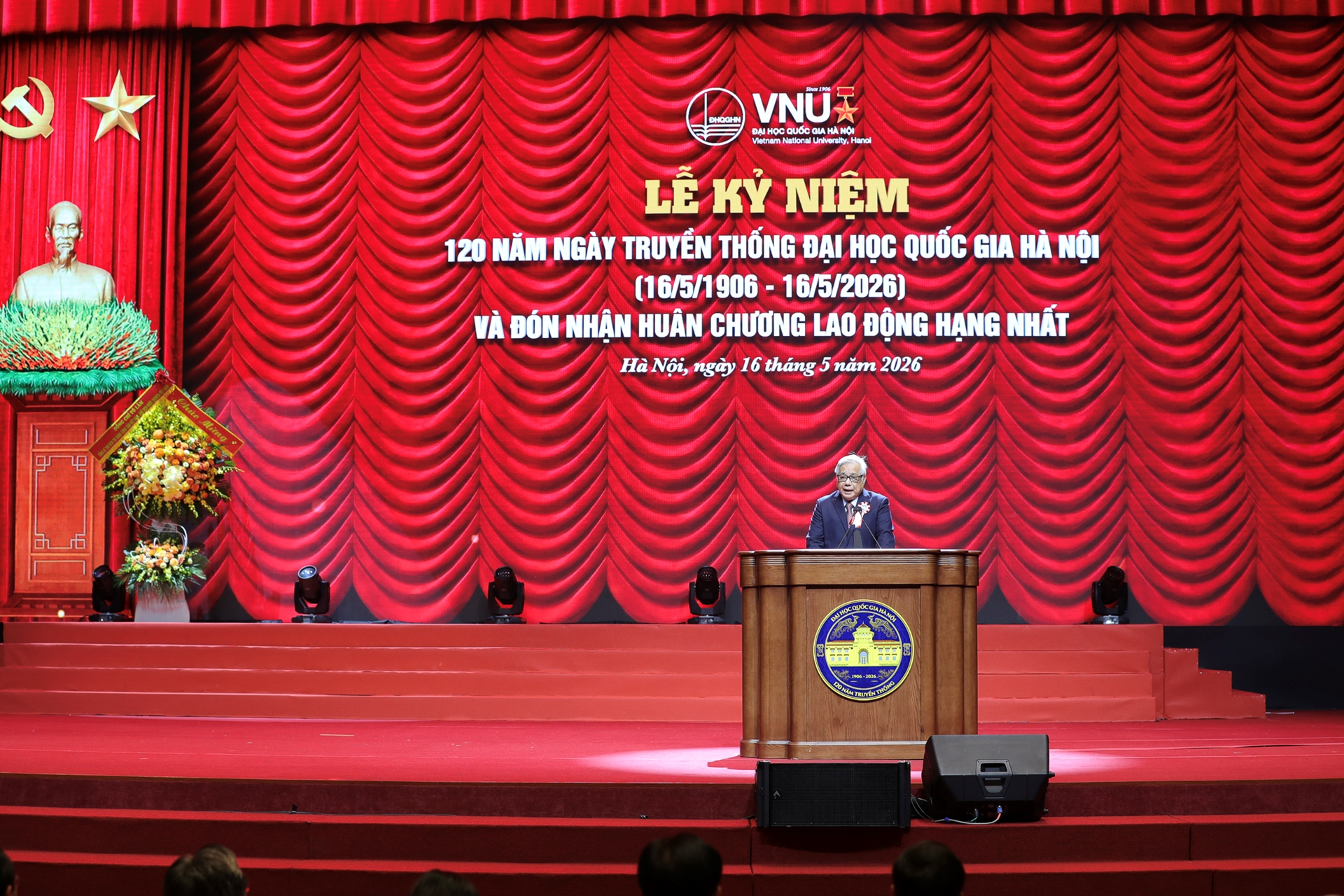
Drawing inspiration from the "Popular Education Movement" launched by President Ho Chi Minh with the aspiration to raise the intellectual level of the people and build the nation, Professor Vu Minh Giang connects it to the spirit of "Digital Popular Education" in the 21st century.
Speaking on behalf of the generations of faculty and staff of Vietnam National University, Hanoi (VNU), Professor Vu Minh Giang, Chairman of the VNU Science and Training Council and former Vice Director of VNU, expressed his deep emotion at the presence and special attention of General Secretary and President To Lam and the leaders of the Party and State towards VNU and the cause of higher education in the country. Recalling the event of November 15, 1945, in the context of a newly independent nation facing countless difficulties, President Ho Chi Minh still took the time to attend the first opening ceremony of Vietnam National University, Professor Vu Minh Giang considered it a message of profound symbolic significance regarding the revolutionary state's view on valuing intellectuals and talents.
Drawing inspiration from the "Popular Education Movement" launched by President Ho Chi Minh with the aspiration to raise the intellectual level of the people and build the nation, he linked it to the spirit of "Digital Popular Education" in the 21st century, considering it a great idea that reminds the entire population, especially intellectuals, teachers, and scientists, to master digital knowledge and technology to propel the country to the ranks of leading nations. Professor Vu Minh Giang affirmed that the establishment and development of Vietnam National University, Hanoi (VNU) is the result of a major policy and a strategic vision of the Party and the State; in the new phase, VNU not only develops with the scale and position of a large university, but also must shoulder the national mission of training talents, developing knowledge, and contributing to bringing the nation into an era of progress and building a prosperous and powerful country.
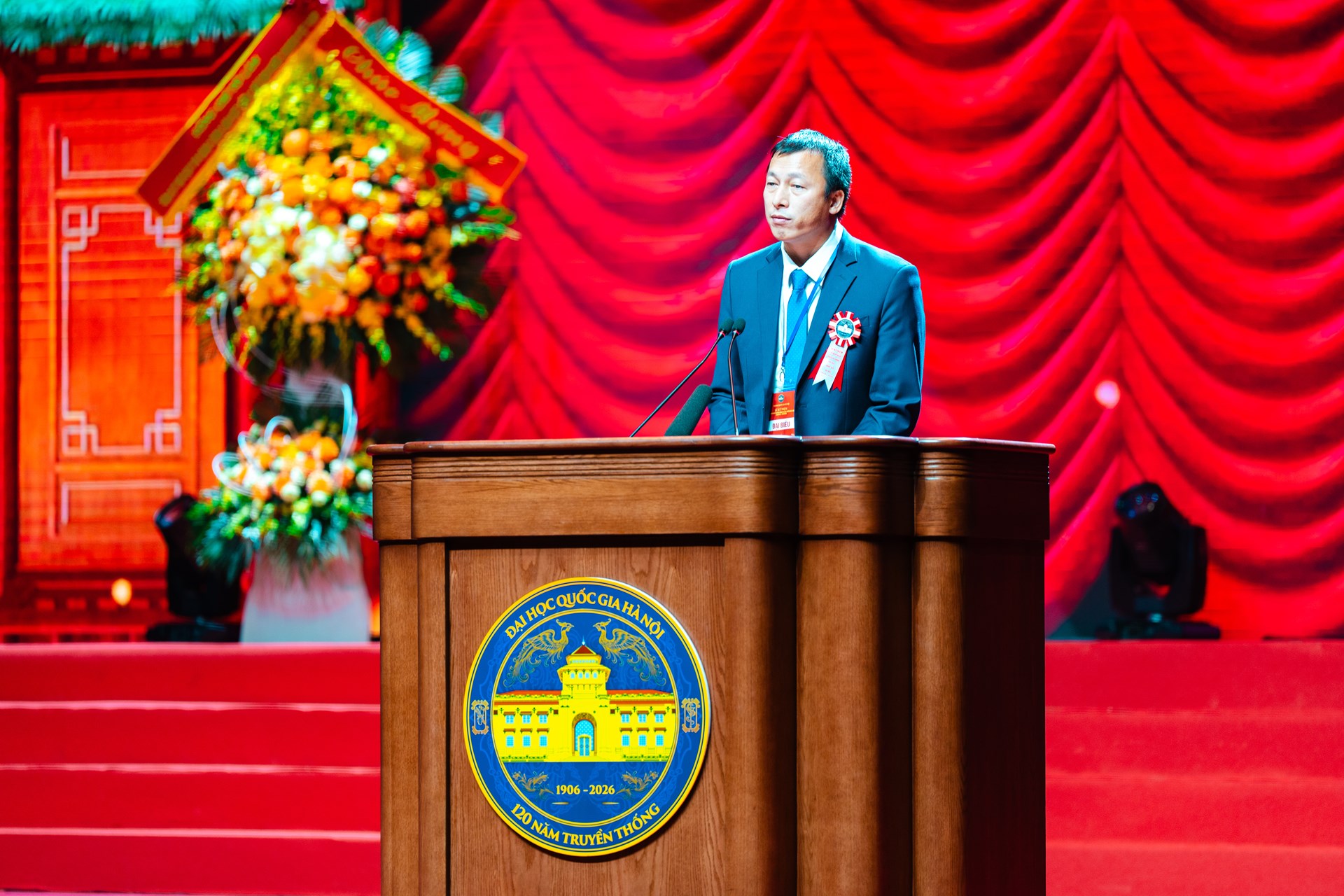
Professor Nguyen Ngoc Minh, a lecturer at the University of Natural Sciences, emphasized that the team of scientists at Vietnam National University, Hanoi, deeply understands the need to contribute to solving major national problems, promoting the country's competitiveness, protecting the nation's cultural and humanistic values, and preparing the intellectual foundation for future generations.
From the perspective of the faculty and scientists, Professor Nguyen Ngoc Minh, a lecturer at the University of Science, Vietnam National University, Hanoi, and a recipient of the Ta Quang Buu Award in 2016, expressed his pride and emotion at representing over 3,000 faculty and scientists of Vietnam National University, Hanoi, at this special historical milestone. According to Professor Nguyen Ngoc Minh, the 120th anniversary of the Indochina University - Vietnam National University, Hanoi, is a glorious journey intertwined with the history of modern Vietnamese development; it is not only the history of a higher education institution, but also the history of a national intellectual center – a place where academic excellence converges, talents are nurtured, enlightened ideas are spread, and aspirations to serve the country are fostered.
He emphasized that the team of scientists at Vietnam National University, Hanoi, deeply understands that the responsibility of intellectuals today is not only to publish research papers or impart knowledge in the classroom, but also to contribute to solving major national problems, promoting the country's competitiveness, protecting the nation's cultural and humanistic values, and preparing the intellectual foundation for future generations.
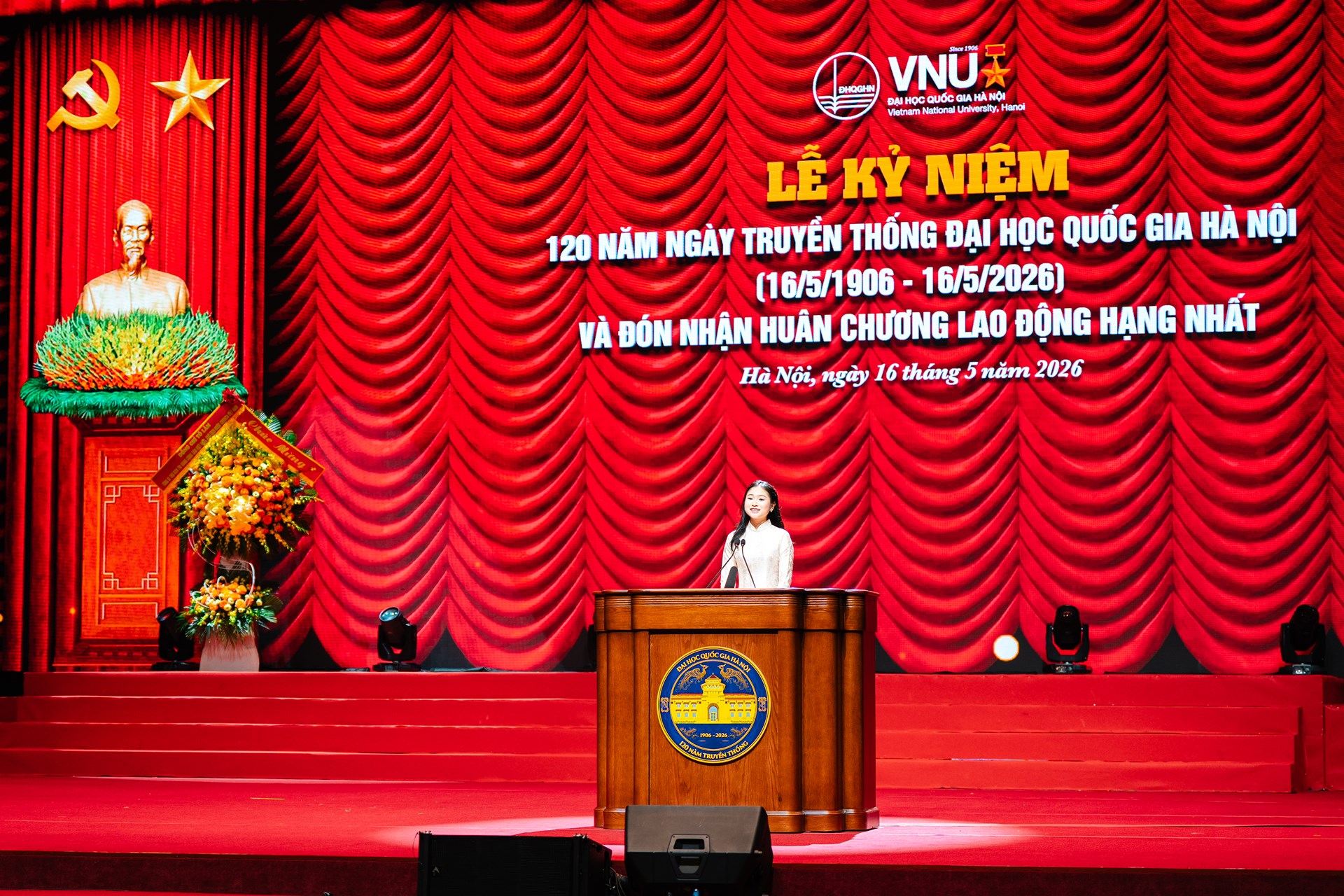
Student Duong Yen Nhu from the University of Foreign Languages shared that the 120-year tradition of Vietnam National University, Hanoi (VNU) is a spiritual foundation for generations of students to continue nurturing their aspirations for learning, creativity, integration, and contribution.
Speaking on behalf of the students of Vietnam National University, Hanoi (VNU), student Duong Yen Nhu from the Department of Chinese Language and Culture, University of Foreign Languages, VNU, expressed her honor and emotion at participating in this special milestone in the university's history. According to Duong Yen Nhu, VNU's 120-year tradition serves as a spiritual foundation for generations of students to continue nurturing their aspirations for learning, creativity, integration, and contribution; while also emphasizing that knowledge must be linked to responsibility, talent must go hand in hand with contribution, and the most beautiful youth is the youth who live for things greater than themselves.
Building upon its 120-year tradition, Vietnam National University, Hanoi (VNU) enters a new phase of development with the spirit of a pioneering university alongside the nation: steadfastly upholding academic values, promoting its leading role in talent training and scientific research, strongly innovating its governance model, expanding international cooperation, deeply connecting with businesses and localities, and aiming to become a leading center for training, research, and innovation in Asia.
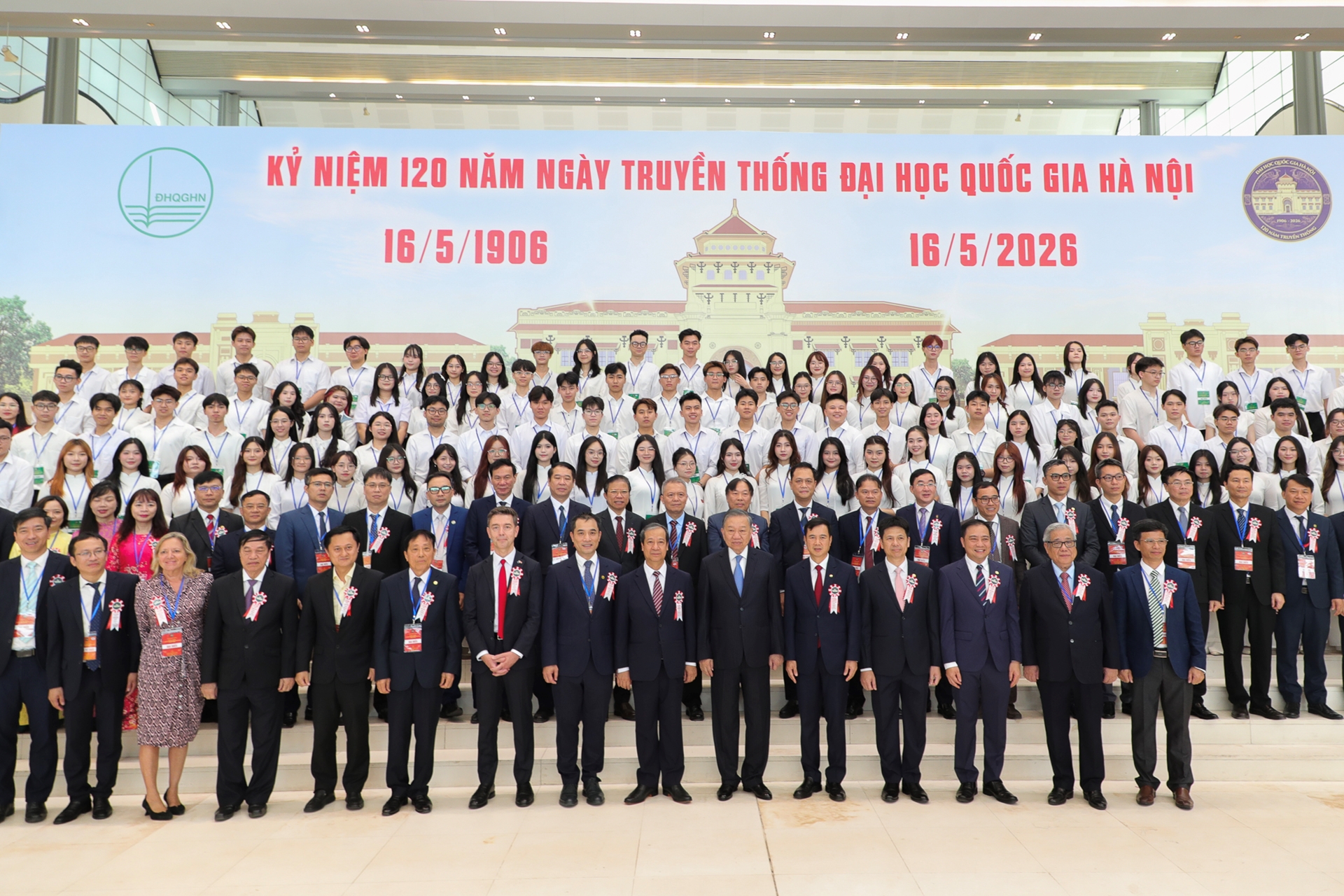
General Secretary and President To Lam poses for a commemorative photo with current and former leaders, international partners, and students from Vietnam National University, Hanoi.
The activities commemorating the 120th anniversary of the Vietnam National University, Hanoi (VNU) are an opportunity to express gratitude to the generations of teachers, scientists, staff, students, and alumni who have contributed to the glorious tradition of the university; and at the same time, affirm VNU's aspiration for development in the new era. Building on the foundation of its 120th anniversary, VNU continues to strive towards becoming a research and innovation university of regional and international stature, directly contributing to the development of a prosperous, strong, civilized, and happy nation.
As part of the series of activities commemorating the 120th anniversary of the Vietnam National University, Hanoi (VNU), on the afternoon of the same day, VNU organized a scientific conference "From Indochina University to Vietnam National University, Hanoi: A 120-Year Tradition of Elite Education" at the Nguy Nhu Kon Tum Hall, 19 Le Thanh Tong Street; in the evening, the exhibition "120 Years of Vietnam National University, Hanoi: A Tradition of Elite and Liberal Education" was inaugurated, creating a cultural, academic, and artistic space to spread the depth of tradition, the spirit of liberal education, and the aspiration for development of VNU in the new era.
Author:According to VNU Media
Newer news
Older news

