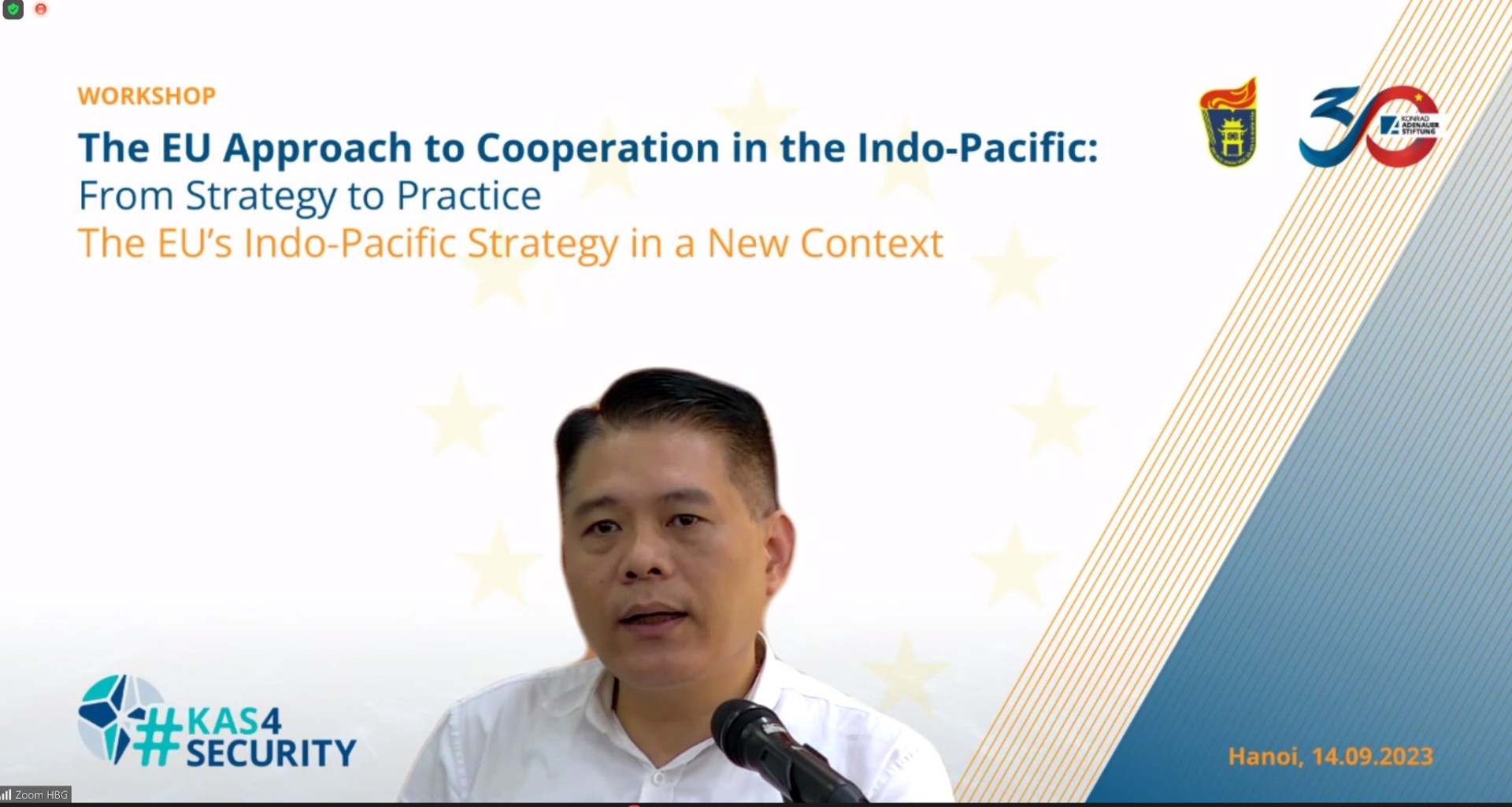
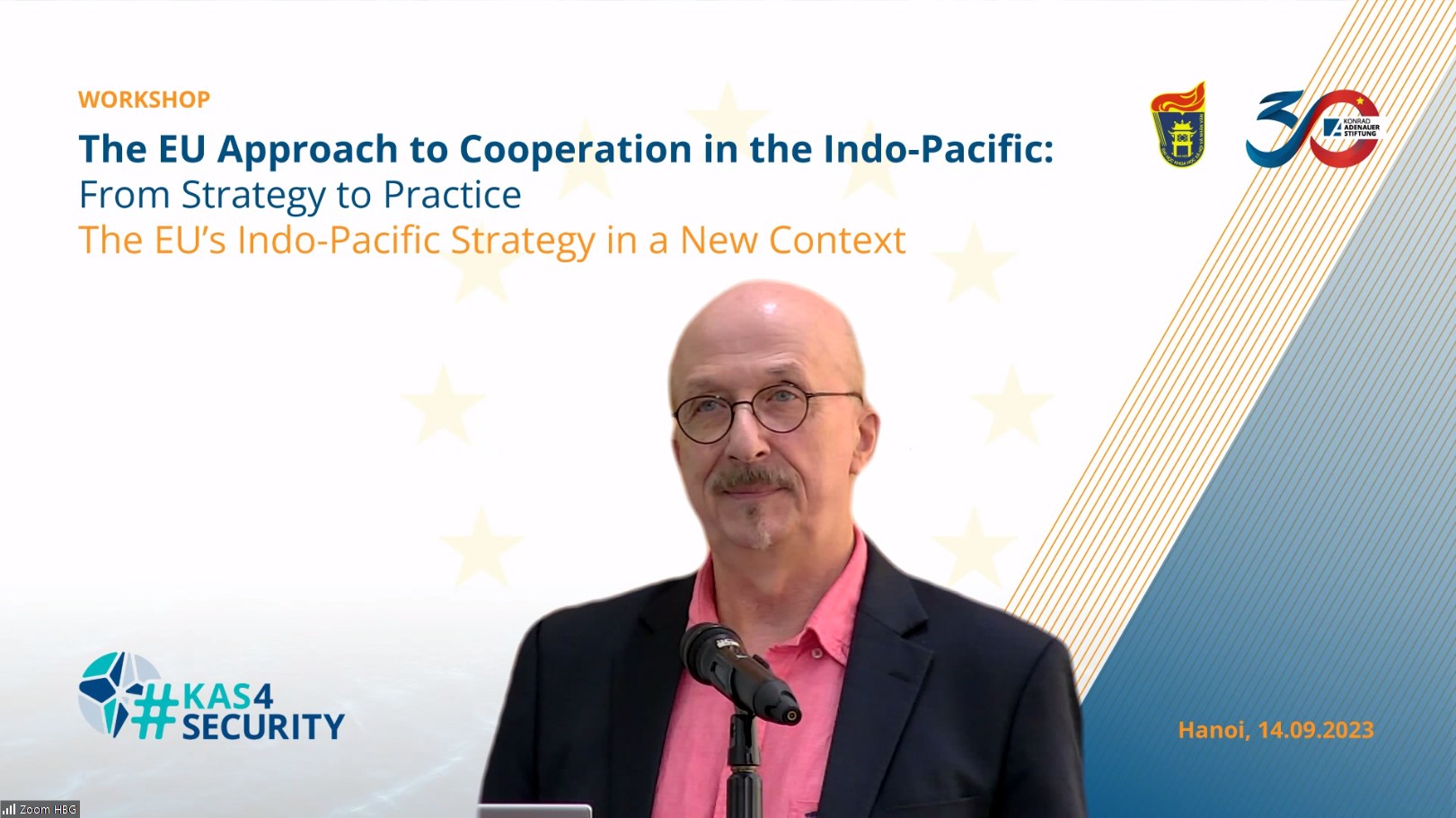
The workshop was held online to discuss and assess the implementation of the European Union's Indo-Pacific Strategy since its official publication in September 2021. Based on this, the workshop also aimed to evaluate the prospects for the EU's implementation of this strategy in the future.
The workshop was attended by Assoc. Prof. Dr. Bui Thanh Nam, Deputy Secretary of the Party Committee of the University of Social Sciences and Humanities; Mr. Florian Feyerabend, Head Representative of the Konrad-Adenauer-Stiftung Institute in Vietnam; the leadership of the Faculty of International Studies; experts; and a large number of lecturers and students from various training and research institutions specializing in International Studies/International Relations across the country.
In his welcoming remarks, Assoc. Prof. Dr. Bui Thanh Nam emphasized the significance of the workshop and highly appreciated the cooperation between the Konrad Adenauer Stiftung Institute in Vietnam and the University: “KAS’s vision and strong support are the foundation that makes this academic cooperation not only feasible but also very promising. The event organized by our two units today further demonstrates this effective and sustainable relationship.”
Highly appreciating the cooperative relationship between the two sides, Assoc. Prof. Dr. Tran Thien Thanh, Head of the Faculty of International Studies, also expressed his desire to further promote the proactive and positive contributions of the Faculty of International Studies to the cooperation between the two sides in the future.
Opening the discussion session, Dr. Detlef Briesen from Justus-Liebig Giessen University (Germany) – a key member of the research team – presented a summary of the main research findings in phase three of the project. Specifically, the reports indicated a strong movement towards a new multipolar world order and the need for the European Union to develop a strategy to increase its global influence (Dr. Detlef).
In this context, the EU needs to develop its own policy direction based on strategic autonomy and prioritize establishing a crucial balance in its engagement with the Indo-Pacific region (Prof. Margit Bussmann, Griefswald University, Federal Republic of Germany).
Regarding specific areas of bilateral relations between the EU and countries in the Indo-Pacific region, the reports focus on several topics: the EU's targeted connectivity strategy with the region to achieve maximum effectiveness (Assoc. Prof. Dr. Bui Hong Hanh, Faculty of Social Sciences and Humanities, Vietnam National University, Hanoi), the potential and strengths of the EU's economic cooperation with the region (Dr. Nguyen Van Dap, Faculty of Social Sciences and Humanities, Vietnam National University, Hanoi), and the complexity of the EU's value-focused approach when engaging in regional issues (Dr. Nguyen Thi Thuy Trang and Dr. Nguyen Thi My Hanh, Faculty of Social Sciences and Humanities, Vietnam National University, Hanoi).
Besides commenting on the main research findings shared by the research team representatives, the workshop then expanded to discuss the perspectives of key actors in the region on the implementation of the EU strategy in the new context. Professor Go Ito of Meiji University (Japan) argued that the Indo-Pacific region is a complex area in terms of security and Japan can play an important role, while the EU's involvement in the region is only effective when it can resolve differences among member states to implement common policies. Commenting on South Korea's perspective, Dr. Professor Nguyen Thi Thu Huong from the University of Social Sciences and Humanities, Vietnam National University, Hanoi, stated: “The EU’s Indo-Pacific Strategy presents an opportunity for South Korea to seek new international partners, beyond traditional partners like the US and Asian countries. Building on previously established relationships, South Korea will undoubtedly aim to strengthen its current relationship with the EU, but will face new challenges, ranging from balancing relationships with partners to ensuring national security and economic development.” Kumaresan Raja of Pondicherry University, India, commenting on India's perspective, stated: “India’s approach to the Indo-Pacific region focuses on the central role of ASEAN. This approach complements the EU’s approach to the region, which aims to maintain political and social stability, with Asia as its core objective. The EU also supports measures to sustain the region’s high economic growth rate. India’s and the EU’s interests converge as both sides agree to build a partnership to strengthen a rules-based world order.”
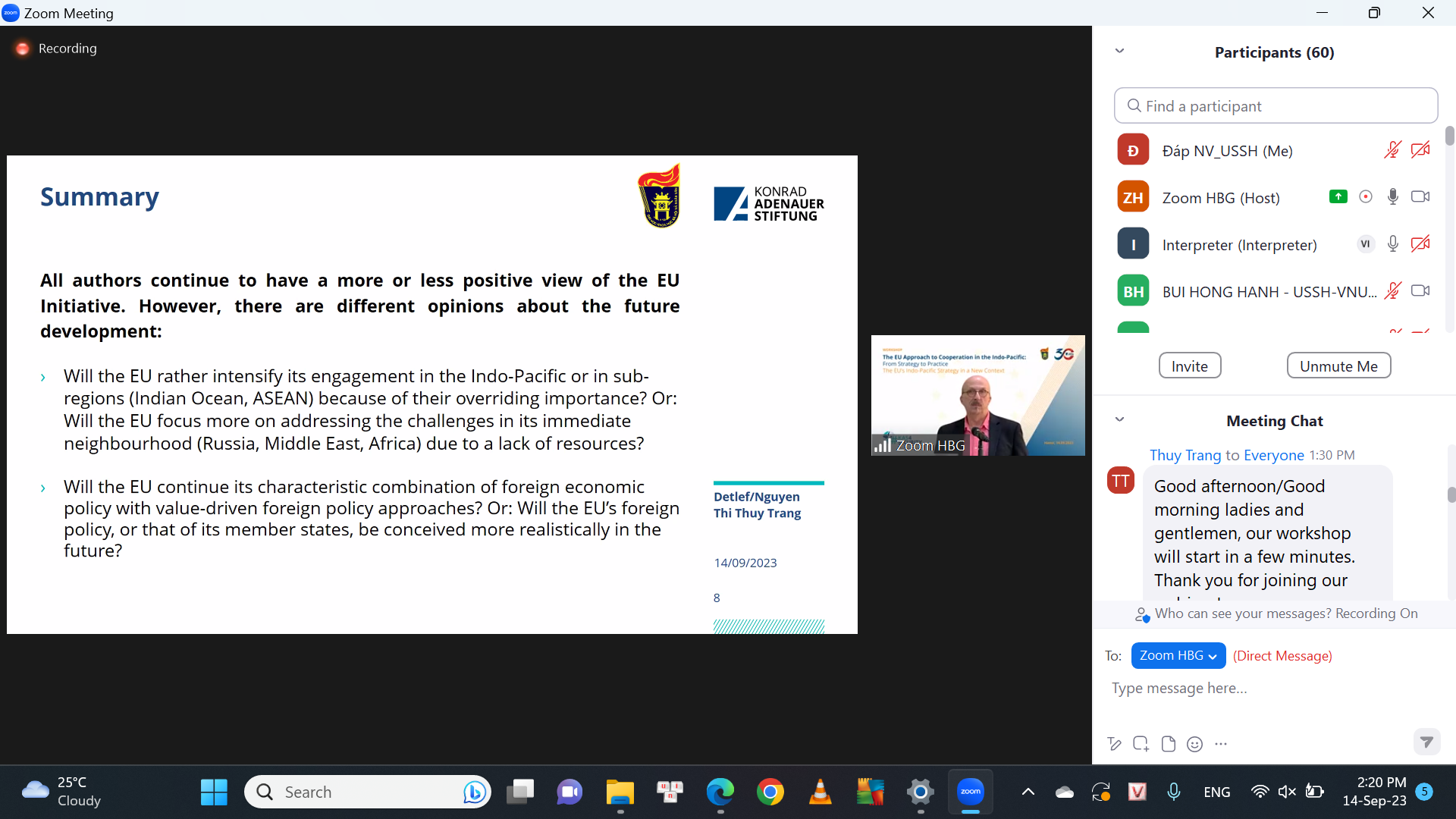
Concluding the seminar, Mr. Florian Feyerabend, Head Representative of the Konrad-Adenauer-Stiftung Institute in Vietnam, reaffirmed: “The Indo-Pacific has become a fascinating geopolitical center of the 21st century. While geographically distant from the European Union, it is a region of paramount importance to both the prosperity and security of the European Union. The European Union's strategy acknowledges the geostrategic and geopolitical importance of the Indo-Pacific in general and Southeast Asia in particular.”
| The research project "The European Union's Approach to Cooperation in the Indo-Pacific Region: From Strategy to Practice," implemented by the University of Social Sciences and Humanities (Vietnam National University, Hanoi) in collaboration with the Konrad Adenauer Stiftung (Germany) in Vietnam, consists of three phases: Phase 1, conducted in 2021, analyzed the EU's strategy and that of several member states regarding cooperation in the Indo-Pacific region and Vietnam's initial perspective; Phase 2, in 2022, examined the views and responses of key countries in the Indo-Pacific region to the EU's strategy; Phase 3, conducted in 2023, studied the impact of changes in the international situation on the implementation of the EU's strategy and the prospects for future EU cooperation in the region. |