Ho Chi Minh Thought is a comprehensive and profound system of views on the fundamental issues of the Vietnamese revolution, including the issues of innovation, creativity, and the development of science and technology. It contains profound values that endure through time. This article systematically studies Ho Chi Minh's views on the content of innovation, creativity, and the development of science and technology, affirming the value of these views in the context of the Vietnamese Party, State, and people actively promoting the development of science and technology and innovation, considering it a strategic breakthrough to successfully achieve the goal of building and defending the socialist Vietnamese Fatherland.
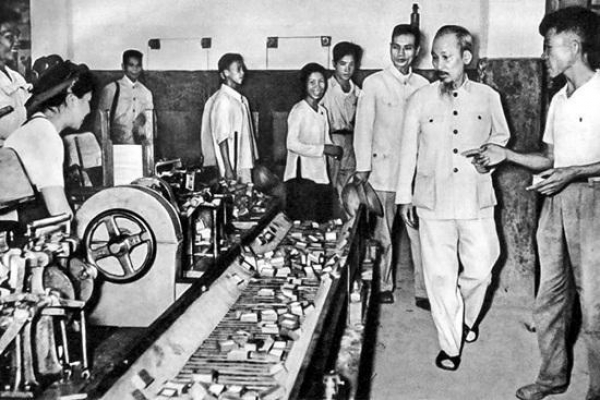
President Ho Chi Minh visits Thong Nhat Match Factory in 1956 (Archival photo)
1. Introduction
President Ho Chi Minh was a brilliant leader, the founder of the Communist Party of Vietnam, and together with the Party, led the Vietnamese revolution to victory. Throughout his revolutionary leadership, he never deviated from the goals and ideals of national independence and socialism, national liberation, class liberation, and human liberation. To achieve these goals and ideals, Ho Chi Minh believed that innovation, creativity, and the development of science, technology, and engineering were among the key elements.condition key.
Based on the creative application and development of Marxism-Leninism, along with his rich practical experience, Ho Chi Minh provided important guidance on innovation, creativity, and the development of science and technology to quickly and permanently liberate our people from poverty and backwardness.(1), successfully building socialism.
Along with his views on the role, objectives, conditions, and methods of implementation, his perspective oncontent related to innovation, creativity, and scientific and technological development.It is considered one of the most outstanding innovations, containing immense value for the cause of national liberation and development. To this day, that system of viewpoints remains valid, playing a guiding role in formulating guidelines, policies, and laws on scientific and technological development and innovation, ensuring the fulfillment of the two strategic tasks of national construction and defense.
2. Content
Based on Ho Chi Minh's arguments and practical guidance related to this topic, we can summarize his viewpoint on...ContentInnovation, creativity, and development of science and technology will focus on the following key areas: Scientific research; Promoting initiatives among the people; Technical improvement activities; and Training of scientific and technical intellectuals.
(1) Scientific research
Scientific research is considered one of the core components within various programs.ContentRegarding innovation, creativity, and the development of science and technology according to Ho Chi Minh's ideology: With its nature as an activity of exploration, discovery, searching, and creation, Ho Chi Minh believed that the results of scientific research would help humanity "expand to new horizons," "master nature, as well as master the destiny of society and of themselves."(2).
According to Ho Chi Minh, the world is constantly changing rapidly; therefore, research, innovation, and the search for new things to master nature and society are absolutely essential. He wrote: “The past fifty years have seen more rapid and significant changes than the previous centuries combined. In those fifty years, there have been inventions such as film, radio, television, and even atomic power. This means that humankind has taken a giant leap forward in controlling the forces of nature.”(3)Therefore, in order to bring our country "on par with the great powers of the world," there is no other way than to devote all our efforts to learning and researching to acquire the cultural, scientific, and technological achievements of humankind, transforming them into the intellectual property of the nation, and successfully building socialism.
He emphasized that: “The world today is making enormous strides in terms of human knowledge. Natural sciences as well as social sciences are constantly expanding into new horizons.”(4)Therefore, it is necessary to constantly innovate, create, conduct scientific research, and seek new inventions "in order topractical"To solve the problems posed by our country's revolution and, in the not too distant future, to reach the pinnacles of science and technology."(5).
According to him, scientific research is a unique field, therefore, perseverance and overcoming difficulties are necessary for success. Given that our country is still poor and investment in science is limited, it is essential to...research has focus, keyAvoid widespread, superficial, or wasteful investments in areas not aligned with the practical needs of the country, and prevent the squandering of the people's resources. He said: "We must promote research and dissemination of science and technology in a focused and steady manner, aiming to..."Serving production, serving people's lives., serving national defense(6).
Specifically, in the field of social sciences, research needs to go deeper and should participate in "summarizing the experiences of the struggle between the exploited class and the exploiting class, and the struggle between man and nature."(7); “summarizing valuable experiences”(8)in production and daily life to best serve the cause of national development; while also focusing on urgent theoretical and practical issues that have not yet been resolved.
Regarding the fields of natural sciences and engineering, he emphasized: "Science must originate from production and must return to serve production, to serve the masses, in order to..."improve labor productivityandcontinuously improving the lives of the people., ensuring the victory of socialism"(9)Thus, for Ho Chi Minh, the task of research in the fields of natural sciences and engineering did not stop at creating and inventing new things, but more importantly, those creations and inventions had to be tested in practice, had to return to serve production and contribute to improving the lives of the people. This is considered a very distinctive argument of Ho Chi Minh, an argument that contains universal values and demonstrates a vision ahead of its time.Genuine science must originate from practice and return to serve practice.,We must contribute to increasing labor productivity and continuously improving people's lives..
According to Ho Chi Minh, scientific personnel in any field must master and develop their specialized knowledge within that field. “For example, military personnel must study military science, medical personnel must study medicine. Personnel in a particular field should study the theory of that field.”(10)Therefore, scientific staff must always be conscious of improving their cultural and technical skills, possessing the ability to explore, innovate, and master technical tools and processes. He also reminded that research projects and topics must have practical effects: "What is disseminated must be practical, accurate, and understandable to the masses so that they can implement it."(11).
To improve the country's scientific and technological level, Ho Chi Minh also believed in "expanding cooperation with fraternal countries in scientific and technological research."(12)This is also a crucial requirement. In fact, to form a team of scientists to serve the cause of national construction and defense, immediately after the establishment of the Democratic Republic of Vietnam, in a letter to the US Secretary of State (November 1, 1945), President Ho Chi Minh proposed "sending a delegation of about fifty young Vietnamese people to America with the intention, on the one hand, of establishing close cultural relations with American youth, and on the other hand, of promoting further research in technology, agriculture, and other specialized fields."(13)He also tried to persuade a number of reputable Vietnamese scientists living abroad to return to the country to participate in building and defending the nation, and at the same time advocated for the selection of many cadres to send to Western countries to promote the training of high-level intellectuals.
Within the country, he established several scientific research centers and higher education institutions, such as the Vietnam People's University, the Tran Quoc Tuan Military Academy, the Polytechnic University, the Hanoi Pedagogical University, the College of Fine Arts, etc. With his interest in scientific activities, Vietnam organized and built a series of scientific research institutions, universities, and colleges. From these, a large number of scientists and scientific research achievements were provided each year to serve the revolutionary cause of the Party and the nation.
(2) Promoteinitiatives among the people
Promoting initiative among the masses is also a distinctive aspect of Ho Chi Minh's views on various issues.ContentInnovation, creativity, and scientific and technological development are activities related to the process of creating innovations in technology and management, and applying technological advancements to production in order to increase labor productivity, improve people's lives, and contribute to the development of the country.
According to Ho Chi Minh, initiative is not something lofty and impossible to achieve, but rather it can be practical, simple improvements that bring great results in work and life. He wrote: "Initiative is not something strange. It is simply the result of research and thought in very ordinary, very common, and very practical circumstances and conditions."(14)Ho Chi Minh also believed that it is not only those with "exceptional talent" who can have innovative ideas, but every ordinary citizen, through the process of learning, observing, and working daily, can also propose initiatives to contribute to the overall development of the country.
He emphasized: "Anyone who is determined to benefit the masses, is willing to learn, is willing to ask the masses, is willing to think hard, and is willing to work hard, will certainly have innovative ideas and will certainly be able to do things that benefit humankind."(15)Thus, according to Ho Chi Minh, everyone has the potential to contribute innovative ideas to the nation, even in the smallest actions. This is considered a highly unique viewpoint of Ho Chi Minh, because he regarded the masses as "scientists"—special scientists.
Ho Chi Minh affirmed that the technical innovations and solutions of the masses mainly arise from practical requirements, serving life and production, including many unique, useful innovations and solutions that bring many practical benefits. Therefore, from the perspective of the masses, they are "very diligent, intelligent, and skillful."(16)"In production and daily life, they have a wealth of valuable experience," and they "know how to solve many problems simply, quickly, and completely, while brilliant individuals and large organizations ponder endlessly without finding a solution."(17)Therefore, Ho Chi Minh always encouraged and motivated the people to enthusiastically participate in labor emulation, develop initiatives, and improve technology to increase labor productivity. He said: “We hope that our compatriots who have talent and initiatives (…) and are willing to enthusiastically help the country will send clear plans to the Government. We will study those plans carefully, and if they are feasible, we will implement them immediately.”(18).
He emphasized:"Initiativeandexperience isbelong to"A valuable asset for the entire nation."(19), therefore theyWe must strive to make it more abundant and spread it ever wider. "It starts by spreading throughout a unit, a factory, a village, etc. Gradually, it spreads throughout the entire army, the entire technology sector, the entire country. Initiatives and experiences are like small streams flowing into large rivers, and large rivers flowing into the ocean. Not valuing initiatives and disseminating experiences is a waste of the nation's resources."(20).
This viewpoint of Ho Chi Minh reflects a humane and progressive perspective, honoring human values and the power of creativity, expressing his profound belief in the intellect, creativity, and role of the masses in the national revolutionary cause. It also reflects his strategic vision for a learning society – where every individual is a scientist, capable of contributing innovative ideas to the nation.
In particular, he also emphasized that, in order to have good initiatives and new methods, the masses must constantly study and improve their cultural and technical skills to meet the demands of practical production. He said: “We need to learn many things: politics, culture, technology, and professional skills. Besides learning in schools, classes, books, newspapers, etc., there is a very good way of learning that everyone can participate in every day. That is learning right in production, learning from advanced people, groups, and units. Advanced people are also ordinary workers. But in their thinking and working methods, there are good points that can help production and work progress quickly and strongly... This will make the common initiatives and experiences increasingly abundant, and the general level of ideology, organization, and technology increasingly higher.”(21).
For the leadership team (from ministries to enterprises and construction sites), Ho Chi Minh believed that their responsibility was to actively encourage, review, apply, improve, and widely disseminate good initiatives in practice. For scientific cadres, he instructed them to be bold, creative, enthusiastic, and proactive in all their work, constantly improving their initiatives; at the same time, they must closely follow the work to summarize the valuable experiences of the people and proactively cultivate and enhance the scientific capacity and cultural level of the workers.
Because new problems and difficulties constantly arise in practice, it's essential to adapt, correct, and improve accordingly, quickly finding new ways to ensure solid results. "As long as we have a strong sense of ownership, a collective spirit, discipline, and a commitment to learning and improving our cultural and technical skills, along with a spirit of creativity, exploration, learning, support, and implementation of new ideas, anything is possible."(22).
(3) Technical improvement activities
Based on the reality that production in our country was still fragmented and backward, with mainly handicraft means of production, Ho Chi Minh believed thatwant to reorganize productionthen of courseTechnology needs improvement.And by summarizing experiences from economic activities, distilling and elevating them into scientific theories, the process shifted from spontaneous to conscious activity. He said: "To progress, we must improve technology."(23)Because "only with technological improvements and improvements in labor organization can we produce more, faster, better, and cheaper. If we only rely on habit or if we only put in more effort, the result is often a trade-off: faster but not better, better but not faster or cheaper... and every aspect is limited."(24).
He often urged the entire Party and the entire nation to "strive to improve technology."(25)And it must be recognized that this is one of the extremely important aspects of innovation, creativity, and the development of science, technology, and engineering, helping "production to develop increasingly rapidly and sustainably, and the lives of working people to become increasingly prosperous and fulfilling."(26).
Technological innovation is the process of introducing measures tomodify, improveMachinery, tools, and improved methods of production and labor organization are essential for increasing labor productivity, reducing production costs, and improving product quality. He affirmed: “To develop production, we must improve technology, meaning: We must learn to master technology and utilize the full capacity of machinery. We must seek innovative ideas to organize labor rationally. We must improve working tools and machinery to achieve high productivity and good quality.”(27).
Ho Chi Minh also argued that, in transitioning from a backward agricultural country to socialism, ""The implementation of the technological revolution must be a long-term endeavor."The caller was: “The long road of the technological revolution(28).He argued that technological innovation must be carried out regularly and continuously in all economic sectors, and must become a widespread movement among the people. "Doing these things means achieving the main part of the economic recovery plan. Therefore, the lives of the people will be improved, leading to a prosperous nation and a strong country."(29).
However, to improve technology, one must have knowledge and scientific understanding, because technology and science are closely related. Every step forward in science is a direct basis for technological development, and vice versa. He advised: "To improve technology, one must know technology. To improve labor organization, one must also know organizational methods and have organizational experience. In both these aspects, we are currently lacking. Therefore, we must..."Learn, learn more, and keep learning!"as Lenin taught"(30)The person making the request said: "Technological improvement requires learning from experience, exchanging experience, and sharing experience with each other. We shouldn't think that having a few experiences makes us very good; we must learn from each other, learn from the experience of our Chinese comrades, just as our Chinese comrades learned from the experience of the Soviet Union. The Soviet Union is constantly progressing and continues to seek ways to advance further."(31).
(4) Training scientific and technical intellectuals
In order for science and technology to fulfill their roles, functions, and tasks, Ho Chi Minh affirmed...human factors- Key resources in the development of science and technology, and a decisive factor. Therefore, in theseContentIn the context of innovation, creativity, and the development of science, technology, and engineering, the issue is...training scientific intellectuals,techniqueHe always cared for and paid attention to me.
According to Ho Chi Minh, in the process of revolutionary development, some intellectuals are products of the old education system, while others are products of the new education system. However, whether old or new, as long as they are genuine intellectuals, they are all highly valuable and play an important role in the nation's revolutionary cause. This view of valuing the role of intellectuals stems from the philosophy of the role of power.humanityButexpressionregarding the role ofawaken,enlightenmentthe people. Because, according to Ho Chi Minh, the intellectual class, as those with knowledge, are the "foreseekers and sighted ones."(32), are people with a missionAcquire knowledge, create knowledge.anddisseminating knowledge, that is the forcedirectmeeting the needsWe need the power of understanding, of wisdom.among the people, helping the peopleRising from spontaneous to conscious actionto achieve revolutionary goals. From that perspective, intellectuals become even more valuable and extremely important.
According to Ho Chi Minh, in his role asexceptional creative forceThe intellectual workforce, including scientific and technical intellectuals, must consist of individuals with high levels of education, specialized knowledge, and independent, creative thinking. To achieve this, scientific intellectuals need to constantly learn, always consciously strive to improve their cultural and technical skills, possess a spirit of creativity and exploration, be capable of mastering technical tools and processes, and have the ability to create and make new inventions.
Ho Chi Minh instructed that, due to the constantly changing domestic and international situation, the country's work is becoming more numerous and innovative, "previously we worked manually, but now we work with sophisticated machinery," and "without cultural and technical skills, we cannot manage it."(33)Therefore, studying culture and improving technical skills is essential.(34)Intellectuals do not rely solely on experiential knowledge; they must be trained and possess a firm grasp of the scientific knowledge of their field of study. Therefore, scientific and technical intellectuals must learn not only in schools and from books, but also from the people and from real-life experiences. He emphasized: "Comrades must go down to the factories and cooperatives, ask the workers and farmers what they need, how they work and live, and disseminate the necessary information to help them improve technology, develop production, and improve their lives."(35).
Besides continuously improving their level of awareness, intellectuals in general, and scientific and technical intellectuals in particular, must also be pioneers in...knowledge, aboutawareness of the new,overtakeContemporary awareness is key. Without forward-thinking awareness, according to Ho Chi Minh, one is unworthy of being called an intellectual. He pointed out that one of the things to avoid is: "An intellectual who does not consider the future."(36).
Furthermore, Ho Chi Minh paid special attention to the output of intellectuals, especially scientific and technical intellectuals. He urged them to "endure hardships to help the people learn and expand the national culture."(37)- oneoutput criteriaThis is very high, reflecting the quality of the work of this team. According to Ho Chi Minh, the measure of the quality of work of scientific and technical intellectuals is not only in culture, but also in quickly and permanently freeing our people from poverty and backwardness, and making our country increasingly developed and prosperous.
When speaking to Vietnamese intellectuals living abroad and students studying overseas, he advised them to "strive to study and master the world's advanced science and technology, so that later, upon returning to the country, they can contribute to building our nation into a prosperous and strong country."(38).
Ho Chi Minh also put forward a very unique concept, stating that scientific and technical intellectuals should not only possess high levels of expertise in their field, but also have practical skills, meaning they must be able to apply their specialized knowledge to practical production. Only then can they be considered "complete intellectuals."(39)The author wrote: “You all must strive to widely disseminate your scientific and technical knowledge among the working people, so that they can intensify the emulation of production—producing more, faster, better, and cheaper. Only then will the country become rich, the people strong, and the people's lives improved in all aspects.”(40)The information disseminated must be practical, accurate, and understandable to the masses. After dissemination, it is necessary to monitor and assist the masses in learning and applying it effectively. If information is disseminated and then left to the masses without monitoring whether they can implement it or not, and whether the results are good or bad, then that shows a lack of responsibility.
He emphasized that, in the new society, the intellectual class "is no longer just people living in ivory towers and detached from the masses."(41)On the contrary, they "must be fighters on the ideological, cultural, and scientific and technological fronts; they must contribute their talents and efforts to transform the face of our country's society, enabling our people to produce and work scientifically, and our people's lives to be civilized, that is, scientific, healthy, and joyful."(42).
Thus, in Ho Chi Minh's view on the contents of innovation, creativity, and development of science and technology,training scientific intellectuals,techniqueThis is one of the contents containing many profound values, with guiding and directing significance, not only for the requirements of innovation, creativity, and development of science, technology, and engineering in the revolutionary period before, but also has contemporary relevance in the present period, enabling our Party and State to apply it in training, nurturing, and effectively utilizing the team of scientific and technical cadres, while simultaneously formulating policies to attract and utilize talent.
3. Conclusion
In Ho Chi Minh's system of views, the view oncontent related to innovation, creativity, and scientific and technological development.It holds a very important position and role. For Ho Chi Minh, revolution is essentially about innovation, and innovation, creativity, initiative, etc., are the basis and conditions for bringing the revolution to success, enabling people to produce spiritual and material products, including science, technology, and, more broadly, to build the national culture. Based on his reflections on innovation, creativity, the development of science and technology, and the application of science and technology in revolutionary practice, Ho Chi Minh built a fairly comprehensive system of views on innovation, creativity, and the development of science and technology. Among these, his views oncontent related to innovation, creativity, and scientific and technological development.These perspectives contain profound values that endure through time. They offer insightful suggestions for defining the content of current scientific and technological development and innovation, such as: the need for scientific research to be grounded, focused, practical, and aligned with the country's potential and conditions; the need to awaken and develop Vietnam's intellectual resources and foster creativity among all segments of the population, combined with the role of the elite intellectual class; the need for continuous improvement in technology based on scientific research achievements and social creativity; and the need to prioritize investment in developing a specialized, pioneering force in scientific research, innovation, and technological advancements – namely, the intellectual class.
To successfully implement the strategic breakthrough identified by the 13th National Congress of the Party, which is: "Continuing to comprehensively develop human resources, science, technology, and innovation, while fostering the aspiration for national development, national pride, self-reliance, and promoting the cultural values and human resources of Vietnam."(43)Therefore, studying, applying, and creatively developing Ho Chi Minh's thought on innovation, creativity, and the development of science and technology in general, including his views on the content of these activities, is an extremely necessary and useful task.
_________________
Date of submission:9-5-2024; Peer review date: May 12, 2024; Publication approval date: May 18, 2024.
(1), (2), (4), (21), (24), (26), (28), (30), (33), (34) Ho Chi Minh:Complete works,Vol. 12, National Political Publishing House, Hanoi, 2011, pp. 501, 104, 528, 527, 528, 183, 527, 459, 459.
(3), (19), (20) Ho Chi Minh:Complete works,Vol. 7, op. cit., pp. 18, 404, 404.
(5), (38) Ho Chi Minh:Complete works,Vol. 15, op. cit., pp. 507, 543.
(6), (7), (8), (9), (11), (12), (16), (25), (27), (35), (40), (42) Ho Chi Minh:Complete works,Vol. 14, op. cit., pp. 96, 96, 98, 97, 97, 96, 98, 44, 140, 97, 97, 97.
(10), (14), (15), (17), (32), (36), (37), (39) Ho Chi Minh:Complete works,Vol. 5, op. cit., pp. 310, 284, 285, 335, 157, 694, 514, 275.
(13), (18) Ho Chi Minh:Complete works,Vol. 4, op. cit., pp. 91, 114.
(22), (41) Ho Chi Minh:Complete works,Vol. 13, op. cit., pp. 70, 118.
(29), (31) Ho Chi Minh:Complete works,Vol. 10, op. cit., pp. 213, 280.
(43) Communist Party of Vietnam:Documents of the 13th National Congress of the Communist Party of Vietnam, tI, National Political Publishing House, Hanoi, 2021, p. 220.
Author:Assoc. Prof. Dr. Lai Quoc Khanh
Newer news
Older news

