
Associate Professor Nguyen Quoc Hung was born in 1936 into an intellectual family in Hanoi. After attending primary school in Hanoi, he studied at Tan Trao Secondary School in Tuyen Quang (1949-1951) and the Central College of Social Sciences (Nanning, China). After graduating from the College of Social Sciences, he was assigned to teach at a secondary school in Ninh Binh town. In mid-1957, he transferred to work in the Education Zone III. From 1958 to 1960, he worked at the Son Tay Education Department. In 1961, he was sent to study at the Lenin Pedagogical University in Moscow, specializing in History. In 1964, by decision of the State, he was one of the social science students who returned from the Soviet Union and Eastern Europe, continuing his studies at the History Department, Hanoi University. He was a student in the first cohort of the World History major (1965-1966). In 1966, after graduating, he was retained by the Faculty of History, Hanoi University, to teach the Modern World History course and specialized topics on imperialism. After the establishment of Hanoi National University in 1993, he was assigned to lead the International Relations group in the general education program. Also in 1993, he, along with Professor Phan Huy Le and Associate Professor Le Quang Thiem, participated in the Steering Committee preparing to establish the Faculty of Oriental Studies. When the Faculty of Oriental Studies was officially established in 1995, he transferred to work there, assuming the position of Vice Dean and Head of the Japanese Studies Department, contributing significantly to the development of the nascent field of Japanese Studies in Vietnam.

Associate Professor Nguyen Quoc Hung - former Head of the Department of Japanese Studies, Faculty of Oriental Studies
As an educator, Associate Professor Nguyen Quoc Hung was well aware of the importance of preparing lesson content. To teach his assigned subjects well, he devoted considerable effort to self-study and acquiring additional knowledge, especially in areas related to the economics and finance of imperialism. Perhaps, the self-reliance and perseverance honed in the former Central University Campus environment helped him develop a high level of self-learning ability. In 1986, after the Sixth National Party Congress, the reform policy and the policy of international integration demanded a strong emphasis on in-depth research on international relations. Associate Professor Nguyen Quoc Hung, with his professional acumen, advocated incorporating research achievements on international relations into undergraduate and postgraduate teaching content, aiming to contribute to serving Vietnam's international integration and multilateral diplomacy policies. In particular, he was interested in issues concerning the world order and international organizations such as the United Nations and ASEAN.
As an expert in world history, Associate Professor Nguyen Quoc Hung has published many foundational works on modern world history, the history of international relations, the history of the Soviet Union (Russia), and the history of Japan. Notable examples include textbooks on...Modern World History 1917-1945(1984)Modern World History 1917-1995(1998)The October Revolution and the national liberation movement(1987)United Nations(1992)International relations in the 20th century(2000),A Brief History of the Russian Federation 1917-1991(co-authored with Nguyen Thi Thu, 2002)Ho Chi Minh – An International Fighter(2005)International Relations - Theoretical Aspects and Issues(co-authored with Hoang Khac Nam, 2006)History of Japan(editor, 2007)The United Nations and United Nations peacekeeping forces(co-authored with Nguyen Hong Quan, 2008)… He participated in compiling history textbooks (world history section) for high school students such asHistory textbooks for 9th grade, History textbooks for 12th grade…In addition, he participated in the compilation.Vietnamese Encyclopedia(4 volumes). Associate Professor Nguyen Quoc Hung is the person who discovered, collected, and translated this version.Nguyen Ai Quoc's speechat the Third Congress of the Red International of Trade Unions (1924) and was includedComplete Works of Ho Chi Minh.He was the first to translate and introduce important documents on international relations such asStatement by the three major powersat the Tehran Conference in 1943,Agreement of the Three Great Powers on the Far Eastern Issuesat the Yalta Conference 2-1945,Documents concerning the military surrender of Nazi Germany in May 1945, and the Universal Declaration of Human Rights.of the United Nations (1948).
Associate Professor Nguyen Quoc Hung demonstrated his educational management capabilities early on, becoming the principal of a secondary school in Ninh Binh town at the age of 19. Upon joining the University, he held numerous management positions, including Acting Head of the History Department (1983-1984), Deputy Head of the History Department (1983-1990), Deputy Director of the Asia-Pacific Research Center (1990-1995), Deputy Head of the Oriental Studies Department (1995-2000), and Head of the Japanese Studies Department (1995-2005). Regardless of his role, he consistently performed his managerial duties well and focused on training the next generation of staff. He particularly invested in building a team of highly specialized professionals, emphasizing continuous learning and research, transforming formal training into self-training. When assigning teaching duties to young faculty members, he always paid attention to balancing foundational knowledge courses with in-depth research-oriented courses, allowing lecturers to both supplement their knowledge and have the opportunity to convey updated research achievements into the lecture content. He diligently guided young faculty members from preparing lesson plans and textbooks to creating timetables and contacting external lecturers. He highly valued building cooperative relationships with research units inside and outside the university. He established a network of collaborators for the Japanese Studies department, including experts from the History Department, International Studies Department, the Northeast Asian Research Institute, and many universities and research institutes in Japan. He also paid special attention to compiling textbooks and reference materials to improve the quality of training. He was the chief editor of the book...History of Japanmore than 400 pages (2007) and he was the one who encouraged the department staff to compile the setLecture on Japanese Studies(5 volumes) in both Japanese and Vietnamese, with contributions from Japanese and Vietnamese professors and researchers. A prominent feature of his work principles is the demand for meticulousness, hard work, and honesty from staff and students. He himself is a role model for younger generations to follow. Furthermore, he always pays attention to building solidarity within the department and cultivating character in the younger generation. His work philosophy has become the guiding principle of the Japanese Studies Department for the past 20 years.
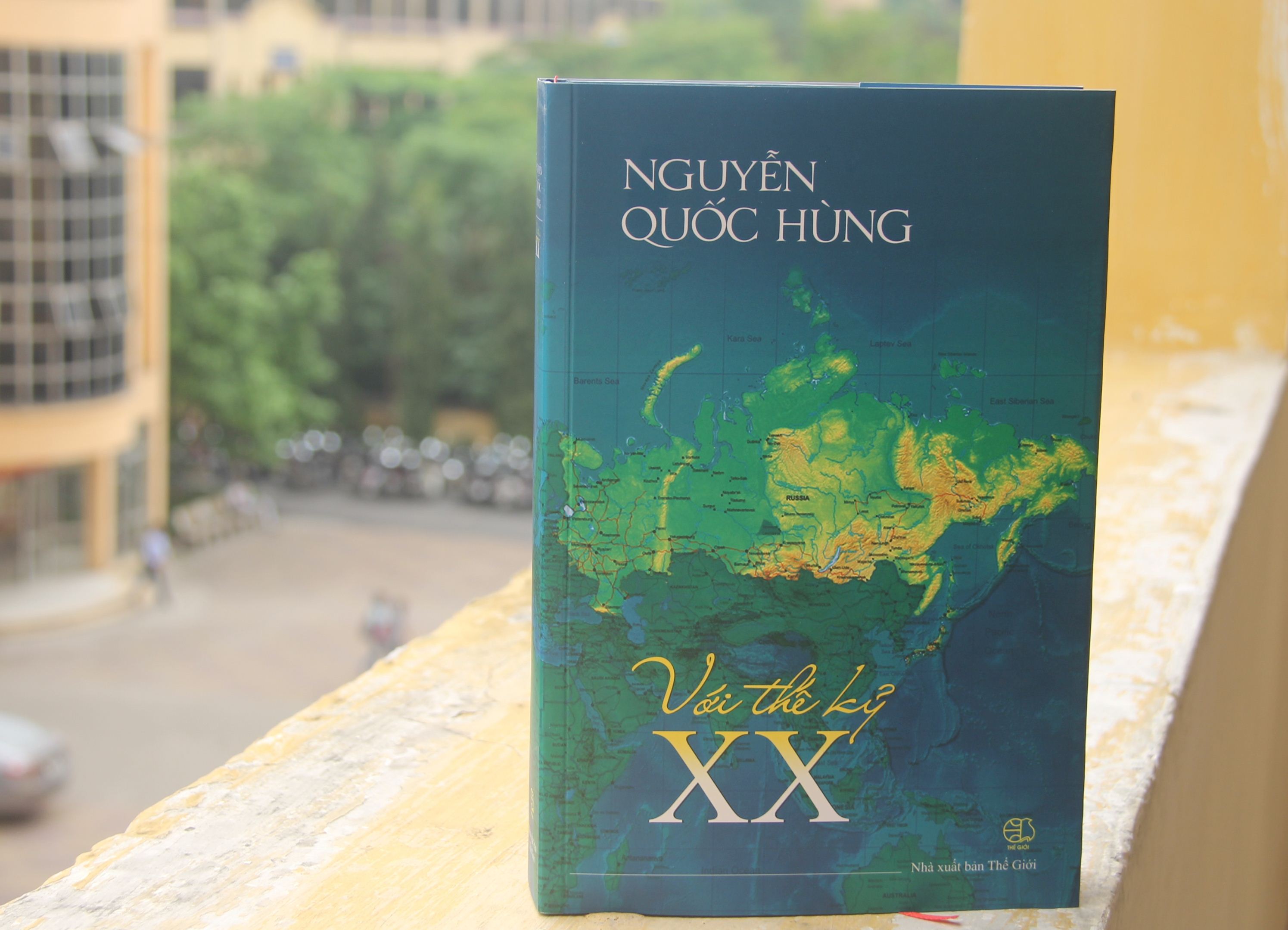
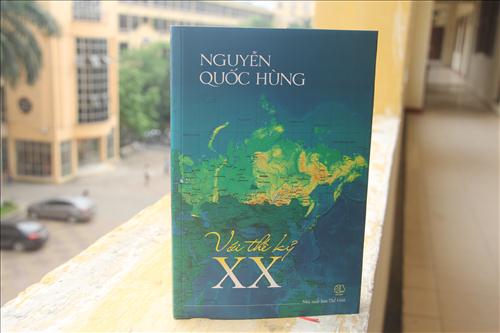
The book "Nguyen Quoc Hung and the 20th Century," recently released to readers, is a gift from generations of lecturers and students of Japanese Studies to Associate Professor and People's Teacher Nguyen Quoc Hung on the occasion of his 80th birthday. The book compiles his most notable works from 1973 to 2013.
For the faculty and students of the Department of Japanese Studies, the two words...Teacher HungHe always evoked feelings of respect, gratitude, and closeness. From the students of cohorts K53 to K50 who were welcomed into the school and directly taught by him, to later cohorts who did not have the opportunity to study under him directly but read his books and heard about him through stories from their seniors, the students of the Department always felt proud to be members of the large family of Japanese Studies that he had painstakingly built. During his years as Head of the Department of Japanese Studies, he always made concessions so that young lecturers could have the opportunity to study and intern abroad to improve their skills, while he himself only went to Japan once on business. It is difficult to recount all the gratitude and memories that generations of students have for him. The greatest thing that the staff and students learned from him is the spirit of responsibility and the silent sacrifice of a dedicated teacher.The Teacher – The Father.
This book expresses the deep gratitude and affection that generations of faculty and students of Japanese Studies have for this cause.Teacher HungTo commemorate his 80th birthday, this book compiles his most notable works over 40 years, from 1973 to 2013, into four main sections.
Part 1: World History and International Relations.This section compiles research papers by Associate Professor Nguyen Quoc Hung on the Russian October Revolution and Soviet history, World War II, the Cold War, international organizations, and significant international events in the late 19th and 20th centuries.
Part 2: East Asia and Vietnam.This section focuses on Associate Professor Nguyen Quoc Hung's research on Vietnamese history, Japanese history, East Asian history, and significant events in the relationship between Vietnam and East Asian countries.
Part 3: Translation.This section introduces translations of four historically significant documents, including one discovered and collected by Associate Professor Nguyen Quoc Hung during his studies in the Soviet Union.
Part 4: Epilogue.This section records the feelings and memories of Associate Professor Nguyen Quoc Hung with his friends and colleagues at the Department of History, Department of Oriental Studies, University of Social Sciences and Humanities.
On the occasion of the book's publication, the Department of Japanese Studies would like to express its deepest gratitude to Associate Professor Nguyen Quoc Hung and his family for providing valuable materials for the editing and publication of this book. We sincerely thank the Faculty of Oriental Studies and all generations of students for their enthusiastic organization and participation in the activities celebrating the professor's birthday. We also sincerely thank The World Publishing House for providing the best conditions for the book's release on Associate Professor Nguyen Quoc Hung's birthday. We believe that this book will not only provide important materials and the author's profound insights into 20th-century world history, but also help readers better understand his personality and his meticulous and passionate work ethic.Teacher Hung.
Hanoi, spring of 2016.
Author:Assoc. Prof. Dr. Phan Hai Linh, Dr. Vo Minh Vu
Newer news
Older news

