
Professor Dinh Xuan Lam was born on February 4, 1925, in Son Tan commune, Huong Son district, Ha Tinh province, into a patriotic family of mandarins. His homeland is a land of "spiritual and talented people," where the legendary physician Hai Thuong Lan Ong practiced medicine and saved lives, and where the top-ranking scholar and Doctor of Philosophy Phan Dinh Phung, along with peasant leader Cao Thang, established a Can Vuong base to persistently resist French colonialism for over a decade.
In 1945, he graduated with a full Baccalaureate in Philosophy and Literature from Hue National High School, right when the entire nation rose up in the earth-shattering August Revolution to reclaim power from the French colonialists and Japanese fascists. The success of the August Revolution changed his perspective and his life. Witnessing firsthand the overwhelming power of the masses during the General Uprising, especially the righteous and compassionate attitude of the Viet Minh leaders commanding the uprising to seize power in Thanh Hoa, he was deeply moved and enthusiastically participated in the patriotic movement. During the years of resistance against French colonialism, he taught at a secondary school while also participating in mass organizations in Thanh Hoa province.
After the liberation of North Vietnam, he was sent to study at Hanoi Pedagogical University, in the History-Geography class with Phan Huy Le and Tran Quoc Vuong. In 1956, the quartet of Dinh Xuan Lam, Phan Huy Le, Ha Van Tan, and Tran Quoc Vuong graduated with honors and were all retained as teaching staff at the university.

Professor, People's Teacher Dinh Xuan Lam
Throughout his half-century of teaching, Professor Dinh Xuan Lam trained thousands of students, successfully supervised dozens of doctoral candidates, and was loved and respected by generations of students, who regarded him as one of the "four pillars" of the History Department at Hanoi University (now the University of Social Sciences and Humanities, Vietnam National University, Hanoi). Professor Dinh Xuan Lam belonged to the generation that laid the foundation and was a leading expert in Marxist historiography in Vietnam. Anyone who studied with, met, or worked with Professor Dinh Xuan Lam felt that he was an intelligent and erudite man, yet very approachable and simple. He lived calmly, humbly, tolerantly, openly, and sincerely with everyone, both colleagues and students. His character and demeanor reflected the straightforwardness and sincerity of the people of Nghe An, the subtlety and formality of Hue culture, and especially the rich humanistic and romantic qualities of French culture. His talent, erudition, and genuine sincerity created the portrait of a teacher who was both noble and humble, yet very approachable and kind.
With his prolific writing skills and over half a century of tireless research, Professor Dinh Xuan Lam left behind a vast scientific legacy, comprising approximately 400 scientific works (including books, textbooks, articles, scientific reports, etc.). His scientific talent bore fruit early on, right after graduating from university. From 1959, less than three years after beginning to teach at the History Department, he, along with several young colleagues and under the guidance of the distinguished historian Professor Tran Van Giau, compiled and published a series of books.Modern history of Vietnam(4 volumes). This is the first set of modern history textbooks highly regarded by historians for its scientific quality. In 1998, despite being 73 years old, Professor Dinh Xuan Lam still wrote articles for newspapers and participated in scientific conferences, and most importantly, he served as the chief editor of the book.General History of Vietnam (Volume 2)In the four-volume series of the same name published by the Education Publishing House, this series has been reprinted 14 times to date and is used as a textbook in universities and colleges. Furthermore, in 2012, the series...History of Vietnam (Volume 3)The book, edited by Professor Dinh Xuan Lam, is now available to readers. This is considered to be the most complete, up-to-date, and highest-quality university textbook on Vietnamese history during the colonial period.
Professor Dinh Xuan Lam's field of historical research is rich and diverse. He has left a profound mark in every area. However, his most successful research, which established his position as a leading expert in modern Vietnamese history, is his work on colonialism and the anti-colonial movement of the Vietnamese people, spanning nearly a century, from the late 19th to the early 20th century. Professor Dinh Xuan Lam's most outstanding research on this topic has been compiled in this book.The anti-colonial movement in Vietnam.
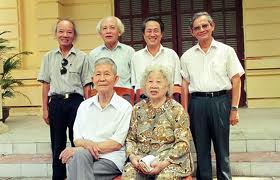
The late Professor Tran Quoc Vuong, Professor Dinh Xuan Lam, Professor Ha Van Tan, and Professor Phan Huy Le – the legendary "four pillars" of the History Department, Hanoi University (now the University of Social Sciences and Humanities, Vietnam National University, Hanoi) – with their teacher, Professor Tran Van Giau, and his wife.
The book is divided into five parts. Part one is titled...From the Can Vuong movement to the Duy Tan movementThis collection features outstanding research by Professor Dinh Xuan Lam on the French colonial invasion plots and the anti-colonial resistance movements of generations of patriotic Vietnamese. Some articles clarify specific details and characteristics of the Can Vuong movement in a particular locality (Thanh Hoa, Nghe An, Ha Tinh, etc.) or French investment activities in a city (Hai Phong), while others delve into the broader aspects of Vietnamese history during this period, such as assessing the responsibility of the Nguyen dynasty in allowing Vietnam to fall into French colonial rule and analyzing the characteristics of French imperialism in Vietnam. Particularly noteworthy is Professor Dinh Xuan Lam's profound knowledge accumulated over decades and his solid scientific methodology, which provide insightful, clear, and highly persuasive explanations of the causes and processes of Vietnam's socio-economic transformation under the impact of French colonial invasion and exploitation during the modern era.
The history of Vietnam in the 20th century is closely intertwined with the name of leader Nguyen Ai Quoc – Ho Chi Minh. Part two of the book –Ho Chi Minh and the Vietnamese Revolution– This helps readers clearly recognize the decisive milestones, representing historical turning points in President Ho Chi Minh's patriotic and revolutionary activities, as well as some prominent features of his thought. Furthermore, Professor Dinh Xuan Lam also attempts to uncover and decipher the deep origins and the attributes that governed Ho Chi Minh's entire life and thought through articles such as:Western culture – one of the sources that shaped Ho Chi Minh's worldview.,Ho Chi Minh's patriotism - a dialectical combination of tradition and modernity.It can be said that, in the study of Ho Chi Minh in Vietnam, Professor Dinh Xuan Lam is one of the pioneers and has achieved the most outstanding successes.
Part three of the book –The international aspect of the Vietnamese revolution– This is yet another perspective on the anti-colonial movement in Vietnam, placing it within the context of international relations. Professor Dinh Xuan Lam not only focuses on the fighting alliances of the Vietnamese people with oppressed nations around the world in their struggle against colonialism and for independence (in Laos, Cambodia, Madagascar, etc.), but also delves into analyzing the influences and impacts of international factors on the Vietnamese revolution (primarily the Chinese Revolution, the Russian Revolution, and the Communist International, etc.).
Research on historical figures – one of Professor Dinh Xuan Lam's "specialties" – is compiled in part four of the book, titled...Notable historical figuresThanks to diligent fieldwork and research from numerous sources, both domestic and foreign, the author has discovered and provided much new knowledge, not only about his homeland and family, but also about the position and role of these figures in Vietnamese history. With his sharp, concise, and clear yet gentle writing style, a series of historical figures, from the Can Vuong leaders and prominent reformers of the late 19th century to famous revolutionaries and cultural figures of the early 20th century such as Phan Chau Trinh, Dao Duy Anh, and Vo Nguyen Giap, have become more accessible to us.
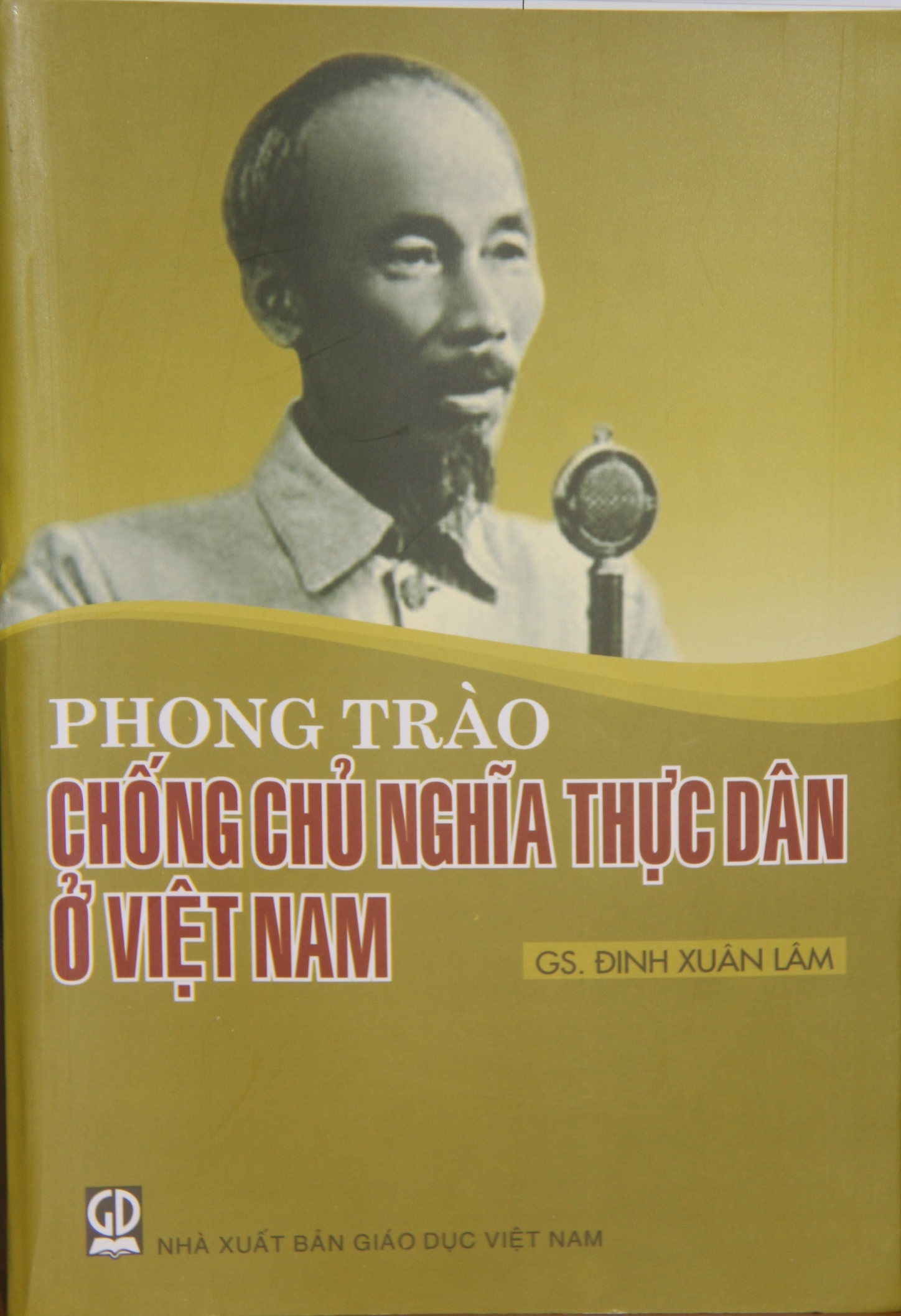
The cover of the book "The Anti-Colonialist Movement in Vietnam" by Professor Dinh Xuan Lam, published by Vietnam Education Publishing House in January 2015.
The final partSeveral issues related to documentation, historiography, and principles for evaluating historical figures.Professor Dinh Xuan Lam's contribution to Vietnamese historiography is another profound one. As a researcher proficient in English and with a deep understanding of French, he collected and compiled many valuable documents from both within and outside the country. While some of these documents may now be familiar to researchers, they were very new more than 20 years ago and contributed to shedding light on a hidden aspect of Vietnamese revolutionary history. Furthermore, drawing on his extensive research experience, Professor Dinh Xuan Lam offered many insightful and methodological summaries regarding the study of historical figures, especially those whose understanding within the academic community remains largely unconventional. He was extremely serious, even with himself, when changing his perspective on certain historical figures such as Phan Thanh Giản, Nguyễn Trường Tộ, Lưu Vĩnh Phúc, etc. His research works reflect the sense of responsibility, courage, and compassion of a talented scientist who cared deeply for his people and his country.
With the content and contributions mentioned above, this bookThe anti-colonial movement in VietnamThis is truly a scientific publication that not only encapsulates the outstanding research of Professor Dinh Xuan Lam but also serves as a source of inspiration and guidance for future generations of researchers, especially the younger generation, regarding a complex, turbulent, yet pivotal and particularly important period in Vietnamese history.
On behalf of the University of Social Sciences and Humanities, Vietnam National University, Hanoi, where he cherished, was deeply connected to, and dedicated his entire scientific life, and as his student and colleague for the past 40 years, I am delighted and honored to respectfully introduce this book to readers near and far. This is also an expression of gratitude and respect from the University, the Faculty of History, and the Department of Modern and Contemporary Vietnamese History to the outstanding leading professor and historian, Professor Dinh Xuan Lam, on the occasion of his 90th birthday in the Spring of 2015.
Author:Professor Nguyen Van Khanh
Newer news
Older news

