
1. Complete the development of the University's Development Strategy and the Science and Technology Development Strategy up to 2020, with a vision to 2030. Complete the development of the Job Position Scheme.
The strategy outlines fundamental development directions for the University in the coming period, aiming to further develop the potential and strengths of a basic science university in training and research in social sciences and humanities nationwide; and towards building a multidisciplinary and interdisciplinary research university, reaching regional and international standards.
2. Faculty members holding doctoral degrees account for 51%, while faculty members with professor and associate professor titles account for 25% of the total teaching staff.
In 2014, the University had 17 more faculty members successfully defend their doctoral dissertations, and 14 lecturers were appointed to the titles of Professor and Associate Professor. The number of lecturers with postgraduate qualifications was 329 out of 365 (over 90%), including 181 PhDs (51%), 6 Professors, and 84 Associate Professors (25%). This high percentage reflects the remarkable development in the quality of the faculty.
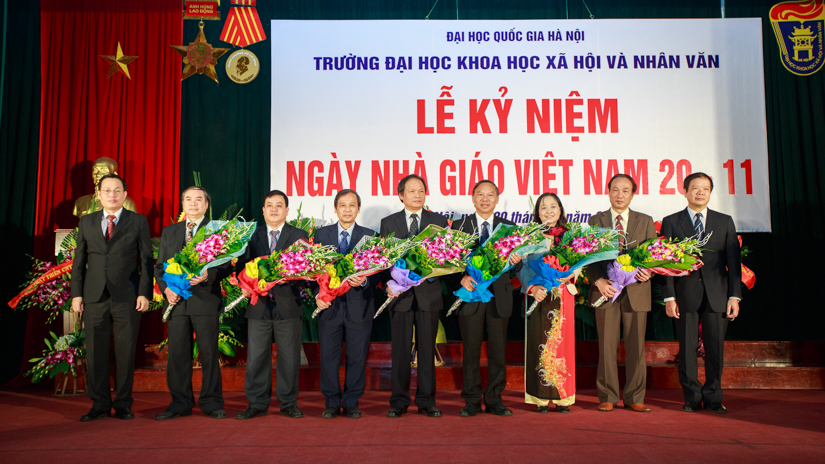
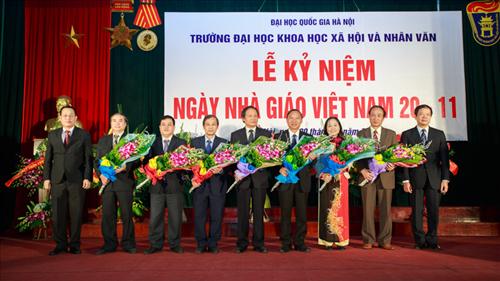
Professor Dr. Nguyen Huu Duc (left) and Associate Professor Dr. Nguyen Van Kim (right) present flowers to congratulate the teachers who were recently awarded the titles of People's Teacher and Excellent Teacher in 2014.
3. Complete the School's Training Program and Specialization Planning Project up to 2020..Continue to implement more international joint training programs.
Accordingly, by 2020, the University will have 38 master's degree programs and 32 doctoral degree programs. Based on a specific survey of social needs and the training capacity of each unit, the Project outlines a roadmap for developing new programs and specializations to ensure the rational and sustainable development of the University in the future.
In addition, the University continues to implement prestigious international joint training programs such as: Master of Child and Adolescent Developmental Psychology, Master of Public and Business Administration (with the University of Toulouse II, France), Master of Media Management (with the University of Stirling, UK)...
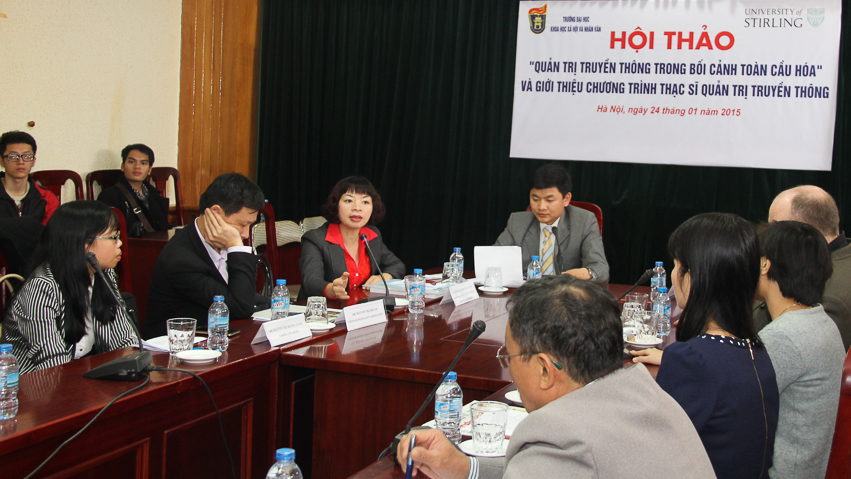
Overview of the Media Management workshop and introduction of the Master of Media Management joint program with the University of Stirling (UK).
4. Completed the evaluation of the Bachelor of Linguistics program according to the standards of the Association of Southeast Asian Universities (AUN).
With this event, the University of Social Sciences and Humanities has taken a step forward in evaluating lecturers' lectures and accrediting the quality of training according to regional and international standards. Currently, quality accreditation and a culture of quality have become indispensable elements in the University's training and research activities.
5. Pilot admissions based on competency assessment for high-quality training programs, internationally recognized training programs, and Master's programs in Social Work.
The University of Social Sciences and Humanities first piloted a competency-based admissions method in 2014. This method ensures an accurate and comprehensive assessment of candidates' overall abilities, while also promoting innovation in teaching and learning towards improving quality and fostering students' creativity. It is expected that this method will be officially implemented in 2015.
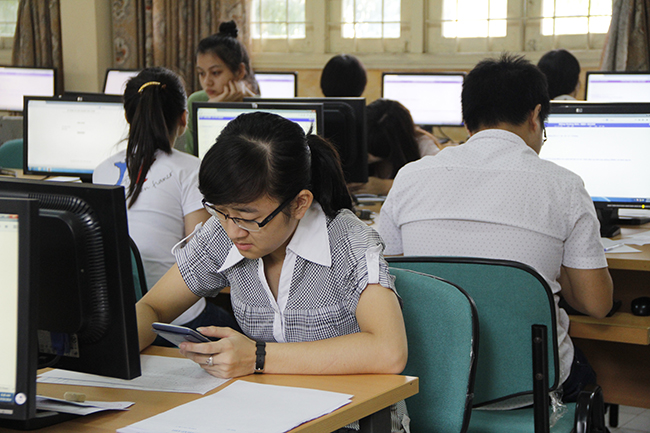
Students are participating in a competency-based assessment method.
6. Develop several new training majors in Religious Studies, International Relations, Vietnamese Studies, History of Vietnamese Religion, etc.
The university continues to demonstrate its pioneering role in opening new majors and specializations to serve societal needs, building upon its strong foundation in basic sciences. To date, the university offers 22 undergraduate programs and 57 master's and doctoral specializations.
7. The doctoral degree awarding ceremony is signed by the Rector.
The new Government Decree on Vietnam National University, Hanoi (November 2013) granted more autonomy to its member units, including the right of the Rectors of member schools to award doctoral degrees to doctoral candidates who completed courses according to the requirements of the School and Vietnam National University, Hanoi. At the end of 2014, the first 46 new doctoral graduates of the University of Social Sciences and Humanities received their degrees from the School.
Along with that, the enrollment scale for doctoral programs has more than doubled. With the policy of maintaining the scale of undergraduate training and expanding the scale of postgraduate training, the University is gradually approaching the criteria of a research-oriented university, increasing the research content in its activities, and strengthening the connection between training and research activities.
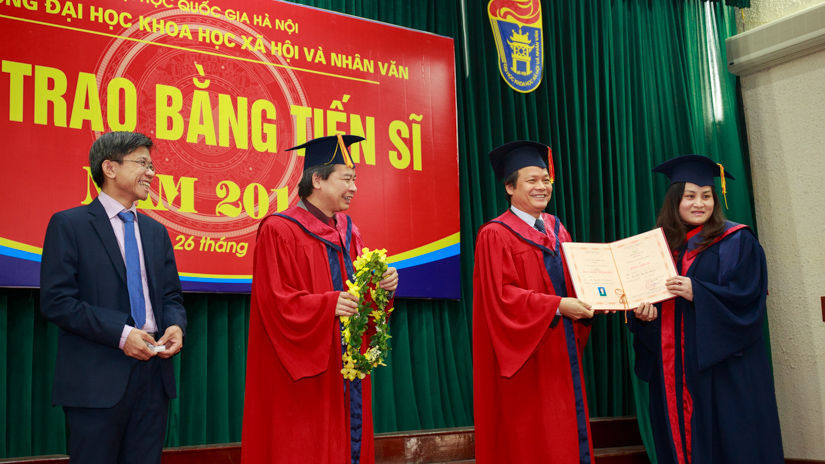
Professor Dr. Nguyen Van Khanh (Rector of the University) and Associate Professor Dr. Pham Quang Minh (Vice Rector of the University) presented diplomas to the new PhD graduates.
8. Continue to organize and implement many large-scale research projects and significantly increase international publications.
The number of large-scale research projects has increased rapidly, with 14 state-level projects, 17 Nafosted Fund projects, 3 Hanoi City-level projects, and dozens of projects at the university and VNU levels. University staff have won numerous science and technology awards at various levels, with 3 projects receiving the VNU Outstanding Science and Technology Award, and 2 research groups recognized as strong research groups at the VNU level. This demonstrates the strong scientific potential of the staff, as well as their flexibility and proactiveness in developing research projects and seeking funding sources.
This year, international publications have seen a significant increase, with the number of published works nearly doubling. In the 2013-2014 academic year, faculty members published 44 works abroad, double the number from the previous year (23 international publications in the 2012-2013 academic year), including 5 articles published in Scopus-indexed journals. This is one of the important indicators contributing to the University's improved ranking as a research university.
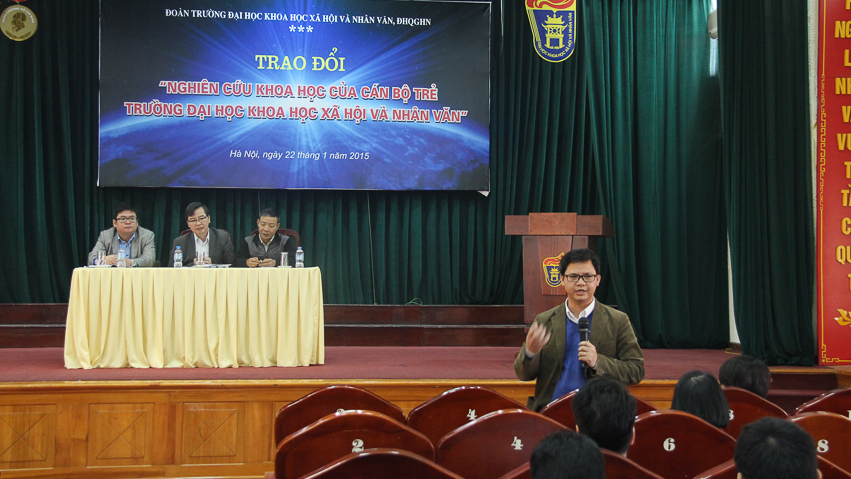
Associate Professor Vu Van Tich (Head of the Science and Technology Committee, Vietnam National University, Hanoi) is sharing his views and discussing the scientific research topics of young faculty members at the University of Social Sciences and Humanities.
9. Continue to expand international cooperation, signing cooperation agreements with 200 universities and international organizations. Successfully organize many major international conferences.
International cooperation has been strengthened in depth by signing and renewing 20 cooperation agreements with top-ranked partners worldwide such as Inha University (South Korea), National Taiwan University, University of Glasgow (UK), the Korea Legislative Research Institute, University of Adelaide, etc., bringing the total number of international cooperation agreements to 200. Based on this, many international research programs and projects with major universities have been and are being effectively implemented, helping to increase resources for development and enhance the university's international standing.
The institution organized 28 scientific seminars and workshops, including 19 international ones, with the participation of partners and renowned scientists from both domestic and international backgrounds, thereby enhancing the institution's prestige and reputation. Several seminars garnered significant attention in the research community and society, such as "Vietnam in World History," "60 Years of Vietnam - France - EU," "United Nations Peacekeeping Forces: International Practices and Lessons for Vietnam," and "From Dien Bien Phu to Geneva: An International Perspective"...
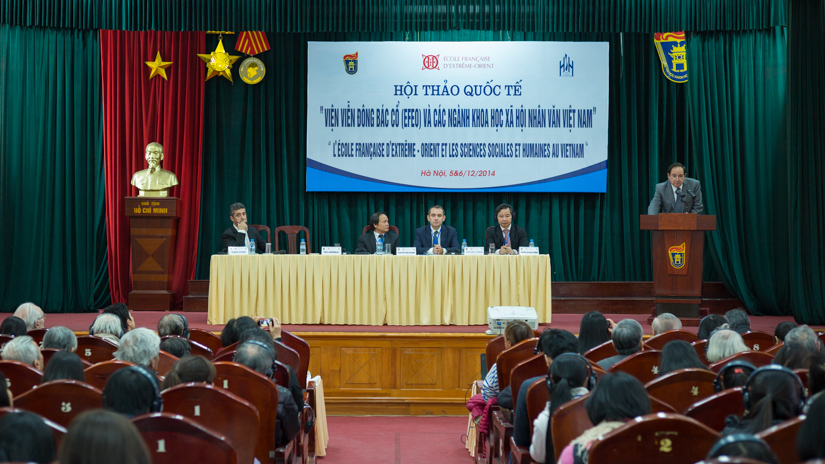
POpening ceremony of the Workshop between the French Institute of Far Eastern Studies and the Social Sciences and Humanities of Vietnam.
10. Continue to expand the working and learning space within the School.
During the past academic year, the School completed the renovation and expansion of building A, and also carried out the renovation of building M; implemented phase 2 of upgrading the equipment of the Center for Journalism and Communication Studies, as well as meeting rooms and lecture halls, practically contributing to improving the quality of training, research, and other activities of the School. Administrative reform according to ISO standards continued to be implemented.
Author:USSH
Newer news
Older news

