
The 2010-2015 term was identified as a crucial period, creating momentum for the development of the Party Branch of the Faculty of Sociology in all aspects: political ideology, personnel work, Party building, and professional work in the new situation. The Party Branch identified the Resolution of the 26th Party Congress of the University as the foundation, and the Resolution of the Party Branch Congress as the core, forming the guiding principle for formulating policies. Joining the vibrant atmosphere of emulation with practical activities of the University's Party Committee, the Party Branch of the Faculty of Sociology demonstrated a unique character of a unit rich in tradition and constantly evolving in the dynamic development trend of social reality.
Political education is considered crucial and ongoing. The Party Branch collective aims for unity and comprehensive development within a spirit of solidarity. Currently, the Faculty's Party Branch has 18 members, focusing on developing new members among young staff and students. The Party Branch directs the Faculty's activities to develop well in all four areas: staff training, education, scientific research, and international cooperation.
.JPG)
The Party Committee of the Faculty focuses on building a strong team of faculty members, as this is the cornerstone of the unit's sustainable development. Emphasis is placed on training the teaching staff, creating all conditions and opportunities for faculty members to improve their academic qualifications and degrees, including studying abroad. Over the past five years, the Party Committee of the Faculty of Sociology has seen five faculty members achieve associate professor status, one faculty member successfully defend a doctoral thesis in Singapore, two faculty members successfully defend master's theses in the USA, one in Australia, one in the UK, one in the Netherlands, one at the university, and six faculty members successfully defend master's theses in the Faculty. Currently, four faculty members are pursuing doctoral degrees in the USA, France, and Australia. To ensure effective faculty training, the Faculty provides the best possible support in terms of time, professional activities, and administration to help faculty members complete their theses on time. On the other hand, the faculty members of the Department are actively engaged in training and self-training to quickly attain academic ranks and degrees, and to participate in teaching undergraduate and postgraduate courses in Social Work, meeting the needs of social development.
Regarding training, the Faculty of Sociology has always upheld its traditions and dynamically kept pace with the societal demand for high-quality human resources, expanding its scale and continuously improving its quality. The Faculty is a leading unit nationwide in research and training of human resources in Sociology and Social Work at the undergraduate and postgraduate levels, both full-time and part-time. Graduates from the Faculty have contributed to the development of the social work profession in their respective localities. Statistics on alumni from cohorts K51 to K54 show that most social work graduates have found stable employment, accounting for 86.4% of the total student body. The Faculty of Sociology has collaborated with the Departments of Labor, Invalids and Social Affairs to open part-time undergraduate social work programs and short-term training courses. The majority of participants in these courses are officials currently working in localities from the grassroots level to the district, provincial, and city levels. In 2013, Hanoi National University implemented the Northwest Project, and the Faculty conducted two training courses on social work for officials from Ha Giang and Hoa Binh provinces, receiving high praise from the localities. The Faculty has been training master's and doctoral students in Sociology for 23 years. For the Social Work specialization, postgraduate training has been offered since 2011 and is the largest in the country..The department regularly conducts discussions and compiles statistics on employment status and the positive contributions of its graduates and trainees to their professional careers and society.
.JPG)
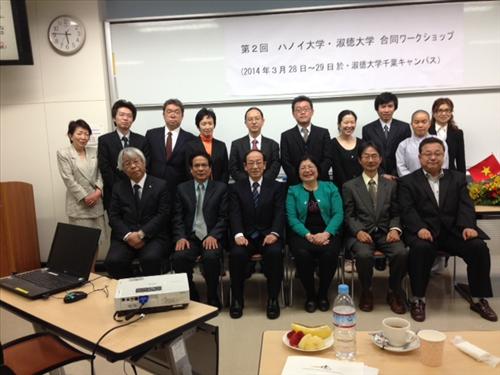
Scientific research and international cooperation are strengths of the Faculty of Sociology, especially in recent years. The Faculty signed a cooperation agreement in the “Society Work Advancement in Vietnam” (SWEEP) project, led by San Jose State University (USA) and funded by USAID (2012-2015); collaborated with Shukutoku University, Japan, and the Asia-Pacific Social Work Association on the research “Buddhism and Social Work” (2012-2015); collaborated with Lund University (Sweden) on the project “Social Welfare Assessment: Scandinavian and East Asian Redistribution Models in a Global Context (2012-2015)”; and collaborated with Degu University (Korea) on the “Multicultural Family” project (2013-2015). The Faculty has led numerous state-level and Hanoi National University-level research projects and is particularly active in community development research activities. The research group "Social Work and Social Welfare," led by Assoc. Prof. Dr. Nguyen Thi Kim Hoa (Head of the Sociology Department), was awarded a "Strong Research Group" certificate by the Director of Hanoi National University (May 2014). Furthermore, the Faculty collaborates with Memorial University (Canada) and experts from the United States to organize training courses on scientific research methods and various fields of social work for postgraduate students and social work lecturers from various universities.

During the 5-year term (2010-2015), implementing the Resolution of the 26th Party Congress of the University of Social Sciences and Humanities, under the direct and comprehensive guidance of the Party Branch Committee, the Faculty of Sociology achieved remarkable accomplishments. These achievements stemmed from consistent and unified political and ideological work, dynamic creativity in professional work, and flexible, humane, and solid personnel management. The activities of the Party Branch Committee of the Faculty of Sociology were a shining example, contributing to the strong development of all Party Branches throughout the University, each unit with its own unique characteristics, and successfully implementing the Resolution of the University's Party Congress.
Author:Le Thu Ha

