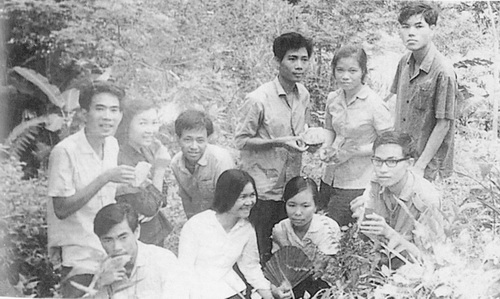
I applied to the Faculty of Literature, Hanoi University during a particularly unusual period:
A soldier with over ten years of military service, his meager school knowledge completely forgotten, daring to take the entrance exam for the Faculty of Literature at the University of Hanoi, was either utterly terrified or incredibly arrogant. Back then, everyone knew the saying: "Mathematics at the Polytechnic University, Literature at the University of Hanoi." This saying implied the extreme difficulty of getting into these two faculties. The very high demands of the Mathematics and Literature faculties at the two top universities in North Vietnam at that time were established as prestigious brands and the dreams of countless students. And it wasn't just those two faculties; to get into the Polytechnic and University of Hanoi in those years, one needed an incredibly high exam score. That's why people jokingly said about the beauty of the female students at these two universities: "The Devils of the Polytechnic University, the Ghosts of the University of Hanoi." This mockery was unfair to the many female students at the Polytechnic and University of Hanoi who were just as delicate and beautiful as anyone else. But it must be admitted that the proportion of "beautiful girls" at these two schools is quite low compared to other schools. This is easy to explain. Back then, high school girls, if they were lucky or unlucky enough to be blessed with some beauty, would certainly face countless challenges and dangers. A female student from the Faculty of Literature, University of Hanoi - a friend of mine - confided: "Honestly, high school students who are too beautiful can't study. Boys swarm around them like flies. If they don't get married early, they neglect their studies, and they don't have the mental capacity to study or pass the entrance exams for those schools. That's why only girls with less beauty like us diligently study and pass the exams to get in here. People say 'the ghosts of the University of Hanoi,' and there's some truth to that."
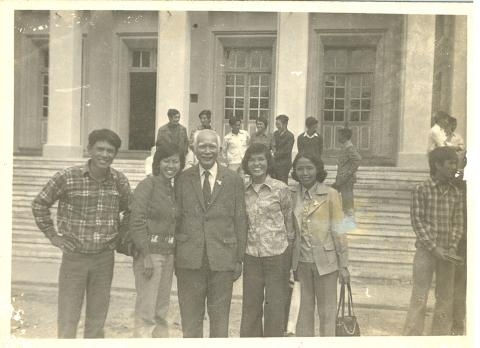
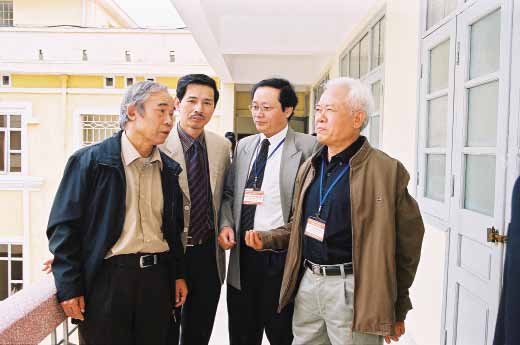
Professor Hoang Xuan Nhi and students of the Faculty of Literature, Hanoi University.
Our Class of 21 enrolled right after the country's reunification. Two-thirds of each class were veterans and former Youth Volunteers. The youngest were 23 or 24, the oldest 45. Most were married with children. Meanwhile, most of the female students had just left high school, barely 16 years old. At first, they addressed us as uncle and niece. By our second year, they had become like brothers and sisters. What was most daunting was their academic prowess and their incredible achievements. A long list of first and second prizes in literature competitions in the North. Some had even become authors with works published in newspapers. They even spoke to each other in Russian and English… it was deafening.
With such diverse backgrounds, we became classmates in a course that combined the youthful energy of students with the clumsy composure of academic officers. We were hungry and lacked everything. Each class had to elect a student council primarily responsible for the students' well-being. This council would buy all the canteen rations and distribute them among the students. Every week or two, they would gather leftover food coupons and organize a hearty meal for the class or groups of friends… Even torn clothes could be skillfully mended and worn back to a decent size. Each class might have one or two bicycles belonging to the academic officers, which were considered precious possessions. And so, over four years of study, we became a family. A truly lovely family. Most of the Literature students were talented, romantic, and incredibly witty.
I wouldn't dare compare them to students from later cohorts of the Faculty of Literature when the university adopted the new name of Humanities, but it's true that students from the time of Hanoi University left an indelible mark. They dedicated themselves to the great struggle for national liberation. While in school, they studied and researched the very "footprints of soldiers" they had left on the path of resistance. Therefore, along with their life experiences, they possessed a very broad knowledge, social understanding, and upon graduation, most found employment and excelled in their work in fields related to the humanities. Many students from the Faculty of Literature at Hanoi University from the 1985 cohort and earlier have achieved considerable success. Dozens became writers, hundreds became renowned journalists and educators, holding leadership positions in newspapers, publishing houses, art troupes, universities, or cultural institutions...
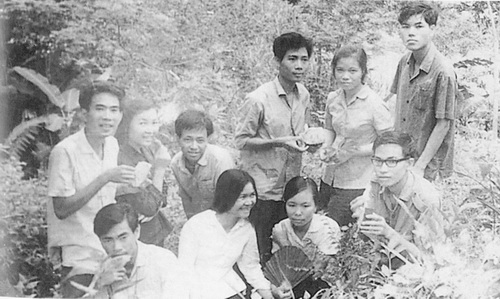
Students of the Faculty of Literature, Hanoi University
*
* *
We were incredibly fortunate to have renowned professors from our country teaching us, such as Hoang Xuan Nhi, Nguyen Tai Can, Tran Quoc Vuong, Dinh Gia Khanh, Hoang Nhu Mai, Le Dinh Ky, Tran Dinh Huou, Phan Cu De, Ha Minh Duc, Bui Duy Tan, Do Hong Chung, Nguyen Van Khoa, Do Duc Hieu, Nguyen Kim Dinh, Le Hong Sam, Dang Anh Dao, Hoang Trong Phien, Thach Giang… Their lectures were invaluable moments filled with a high level of knowledge. I still remember the scene whenever Professors Nguyen Tai Can, Tran Quoc Vuong, Hoang Nhu Mai… gave a lecture; the entire courtyard in front of our single-story classroom would be packed with students from other faculties. The names, personalities, and even details of each professor's personal life became topics for the Literature students to weave into stories with immense affection and mischievousness. The humorous rhyming couplet about the teachers' names that I heard and still remember to this day, right from my first days of school, was: "Luong Nhi, Viet Ky, Noi Mai, Tai Can, Lan Man Duy Tan…". Teacher Hoang Xuan Nhi had the highest salary in the school. Teacher Le Dinh Ky was the best writer. Teacher Hoang Nhu Mai was the most captivating lecturer, and Teacher Nguyen Tai Can had the most profound knowledge. Teacher Bui Duy Tan wasn't at all absent-minded. Besides his impressive knowledge, he also had a charmingly mischievous side. But being meticulous, strict, and specializing in Ly-Tran-Le literature, Teacher Tan had a style quite characteristic of the literature of that era. His wife lived far away in Nam Ha, and Teacher Tan lived in a small attic room a few square meters below the faculty office in building C2. At home, he often went shirtless and wore wooden clogs. His hair was cut short, white at the nape of his neck. One summer afternoon, he shuffled down to the public water tank between buildings C2 and C3 to get water. The students saw him wearing very loose military shorts. To keep it neat, the professor pulled the excess fabric from both sides of his trousers upwards like two earlobes. The very next day, the Literature students had a riddle rhyme: "Walking on tiptoe, talking logically, shirtless. New head, old feet, elephant ear trousers." Who is it? The cleverness here was combining Professor Tan's teaching with his unique style. Professor Do Duc Hieu, on the other hand, had a different kind of strictness that often intimidated us students. Professor Hieu was thin, had severe myopia, and spoke very softly and politely. He repeatedly reminded us: "I don't know what kind of people you will become in the future, but today I ask you to write correctly and practice your Vietnamese." I can't forget one time during a paper test, I capitalized incorrectly. When he returned my paper, I was both embarrassed and amused, tears streaming down my face. He wrote a sarcastic comment: "Oh, you capitalized again!" My friend was scheduled to meet him in the faculty office at 2 p.m. At 2:02, upon entering the office, I saw a note posted by the professor that read: "I scheduled an appointment with you at 2:02. It is now 2:01, goodbye." After that, I bet no one dared be careless about the time with the professor.
Faculty of Literature, University of Social Sciences and Humanities, Vietnam National University, Hanoi
In short, our generation of students' teachers were so respectable and lovable. The students endured hardship, and the teachers also lived very difficult lives. But their sense of responsibility was immense, and the teacher-student relationship was close and intimate. Although textbooks and learning materials were scarce and rudimentary, the teachers imparted to us a wealth of knowledge they had accumulated through their great efforts throughout their teaching careers. As our ancestors used to say, "The teacher is old, the student is young." We were very fortunate to have been taught by teachers who had reached the peak of their lives and careers. Their life experiences and teaching experiences truly served as role models for us to learn from and emulate in the future.
The stories from my student years at the Faculty of Literature are countless. It will forever remain a beautiful memory of my life. Those of us who were fellow students in the 21st cohort of the Faculty of Literature back then are now all doing our own thing. Most have become grandparents, some have retired, and a few have even passed away… Whenever I think of them, looking back at those photos, I feel even more strongly about a truly beautiful period of my life under the roof of the beloved and prestigious Hanoi University of Literature.
Author:Nguyen Trong Tan

