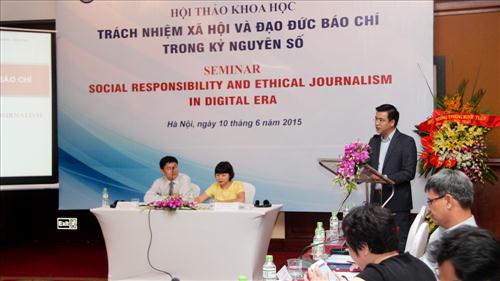
Some photos from the workshop "Social Responsibility and Journalistic Ethics in the Digital Age"
News articles in the press
Nhan Dan Online Newspaper: Social responsibility and journalistic ethics in information competition
Dan Tri Online Newspaper: Turning their backs on human dignity, journalism will lose its readers.
Vietnam News Agency: Upholding social responsibility and journalistic ethics in the digital age.
Hanoi New Newspaper: Social responsibility and journalistic ethics in the digital age
VOV Online Newspaper: Journalism in the Digital Age: Prioritizing the Right Thing
The 17 papers submitted to the conference were analyses and assessments of the current state of journalistic activities and violations of journalistic ethics in Vietnam, identifying the social responsibility of journalists and proposing numerous solutions and recommendations to improve the quality and effectiveness of journalistic and media activities in Vietnam.
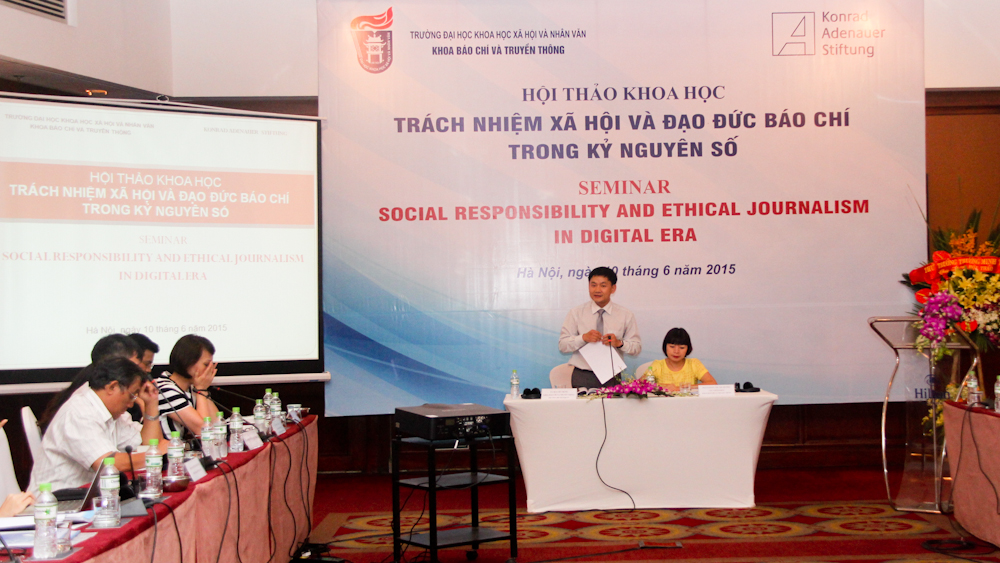
Dr. Bui Chi Trung (left) and Assoc. Prof. Dr. Dang Thi Thu Huong are chairing the workshop.
Learning to live with information in the digital age.
This is journalist Huu Tho's assessment of the current information landscape. In the digital age, the public is living amidst a mix of true and false, good and bad information. According to him, in the daily information the public receives, there is always good within the bad, and bad within the good; there is truth within falsehood, and falsehood within truth. He explains that if all information were either entirely good or entirely bad, the public would not want to receive it.
This has brought the issue of journalistic ethics in the digital media environment to the forefront of current affairs. The massive amounts of information transmitted every second via the internet have left people unable to control what they consume.

Journalist Huu Tho is speaking at the conference.
According to journalist Huu Tho, the amount of fake information on the internet today often outweighs the truth. However, the public still has to live with online information. He believes there is no solution to prevent or eliminate this information from the online environment. In the digital age, the public needs to learn how to live with these information flows, and those who provide information – specifically journalists – must set high standards for ethics and professional integrity.
"The editors-in-chief of today's newspapers no longer simply read and censor news. Besides that heavy responsibility, they also have to shoulder the burden of advertising and distribution. Sometimes, advertising and distribution become an even bigger worry for the editor-in-chief," journalist Huu Tho said.
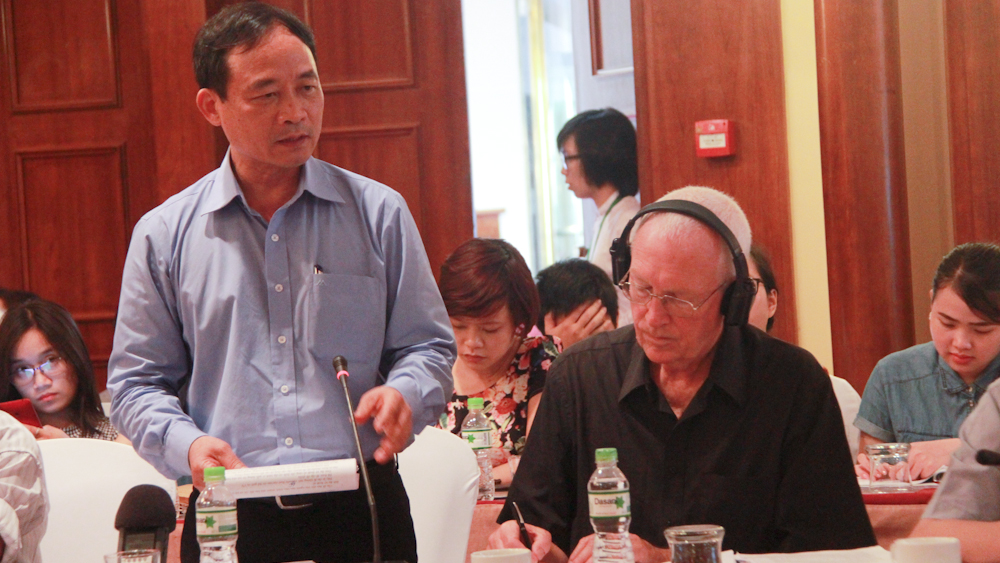
Journalist Le Duy Truyen, Deputy Director General of the Vietnam News Agency, is sharing his views.
Sharing this view, journalist Le Duy Truyen, Deputy General Director of the Vietnam News Agency, also believes that the digital age has led to an explosion of social media. From a certain perspective, social media is no less effective than traditional journalism in terms of rapid updates, rich content, and multi-faceted information. Furthermore, the potential for information dissemination on social media seems limitless, as the emergence of numerous sharing tools has turned social media into powerful "information transmission machines," unconstrained by human or financial resources. However, this information is not always accurate and objective. This has created pressure on the press to provide timely counter-arguments and to guide public opinion.
The personal responsibility of each journalist
The workshop also discussed various solutions to enhance the ethics and social responsibility of journalism in the digital age. One solution that many experts agreed upon and mentioned was that responsibility primarily stems from the journalist's own inherent qualities.
Journalists themselves must constantly enhance their social responsibility and civic duty, ethics, and professional skills, as these are central elements that enable journalists to confidently write for the job.
Journalist Luong Bich Ngoc, Editor-in-Chief of the online newspaper Kham Pha, shared: "In a journalist's career, no journalist is immune to mistakes. Some mistakes are minor and can be corrected, but others come at a very high price. However, the important thing is that every journalist needs to strive to become an ethical journalist."

Journalist Dang Dung (Deputy Editor-in-Chief of Tuoi Tre newspaper) shared:
Emphasizing the personal responsibility of each journalist, journalist Dang Dung, Deputy Editor-in-Chief of Tuoi Tre newspaper, said: "I am often proud of my pen, but sometimes I also fear that very pen. When I write a journalistic work, that work will affect many people in society. A small mistake, not exploring all aspects of the information, will lead to lifelong regrets. But when embarking on a career in journalism, always be proud of your own pen, writing about the beauty and humanity of life."
It can be said that journalism possesses a unique power, capable of disseminating information and impacting society every day and every hour, affecting every member and organization within society. Journalism is not merely a profession but a mission, because it does not exist for itself, but for society. Journalism and journalists must work for the lives and interests of the vast majority of workers in society, and therefore must always strive for genuine values of truth, goodness, and beauty. Consequently, in the digital age, journalistic ethics are more highly valued and require more effective implementation than ever before.
Author:Dinh Hau - video: Anh Thu
Newer news
Older news

