
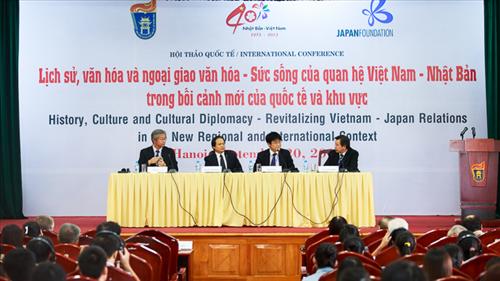
As part of the series of activities commemorating the 40th anniversary of diplomatic relations between Vietnam and Japan, on September 20th, the seminar "History, Culture and Cultural Diplomacy – The Vitality of Vietnam-Japan Relations in the New International and Regional Context" was held at the University of Social Sciences and Humanities.
Attendees included Mr. Saita Yukio (Counselor of the Japanese Embassy in Vietnam) and Mr. Inami Kazumi (Director of the Cultural Exchange Center, Japan Foundation). The workshop also attracted the participation of many scientists from Vietnam, Japan, and Singapore, including many renowned scientists such as Professor Phan Huy Le (President of the Vietnam Historical Science Association), Professor Furuta Motoo (University of Tokyo), Professor Shiraishi (Waseda University), Professor Momoki (Osaka University), etc.
In his welcoming speech, Professor Nguyen Van Khanh (Rector of the University of Social Sciences and Humanities) recalled the history of relations between the two countries, which began very early in the 11th century, and the strong achievements of cooperation and development between Vietnam and Japan over the past four decades. Throughout centuries of building and establishing its economic and diplomatic position in East Asia, Japan has always maintained friendly relations with Vietnam. During the Vietnamese people's resistance against American aggression, the Japanese people and government actively supported Vietnam in its struggle for peace, unification, independence, and territorial integrity. Entering the period of reform, as Vietnam implemented a policy of multilateralizing and diversifying its foreign relations, Vietnam-Japan relations have been elevated to a new level, developing both in breadth and depth. In July 2004, the two countries issued a joint statement "reaching new heights of sustainable partnership," and in October 2006 agreed to build a "strategic partnership." Currently, Japan is one of Vietnam's most important economic partners, the number one provider of official development assistance, and one of the largest investors in Vietnam.
The Rector's speech also emphasized the lessons learned during the process of building cooperative relations between the two countries, namely "sharing, empathy, and close cooperation." This is the foundation and also a valuable asset for the two countries to continue promoting and developing strategic cooperation in the coming period.
From a different perspective, Mr. Saita Yukio (Counselor at the Japanese Embassy in Vietnam) mentioned "mutual understanding and respect" as an important condition for building relations between the two countries in the present and future. The Counselor also suggested strengthening mutual understanding of history and culture between the two nations, primarily by increasing exchanges between scholars and young people from both countries.
Mr. Inami Kazumi (Director of the Japan Foundation) stated: "In the process of expanding exchanges between the people of the two countries, rushing too quickly will lead to 'clashes' and misunderstandings due to the lack of deep understanding between the two sides." Therefore, he believes it is essential to improve the quality and quantity of Japanese studies in Vietnam, creating a foundation for genuine understanding between the two countries.
Following the opening session, more than 20 reports were presented in three subcommittees: “History”; “Culture and Cultural Diplomacy”; and “Prospects for Vietnam-Japan Diplomatic Relations in the New Regional and International Context”. Experts from various fields shared academic perspectives and exchanged new findings, aiming for a deeper and more comprehensive understanding of the history, culture, and international relations between Japan and Vietnam.
In the "History" subcommittee, delegates discussed specific topics: the "Chau An Trading Ship Map" as seen through archaeological investigations in Hoi An; a regional perspective on Vietnam-Japan relations in the 17th century; currency circulation in Vietnam during the modern period – as seen from research on ancient coin jars; "Reconnecting" and "comparing" Japanese history with Vietnamese history; Annamese diplomatic documents from the 16th-17th centuries; Japanese samurai in the medieval period and the concept of inheritance; and the export of Hizen ceramics abroad…
In the "Culture and Cultural Diplomacy" subcommittee, the main presentations included: the influence of Japanese culture on Vietnamese youth today; the activities of Mitsui Bussan in Indochina during the Asia-Pacific War; perspectives on Japan's soft power in Southeast Asia; Phan Boi Chau - the founder of the Vietnam-Japan friendship castle; Vietnamese students studying in Japan - history and prospects; the potential for collaboration between businesses and education in the mobile age; proposals for cooperation between Vietnamese and Japanese universities; and Vietnam-Japan relations across historical and cultural timeframes and spaces.
The subcommittee "Prospects for Vietnam-Japan Diplomatic Relations in the New Regional and International Context" included presentations on: Sino-Japanese competition in relations with ASEAN and its implications for Vietnam; changing East Asian strategic environment: Japan-Vietnam cooperation in seeking a new civilized approach; some subjective factors contributing to the future promotion of Vietnam-Japan relations; ASEAN and Vietnam in Japan's security policy…
Newer news
Older news


