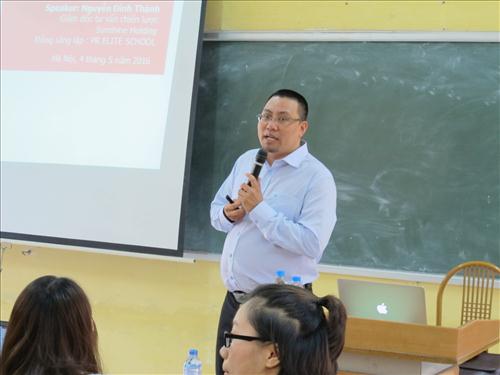
Public relations is a relatively new field of study in Vietnam's higher education system, attracting a dynamic, creative, and critical-minded student community not only in media but also in all aspects of life. In today's globalized information landscape, this unique characteristic presents both opportunities and challenges for students as they enter the real world. Recognizing the importance of equipping students with professional knowledge and skills, the Youth Union and Student Association of the Faculty of Journalism and Communication, University of Social Sciences and Humanities (Hanoi), organized this seminar. Attendees included not only lecturers, undergraduate students, and graduate students from journalism and PR programs within and outside the faculty, but also many individuals currently working in PR who are interested in this field.
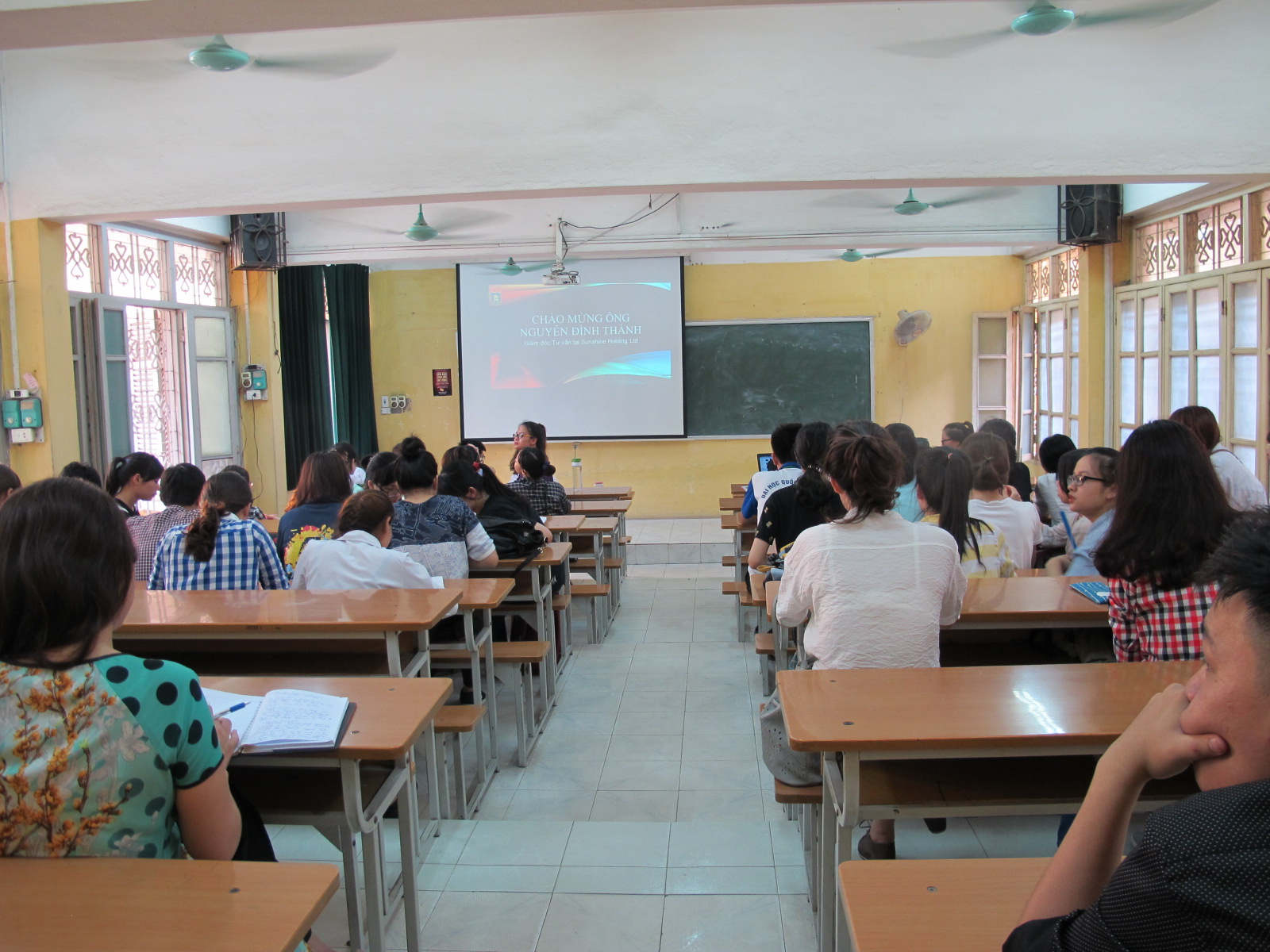
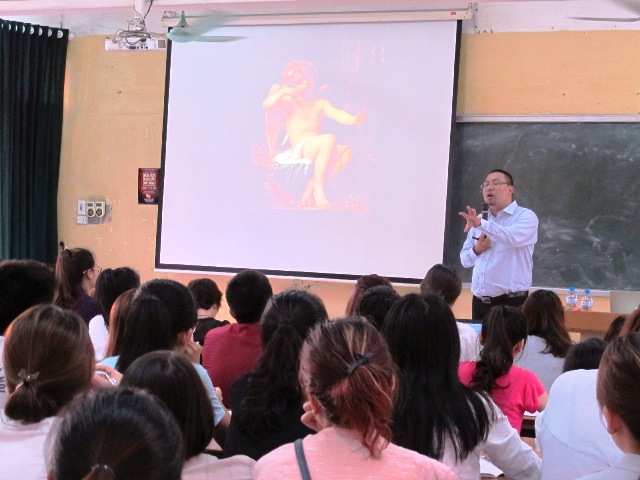
A panoramic view of the classroom.
Through 11 images and specific illustrative examples, Mr. Nguyen Dinh Thanh pointed out the nature of communication and reminded those working in communication of the principles of conduct both on social media and in real life:
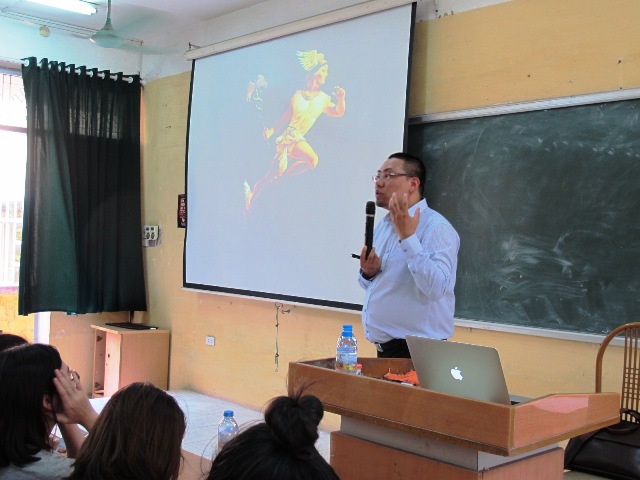
“I want to use the image of the god Hermes to illustrate the nature of communication. As you've learned, communication is when one person transmits information and another receives it. In between are encoded messages and noise. And Hermes here plays the role of the communication channel. So, the essence of communication is to pay attention to the audience: one party transmitting information and the other receiving it. And this information is easily misunderstood because this god can travel fast, slow, or the weather can be too hot for people to listen – that's the noise. When you search online for "Communication Models," you'll find many results, and every model will have elements like the information transmitter, the information receiver, the communication channel, and noise. In short, I want to emphasize the audience: the information transmitter and the information receiver.”
The second image is that of Cupid. This god has a bow and shoots two types of arrows: silver arrows that make people fall in love, and bronze arrows that make people hate each other. Through this, I want to emphasize that a communication campaign must always pay attention to its communication channel and the effects it creates. Just like the god of love can create either love or hate. Incidentally, I also want to briefly define my PR: "PR is the art of using communication tools to make the target audience react in the direction and to the extent that the sender of the information desires." Information is always created to elicit some kind of reaction: either to make people love or to make them hate. So, through the image of Cupid, we can see that PR always has to create some kind of effect; there is no such thing as generic, purposeless PR. Public relations is an art because not everyone can do it; PR professionals need both talent and hard work. It's like anyone can sing a few lines, but not everyone can become a singer.
Next is an image depicting one of the most brilliant military leaders in human history – the man who conquered a third of the world known at the time – Alexander the Great. Alexander the Great was meticulously prepared in the skills and techniques to become a world ruler. His father once said, "Macedonia is too small for you." And from a young age, his father brought Aristotle to teach him. This painting depicts Alexander the Great entering Jerusalem. He used a tactic similar to Genghis Khan, which was to kill all the inhabitants of any city he entered. However, he always let some people escape so that these people would be frightened and flee, spreading the word about the strength of his army wherever they went. That was a form of communication. But this case is different. Perhaps, through his education, he somehow came to admire the millennia-old Jewish culture, which led him to make a different decision than usual: After conquering Jerusalem, he knelt before the High Priest of the Jews and said, “Throughout the siege, I saw an angel welcoming me, and that was you.” The High Priest accepted this, and all the Jewish people in Jerusalem were thus won over by Alexander the Great. That is what I want to convey to you through this image.”
Furthermore, he noted that Vietnamese businesses currently have many limitations in handling crises. Using the image of the Sword of Damocles, he pointed out that a sword always hangs over the head of every business (like over the head of a king), and a crisis can strike at any time. At any moment of inattention, the sword could fall on their heads.
Today, with advancements in information technology and the Internet, the emergence and rapid development of social media has changed the way people receive information. Everyone, through the keyboards of electronic devices, can become an information disseminator. Many of them cannot control the information they disseminate, leading to numerous cases of legal liability. Therefore, those working in media in this era must constantly hone their skills, be vigilant about information sources, and act tactfully.
He emphasized: “Public relations and communication must honor human values and be based on substance. All those gimmicks and tricks are examples of failed PR because they don't nurture human relationships. I oppose black PR. We need to aim for DECENT PR, caring not only about the interests of the business but also of the customers. That is the yin-yang philosophy in PR. PR professionals must balance the interests of their business and their customers for sustainable development. Otherwise, the business will face a crisis. Especially now, we can consider this the era of PR and Marketing 3.0, which is people-centered. Consumers care that the money they spend not only brings them happiness but also brings happiness or at least does not harm society, protects nature, the environment, and contributes to sustainable development.”
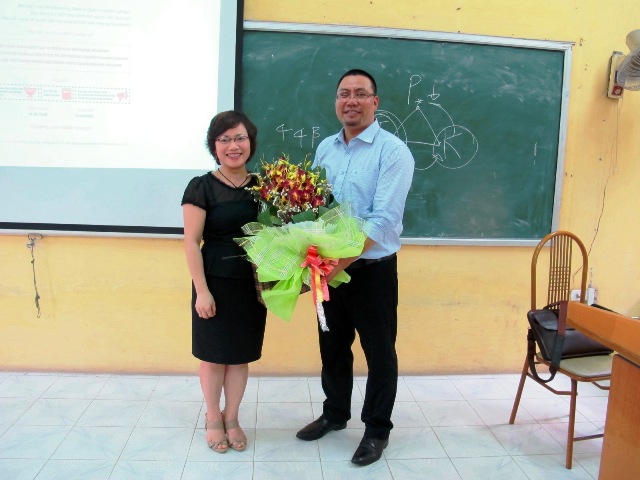
Associate Professor Dr. Nguyen Thi Thanh Huyen (Head of the PR-Advertising Department, Faculty of Journalism and Communication) presents flowers to Mr. Nguyen Dinh Thanh.
During this seminar, Mr. Thanh also shared his perspective on an issue based on three aspects: the P-F-K triangle. P stands for Politics (human relationships), F for Finance (economic and financial issues), and K for Knowledge (technical and technological issues). When promoting a project, we need to pay attention to the P factor: how the social impact and human relationships are handled in this project; F is the economic impact of the project. In the case of a real estate project, F represents the financial capacity of the investor; and K represents the technology, technical aspects, feasibility, and professionalism of the project. Based on this, we can develop different PR angles.
The seminar concluded at 4:30 PM on the same day.
This seminar was announced by the Youth Union – Student Association of the Faculty of Journalism and Communication, University of Social Sciences and Humanities (Vietnam National University, Hanoi) and with the permission of Mr. Nguyen Dinh Thanh. Please cite the source fully when using information from this document.
Author:Tran Hieu (K59, Faculty of Journalism and Communication)
Newer news
Older news

