
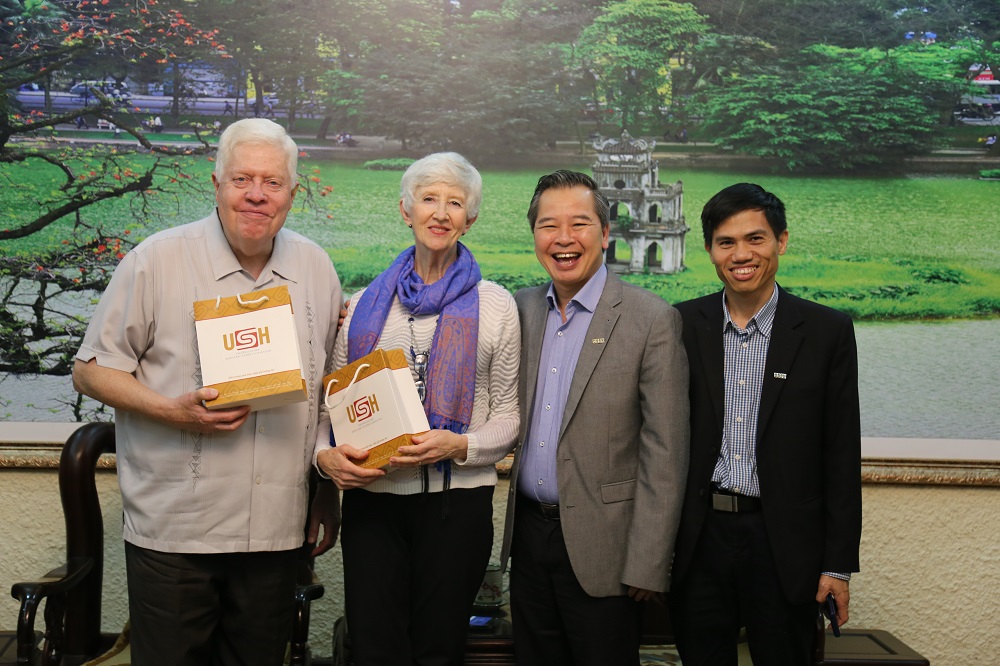
Professor Pham Quang Minh poses for a commemorative photo with Professor Donald B. Holsinger and his wife.
Professor Donald B. Holsinger's presentation was titled "From Aspiration to Global Human Rights Standards: On the Occasion of the 70th Anniversary of the Universal Declaration of Human Rights." The Universal Declaration of Human Rights is a declaration of fundamental human rights adopted by the United Nations General Assembly on December 10, 1948, in Paris, France. The Declaration comprises 30 articles, listing the minimum rights that every individual is entitled to, without distinction as to race, color, sex, language, religion, or any other circumstance. Vietnam acceded to this Declaration in 1982.
Although the Declaration has global scope, differences have arisen among UN member states in interpreting and applying the concept of human rights. According to Professor Donald B. Holsinger, historically, not all countries have been willing to comply with the 30 articles. This is because each country has its own unique political, economic, social, cultural, and educational characteristics. Disagreements have even arisen on some articles, especially in the areas of freedom of religion and belief, and freedom of expression.
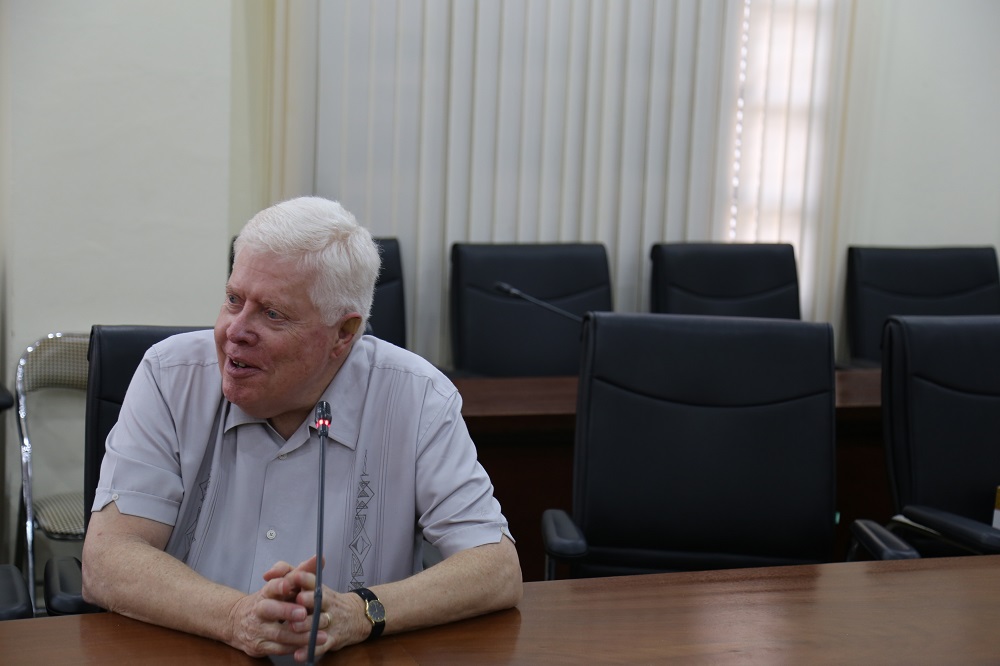
Professor Donald B. Holsinger
Having spent nearly half his life experiencing diverse lives in countries outside his homeland, Professor Donald B. Holsinger opposes the imposition of one country's human rights views on another. He also argues that a nation's economic development does not necessarily correlate with its level of human rights protection; and human rights are not entirely synonymous with happiness. In fact, many developed countries have faced criticism for various human rights issues. Conversely, in some less developed countries like Mozambique, people live very happily and express optimism about the future. Regarding Vietnam, Professor Donald B. Holsinger highly appreciates the country's progress in implementing human rights and improving the happiness of its people in recent years. One example is that in 2018, Vietnam was selected as one of the top 5 countries with the Happy Planet Index in the world.

To promote the implementation of human rights, Professor Donald B. Holsinger considers education a key factor. Only through educating citizens about their rights and responsibilities can each nation help them understand the true nature of the concept of human rights. This avoids misunderstandings and conflicts of interest when applying this concept. In this process, higher and postgraduate educational institutions also play a crucial role, as these are where the elite and distinguished members of society study and work. According to Professor Donald B. Holsinger, it is the scholars and university lecturers, such as the staff of the University of Social Sciences and Humanities, who will be the most aware and sensitive to human rights issues in the country.
Professor Donald B. Holsinger also spent time discussing with the audience topics such as current schools of thought and major debates on human rights; obstacles to the implementation of human rights in various countries; fundamental theoretical issues concerning human rights today; and the relationship between conflicts of political interest and human rights conflicts.
Professor Donald B. Holsinger currently works at the Geneva Office for Human Rights Education; he is also a sociologist and has been a distinguished professor of International Development Studies at Brigham Young University since 2007. He received his PhD in International Development Education from Stanford University in 1972. He also served as a senior education advisor to the World Bank from 1975 to 1987.
Author:Tran Minh
Newer news
Older news

