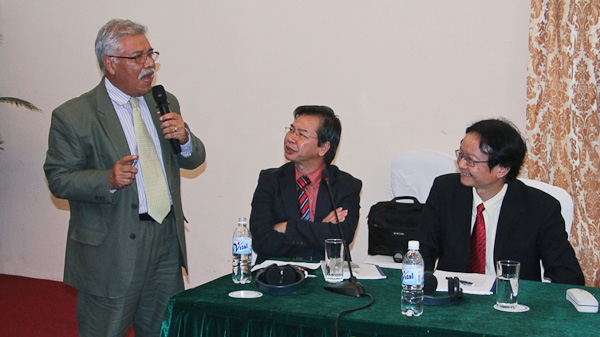
On the afternoon of October 18th, at the Government Guest House, the International Economic and Cultural Exchange Club of the WTO and International Affairs Research Center, University of Social Sciences and Humanities, and VIPTOUR Company under the Ministry of Culture, Sports and Tourism, in collaboration with the Representative Office of the United Nations Educational, Scientific and Cultural Organization (UNESCO) in Hanoi, organized an international scientific seminar entitled "Culture - A Resource for Tourism Development".Attending the seminar were Ms. Katherine Muller-Marin, Head of UNESCO Representative Office in Hanoi, Ambassadors from Venezuela, Romania, and Palestine, representatives from the Embassies of the Lao People's Democratic Republic, the Russian Federation, South Korea, and Australia, representatives from the Departments of Culture, Sports and Tourism of Hanoi, Ha Giang, and Ninh Binh, along with numerous members of the Club, teachers, and students of the School. The organizing committee received a total of 15 reports, of which 10 were presented at the seminar. In the opening report...
Culture, Development and TourismKatherine Muller-Marin stated: "Sustainable development is only possible if countries ensure that cultural values are respected and know how to leverage the benefits of dynamic interaction between cultures. Development programs should properly utilize cultural values, paying attention to enhancing the role of communities and individuals, alongside state management. Furthermore, these programs contribute to protecting the cultural diversity of the global community: a key attraction for tourism development. Integrating cultural aspects into all development policies, for example, education, gender, health, and poverty reduction, is a crucial foundation for sustainable development." Ambassador Jorge Rondon Uzcategui of Venezuela introduced the allure of traditional Venezuelan culture, the invitation from its stunning landscapes, unique cuisine, friendly people, the mystery of Maaca and Aztec cultures, and the country's beautiful landmarks through a lively video clip. In addition, The Venezuelan ambassador also brought many unique traditional products and signature Venezuelan pastries to the seminar.

Ambassador Saadi Salama of Palestine introduced cultural tourism in the Palestinian territories, highlighting information not widely known internationally or in Vietnam due to prevailing geopolitical conditions. The Ambassador also spoke about the tourism potential and challenges in organizing and developing cultural tourism within the Palestinian tourism landscape. The prerequisite for tourism development in Palestine is lasting peace and the establishment of an independent, sovereign, and territorially integral Palestinian state. Mr. Keum Gi Hyong, Director of the Korean Cultural Center in Vietnam, presented a report on "Temple Stay in Korea." The report stated that temple tourism is a unique cultural program that allows visitors to experience the lives of Buddhists at various traditional temples, preserving 1700 years of Korean temple tourism history and offering a wide range of diverse tourism options. The Temple Tourism Program contributes to enriching the attractiveness of localities and makes a significant cultural contribution to the tourism sector. In 2010, an estimated 20,000 foreign tourists and 153,000 Koreans participated in the Temple Tourism Program at 109 temples in Korea. Ambassador Dumitru Olaru of Romania offered suggestions on two areas that Vietnam needs to focus on developing in cultural tourism: beach tourism and handicraft village tourism. The Ambassador also highly appreciated Vietnam's recent initiative to organize the "Indochina Passion" Cultural and Tourism Festival at the Paris Flower Park, aiming to introduce opportunities to explore the culture and tourism of three countries in the Indochina region: Laos, Cambodia, and Vietnam. The Ambassador also introduced Romania and its tourism strengths. Romania currently holds the Vice-President position on the Executive Board of the World Tourism Organization and will actively support Vietnam's accession to the organization. A report from the Australian Embassy addresses this issue.
Tourism and environmental protectionThe report states that Australia's tourism strengths lie in its beautiful beaches, diverse natural environments, and unique flora and fauna. Seventeen of Australia's natural landmarks are on the World Heritage list, and 34 are on the National Heritage list, making them attractive destinations in the land of kangaroos. An impressive figure is that in 2008, 5.6 million international visitors from over 170 countries visited Australia. One of the most important lessons learned regarding environmental protection and tourism promotion is the need for a robust legal framework. The report also mentions that Australia is collaborating with the German government through the GIZ program to explore ideas for sustainable environmental protection in Kien Giang province, including Phu Quoc National Park and U Minh Thuong National Forest. Mr. Nguyen Trung Duong, Director of the Department of Culture, Sports and Tourism of Ha Giang province, reported on the conservation and exploitation of the value of the Dong Van Karst Plateau Geopark, which has been recognized by UNESCO as a Global Geopark for tourism development. Spanning four highland districts in the northern part of the province, the Dong Van Karst Plateau has nearly 140 heritage sites, divided into many groups of geomorphological landscapes, fossils, paleontology-stratigraphy, and limestone caves, considered suitable for adventure tourism and tourism exploring the mysteries of nature. At the same time, the presence of 17 ethnic minority groups residing in this area contributes to the diversity of Ha Giang's cultural and tourism landscape. In 2010, Ha Giang welcomed over 301,000 visitors, including over 48,000 international tourists and over 253,300 domestic tourists. The report also presented the comprehensive solutions that Ha Giang has implemented to effectively preserve its heritage and promote the tangible and intangible cultural values of the province. Mr. Nguyen Ngoc Luyen, Deputy Director of the Department of Culture, Sports and Tourism of Ninh Binh province, presented a report on...
The Trang An Scenic Landscape Complex is a unique Vietnamese cultural heritage site.According to the report, the Trang An Scenic Landscape Complex is a complex of historical sites including: the Tam Coc-Bich Dong tourist area, a stunningly beautiful scenic area; the Hoa Lu ancient capital historical site, the first capital of Vietnam, which existed for 42 years under 6 kings of 3 dynasties: Dinh, Early Le, and Ly; the Trang An ecological tourist area, a complex of limestone mountain ranges with caves, valleys, and rivers, blending together in a mystical and enchanting space, likened to "Ha Long Bay on land"; and the Bai Dinh Pagoda mountain area, covering 700 hectares, comprising 21 items including the ancient Bai Dinh Pagoda and the new Bai Dinh Pagoda. The new Bai Dinh Pagoda is one of the largest Buddhist structures in Vietnam. The report shows the enormous tourism potential of the Trang An Scenic Landscape Complex and hopes that Trang An will soon be recognized by UNESCO as a World Cultural Heritage site. (Dr.) Nguyen Van Son, Director of the Co Loa Ancient Citadel Conservation Center in Hanoi, presented some aspects of the current state of the Thang Long Imperial Citadel Heritage Site in Hanoi. The report highlighted three characteristics that contribute to the Thang Long Imperial Citadel's outstanding global value: its long history, its role as a center of power, and the presence of diverse and rich layers of relics. The report also mentioned the World Heritage Committee's recommendations on what Vietnam needs to do to improve the Thang Long Imperial Citadel Heritage Site in Hanoi, and the fact that Vietnam has been actively implementing those recommendations. However, some issues need to be addressed urgently, such as the unification of the site's management, as Vietnam has committed to. He warned that if this is not implemented in practice, the risk of the Heritage Site being removed from the World Heritage list is a foreseeable possibility.

The report by Associate Professor Dr. Tran Thi Minh Hoa, Head of the Faculty of Tourism Studies, University of Social Sciences and Humanities, Vietnam National University, Hanoi, addressed the topic of exploiting cultural heritage for tourism development. With specific statistics, the report demonstrated Vietnam's tourism development potential. The report also highlighted achievements in tourism development strategies, legal documents, the responsibilities of management levels, and the exploitation of cultural heritage in tourism development. Cultural tourism destinations are expanding, tours are becoming more diverse in form (thematic or comprehensive), and tourism-cultural events are being organized more systematically by the Ministry of Culture and Tourism. The report also highlights the challenges and solutions regarding the commercialization of heritage, the disruption of heritage's pristine nature, the protection and restoration of heritage, the exploitation of heritage, conservation and development, and policies and regulations concerning the socialization of exploitation and conservation activities. Associate Professor Pham Quang Minh, Head of the Department of International Studies and Director of the Center for WTO and International Affairs Research, presented the report "Culture, Cultural Norms, and German Cultural Norms in the Context of Globalization." The author emphasized that the essence of culture is interaction, contact, and exchange, so intercultural communication plays an increasingly important role in the context of globalization. To preserve cultural identity and limit "clash between cultures," the best way is to understand the norms of other cultures and strengthen exchanges, interactions, and introductions to different cultures. To illustrate this point, the author introduced seven norms of German culture: emphasizing the importance of work, time, rules, separation of public and private affairs, honesty, self-restraint, and maintaining personal distance. A lack of understanding of these cultural norms can easily lead to misunderstandings, prejudices, and negatively impact relationships. The report "Japanese-Vietnamese Culture through the Story of Chopsticks" by Assoc. Prof. Dr. Nguyen Thien Nam, Deputy Director of the Center for WTO Research and International Affairs, and lecturer in the Department of Vietnamese Studies and Vietnamese Language, is a case study on the cultural correlation between Japan and Vietnam. The report introduces chopsticks, highlighting interesting similarities and differences in history, form, types, rituals, and philosophy. The report notes that travel guides often advise tourists visiting countries known for chopsticks to "learn to eat with chopsticks." The report also reaffirmed that chopsticks are a product of rice-farming civilizations and an indispensable part of life for the Vietnamese, Japanese, and other "Chopstick Nations." Concluding the seminar, Ms. Katherine Muller-Marin stated:
Let me conclude today's discussion with a quote from Nigerian Nobel laureate Wole Soyinka, who emphasized the significance, potential, and challenges that culture presents:
"Culture is a matrix of infinite prospects and choices. Within this same cultural matrix, we can extract arguments and strategies about the degradation and nobility of our species, about slavery or liberation..."
I can easily say that I have one desire and commitment: I want to see Vietnam become a role model for the world, fully demonstrating the nation's potential in balancing the preservation and utilization of culture for development and promoting high-quality tourism that benefits local communities.With such rich content, the seminar provided a multifaceted perspective on culture and tourism development, laying the groundwork for new collaborations and explorations in this field.