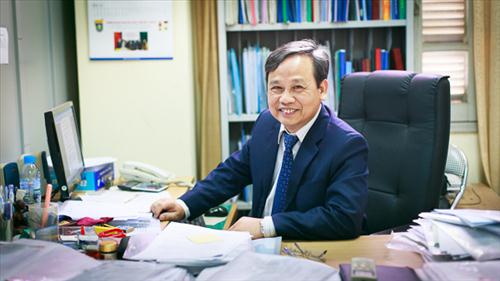
Associate Professor Dr. Dang Xuan Khang was born on July 19, 1954, into a farming family in a village on the banks of the Red River in Nam Hong commune, Nam Truc district, Nam Dinh province. Following the tradition of studiousness in his birthplace, his childhood was filled with hardship, learning, and striving to excel, always being one of the outstanding students from elementary to high school. In September 1971, at the age of 17, like many other students, he received his acceptance letter from Hanoi University, and he was overjoyed. However, that joy only lasted from home to school, because on the day of enrollment he learned that he had not been admitted to the Faculty of Literature as he had hoped. Nevertheless, "studying and working in history felt like destiny to me," he said. The more he studied history, the more he fell in love with it, and he developed a passion for it without even realizing it. However, it's certain that the lessons he learned from renowned professors in the "Four Pillars of the Court" of history, such as Professor Dinh Xuan Lam, Professor Phan Huy Le, Professor Ha Van Tan, and Professor Tran Quoc Vuong, led him to the profession of history.
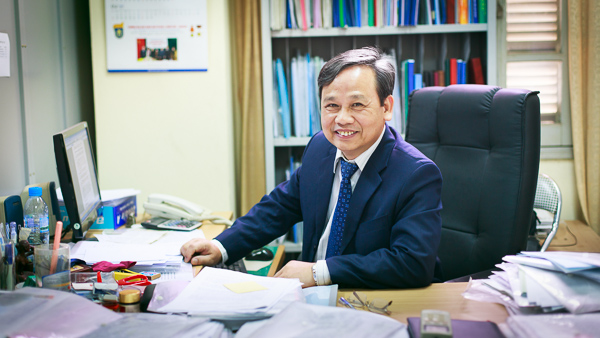
Associate Professor, Doctor, Distinguished Teacher Dang Xuan Khang
After graduating from the 16th cohort of the 4.5-year program in January 1976, he was retained as a teaching staff member in June of that year. For the first two years in the department, he served as an Academic Assistant while also participating in professional activities with the World History Department in the Modern World History group. As assigned by the Department, he became one of the first to research and teach about Africa in the History Department, as this was a completely new field, with no one having studied the continent before. This requirement also stemmed from the historical reality of the rapidly developing African revolutionary movement; many African countries, like Vietnam, declared their commitment to socialism after gaining independence, such as Angola, Mozambique, and Ethiopia. Three books on Africa were quickly completed in a short time with Professor Vu Duong Ninh (then Head of the World History Department) to serve the teaching work of the Department and the Faculty.African countries- Volume 1,African countries- Volume 2andThe struggle against the Apartheid regime in South Africa.
Around that same time, following a suggestion from a colleague who had just successfully defended his doctoral thesis in the Soviet Union – Professor Vu Minh Giang (former Vice Director of Vietnam National University, Hanoi): “The department needs someone to research Japan because in the future, Japan will occupy a very important position in the economic development of Vietnam,” he came to Japan – seemingly by chance or fate. He began learning Japanese at a not-so-young age, especially after having used Russian for a long time before. However, with diligence and perseverance, he initially overcame the challenge. In 1991, with the help of Professor... Phan Huy Lê received a scholarship from Keio University – Japan's first university, founded in 1858 by the renowned reformer Fukuzawa Yukichi during the Meiji Restoration. During his two years of study and research in Japan, he devoted himself to the Meiji Restoration and Japan's educational reforms. For him, Japanese schools played a significant role in changing Japan's position and role on the international stage. This is why he focused on researching and exploring the history, people, and educational culture of Japan, with the aspiration of finding lessons that could be applied to Vietnam.
In 1994, he returned to Vietnam to continue his teaching career and became the first lecturer specializing in Japanese history and culture at Hanoi University in the 1990s. From June 1995, he was appointed Deputy Head of the World History Department, Faculty of History, responsible for teaching modern world history and Japanese history to the Faculty of Literature and the Faculty of Oriental Studies. In October 1998, he was transferred and appointed Deputy Head of the Faculty of International Studies, while also teaching modern international relations history. Then, fate led him in a new direction with a new political role as Deputy Head of the Personnel Department in 2002. Although the work of an administrator distracted him greatly, he still prioritized teaching and scientific research. At the end of 2002, he successfully defended his doctoral dissertation.Educational reforms and their major impacts on Japan's socio-economic development (from the Meiji Restoration to the post-World War II period)He was awarded the Pham Than Duyat Prize (Third Prize) by the Vietnam Historical Science Association for outstanding doctoral dissertations of the year. Six years after receiving his doctorate, he was appointed Associate Professor of History by the State Council for Academic Titles in 2009. In 2014, for his many outstanding contributions to teaching and scientific research, he was further awarded the title of Excellent Teacher by the State.
Having worked at the university for over 39 years, holding various positions and managing different responsibilities, Associate Professor Dr. Dang Xuan Khang has always maintained his passion for scientific research. His contributions to the academic field include, first and foremost, a system of outstanding articles and works related to Japanese history and culture, such as:Fukuzawa - a renowned reformer of the Meiji RestorationJournal of Historical Studies,1991;Developments in Japanese education from the late 19th century to the present day.Journal of Science, Hanoi University of Technology,1995;Several issues concerning the adoption of culture and the preservation of national cultural identity in Japan., Statistical Publishing House, 1996;Reasons for the success of the Meiji Restoration, Journal of Japanese Studies, 1996;The international context of the Meiji Restoration"//Eastern Cooperation and Development, Vietnam National University, Hanoi Publishing House, 2003;The Meiji Restoration in Japan, along with Vietnamese intellectuals and the patriotic educational movement they led, played a significant role.//Vietnam-Japan relations: Historical and current issues., Vietnam National University, Hanoi Publishing House, 2003;Some key ideas of the Japanese educational reforms during the Meiji Restoration, World Publishing House, 2004;History of Japan, World Publishing House, 2007;Reform movements in some East Asian countries in the mid-19th to early 20th centuries, Vietnam National University, Hanoi Publishing House, 2007;The problem of building a modern state apparatus in Japan under the Meiji government., Journal of Historical Studies, 2008;Women and education in Japan under the impact of the Meiji Restoration educational reforms.//Asian women and education - Asian, European, and other perspectives.(International Conference, 2012)… In addition, it is impossible not to mention the scientific research topics that Assoc. Prof. Dr. Dang Xuan Khang has led or participated in, contributing practically to the teaching of undergraduate and postgraduate students in the Departments of History, Oriental Studies, and International Studies. Among them, the most notable are:ThoseIssues concerning the history and culture of the East and Northeast regions.A, 2001;Some regional conflicts after the Cold War: history and issues,2005;Reform movements in several East Asian countries in the mid-19th to early 20th centuries.2007; and most recently, a Key Research Project at the National University level.Dictionary of World Historical Events (1500-2000).
As a highly experienced researcher and lecturer at a leading university in the country, he has also made extremely positive contributions to society. In addition to participating in providing feedback on the National Council for the Evaluation of History Textbooks, he has also contributed significantly to the community.,In addition to teaching Modern World History in 12th grade, he also participated in discussions and provided feedback on many draft legal documents of the Ministry of Education and Training as the Chairman of the University's Trade Union, such as: the Law on Higher Education, the Circular on Working Regimes for Lecturers, the Circular on Standards for Ranks of Civil Servants, and the University Charter; he also directly organized many seminars and workshops on innovation in higher education management…
Writing about Associate Professor, Doctor, and Meritorious Teacher Dang Xuan Khang, besides the simple and unpretentious remarks above about his contributions to the department, faculty, university, and society, my most important impression of him is that of a compassionate and kind teacher, always wholeheartedly devoted to his students, a diligent, meticulous, and compassionate colleague, and always willing to help younger generations of colleagues.
|
Associate Professor, Doctor, Distinguished Teacher Dang Xuan Khang
Department of History (1976-1998). Department of International Studies (1998-2002). Department of Personnel and Organization (2002-2014).
Deputy Head of the Department of World History, Faculty of History (1995 - 1998). Deputy Head of the Faculty of International Studies (1998 - 2002). Deputy Head of the Personnel Department (2002 - 2006). Head of the Personnel Department (2006 - 2014).
1.The international context of the Meiji Restoration//Eastern cooperation and development,Vietnam National University, Hanoi Publishing House, Hanoi, 2003. 2.The Meiji Restoration in Japan, along with Vietnamese intellectuals and the patriotic educational movement they led.Vietnam-Japan Relations: Historical and Current Issues, Vietnam National University Hanoi Publishing House, Hanoi, 2003. 3.Some topics in World History, Volume II (co-authored), Vietnam National University Hanoi Publishing House, Hanoi, 2007. 4.History of Japan(co-authored), The World Publishing House, Hanoi, 2007. 5.Reform movements in some East Asian countries in the mid-19th to early 20th centuries(co-authored), Vietnam National University Hanoi Publishing House, Hanoi, 2007.
|
Author:Dr. Ly Tuong Van

