
Associate Professor, Doctor, and Meritorious Teacher Pham Xuan Hang was born in 1950 in Rang village, now part of Thuong Hien commune, Kien Xuong district, Thai Binh province. Orphaned at the age of 10, six years later, along with his younger sister, he followed his mother to Lao Cai to reclaim land. Perhaps that "forest sun and mountain wind" shaped him into the person he is – always at the forefront, pioneering and exploring difficult and new territories in research and education.
Perhaps from his family's and his own experiences of escaping poverty and overcoming hardship, he understood the role of education. Therefore, after graduating from the Moscow State Archives and History University (Soviet Union), he refused a job at the Party History Research Department of the Central Committee of the Communist Party of Vietnam to become a lecturer at the History Department, Hanoi University.
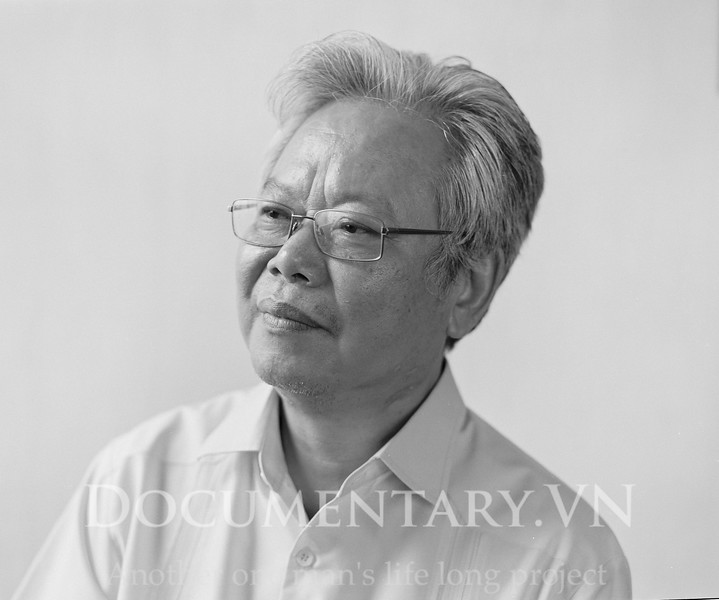
Associate Professor, Doctor, Distinguished Teacher Pham Xuan Hang / Photo: Thanh Long
We fondly remember the hours our teacher spent in class – his eloquence and debate were essential to his lectures, helping us understand the role of historiography in historical research and writing. The spread of this new discipline in Vietnam prompted him to return to the National Archives and History University in Moscow as a postgraduate student, primarily to enhance his knowledge in order to build and develop this new discipline – Historiography and Historiography – within the curriculum of the Faculty of History, Hanoi University – now the University of Social Sciences and Humanities, Vietnam National University, Hanoi. As F. Engels said, to understand things one must understand their history, the Historiography and Historiography discipline quickly developed, attracting students at the master's and doctoral levels.
Associate Professor, Doctor of Science, Meritorious Teacher Pham Xuan Hang is an expert in the Theory of Historiography in Vietnam. He has published many valuable scientific works such asApplying the method of source analysis in evaluating the value of written documents.(1982)Some characteristics of Soviet source theory during its formation.(1983)The problem of source materials in the history of modern Soviet historiography.(1988);The concept and nature of source materials in modern Soviet historiography.(1990); History - a science, a reality(1991);Written sources of Vietnamese history(1994);The problem of handling historical data in relation to written documents.(1996)The nature of historical sources(2011), etc.
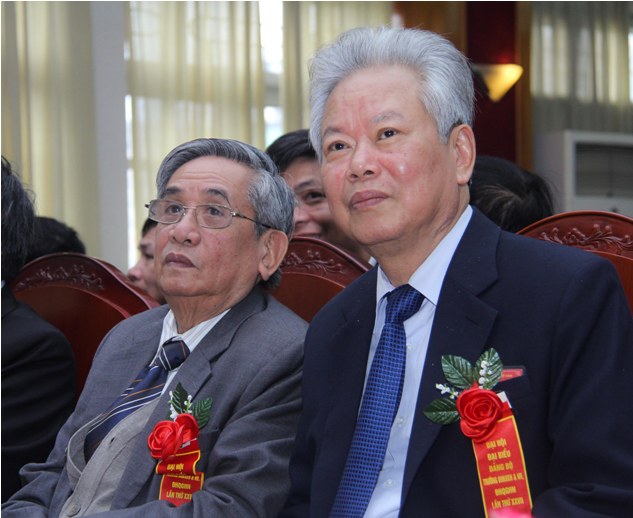
Professor Vu Duong Ninh and Associate Professor Pham Xuan Hang at the 27th Party Congress of the University of Social Sciences and Humanities (April 2015)
Based on the methodology of historiography and source studies.,Associate Professor, Doctor, Meritorious Teacher, Pham Xuan Hang also published valuable monographs such asDiplomatic activities of the Ly Dynasty(1009-1225) (2009),Think aboutDDiplomatic struggle during the resistance war against the Ming invasion.(2010)Vietnamese diplomacy during that eraDin Ho Chi Minh City(2010)Diplomatic activities in Thang Long-Hanoi(2010), etc.
It is said that those with a "lucky" fatepine trees, cypress trees"Those who grow up amidst the mountains and forests often possess the qualities of a leader. We don't know about astrology, but it seems that this is linked to Associate Professor, Doctor, and Meritorious Teacher Pham Xuan Hang. He was nominated and assigned to many important management positions: Member of the Standing Committee of the Youth Union of Lao Cai Town High School (1968-1970); Member of the Standing Committee of the Youth Union of Vietnamese Students in Moscow (1973-1974); Deputy Secretary of the Party Branch of the Moscow State Archives and History University (1986-1987), Deputy Head of the History Department (1990-1995), Vice Rector of the University of Social Sciences and Humanities, Vietnam National University, Hanoi (1995-2001), Secretary of the Party Committee (1999-2001), Rector..."1University of Social Sciences and Humanities, Vietnam National University, Hanoi (2001-January 2006). In 2006, he was transferred to work at agencies of Hanoi City and the Central Government, successively holding the positions of: Member of the Standing Committee, Head of the Propaganda Department of the Hanoi City Party Committee, Chairman of the Hanoi City Fatherland Front, and Vice Chairman of the Central Committee of the Vietnam Fatherland Front.
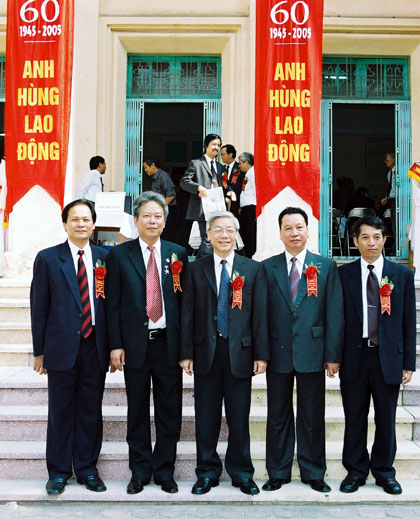
From left to right: Prof. Dr. Nguyen Van Khanh, Assoc. Prof. Dr. Pham Xuan Hang, Secretary of the Hanoi City Party Committee Nguyen Phu Trong, Prof. Dr. Phung Huu Phu, Assoc. Prof. Dr. Pham Quang Long (at the 60th anniversary celebration of the Faculty of Literature in 2005)/Photo: Bui Tuan
In his capacity as Vice Chairman of the Central Committee of the Vietnam Fatherland Front – an agency responsible for critically reviewing development policies – with the integrity and character of a scientist, he not only provided numerous consultations and critiques on the development policies of the country and Hanoi City, but also published works aimed at exploring the thinking and methods of social critique in Vietnam.Reflecting on the issue of self-criticism and criticism in President Ho Chi Minh's work "Correcting Working Methods"” (2008),Social criticism by the Vietnam Fatherland Front – A method of practicing democracy that creates the strength of national unity.”(2010); AuthorRegulations on coordinating the organization of social critique in Hanoi City(2010)Practicing democracy within the Party is a prerequisite for building a strong Party.(2011)Political and social organizations participate in the policy-making process.(2011)Regulations on questioning within the Party - Issues raised(2012), etc. Indirectly, these works contribute to improving the quality of social criticism in Vietnam.
In 2010, at the age of sixty, when he should have been retired, but following the call of his conscience and the demands of the University, drawing on his practical experience in various management positions, our teacher, undeterred by difficulties, continued to contribute to the development of a new field of study – Management Science – with practical approaches such as Leadership Skills, Introduction to Social Critique, etc.
He didn't preach to us, but the practice of his career has reminded, is reminding, and will continue to remind us that:Learn-Understand-Act"(Ho Chi Minh) is a valuable lesson, a guiding principle for unlocking and acquiring new knowledge."
It's heartwarming to see that our teacher's hair has turned gray with age, yet he continues to dedicate himself tirelessly to the noble cause of educating future generations. We sincerely hope that he remains healthy so that he can continue to ignite many more sparks with us, contributing to the development of science and education in our country, and to the prosperity of Vietnam.
|
Associate Professor, Doctor, Distinguished Teacher Pham Xuan Hang
+ Workplace: Department of History (1978-1995). Faculty of Management Science (2010-present). + Management position: Deputy Head of the Department of History (1978-1995). Vice Rector of the University of Social Sciences and Humanities (1995-2001). Secretary of the Party Committee of the University of Social Sciences and Humanities, Rector of the University of Social Sciences and Humanities (2001-2006). Member of the Standing Committee, Head of the Propaganda Department of the Hanoi City Party Committee, Chairman of the Hanoi Fatherland Front Committee (2005-2010). Vice Chairman of the Central Committee of the Vietnam Fatherland Front, 8th term (2014-2019). Head of the Department of Social Management (Faculty of Management Science) (2010 - present).
History - a science, a realityNCLS, H.; 1991, No. 5. Diplomatic activities in Thang Long - Hanoi, Hanoi Publishing House, 2010 (editor) (Part of the Thang Long Millennium Cultural Heritage Book Series). Social sciences and humanities in the cause of industrialization and modernization of the country. (editor), National Political Publishing House, Hanoi; 2000. An Overview of Social Criticism. Included in the book "Analytical and Policy Planning Skills"; World Publishing House, November 2011. Practicing democracy within the Party is a prerequisite for building a strong Party..Communist Magazine, September 2011 issue, pp. 63-66. Regulations on questioning within the Party - Issues raised, Communist Magazine, July 2012 issue. |
Author:Ms. Dinh Thi Thuy Hien

