
Minister Nguyen Kim Son assumes the role of "head of the industry" and makes impressive statements.
On April 8, 2021, at its 11th session, the 14th National Assembly passed a resolution approving the Prime Minister's proposal to appoint Associate Professor Nguyen Kim Son - Member of the Central Committee of the Communist Party, Secretary of the Party Committee, Chairman of the Council, and Director of Hanoi National University - as Minister of Education and Training.
Immediately after assuming his duties, Minister Nguyen Kim Son shared an impressive viewpoint on "genuine learning, genuine testing, and genuine talent." This is a directive from the Prime Minister requiring the education and training sector to implement.
 |
|
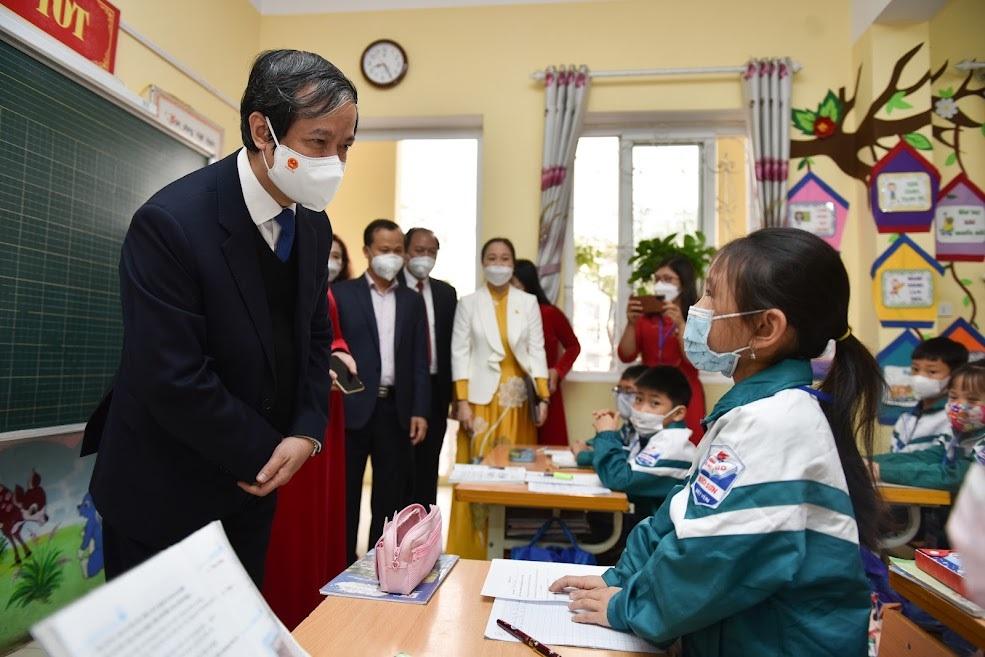
On April 8, 2021, at its 11th session, the 14th National Assembly passed a resolution approving the Prime Minister's proposal to appoint Associate Professor Nguyen Kim Son - Member of the Central Committee of the Communist Party, Secretary of the Party Committee, Chairman of the Council, and Director of Hanoi National University - as Minister of Education and Training (photo: The Dai). |
According to the head of the education and training sector, another very important social reality that is directly undermining the motivation for genuine learning and testing is that many units and organizations recruit, employ, and evaluate people based on academic qualifications without paying attention to actual competence.
In other words, to ensure that students learn and take exams genuinely, a crucial part lies in utilizing the output of education, which is the recruitment, selection, and evaluation of personnel. If recruitment is based solely on paperwork, connections, and is influenced by superficial factors, students will tend to focus only on making their resumes look good and meeting all the requirements, without considering their actual abilities.
If recruitment, employment, and evaluation are based on genuine ability, and those with real talent are valued and properly assessed, then students in schools will strive to study and take exams honestly. If employment is based solely on genuine ability and character, then teaching and learning will move forward rapidly. On the foundation of genuine learning, when people are employed according to their abilities, then talented individuals will emerge and be nurtured. When employment is based on ability and character is accurately assessed, then true talent will flourish.
Genuine learning and genuine testing are, first and foremost, the responsibility of the education sector, but also of the entire society. If everyone is united in their commitment to genuine education, a quality life, and the development of the country, then one of the first things society as a whole should do is to work together for genuine learning!
Furthermore, at the conference summarizing the 2020-2021 school year and outlining tasks for the 2021-2022 school year for secondary education, Minister of Education and Training Nguyen Kim Son assigned the task, specifically for the Literature subject, to put an end to teaching in a rote manner.sample essaysUsing sample essays stifles creativity in both teachers and students.
Minister Nguyen Kim Son's opinion quickly received widespread support from the public because it resonated with the concerns of many. Everyone recognized the "side effects" of teaching based on model essays and sample papers, which in the long run negatively impact students' thinking and stifle creativity in both teachers and students. Only with decisive action can the effort to end the reliance on model essays and sample papers, and instead foster student creativity, yield positive results.
The period of online learning between teachers and students was unprecedentedly long in history.
For almost two years now, due to the impact ofCovid-19 pandemicThe school year plan was disrupted, and educational programs and content had to be changed; many educational activities could not be carried out as planned. Nearly 20 million students and over 1 million teachers and lecturers were unable to attend school for a very long period. Thousands of teachers working in private schools went without pay, facing immense difficulties in their lives.
During that difficult period, the Ministry of Education and Training encouraged all administrators, teachers, and staff throughout the sector to overcome difficulties, uphold a sense of responsibility towards their profession and students, and unite to respond to the epidemic; all for the sake of our beloved students.
Thus, since May 2021 (the end of the old school year), students in many localities, including Hanoi, have been staying at home and studying online for many consecutive months, an unprecedented period in history.
Successfully organized the 2021 high school graduation exam and university entrance exam.
In the context of the complex developments of the Covid-19 pandemic, based on an assessment of the impact of Covid-19 on education and training, and in accordance with the Prime Minister's directive, the Ministry of Education and Training has decided to organize the 2021 High School Graduation Examination in two phases: Phase 1 from July 6-9, 2021; Phase 2 from August 5-7, 2021, approximately one month after Phase 1, based on proposals from 38 provinces and cities that had to implement social distancing and localities where candidates could not take the first phase exam due to the impact of Covid-19; these phases will be held in locations that ensure the safety of the examination process.
The 2021 high school graduation exam was successfully organized, ensuring objectivity, seriousness, fairness, and safety amidst the complex and unpredictable developments of the Covid-19 pandemic. Basic statistics remained largely unchanged compared to 2020, confirming that the exam is gradually stabilizing and increasingly aligning with the true nature of the high school graduation exam.
The exam questions closely adhered to the knowledge and skills standards, were appropriate to the teaching conditions during the Covid-19 pandemic, and showed suitable differentiation, objectively reflecting the learning outcomes of the candidates. The exam results objectively reflect the quality of teaching in different localities according to region, meeting the purpose of assessing high school graduation and university/college admissions, and serving as a basis for localities to refer to and adjust teaching, testing, and evaluation activities.
Maintain your performance in the Olympic competitions.
Annual reports on the results of the International Olympiads show that, over the years, the Vietnamese national teams have consistently achieved outstanding results and have improved with each stage.
The Vietnamese national teams achieved outstanding results in the International Olympiads in all subjects, from Mathematics - a traditional Olympic subject - to subsequent subjects such as Physics, Chemistry, Biology, and Informatics.
In the 2021 regional and international Olympiad competitions, all 37 Vietnamese students participated and won awards: 12 Gold Medals, 13 Silver Medals, 10 Bronze Medals, and 2 Certificates of Merit. At the International Science and Engineering Fair (ISEF), one Vietnamese student project won third prize – the official award of the competition – and two projects won three special awards presented by science and technology associations, organizations, and businesses.
 |
|
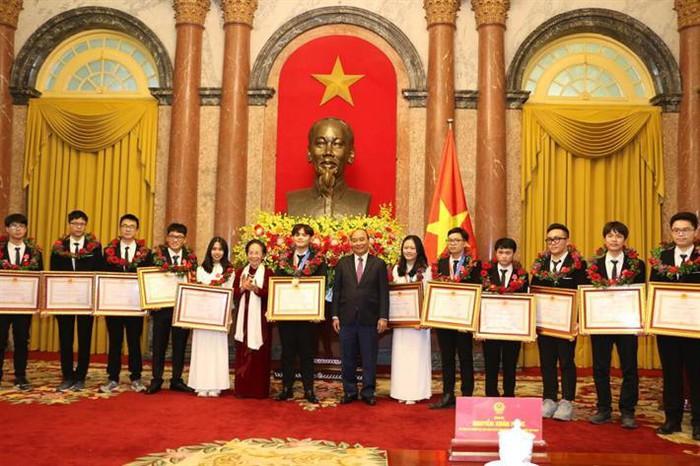
CPresident Nguyen Xuan Phuc and former Vice President Nguyen Thi Doan present the Labor Order to 19 students with outstanding achievements in the 2021 International Olympiad in Science and Technology (photo: Ministry of Education and Training). |
The achievements of the teams have affirmed the outstanding efforts in learning and training of the students, teachers, schools, units assigned to organize the competition, and even parents, especially in the context of the Covid-19 pandemic; in which many students overcame their personal and family difficulties to successfully complete the exam.
That achievement is also the result of appropriate policies and strategies of the Ministry of Education and Training and educational institutions in gifted education in general; in the selection, training, and nurturing of gifted students for international Olympic competitions in particular, and encouraging high-achieving students in university entrance examinations.
This achievement affirms the correctness of the guiding principle of the Vietnamese Party and State: "Developing education and training is about raising the intellectual level of the people, training human resources, and nurturing talent."
University rankings have improved significantly.
In November 2021, the American magazine USNews & World Reports published its ranking.The best universities globallyIn 2022, the ranking was compiled for the Best Global Universities list. In Vietnam, in addition to the four universities that made it onto this list last year, Duy Tan University was added this year, bringing the total number of Vietnamese universities ranked in 2022 to five.
This year, US News & World Reports ranked 1,750 higher education institutions globally. Compared to last year, Vietnamese universities have all significantly improved their rankings. Specifically, Ton Duc Thang University rose 236 places (from 623rd in 2021 to 387th in 2022); and Vietnam National University Ho Chi Minh City rose 84 places (from 1,271st in 2021 to 1,187th in 2022).
Hanoi National University rose 11 places (from 949th position in 2021 to 938th position in 2022); while Hanoi University of Science and Technology dropped 93 places (from 1,356th position in 2021 to 1,449th position in 2022).
Duy Tan University made its first appearance on the ranking in 2022 and achieved a relatively high position: 577.
Vietnam has 28 scientists among the top 10,000 scientists in the world.
According to the ranking published on October 20, 2021, 28 Vietnamese scientists working in Vietnam made it onto the list.Top 100,000 most influential scientists in the world.in 2021.
The authors of this publication are the Metrics group of professors Jeroen Baas, Kevin Boyack, and John PA Ioannidis of Stanford University, USA, who researched and published their findings in the American journal PLoS Biology.
Accordingly, the authors used the Scopus database from 1960 to August 2021, which contains data on over 7 million scientists, to filter out the top 100,000 most influential individuals. Scientists are categorized into 22 scientific fields and 176 subfields (disciplines/specializations). The ranking is based on research using measurement tools and evaluating the database of over 100,000 most cited scientists (from the Scopus database), and their ranking is based on key criteria such as: scientific influence score (composite score); total citations (excluding self-citations); Hirsch h-index; Schreiber hm-index; and the number of citations for articles published as a single author. The citations for articles are for the main author (first name - first author and corresponding author) and the last author.
Notably, according to the 2021 rankings, Vietnam has 5 scientists in the top 10,000 scientists in the world, including: Professor, Doctor of Science Nguyen Dinh Duc (Vietnam National University, Hanoi) - ranked 5,949th in the world; Associate Professor Le Hoang Son (Vietnam National University, Hanoi) - ranked 6,766th; Professor Nguyen Xuan Hung (Ho Chi Minh City University of Technology) - ranked 6,818th; Professor Bui Tien Dieu (Duy Tan University) - ranked 9,488th; Professor Vo Xuan Vinh (Ho Chi Minh City University of Economics) - ranked 9,528th.
Thus, Professor Nguyen Dinh Duc, Professor Nguyen Xuan Hung, and Associate Professor Le Hoang Son are the three individuals who made it into the top 10,000 most outstanding scientists in the world for three consecutive years: 2019, 2020, and 2021.
These impressive achievements once again affirm the growing strength and recognized position of Vietnamese scientists in the international scientific community. They are also the result of fundamental and comprehensive reforms in Vietnam's higher education system.
Many policies regarding teachers have been eased.
Recently, many teachers have felt immense pressure due to the constant need to attend training courses, participate in self-study and professional development programs, and the added burden of other responsibilities.professional title certificate.
In early December 2021, during a meeting with the Ministry of Education and Training, the Ministry of Home Affairs, and the Ministry of Finance regarding several issues related to the appointment, ranking of professional titles, and salary classification of teachers according to the new regulations of the Ministry of Education and Training, Deputy Prime Minister Vu Duc Dam requested that the relevant circulars and regulations on ranking professional titles and salary classification for teachers be revised to ensure fairness, prevent disadvantages, and "genuine innovation in the system for teachers."
Accordingly, the Deputy Prime Minister requested: “The Ministry of Education and Training shall take the lead and coordinate with the Ministry of Interior, the Ministry of Finance, and other relevant agencies to urgently review and amend Circulars No. 01, 02, 03, and 04/2021/TT-BGDĐT dated February 2, 2021, of the Ministry of Education and Training, which regulate the codes, standards for professional titles, and appointment and salary classification of teaching staff in public preschools, public primary schools, public lower secondary schools, and public upper secondary schools, to conform with the provisions of Government Decree No. 89/2021/NĐ-CP dated October 18, 2021, amending and supplementing a number of articles of Decree No. 101/2017/NĐ-CP on training and professional development of cadres, civil servants, and public employees; and protect the rights of teachers when classifying and transferring professional titles.” "Ensure fairness in responsibilities and duties; avoid excessive disparities in responsibilities and tasks between different professional ranks, especially regarding ethical standards."
Previously, during the question-and-answer session at the 2nd session of the 15th National Assembly on November 11th, regarding questions from delegates about teacher staffing and certifications, Minister of Home Affairs Pham Thi Thanh Tra provided several explanations and proposals to the Ministry of Education and Training, including:
"Most recently, the Government issued Decree 89 amending and supplementing Decree 101 on the training and professional development of cadres, civil servants, and public employees, which decided to cut 150 training and professional development certificates, including 152 mandatory certificates in informatics and foreign languages, of which 61 certificates are for civil servants and 87 certificates are for public employees."
I earnestly hope that the Ministry of Education and Training will soon use this Decree as a basis to review and amend Circulars 01, 02, 03, and 04 as urgently as possible. Currently, during the implementation process, we have received many requests from teachers at the grassroots level regarding remaining difficulties and shortcomings, because we have not taken into account the transition for many generations of teachers trained through various educational systems.”
Following the speech by Minister of Home Affairs Pham Thi Thanh Tra in the National Assembly and the directive from Deputy Prime Minister Vu Duc Dam regarding the amendment of the series of circulars on teacher salary classification, many teachers thanked the Deputy Prime Minister for his very correct guidance on the issue, especially regarding the inadequacies and injustices of salary classification according to Circulars 01, 02, 03, and 04.
Hopefully, with a proactive approach, attentiveness, and concern for the teaching staff, this revision of the Circulars will ensure the best possible adjustments, making salary adjustments fairer and ensuring that no teacher is disadvantaged when transitioning from the old to the new salary scale, while upholding the principle of salary payment based on work performance and job position.
The shortcomings and injustices regarding salary grade transfers and classifications, as reflected by teachers, may come to an end, eliminating the element of luck in salary adjustments…
Implement the new general education program for grades 2 and 6.
In implementing Resolution No. 88/2014/QH13 of the National Assembly, the Ministry of Education and Training issued the new general education program in 2018, ensuring it is streamlined, modern, practical, and appropriate for the age of the students; highly integrated in the lower grades and gradually differentiated in the upper grades. At the primary and lower secondary levels, related content from several educational fields and subjects in the current curriculum is integrated to create integrated subjects and themes to reduce the workload, minimize academic knowledge and duplication, and ensure suitability for primary school students. Initial implementation shows that students are learning at an appropriate level, partially meeting the expectations of families and society.
The 2021-2022 school year was the first year that students in grades 2 and 6 nationwide began implementing the new curriculum and textbooks for general education according to Resolution No. 88/2014/QH13.
 |
|
The 2021-2022 school year was the first year that students in grades 2 and 6 nationwide began implementing the new curriculum and textbooks for general education according to Resolution No. 88/2014/QH13. (Illustrative photo: Thuy Linh) |
Given the complex developments of the Covid-19 pandemic, and the fact that students in many areas are unable to return to school and must study online or via television, the Ministry of Education and Training requires that all grade levels implementing the new general education program adhere to the curriculum, closely following the learning objectives of each subject/educational activity; strengthen professional development activities and exchange ideas on teaching according to the 2018 General Education Program; evaluate and learn from teaching experiences and promptly adjust teaching plans to suit local realities.
Minister Nguyen Kim Son appeared before the National Assembly for the first time to answer questions.
At the second session of the 15th National Assembly on November 11, 2021,Minister of Education and Training Nguyen Kim Son addressed the National Assembly for the first time.Answering questions from members of Parliament.
Accordingly, Minister Nguyen Kim Son answered numerous questions related to issues such as ensuring the quality of teaching and learning, fundamental reform of education and training, online teaching and learning, curriculum reduction, ensuring equity in teaching and learning, school health safety, and the organization of the high school graduation exam…
Minister Nguyen Kim Son stated that over the past nearly two years, the COVID-19 pandemic has disrupted life, with education and training being particularly hard hit. School year plans were interrupted, and educational programs and content had to be changed to focus only on the core curriculum; nearly 20 million students were unable to attend school for a very long time; and over 70,000 students were unable to graduate on time, impacting the supply of human resources. Online and television-based learning, under challenging and inadequate infrastructure, has led to numerous negative consequences: students are stressed and exhausted; teachers are overworked and under pressure; parents are frustrated; society is worried; and tragic and even heartbreaking incidents have occurred.
According to the Minister, although the pandemic is gradually being brought under control, a new normal is being established, and the economy and social activities will gradually recover... the education sector is embarking on a new journey with difficulties that remain and may even be greater in the future. The consequences of the pandemic are long-lasting, and overcoming them will not happen overnight...
Author:Linh Huong
Newer news
Older news

