In Decision No. 1885/QD-TTg, the Prime Minister transferred and appointed Mr. Hoang Minh Son, Deputy Minister of Education and Training, to the position of Chairman of the Council and Director of Hanoi National University. (Photo: Minh Thu/TTXVN)
Our country is facing a historical opportunity for breakthrough development. Therefore, the urgent need to build human resources and develop a high-quality workforce demands a strong development of education and training.
On the occasion of the opening of the new academic year, a reporter from the Vietnam News Agency (VNA) had a conversation with Associate Professor Dr. Hoang Minh Son, in his new position as Chairman of the Council and Director of Hanoi National University, about the implementation of the contents of Resolution 71-NQ/TW of the Politburo on breakthroughs in education and training development.
- The Politburo has just issued Resolution 71 on breakthroughs in education and training development, which continues to emphasize the consistent viewpoint: "Education and training is a top national priority, determining the future of the nation." In your opinion, what role does education play in the aspiration to make Vietnam a developed country?
Assoc. Prof. Dr. Hoang Minh Son:A developed country is one with a modern economy, high labor productivity and income, a secure standard of living for its people, transparent institutions, and sustainable development.
Although Vietnam has achieved many remarkable successes, it remains a developing economy, primarily relying on cheap labor and capital-intensive practices. In this context, our greatest and most inexhaustible resource is human intellect.
Education is the key to transforming knowledge into wisdom and wisdom into strength. Early childhood and primary education form the foundation for shaping character and developing the qualities and abilities of learners.
Vocational education plays a key role in developing a highly skilled workforce. Higher education is the core of developing highly qualified human resources and talent, promoting the development of science, technology, and innovation.
Only through this path can Vietnam achieve breakthroughs in productivity, overcome the middle-income trap, maintain its independence and sovereignty, and realize its aspiration to become a developed, powerful, prosperous, and happy nation.
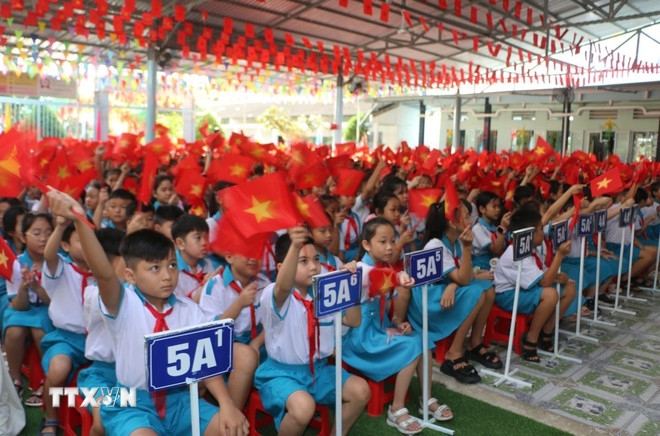
Students of Hoa Binh A Primary School (Hoa Binh commune, Ca Mau province) on the opening day of the 2025-2026 school year. (Photo: Tuan Kiet/VNA)
- Resolution 71 sets the goal of bringing Vietnam's education system to an advanced Asian level by 2030 and among the top 20 education systems in the world by 2045. In your opinion, what are the key factors in realizing these ambitious goals?
Assoc. Prof. Dr. Hoang Minh Son:For Vietnam's education system to reach an advanced level in the Asian region, and eventually become one of the world's leading systems, it must be equitable, inclusive, modern, and high-quality, achieving corresponding international benchmarks.
The resolution outlined eight groups of comprehensive, strategic, and groundbreaking tasks and solutions to realize these major goals, focusing on three key elements: resources, motivation, and development space.
The resolution emphasized: “Breakthroughs in education and training development must begin with innovation in thinking, awareness, and institutions. We must create breakthroughs in resources, motivation, and new spaces for the development of education and training.”
Regarding resources, it is necessary to focus on implementing solutions to enhance the attraction and effective utilization of resources for the development of the school network, modernization of facilities, building a qualified teaching staff, and providing effective support to learners (ensuring that no student drops out due to financial difficulties).
Regarding motivation, it is necessary to focus on improving and innovating mechanisms and policies that create incentives for teachers to develop their abilities and dedicate themselves wholeheartedly; to motivate learners to strive for learning, research, and self-development; to motivate educational institutions to compete in innovation, fair competition, and cooperative development; and to motivate many organizations and individuals in society to invest in, sponsor, and contribute to the development of education.
Regarding the spatial development aspect, I believe it is necessary to focus on perfecting the institutional framework and implementing other solutions in a coordinated manner to create a transparent legal framework, expanding the development space for educational institutions through a comprehensive autonomy mechanism independent of financial factors, optimizing the planning and arrangement of the network and expanding school facilities, promoting education and training in the digital space and applying advanced technologies (such as artificial intelligence, smart classrooms...), creating a space for innovation and creativity, and an academic environment of integrity for teachers and students to unleash their full potential…
Finally, and most importantly, it requires the active and proactive participation of the entire political system and society, creating a synergy of resources, motivation, and space for breakthrough development in education and training, as emphasized in the Resolution: “Developing education and training is the undertaking of the Party, the State, and the entire people. The State plays a strategic guiding role, creating development, ensuring resources and equity in education; ensuring sufficient schools, classrooms, and teachers to meet the learning needs of the people. The entire society has the responsibility to care for, participate in contributing resources, and supervise the development of education.”
- Resolution 71 mentions the goal of having one Vietnamese university in the top 100 globally by 2030 and five universities in the top 100 globally by 2045. In your opinion, what breakthrough changes in policy mechanisms, university governance, and training programs are required to achieve this?
Assoc. Prof. Dr. Hoang Minh Son:Resolution 71 identified strong investment and specific, superior mechanisms to develop 3-5 elite universities modeled after world-class research universities, training national talents.
Previously, Resolution 57 of the Politburo was also issued to create breakthroughs in institutions, policies, and resources for the development of science, technology, and innovation, in which higher education institutions play a core role in scientific research and technological development.
The world-class university model has been implemented in many countries, with both successful and unsuccessful experiences. Among these, the three core success factors within a world-class university, as summarized by many experts, include abundant resources, effective governance, and a convergence of talent. This aligns perfectly with the three key elements of resources, motivation, and development space mentioned generally for the entire education system.
Students at Vinh Phuc Vocational College receive training programs that emphasize practical skills and vocational training. (Photo: Nguyen Thao/VNA)
In my opinion, five breakthroughs are needed to achieve the goals set out in the Resolution regarding higher education.
The first breakthrough is the policy of ensuring full and comprehensive autonomy for higher education institutions, regardless of their level of financial autonomy, including the right to independently conduct the selection and appointment process for professors, associate professors, and specialized unit administrators, as well as to recruit and hire lecturers from abroad.
The second breakthrough is the policy of investing in and allocating resources to higher education based on mission, quality, and operational efficiency, prioritizing full investment in a number of key scientific and technological fields at a number of universities with the highest capacity and prestige.
The third breakthrough is the policy of supporting and attracting excellent lecturers from abroad, promoting the integration of talent training and doctoral training with scientific research, technological development, and innovation.
The fourth breakthrough is the policy of promoting cooperation and linkages between key higher education institutions by ngành (sector/field), cooperation with businesses, and international cooperation to effectively utilize resources and focus on solving major national problems (following the three-party model: State-University-Business).
The fifth breakthrough is comprehensive digital transformation, the strong application of digital technology and artificial intelligence, and the improvement of quality and efficiency in university administration, training, and research.
- In your new role as Director of Hanoi National University, how do you plan to promote the implementation of Resolution 71 within the national university model?
Assoc. Prof. Dr. Hoang Minh Son:Politburo Resolutions 57 and 71 have opened up tremendous opportunities for the higher education system in general, and for the two national universities in particular, to achieve breakthrough development in the coming period. Therefore, Hanoi National University must play a pioneering and exemplary role in successfully implementing these two particularly important resolutions.
To leverage the strengths of the national university model, I believe that one of the core tasks is to promote the role and interconnectedness of member universities, affiliated schools and research institutes, strengthen cooperation with other higher education institutions domestically and internationally, as well as cooperate with businesses to jointly solve major national problems.
There will be many things that require thorough research; for now, Hanoi National University will focus on developing a plan to implement the tasks and solutions related to Resolution 71, in parallel with the implementation of Resolution 57, to modernize and create breakthroughs in the development of Hanoi National University according to the orientations and objectives set forth.
Thank you very much, sir!