
The seminar was attended by school leaders, leaders of the Faculty of Literature, speakers and scientists from the Institute of Literature, Japan Foundation, and the University of Theatre and Film; as well as lecturers and students from the University of Social Sciences and Humanities.
Following the introduction of the speakers and guests by Dr. Ngo Viet Hoan, Assoc. Prof. Dr. Dang Thi Thu Huong - Vice Rector of the University of Social Sciences and Humanities - delivered the opening remarks for the seminar. She noted that ecological criticism is a new research direction and is receiving increasing attention in the context of unpredictable natural disasters. Cinema, as an art form with a powerful emotional impact, also has the potential to awaken human responsibility in its relationship with nature. Assoc. Prof. Dr. Dang Thi Thu Huong hoped the seminar would continue to foster creativity in students' learning and research. Continuing Assoc. Prof. Dr. Dang Thi Thu Huong's presentation, Assoc. Prof. Dr. Nguyen Thu Hien - Head of the Literature Department - extended a welcome to the speakers and guests present at the seminar, and shared the significance of the seminar for the activities of the Literature Department. Within the framework of SSHWeek 2026, the seminar clearly demonstrates the academic development of the Faculty of Literature and its three affiliated units, guided by the "academic - interdisciplinary - integrated" approach.
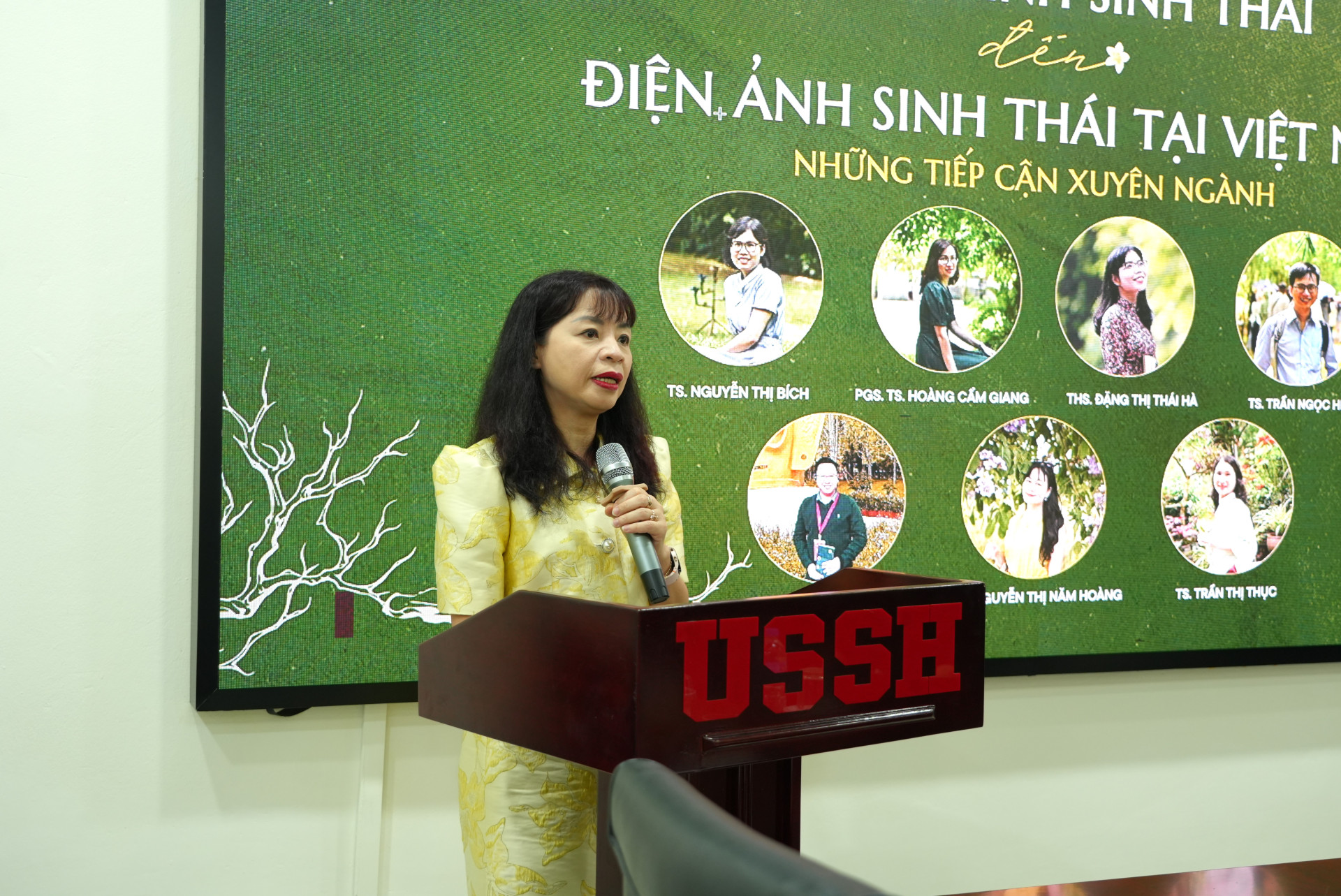
Assoc. Prof. Dr. Dang Thi Thu Huong - Vice Rector of the University of Social Sciences and Humanities, delivered the opening remarks at the seminar.
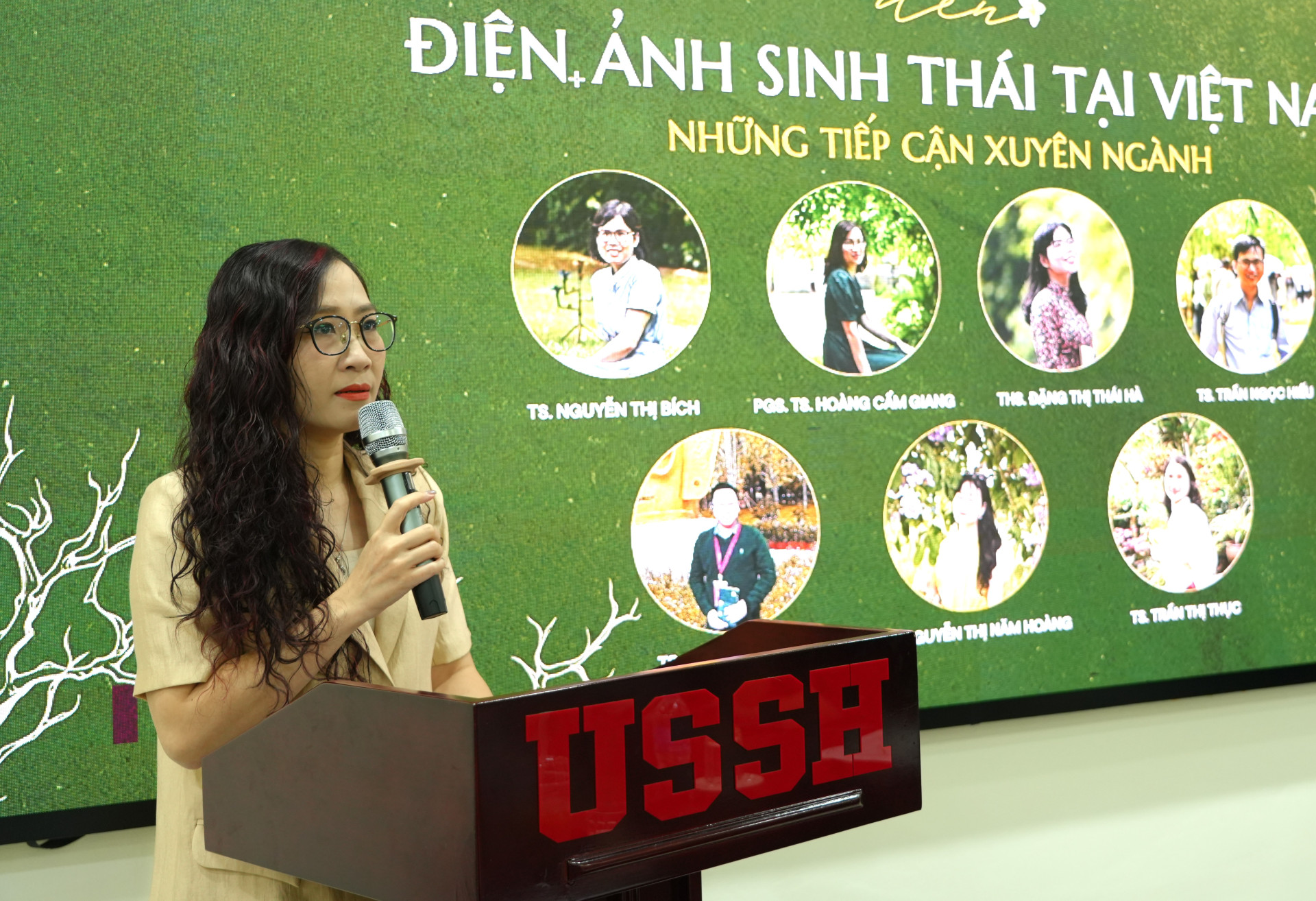
Associate Professor Dr. Nguyen Thu Hien - Head of the Department of Literature, emphasized the significance of the seminar in the department's training and research activities.
Before the first discussion session, Associate Professor Dr. Hoang Cam Giang - Head of the Subcommittee - represented the expert panel in reading an overview report, summarizing the key points in the current state of ecological criticism research. The speaker pointed out that there are not many intercultural studies from an ecological criticism perspective, especially in relation to the East Asian cultural context. On the other hand, film art has great potential to express ecological issues, but the manifestations of ecological issues in film are very complex and need to be explored from a broader perspective. For this reason, the seminar was organized to discuss prominent issues in the representation of the environment in cinematic works, through two main presentations: environmental narratives in Vietnam and Vietnamese films in a cross-cultural context.
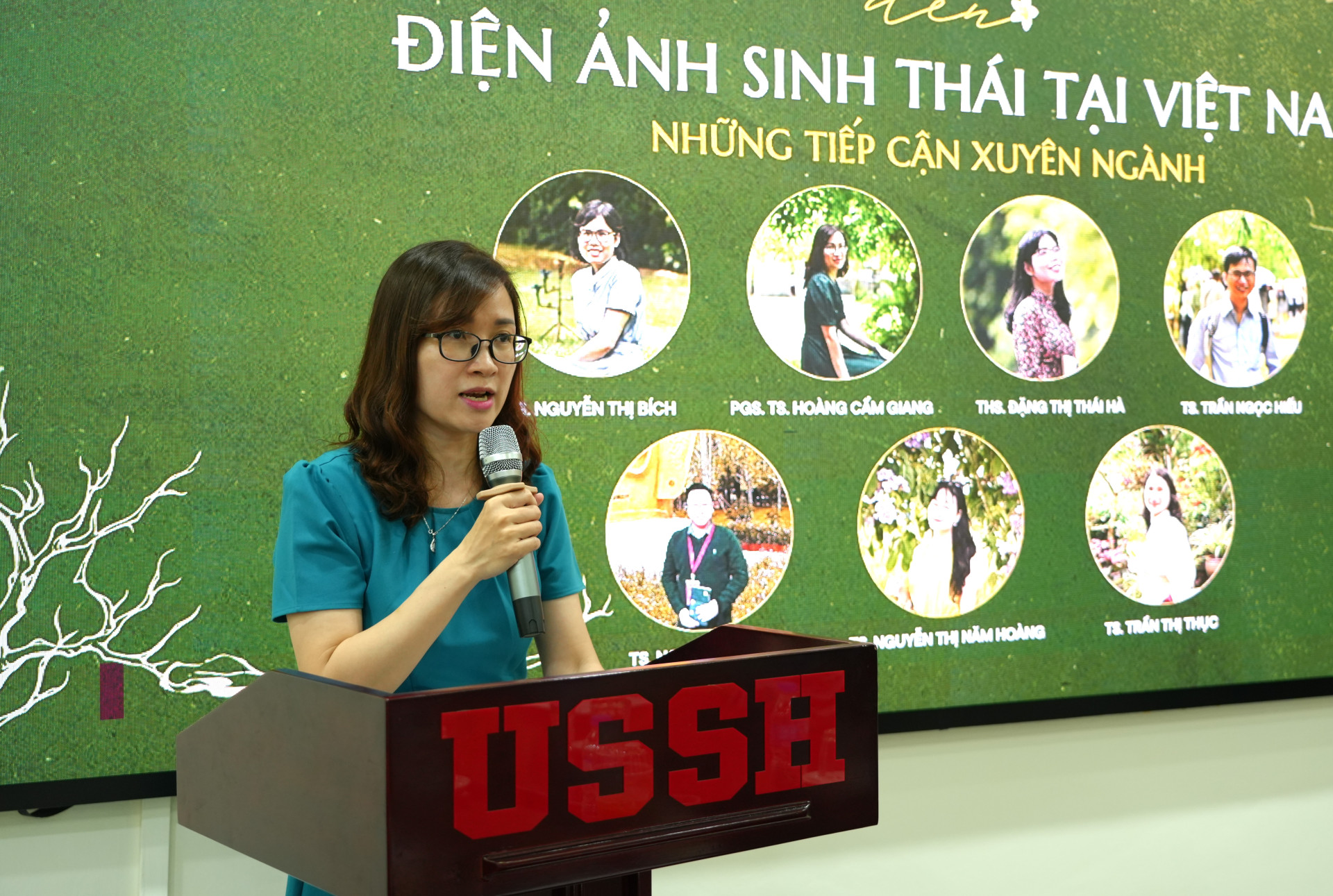
Assoc. Prof. Dr. Hoang Cam Giang - Head of the Subcommittee presenting the overview report of the seminar.
In the first discussion session, the presentations focused on analyzing and clarifying the turning points in environmental narratives in Vietnam, through four reports by Dr. Nguyen Thi Nam Hoang, Dr. Tran Ngoc Hieu, Dr. Ngo Viet Hoan, and Ms. Dang Thi Thai Ha.
Through analyses of the causes, manifestations, and mechanisms of "ecological questioning" in contemporary Vietnamese literature and cinema, using several representative cases, Dr. Nguyen Thi Nam Hoang has sparked reflections on the relationship between literary narrative, cinematic imagery, and current environmental issues. She affirms that environmental narrative is undergoing a paradigm shift; in which literature and cinema play a crucial role, contributing to the formation of a post-human environmental consciousness where humans are no longer the absolute center of narrative, but become a component in a vast network of constantly evolving and restructuring ecological relationships. Dr. Tran Ngoc Hieu, on the other hand, approaches ecological cinema from the perspective of habitation, the politics of living space, and poetics through the case of Truong Minh Quy's film "Tree House." The author does not approach ecological cinema as an environmental discourse like pollution or disaster, but delves into a fundamental concept – "house." However, "home" here is not just a physical dwelling place, but also an experience, a structure of memory, and a political-ecological issue. From this, the author raises new reflections on humanity's relationship with place and environment.
Approaching ecological cinema from a comparative and intercultural perspective, Dr. Ngo Viet Hoan proposed the concept of "ecological poetics" as a framework for reading, aiming to shift the focus of ecological film criticism from environmental content to the mechanisms of perception and meaning construction in cinema. Simultaneously, through the analysis of several representative works of Chinese cinema, Dr. Ngo Viet Hoan asserted that the Chinese experience has reference value, contributing to the identification of research possibilities for ecological cinema in the region, especially Vietnamese ecological cinema. The first session also included a contribution from Ms. Dang Thi Thai Ha with an article on issues of material ecological feminism, interbodying, and interspecies empathy through reading Han Kang and Nguyen Ngoc Tu. Expanding the dialogue from literature and ecology to gender approaches has provided a deeper perspective in re-examining the body, placing the materiality of the body and the natural world at the forefront of critical analysis. This opens a path to reconnecting our existence with the physical world around us.

In the second session of the seminar, the discussions expanded to issues facing Vietnamese cinema in the context of contemporary cross-cultural context, thereby assessing the prospects of sustainable cinema. From analyzing the creaturethriller and eco-thriller models of Hollywood cinema, Dr. Nguyen Thi Bich evaluated the Vietnamese film "Claws" (2024) in its process of adopting and applying these two models. The speaker affirmed that "Claws" has initially absorbed Hollywood genre models while simultaneously localizing them through a sense of community and the concept of cause and effect, reflecting East Asian culture. Dr. Tran Thi Thuc, through her examination of the case of "Evil Does Not Exist" (2023), viewed the dystopian world in contemporary Japanese films as a noteworthy direction for ecological cinema. According to her, the dystopian ecological element in the film is expressed through the simmering ecological anxieties arising from the conflict between rural and urban spaces; From there, the work questions discourses on “green tourism” and “ecotourism” in a modern context. Applying the approaches of ecological memory and post-memory, Assoc. Prof. Dr. Hoang Cam Giang proposed a new way of reading the film “The Coolie Never Cries” (2024). The speaker emphasized the layer of memory hidden in non-human spaces and existences, as well as the traumas and crises expressed through the silent, colorless state created by the film's symbolic system. At the same time, she acknowledged director Pham Ngoc Lan's efforts to break free from the molds of nostalgic-landscape films and independent dystopian films.
Following the presentations, a lively and open roundtable discussion took place, featuring diverse comments from guests with expertise in various fields. Here, Associate Professor Dr. Nguyen Thi Nhu Trang, Dr. Le Thi Tuan, and Ms. Hoang Da Vu expressed their interest in the issues raised by the speakers in each presentation, and shared their thoughts on the problems presented in the films, as well as the development of ecological cinema in Vietnam. The discussion also included contributions from director Nguyen Hoang Diep and Dr. Do Thi Thu Huyen, who posed insightful questions about aesthetic shifts, the correlation between Vietnamese and Chinese cinema, and the new direction of cinema in the context of contemporary popular culture. Furthermore, from a cross-disciplinary perspective, Professor Tran Hinh and critic Nguyen Hung Vi linked the issue of ecology in cinema to literary works and naturalistic concepts in Eastern culture. This thus raises the issue of environmental protection in filmmaking in the modern era.
Moreover, the discussion attracted considerable attention from the audience. Dr. Ta Thi Thu Huyen expressed her interest in the papers by Dr. Nguyen Thi Bich and Dr. Tran Thi Thuc, raising questions about the possibility of humans resisting the industrialization and modernization trends mentioned. Participating students also hoped to gain further perspectives on religion in ecological research, such as the natural symbols reflecting humanity's journey of faith in "Inside the Golden Cocoon."
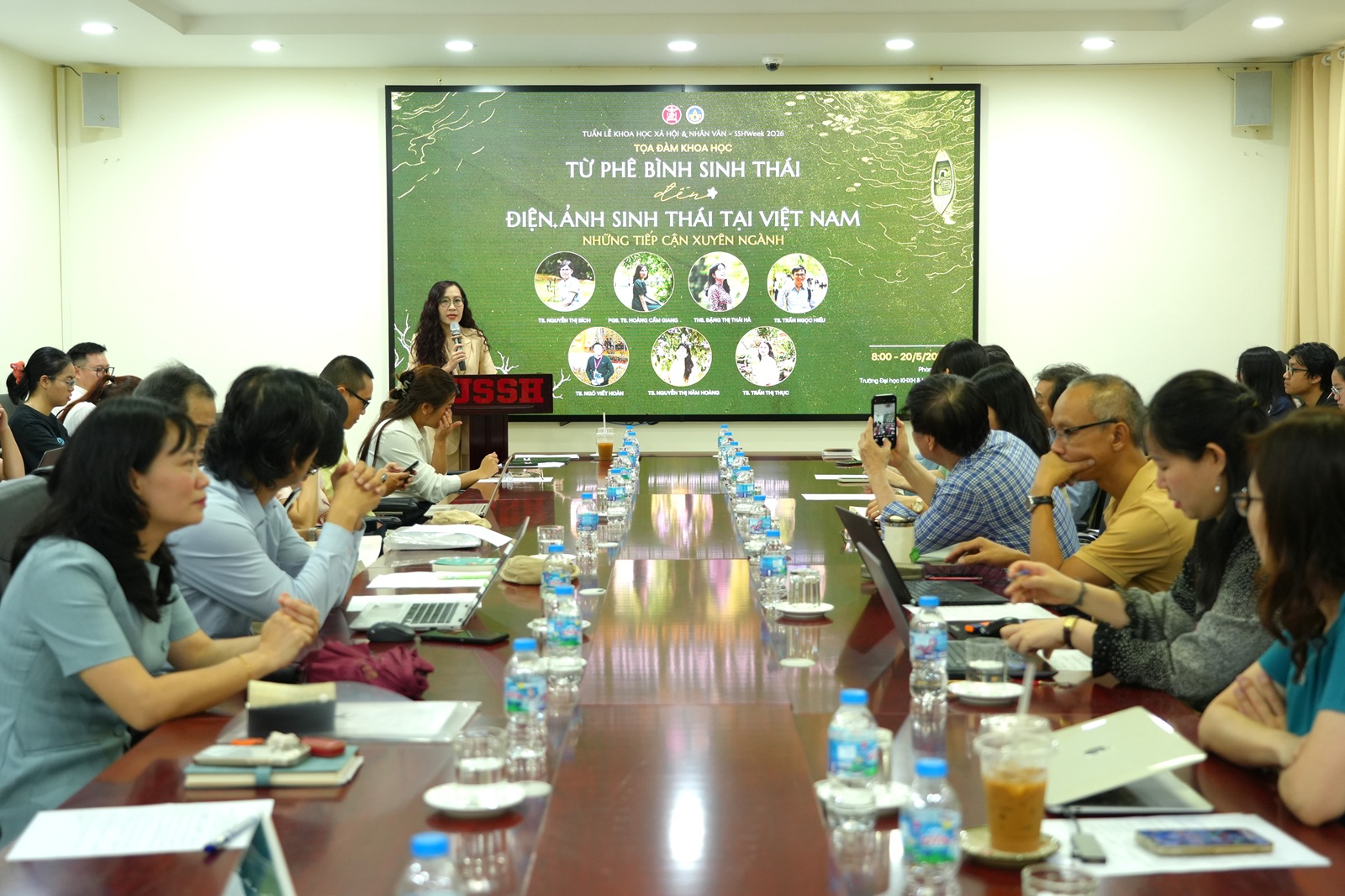
The seminar “From Eco-Criticism to Eco-Cinema in Vietnam: Interdisciplinary Approaches” concluded successfully, demonstrating the serious preparation, responsible work ethic, and high academic quality of the Organizing Committee, speakers, and guests. From the insights gained from the presentations and roundtable discussions, the seminar opened up interdisciplinary academic reflections and dialogues, affirming the pioneering role of the University of Social Sciences and Humanities, VNU Hanoi in general and the Faculty of Literature in particular in social sciences and humanities research, especially in the fields of literature, film, cultural industries, and sustainable development; while also contributing to suggesting many new approaches for the development of cinema in Vietnam in the contemporary context.
Related articles:
Digital competencies in higher education: Assessment, measurement, and policy implications.
From ecocriticism to ecocinema in Vietnam: Interdisciplinary approaches
Heritage Economy: Identifying Cultural Capital and Guiding Policies for Sustainable Development
Author:Article: Faculty of Literature. Photo: USSH Media
Newer news
Older news

