

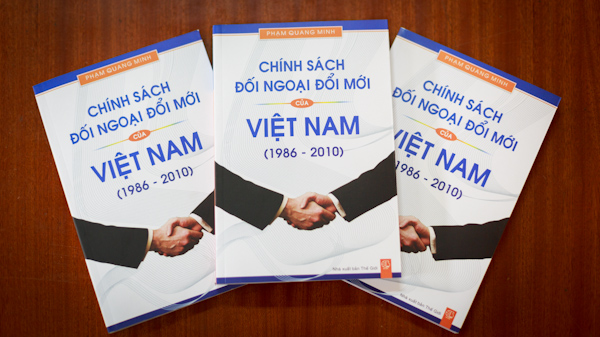

USSH is pleased to introduce the new book "Vietnam's Innovative Foreign Policy (1986-2010)" by Associate Professor Dr. Pham Quang Minh. The book is 212 pages long, printed in 500 copies, priced at 48,000 VND, and published by The Gioi Publishing House in 2012.
In the decade (1975-1985) following the end of the Vietnam War, Vietnam faced a profound and comprehensive crisis in economic, political, and social spheres. The victory in the war against foreign invaders was not capitalized on during the period of economic reconstruction and development. This situation was partly due to the devastating effects of war and natural disasters, but also partly a consequence of international relations issues related to Vietnam's policies toward other countries, including the Soviet Union, the United States, China, and its Southeast Asian neighbors.
From the mid-1980s onwards, changes occurring not only within Vietnam but also regionally and globally opened up new prospects for broader and more effective international relations between Vietnam and its partners. From Vietnam's perspective, the biggest change during that period was the decision to implement the Doi Moi (Renovation) policy, officially adopted by the Sixth National Congress of the Communist Party of Vietnam in 1986. In that short time, the country underwent numerous transformations in politics, economics, culture, society, and especially in foreign relations. From a member state of the socialist bloc, with economic relations only with countries in the Council for Mutual Economic Assistance (SEV) and considering relations with the Soviet Union as the "cornerstone" of its foreign policy, Vietnam became a member of ASEAN in 1995, ASEM in 1996, APEC in 1998, WTO in 2007, and a non-permanent member of the United Nations Security Council in 2008.
How could a country like Vietnam achieve such dramatic changes in such a short period? To date, there are still differing opinions on the causes, content, and results of Vietnam's foreign policy reforms. One group argues that the reforms in Vietnam's foreign policy are merely situational reactions to the rapid changes in the world, rather than proactive, calculated, and carefully prepared responses. A second group believes that while the results achieved in Vietnam's foreign policy are impressive, they are limited and do not fully reflect the country's potential. A third group argues that, despite implementing foreign policy reforms for 25 years, Vietnam remains uncertain, lacking a clear foreign policy strategy and appropriate tactics in the face of rapidly changing and complex global and regional situations.

How could a country like Vietnam undergo such dramatic changes in such a short period of time?
With the aim of contributing to clarifying the above questions, this book will analyze the formation, development, and evolution of Vietnam's innovative foreign policy from 1986 to 2010, thereby evaluating outstanding achievements, drawing lessons learned, and pointing out limitations that need to be overcome in order to improve foreign policy in the future. To that end, the book will consist of three chapters:
Chapter One: The Causes of the Formation of the Reform Foreign Policy. This chapter focuses on analyzing the factors influencing the formation of the reform foreign policy as a foundation for understanding why the Communist Party of Vietnam made the decision to reform in general, and foreign policy in particular, in 1986.
Chapter 2: The Formation and Development Process of Vietnam's Reform Foreign Policy 1986-2010. The main content of Chapter 2 is to systematically present, from a historical perspective, the formation process of Vietnam's foreign policy from 1986 to 2010, through an analysis of the basic content of Party congress documents and other Party materials to answer the question: what are the basic contents of the reform foreign policy, and how was it formed and adjusted through each stage?
Chapter 3: Results of Implementing the Reformed Foreign Policy. This chapter focuses on evaluating the achievements of Vietnam's reformed foreign policy in both theoretical and practical aspects. Based on this, chapter three also draws some lessons and offers some recommendations to contribute to the more effective implementation of the reformed foreign policy.